

SEO Carletonville: Why a Post-Mining Town in Transition Has More Digital Opportunity Than Most Businesses Realise
Carletonville has spent the better part of a century being defined by what’s underground. Gold mining built the town, employed the bulk of its workforce, and shaped almost everything about how the local economy moved. That story hasn’t ended — mining still matters — but it’s shifting. The town is diversifying, slowly and sensibly, into retail, services, logistics, and small manufacturing. And that economic transition creates something surprisingly valuable for local businesses: a digital marketing landscape where being early actually counts.
In Johannesburg or Cape Town, the battle for Google’s first page is expensive, crowded, and often dominated by national brands with six-figure SEO budgets. In Carletonville, you’re competing in a market where most businesses still think a Facebook page and a phone number constitute a digital strategy. That gap is opportunity. And if you move now — before your competitors figure this out — the advantages compound for years.
The Economic Transition Creates Search Demand That’s Not Being Met
Here’s what’s happening on the ground: as mining employment fluctuates and diversification picks up, Carletonville residents increasingly need local services they used to access through mining infrastructure or employer programmes. Medical specialists. Legal services. Accounting and tax advice. Equipment hire. Auto repair that isn’t mine-vehicle focused. Home improvement. Training providers. The demand exists. What doesn’t exist is a reliable way to find those services online.
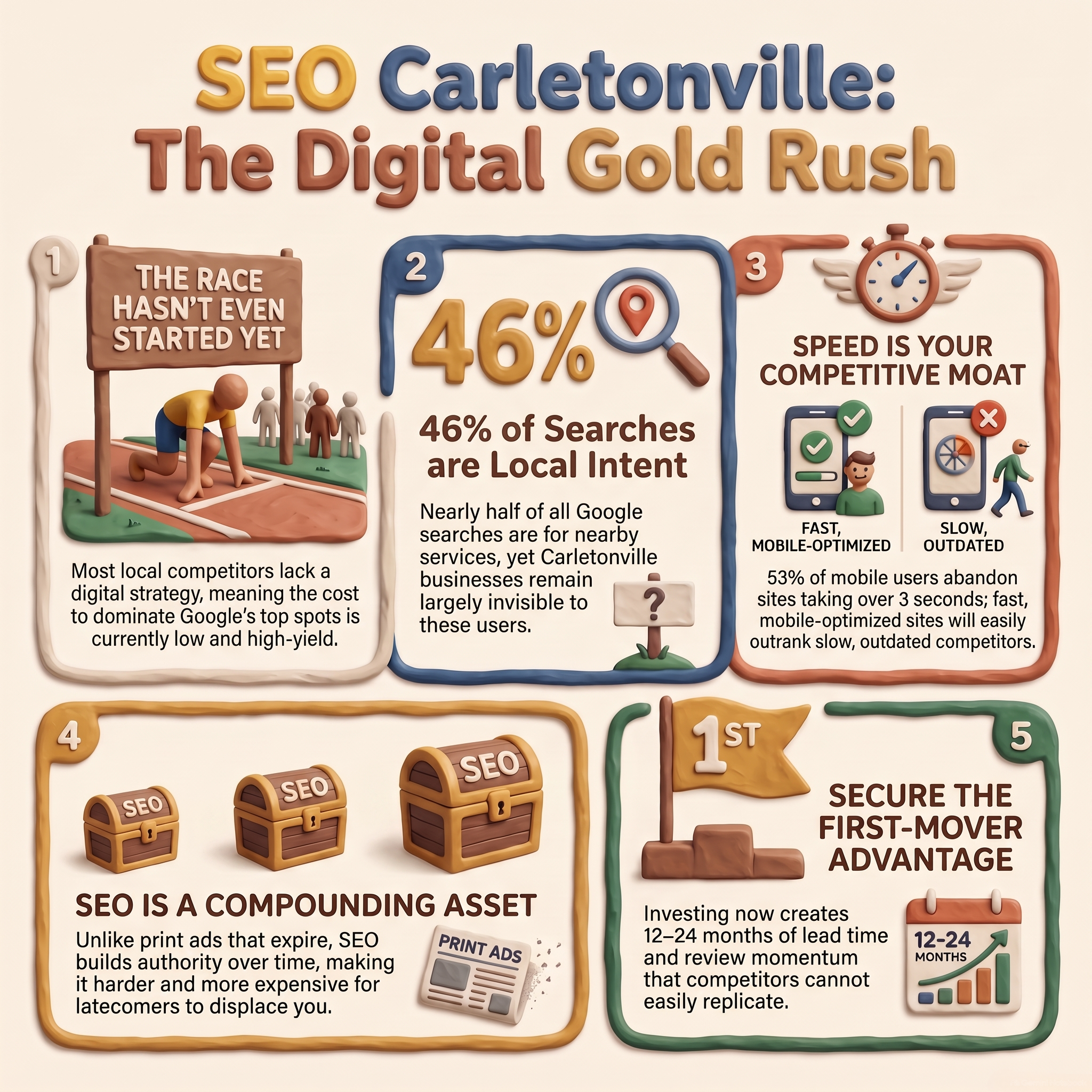
According to Google’s own research, 46% of all searches have local intent — people looking for something nearby, available now, or relevant to where they live. In smaller towns like Carletonville, that percentage skews even higher because residents prefer to support local businesses when the option is visible. But here’s the kicker: if your business doesn’t show up in the top three organic results for “plumber Carletonville” or “family lawyer Carletonville,” you’re essentially invisible to that 46%. And in most cases, nobody is ranking well for those terms yet. The race hasn’t even started.
This isn’t theory. A quick scan of competitive search terms in Carletonville shows pages with thin content, outdated websites, incomplete Google Business Profiles, and almost no structured local SEO. That’s the gap. Your competitors aren’t sleeping on SEO — they genuinely don’t know it’s a competitive advantage yet. Which means the cost to dominate local search is still reasonable, and the return on that investment stretches years into the future.
Lower Competition Means Your SEO Investment Goes Further
One of the most frustrating realities of SEO in major metros is that even a solid campaign can take 9–12 months to move the needle, because you’re fighting established players with deep pockets and years of domain authority. In Carletonville, the dynamics are different. You’re not trying to outrank TakealotBusiness or a Sandton agency with 500 backlinks. You’re competing with businesses that either don’t have websites, or have websites built in 2014 that don’t load properly on mobile.
The result: your early investment in proper SEO delivers rankings faster, and those rankings stick longer. Once you establish authority in Carletonville’s local search ecosystem — through optimised content, consistent citations, quality backlinks from credible local and regional sources, and a properly managed Google Business Profile — it’s expensive for a competitor to displace you. They’d need to match your effort and exceed it. Most won’t bother. Some will try half-heartedly and give up. A few will hire someone’s cousin who “knows computers.” You’ll stay on top.
This isn’t about exploiting a sleepy market. It’s about recognising that timing matters in SEO, and Carletonville is at the exact moment where investment yields durable competitive advantage.

Mobile-First Search Behaviour Is Already Dominant Here
South Africa is a mobile-first country. According to We Are Social’s 2023 Digital Report, 94.4% of South African internet users access the web via mobile devices, and for many in smaller towns, their smartphone is their only internet access point. In Carletonville, where load shedding still disrupts fixed-line connections and fibre rollout is patchy, mobile search isn’t a preference — it’s the default.
What that means practically: if your website isn’t fast, mobile-optimised, and built to convert on a small screen with inconsistent connectivity, you’re losing business daily. Google’s mobile-first indexing has been standard since 2019, which means your mobile site performance directly affects your rankings. A slow-loading site doesn’t just frustrate users — it actively harms your visibility. Google’s own data shows that 53% of mobile users abandon sites that take longer than three seconds to load, which in SA’s network environment is a figure worth tattooing on your dashboard.
Local businesses that invest in lightweight, mobile-optimised sites with fast hosting, compressed images, and clean code will outrank competitors with flashy, bloated sites that take eight seconds to render. Speed is a ranking factor. Speed is a conversion factor. And in Carletonville, speed is a competitive moat.
The First-Mover Advantage Is Real and Measurable
SEO isn’t like paid advertising, where you stop spending and the leads evaporate overnight. It’s a compounding asset. Every quality piece of content you publish, every authoritative backlink you earn, every positive review you collect, every citation you build — they stack. Over time, your domain authority grows, your topical relevance strengthens, and your rankings stabilise at the top of local search results.
In markets like Carletonville, where competition is still light, being the first serious player in your category creates a self-reinforcing cycle. You rank first. You get the clicks. You earn the reviews. The reviews boost your rankings further. Competitors trying to catch up have to work twice as hard for half the result, because you’re already established as the authority.
This is why investing in SEO now — while Carletonville’s digital landscape is still open — is smarter than waiting until the market matures. By the time your competitors wake up to the value of local search, you’ll have 12–24 months of domain authority, content depth, and review momentum they can’t easily replicate.

What Smart SEO in Carletonville Actually Looks Like
Let’s be specific. Effective SEO in a transitioning town like Carletonville isn’t about chasing national keyword volumes or trying to rank for “best lawyer in South Africa.” It’s hyper-local, intent-focused, and built around the search behaviour of real people in your immediate area.
Google Business Profile optimisation is non-negotiable. Your GBP is often the first thing potential customers see, especially on mobile. Complete every field. Upload real photos of your premises, team, and work. Collect reviews consistently (and respond to every one). Post updates weekly. Use local landmarks in your description. If someone searches “electrician near me” while standing in Carletonville CBD, you want to be in that map pack.
Location-specific content separates serious players from amateurs. Create pages and blog posts that speak directly to Carletonville’s context. “How to Prepare Your Carletonville Home for Load Shedding” beats “Load Shedding Tips” because it signals local relevance to both users and Google. Write about local challenges, local events, local business conditions. You’re not trying to rank nationally — you’re trying to own the local conversation.
Citation consistency across directories, industry listings, and local platforms builds trust with search engines. Your business name, address, and phone number (NAP) should be identical everywhere it appears online. Inconsistencies confuse Google and dilute your local authority.
Backlinks from credible local sources — regional news sites, business associations, community organisations, local government sites — carry disproportionate weight for local SEO. A single link from a Merafong City Local Municipality page or a Carletonville community hub is worth more than ten links from generic directories.
Mobile performance and technical health underpin everything. Fix broken links. Compress images. Use a reliable host. Ensure your site loads in under three seconds on 3G. Google’s PageSpeed Insights will tell you exactly what to fix — just don’t ignore it.
The Investment Makes Sense for Carletonville’s Economic Reality
We’re not suggesting you throw R50,000 a month at SEO like a Sandton fintech startup. That’s neither necessary nor sensible for most Carletonville businesses. But a modest, consistent investment — R3,500 to R6,500 per month depending on your industry and competitive intensity — delivers measurable returns in a market with low competition and high unmet demand.
That investment typically covers foundational technical SEO, ongoing content creation, GBP management, citation building, review generation support, and monthly reporting. It’s enough to establish authority, capture local search traffic, and build durable rankings that outlast the campaign itself.
Compare that to traditional advertising: a quarter-page ad in a regional print publication costs R2,000–R4,000 and disappears the day it runs. A decent SEO campaign compounds monthly, bringing in leads long after the initial work is done. The ROI comparison isn’t subtle.

What Happens If You Wait
Here’s the uncomfortable truth: this window won’t stay open. As Carletonville’s economy continues diversifying, more businesses will recognise the value of digital visibility. National franchises eyeing regional expansion will start targeting smaller towns with local SEO strategies. Agencies in Johannesburg will begin offering affordable packages to West Rand businesses. And when that happens, the cost to compete goes up, the timeline to results stretches out, and the first-mover advantages you could have secured evaporate.
Waiting makes sense only if you believe your competitors will also wait. They won’t. Someone in your industry is reading something like this right now and thinking, “Right, time to sort this out.” The question is whether that someone is you or the business that ends up outranking you for the next five years.
Frequently Asked Questions
Q: How long does it take to see results from SEO in a smaller market like Carletonville?
A: Faster than in Joburg or Cape Town — usually 3–6 months for meaningful ranking improvements in low-competition niches, with compounding gains over 12–18 months. The lighter competition means early wins come quicker, but consistency still matters.
Q: Is SEO worth it if I already get referrals and word-of-mouth business?
A: Absolutely. Referrals are gold, but they’re limited by your existing network. SEO captures demand from people who don’t know you exist yet but are actively searching for what you offer. It’s new business on top of what you’re already getting, not instead of it.
Q: What if my business serves the whole West Rand, not just Carletonville?
A: Even better. You optimise for multiple locations — Carletonville, Fochville, Westonaria, Khutsong — with location-specific pages and content. Multi-location SEO captures broader regional demand while still dominating hyper-local search in each area.
Q: Can I do SEO myself or do I need an agency?
A: You can handle basics like GBP updates and review requests yourself. But technical SEO, content strategy, backlink building, and competitive analysis benefit enormously from expertise. Most successful businesses do the quick daily tasks in-house and outsource the strategic heavy lifting to specialists who live and breathe this stuff.
If you’re ready to explore what SEO could actually do for your Carletonville business — without the fluff or the five-year contract — let’s have a straightforward conversation. Thickrope Marketing works with SA businesses who want results they can measure, not promises they can’t verify. Book a free consultation and we’ll walk you through exactly what’s possible in your market.