

Vereeniging’s Industrial Identity Is Stronger Than Most Digital Agencies Give It Credit For — And It Changes How SEO Should Work Here
Most SEO agencies look at Vereeniging and see another Gauteng town that needs “local SEO” and a Google Business Profile.
They’re not entirely wrong. They’re just dangerously incomplete.
Because Vereeniging isn’t Sandton. It’s not even Alberton. This is the Vaal Triangle — a place where ArcelorMittal, Sasol, and PPC Cement aren’t just names on buildings, they’re the economic backbone of the region. Where B2B industrial services, steel fabrication, chemical suppliers, and freight logistics employ thousands and drive millions in local revenue.
And if your SEO agency doesn’t understand that industrial identity, they’re building a strategy for the wrong audience, targeting the wrong intent, and missing the commercial searches that actually matter in this economy.
Let’s talk about what changes when you stop treating Vereeniging like a generic suburb and start building SEO that reflects its actual business landscape.
The Problem With Template SEO in an Industrial Economy
Here’s what happens when a Joburg agency applies their standard “local SEO package” to a Vereeniging business:
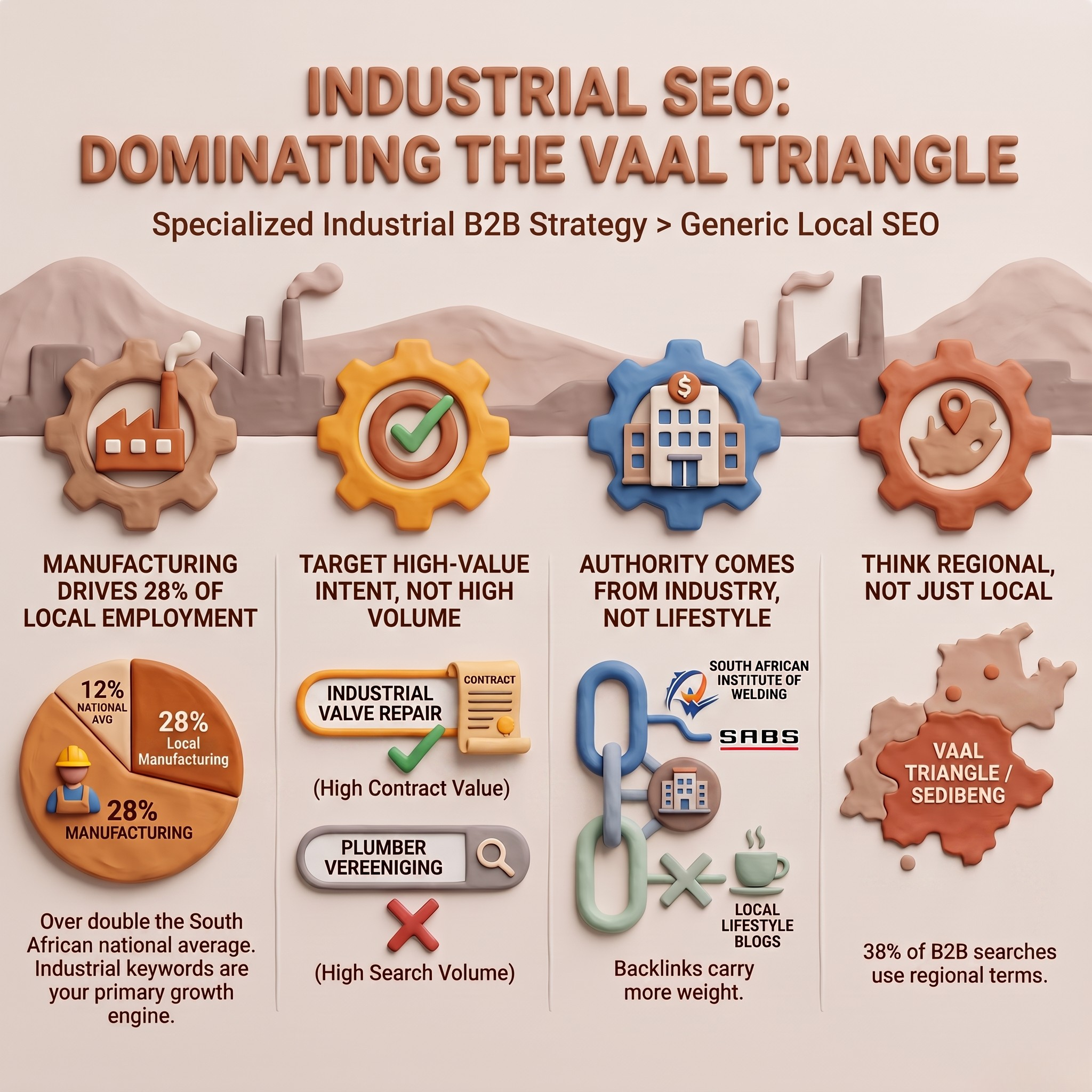
They optimise for “plumber Vereeniging” when the real opportunity is “industrial valve repair Vaal Triangle.”
They build content around consumer keywords when your actual clients are procurement managers Googling “ISO-certified steel supplier Gauteng” at 11pm under load shedding, trying to hit a deadline.
They chase high search volumes instead of high commercial intent — because their keyword tool says 880 people search for “restaurants Vereeniging” monthly, but doesn’t flag that 40 searches for “bulk chemical transport Sedibeng” represent R12-million in annual contract value.
This isn’t theoretical. According to Stats SA’s 2023 business census data, manufacturing accounts for 28% of Vereeniging’s formal employment — more than double the national average of 12%. That’s not background information. That’s your keyword strategy, your content pillars, and your link-building targets all rolled into one number.

What Industrial SEO Actually Looks Like
When you understand Vereeniging’s economic character, your entire approach shifts.
Keyword clusters change. You’re not just targeting “engineering services Vereeniging.” You’re going after the specific industrial sub-sectors that drive this region: pressure vessel inspection, conveyor systems, furnace refractory, industrial coating contractors, bulk raw material handling. These terms have tiny search volumes nationally. They’re gold locally — because the searcher already knows what they need, and they’re three clicks from a tender.
Content topics shift from generic to sector-specific. Instead of “5 Reasons to Hire a Local Electrician,” you’re publishing “Electrical Compliance for Heavy Industry: What’s Changed Since the 2024 OHS Amendment” or “How Vereeniging Manufacturers Are Navigating Eskom’s New Time-of-Use Tariffs.” That content won’t rank you for thousands of vanity impressions. It’ll get you five phone calls from exactly the right decision-makers.
Your backlink profile reflects actual business relationships. You’re not chasing links from “Top 10 Things to Do in the Vaal” listicles. You’re getting mentions from the Sedibeng Chamber of Commerce, supplier directories for Sasol and Mittal contractors, SABS certification bodies, and trade association sites. Google understands relevance — and a link from the South African Institute of Welding carries more weight in this economy than ten lifestyle blogs.
Local Pack optimisation includes industrial zones, not just the CBD. Your Google Business Profile categories need to reflect that your clients aren’t walking in from Three Rivers Mall. They’re coming from Vanderbijlpark, Sasolburg, and the industrial estates off the R59. Your service areas, your business description, and even your photos need to signal “we work in industrial environments” — not “we’re a shopfront near the Wimpy.”
The Competitive Landscape No One’s Mapping Properly
Here’s something most agencies miss entirely: Vereeniging businesses don’t just compete locally.
Your steel fabricator is competing with suppliers in Germiston and Newcastle for the same Sasol contract. Your industrial electrician is up against Joburg firms willing to travel for the right job size. Your chemical waste management company is being compared to national players with Gauteng coverage.
Which means your SEO can’t be parochial. You need to rank locally to capture “near me” and immediate intent. But you also need to rank regionally — across Sedibeng, the southern Gauteng corridor, and key industrial hubs — because that’s where your actual market is.
Google’s 2024 search behaviour data shows that 61% of B2B service searches now include a location modifier, but 38% of those are regional terms (“Gauteng,” “Vaal Triangle,” “Free State border”) rather than specific town names. If your SEO strategy is hyper-focused on “Vereeniging” alone, you’re invisible to nearly 40% of the relevant market.

Why Market Knowledge Isn’t Optional
Let’s be blunt: an SEO agency that doesn’t understand the difference between consumer and industrial search intent will burn your budget chasing the wrong metrics.
They’ll celebrate 10,000 impressions when you needed 50 qualified leads.
They’ll optimise your homepage for “Vereeniging businesses” when you should be ranking for “SABS-approved lifting equipment supplier.”
They’ll recommend a blog about “spring maintenance tips” when your actual buyers are searching for “scheduled shutdown contractor Sasol Natref.”
Industrial SEO requires someone who understands your sales cycle, your buyer personas (procurement managers, plant engineers, safety officers), and the regulatory environment you operate in. It requires content that reflects real technical knowledge — because your potential client can smell generic fluff from three provinces away.
And critically, it requires local market knowledge. Someone who knows that when ArcelorMittal announces expansion plans, there’s a six-month window where every B2B supplier in the region should be visible for contractor and sub-supplier searches. Someone who understands that December and January aren’t “slow months” here — they’re planned shutdown season, which means maintenance, inspection, and supply contracts are being Googled in October and November.
That knowledge doesn’t come from a Semrush dashboard. It comes from actually understanding Vereeniging’s industrial economy.
What This Means for Your SEO Investment
If you’re a Vereeniging business operating in the industrial, B2B, or trade services sector, here’s what to look for in an SEO agency:
Do they ask about your sales cycle before they talk about keywords? If they’re leading with “we’ll get you to page one,” they don’t understand B2B. If they’re asking “who makes the buying decision and what do they Google when they have a problem?” — you’re talking to someone who gets it.
Do they understand search intent beyond volume? A good agency will show you why 20 searches/month for a high-intent industrial term is more valuable than 2,000 for a generic consumer query. They’ll prioritise commercial intent over vanity traffic.
Can they speak your industry’s language? You shouldn’t have to translate your business into layman’s terms for your SEO strategist. If they can’t differentiate between a conveyor system and a compressor, they can’t write content or target keywords that’ll convert your audience.
Do they have a regional view, not just a local one? Vereeniging SEO isn’t about dominating the Vereeniging Local Pack alone. It’s about being visible across the entire Vaal Triangle, southern Gauteng, and wherever your actual customers are searching from.
Frequently Asked Questions
Q: Why does Vereeniging need different SEO than other Gauteng towns?
A: Because its economy is disproportionately industrial and B2B-driven. Template consumer SEO strategies miss the high-value commercial searches that actually drive revenue here — technical services, compliance-driven procurement, and industrial supply chains that operate on completely different search behaviour patterns than retail or lifestyle businesses.
Q: How long does it take to see SEO results for industrial or B2B businesses in Vereeniging?
A: Typically 4-6 months for meaningful movement, longer for highly competitive industrial terms. B2B sales cycles are longer, and trust signals (content depth, backlink quality, technical authority) take time to build. But the leads that come through are higher value and better qualified than consumer traffic, which makes the investment worthwhile for most industrial businesses.
Q: Should Vereeniging businesses target local keywords only, or go broader?
A: Both. You need local visibility for “near me” searches and immediate-area opportunities, but you should also target regional terms (Vaal Triangle, Sedibeng, southern Gauteng) because your actual market isn’t confined to municipal boundaries. Most Vereeniging industrial businesses serve clients across a 100km radius — your SEO should reflect that reality, not an artificial postcode limit.
Q: What’s a realistic SEO budget for an industrial business in Vereeniging?
A: For a serious B2B or industrial SEO strategy — not just a Google Business Profile and a blog post — expect R5,500 to R12,000/month depending on competitiveness and scope. Cheaper packages exist, but they’re usually template approaches that won’t address the specific industrial keyword clusters and technical content depth your market requires. One qualified lead from a R50,000 contract justifies the spend; most industrial SEO delivers multiples of that within six months.
If your current agency treats Vereeniging like just another pin on a map, let’s talk. Thickrope Marketing builds SEO strategies around your actual business environment — industrial, commercial, and everything in between. [Get in touch](https://www.thickrope.co.za/contact) for a free audit that looks at what you’re ranking for now, and what you should be ranking for instead.