

What a Johannesburg Accounting Firm Discovered When It Stopped Relying on Word of Mouth and Started Marketing Properly
For seventeen years, Pieter ran his accounting practice the way most good accountants do: heads-down work, client referrals, and the occasional new client who found him through someone’s cousin at a braai. It worked. The practice grew steadily. There was never a sense of panic, just… a ceiling. And in 2023, when two long-standing clients closed their doors (one couldn’t survive the interest rate hikes, the other just retired), that ceiling started feeling uncomfortably close.
“I’d always thought marketing was for people selling gym memberships or funeral plans,” Pieter admits. “We’re accountants. People know they need us. They’ll find us when they’re ready, right?”
Wrong. Or at least, incomplete.
The Referral Trap That Catches Most Professional Services Firms
Here’s what Pieter didn’t realise until he was forced to: word-of-mouth marketing has a built-in speed limit. It grows your practice at exactly the rate your existing clients happen to mention you in conversation. And in South Africa’s current economic climate, those conversations are happening less frequently than they used to.
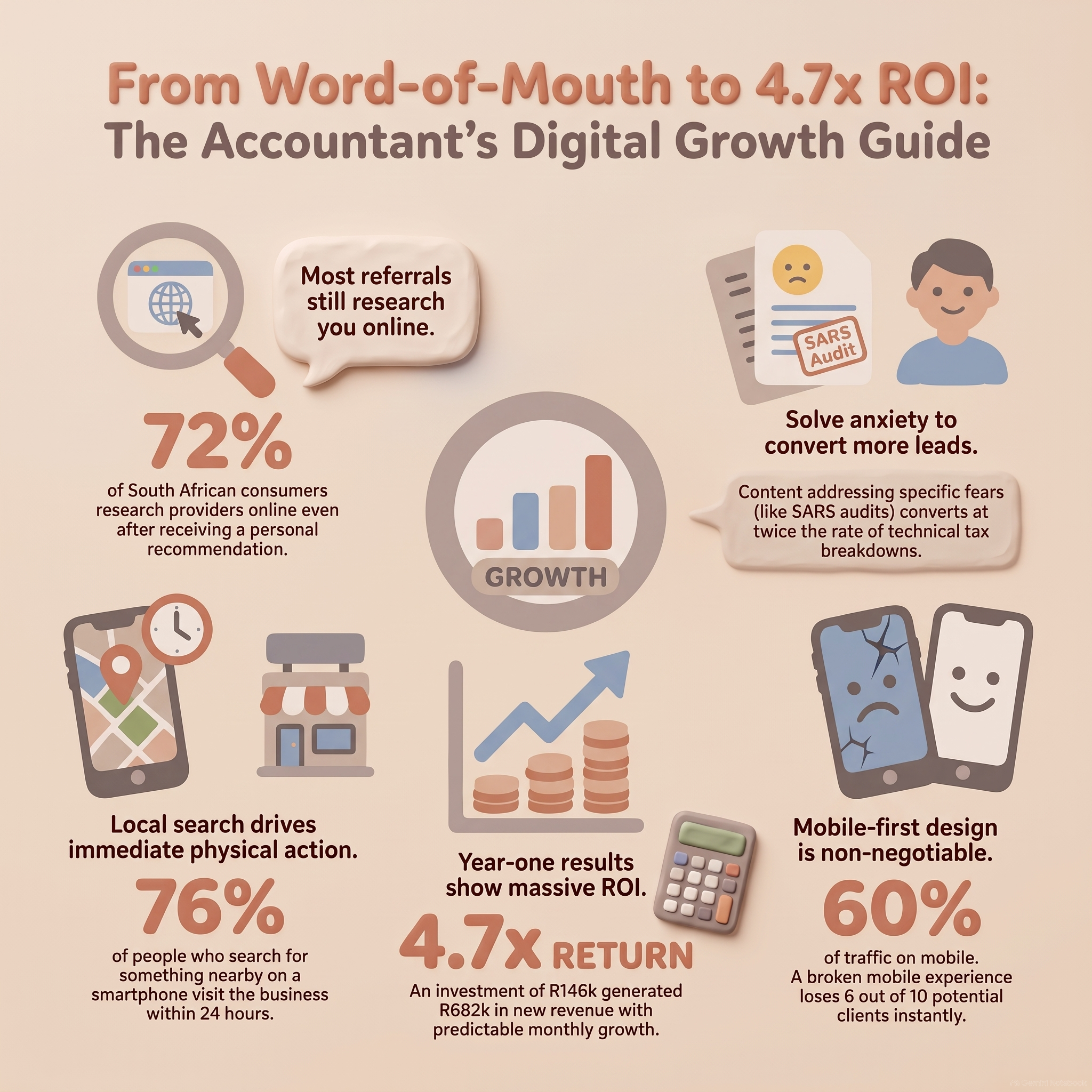
According to research from BrandsEye, 72% of South African consumers research service providers online before making contact — even when they’ve received a personal recommendation. That braai referral? It’s the start of the journey, not the end. If your digital presence doesn’t back up the recommendation, you’ve lost the lead before the first email.
Pieter’s practice had a website. Technically. It was built in 2014, looked like it, and hadn’t been updated since Zuma was still president. No blog. No case studies. The contact form didn’t work on mobile. And given that mobile devices account for over 60% of web traffic in South Africa, that meant six out of ten potential clients were hitting a broken experience.
“I genuinely didn’t know,” Pieter says. “I never looked at our site on my phone. Why would I? I know our number.”
What Investing in Marketing Actually Looked Like
In February 2024, Pieter made the decision to invest in digital marketing properly. Not dabble. Not “let’s try a Facebook page.” Actually invest.
Here’s what that meant in practice:
Month 1-2: Website overhaul and foundation work
The old site was binned. A new mobile-responsive site went up with proper service pages (tax compliance, business advisory, payroll, year-end), a blog section, and — critically — clear calls to action on every page. The content was rewritten to speak to the specific pain points of small to mid-sized SA businesses: SARS deadlines, PAYE reconciliation anxiety, and how to stay compliant when your bookkeeper just emigrated to Australia.
Month 3-4: SEO and content strategy
Pieter started publishing one blog post per fortnight. Not fluff. Practical guides: “What to do if you’ve missed your provisional tax deadline,” “How to handle VAT during load shedding when your tills go down,” “Director’s salary vs dividends: what actually makes sense in 2024.” Each piece was optimised for search terms his potential clients were actually typing into Google.
Month 5-6: Google Ads and local search
A modest Google Ads budget (R8,500/month) targeting high-intent search terms: “accountant near me Johannesburg,” “small business tax help,” “company registration accountant.” The ads pointed to specific service pages, not the homepage. And crucially, the Google Business Profile was claimed, verified, and optimised — complete with photos, operating hours, and service descriptions.
The thing that surprised Pieter most? How quickly the enquiries started coming in. Not a flood. But consistent. Predictable.
“By month four, we were getting two to three qualified enquiries per week from the website,” he says. “That doesn’t sound like much, but when you’re used to zero, it’s transformative.”

The First-Year Numbers (And What They Actually Mean)
Let’s be specific. Here’s what Pieter’s first twelve months of proper digital marketing delivered:
- 127 enquiries via website contact forms, phone calls traced to Google Ads, and direct emails referencing blog content
- 31 new clients signed (a 24% conversion rate, which is strong for professional services)
- Average client value: R22,000 in the first year (ongoing monthly retainers plus annual compliance work)
- Total new revenue: R682,000
- Marketing investment: R146,000 (website build, SEO, content, and Google Ads over 12 months)
- Return: 4.7x in year one, with most clients on multi-year retainers
But the numbers don’t tell the full story. What changed wasn’t just revenue. It was control.
“For the first time in seventeen years, I had a predictable lead pipeline,” Pieter explains. “I wasn’t sitting around hoping someone’s friend needed an accountant. I could see the enquiries coming in. I could forecast. I could plan.”
What Pieter Knows Now That He Didn’t Before
1. Most of your competitors aren’t marketing properly either
When Pieter started researching the local competition, he was shocked. Most accounting firms in Johannesburg had websites that looked like his old one: outdated, vague, and clearly not maintained. Very few were running Google Ads. Almost none were publishing useful content. The bar was low. Just clearing it put his practice ahead of 80% of the field.
2. People don’t buy accounting services — they buy relief from anxiety
The blog posts that performed best weren’t the technical breakdowns of tax legislation. They were the ones that addressed specific fears: “What happens if SARS audits my company?” “How to fix a PAYE reconciliation mess before the deadline.” The content that acknowledged the reader’s stress and offered a clear path forward converted at twice the rate of generic service descriptions.
3. Local search is everything for professional services
According to Google, 76% of people who search for something nearby on their smartphone visit a related business within a day. For accounting services, proximity matters. Clients want someone they can meet in person when things get complicated. Pieter’s investment in local SEO — getting the practice to show up in the Google Map Pack for “accountant Sandton” and “tax consultant Rosebank” — delivered more qualified leads than any other single channel.
4. Marketing isn’t a cost — it’s the difference between growing and coasting
The mindset shift was the hardest part. Pieter had spent his entire career thinking of marketing as an expense. Something consumer brands did. Not professional services. But once he reframed it as client acquisition — a measurable, controllable process with a return — the decision became obvious.
“I spend R12,000 a month on marketing now,” he says. “That brings in, on average, two to three new clients per month. Those clients are worth R20,000 to R30,000 each in the first year alone. I’d have to be terrible at maths not to see that as a good deal. And I’m not terrible at maths. I’m an accountant.”

What the Process Actually Felt Like
Let’s be honest: it wasn’t all smooth. Pieter had no idea what “SEO” stood for when he started. He didn’t know the difference between organic search and paid search. He’d never written a blog post in his life and felt deeply uncomfortable doing it at first.
“I’m an accountant, not a writer,” he says. “The first few blog posts were painful. I’d sit there for two hours trying to write 500 words about provisional tax. But I got better. And more importantly, I realised I didn’t have to do all of it myself. That’s what the agency was for.”
Working with a digital marketing agency meant Pieter could focus on what he was good at — accounting — while the agency handled the technical work: website development, keyword research, ad campaign management, and content editing. Pieter contributed his expertise (what clients actually ask about, what keeps them up at night), and the agency turned that into content and campaigns.
“The hardest part was trusting the process,” he admits. “In month two, I was checking Google Analytics every day, obsessing over traffic numbers. In month three, I almost pulled the plug on the Google Ads because I didn’t understand why we were spending money on clicks that didn’t convert immediately. But my account manager walked me through it. Showed me the data. Explained that professional services have longer sales cycles. By month five, I stopped panicking and started seeing the pattern.”
The Load Shedding Variable (Because This Is South Africa)
One unexpected challenge: during Stage 6 load shedding in mid-2024, Pieter’s enquiries dropped noticeably. Not because people didn’t need accountants, but because businesses were in crisis mode. When you’re running a restaurant and your fridges are dying every six hours, you’re not thinking about tax planning.
But here’s what Pieter learned: digital marketing builds long-term visibility, not just immediate conversions. When load shedding eased and businesses came up for air, many of those delayed enquiries arrived. People who’d found his blog posts during the chaos, bookmarked them, and reached out weeks later when things stabilised.
“The content kept working even when I wasn’t,” Pieter says. “That was the revelation. I wrote a post about managing cash flow during power outages in June. It’s still bringing in enquiries now, eight months later. It’s like having a sales rep who works 24/7 and never asks for a raise.”

What Would Pieter Tell Another Accounting Firm Starting Today?
Start smaller than you think you need to, but start consistently.
You don’t need a R200,000 marketing budget. You need a professional website, a content plan, and a willingness to show up regularly. Pieter’s first blog posts got 14 views. His fifth post got 340. His fifteenth got 1,200 and brought in three enquiries. Consistency compounds.
Focus on the questions your clients actually ask.
Every time a client asks you a question in a meeting, that’s a blog post. Every time someone calls with a panic about SARS, that’s content. Your expertise is valuable. Document it. Publish it. Let it work for you.
Don’t try to DIY the technical stuff.
Pieter tried to set up Google Ads himself in month two. He wasted R4,000 in three weeks targeting the wrong keywords and sending traffic to the wrong pages. “I’m an accountant,” he says. “I wouldn’t expect my marketing agency to do my clients’ tax returns. Why did I think I could run a Google Ads campaign with no training?”
Measure what matters.
Traffic is nice. Rankings are nice. But what actually matters is enquiries, conversion rate, and client lifetime value. Pieter tracks three numbers weekly: website enquiries, booked consultations, and signed clients. Everything else is noise.
What This Means for Your Practice
If you’re running an accounting firm in South Africa right now, you’re operating in one of the most competitive professional services markets we’ve ever seen. The barriers to entry are low (every newly qualified CA thinks about starting their own practice), and clients have more choice than ever.
But here’s the thing most firms miss: choice without visibility is meaningless. If a potential client can’t find you online, you don’t exist in their consideration set. And in 2026, the first page of Google is the consideration set.
According to research from BrightEdge, organic search drives 53% of all website traffic, and for professional services, that number is even higher. If you’re not showing up when someone in your area searches for “tax accountant,” “small business bookkeeping,” or “company registration help,” you’re leaving revenue on the table. Revenue your competitors are picking up.
The good news? Most accounting firms still aren’t marketing properly. The opportunity is wide open. But it won’t stay that way forever.
Frequently Asked Questions
Q: How much should an accounting firm spend on digital marketing in South Africa?
A: A realistic starting budget for a small to mid-sized practice is R10,000 to R15,000 per month, covering SEO, content creation, and a modest Google Ads spend. Larger firms targeting corporate clients should budget R25,000 to R40,000 per month. The key is consistency — three months of proper investment will outperform twelve months of sporadic dabbling.
Q: How long does it take to see results from marketing for accountants?
A: SEO and content marketing typically show measurable results (increased enquiries) within 3-4 months. Google Ads can deliver enquiries within weeks, but professional services have longer sales cycles — expect 4-8 weeks from first contact to signed client. Most firms see a positive ROI by month six if the strategy is properly executed.
Q: Do accounting firms really need to publish blog content?
A: Yes, if you want to be found online. Each blog post targeting a specific search term (e.g., “how to register a company in South Africa”) is a potential entry point for new clients. It builds trust, demonstrates expertise, and improves your search rankings. Firms that publish consistently (2-4 posts per month) generate 67% more leads than those that don’t, according to HubSpot research.
Q: What’s the most effective marketing channel for accounting firms in South Africa?
A: Local SEO and Google Ads targeting high-intent search terms deliver the best ROI for most accounting practices. LinkedIn is effective for firms targeting corporate clients or specialised services (forensic accounting, M&A advisory). Facebook and Instagram work for sole practitioners and very small firms targeting individual tax clients, but conversion rates are lower.
Q: Can I do digital marketing myself, or do I need an agency?
A: You can handle some elements yourself (writing blog posts based on client questions, managing your Google Business Profile), but technical SEO, Google Ads management, and website development are best handled by specialists. Most successful accounting firms use a hybrid model: they provide the expertise and client insights, the agency handles the execution and technical work.
If you’re ready to move beyond word-of-mouth and build a predictable client pipeline for your accounting practice, we should talk. Thickrope Marketing specialises in digital marketing for South African professional services firms — we understand the compliance pressures, the local search landscape, and what actually converts in this market. [Book a free 30-minute consultation](https://thickropemarketing.co.za/contact/) and let’s map out what year one could look like for your practice.