
SEO for Accountants in South Africa: What the Local Search Landscape Looks Like and Where the Real Opportunity Sits
Here’s something most South African accounting firms get wrong: they optimise for the keywords they think clients are searching for, not the ones they actually use.
You’ve got practices chasing “chartered accountants Johannesburg” while potential clients are typing “how to register a company CIPC” or “do I need an accountant for tax clearance certificate” into Google at 11pm on a Sunday. The disconnect isn’t just costing visibility — it’s leaving money on the table in a market where every qualified lead counts.
SEO for accountants in South Africa operates differently from most professional services, and understanding those differences is the gap between a website that generates enquiries and one that just… exists.
The Search Intent Problem: SA Clients Don’t Start With “Find an Accountant”
Most accounting firms structure their SEO around service pages: tax consulting, audit services, financial statements. Standard stuff. Logical, even.
But here’s what the search data actually shows: South African business owners and individuals spend far more time searching for solutions to specific problems than they do searching for accountants directly.
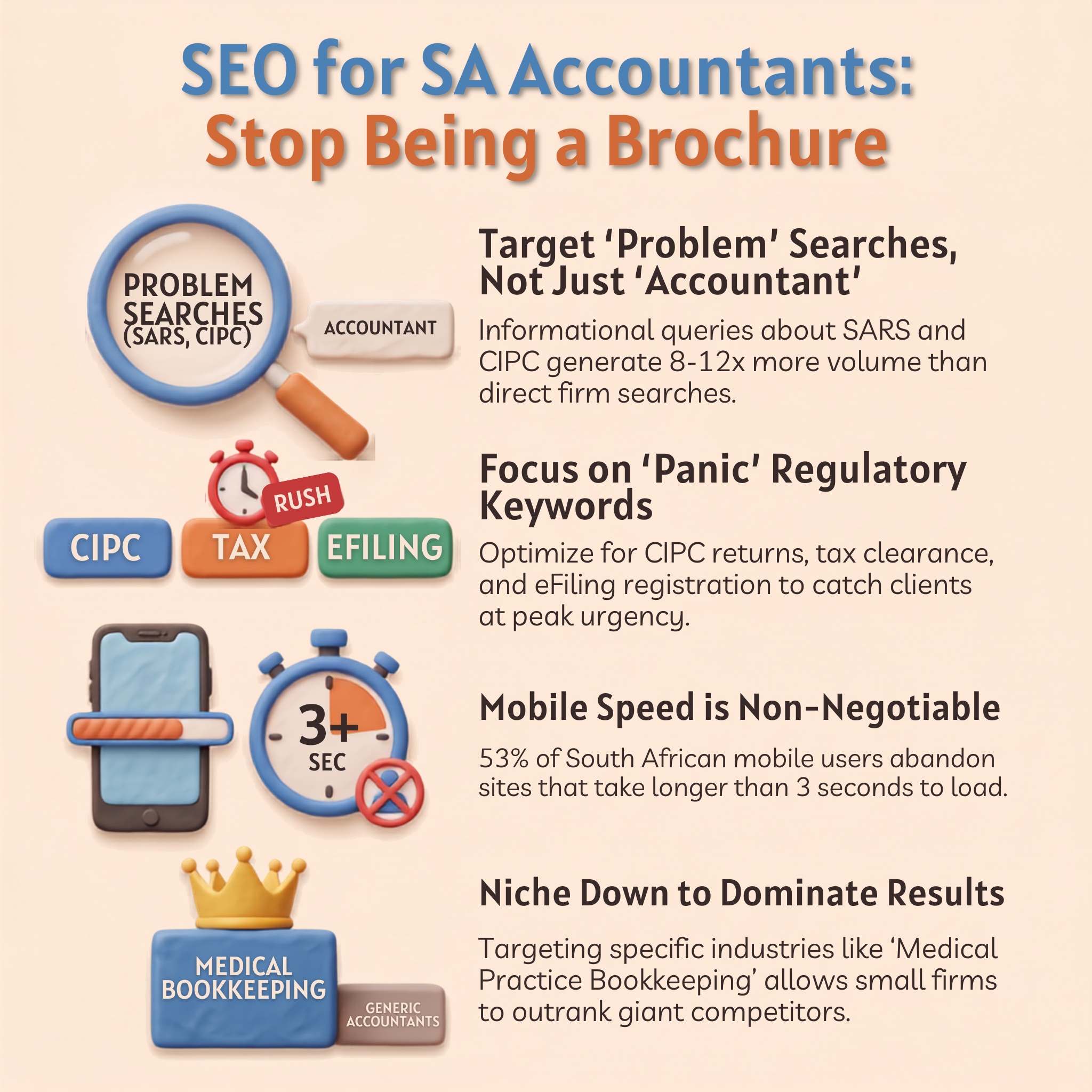
According to SEMrush data for South African search volumes, informational queries around tax compliance, SARS filing deadlines, and BEE verification collectively generate roughly 8-12 times the monthly search volume of direct “accountant near me” type queries. The commercial intent is there — they need an accountant to solve these problems — but they’re not searching for one yet. They’re trying to understand the problem first.
This creates an enormous content opportunity that most firms ignore entirely.
When someone searches “provisional tax payment dates 2026 SARS” at 2am (and they do — mobile search spikes between 9pm and midnight for tax-related queries in SA), they’re not window shopping. They’re stressed, they’ve probably left something too late, and they need help. If your content is the one that answers that question clearly and then positions your firm as the solution, you’ve captured them at peak intent.
The Four Keyword Categories That Actually Drive Accounting Enquiries in SA
Forget the generic “accounting services Cape Town” approach. Here’s where the qualified traffic actually lives:
1. Regulatory Compliance Searches (High Intent, High Volume)
These are the “oh hell, I need this sorted now” searches:
- CIPC annual returns
- Tax clearance certificate requirements
- SARS eFiling registration
- BEE affidavit vs verification
- PAYE reconciliation deadlines
These queries spike hard around SARS submission deadlines (end of July for individuals, various dates for provisional tax). Business owners searching these terms are already behind schedule. They need an accountant, they know they need an accountant, they’re just trying to understand what they’re actually supposed to do.
Create content that answers the question, then immediately positions booking a consultation as the sensible next step. The conversion rate on traffic from these pages should be 2-4x higher than your service pages if you’ve structured them properly.
2. Life Event + Accounting Searches (Lower Volume, Ridiculously High Intent)
These are the crossroads moments:
- Do I need an accountant when starting a business
- Accountant for sole proprietor vs Pty Ltd
- Selling a business capital gains tax
- Freelancer tax obligations South Africa
- Estate duty and executors
Someone searching “do I need an accountant to register a company” is often days away from making that decision. They’re not researching for fun. These queries have smaller search volumes (typically 100-500 monthly searches depending on specificity), but the people behind them have budget and urgency.
3. Industry-Specific Accounting Queries (Niche Dominance)
This is where smaller or specialised firms can absolutely dominate:
- Accounting for construction companies CIPC compliance
- Restaurant accounting and VAT
- Medical practice bookkeeping
- E-commerce business tax obligations
- Nonprofit organisation financial reporting SA
If you serve a specific industry, these keywords are gold. The search volumes might look modest (sometimes 50-200 monthly searches), but you’re competing against far fewer firms, and the leads are pre-qualified by industry.
4. Local + Urgent Queries (Mobile-First Opportunity)
According to Google’s consumer insights data, roughly 76% of people who search for something nearby on their smartphone visit a related business within a day. In South Africa, where mobile data costs have dropped and smartphone penetration among business owners is near-universal, mobile search behaviour for professional services has shifted dramatically.
But here’s the thing: “accountants near me” is only part of it. The real opportunity is in location-specific problem searches:
- Tax practitioner [suburb name]
- SARS tax help [city]
- Company registration accountant [area]
These often happen when someone’s been referred by word of mouth but wants to verify credibility, or when they’ve realised they need immediate help and are searching from their phone during load shedding with one bar of battery left.
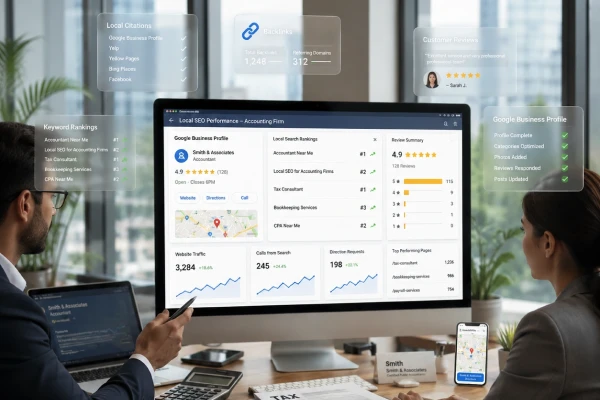
Your Google Business Profile optimisation, local citations, and mobile site speed matter more for these queries than almost anything else.

Why Most Accounting Firm Websites Don’t Rank (Even When the Firm Is Good)
Let’s talk about the technical realities. Most accounting websites we audit have one or more of these problems:
Thin service pages with identical content: Every service page says basically the same thing with a different heading. Google sees this as low-value content. You’re better off with three properly detailed pages than twelve variations of “we offer professional accounting services tailored to your needs.”
No content targeting search intent: The website is a brochure. It tells you what the firm does, but it doesn’t answer a single question a prospective client actually searched for. Zero informational content means zero entry points from the 90% of searches that start with questions, not service names.
Terrible mobile experience: Page speed matters everywhere, but in South Africa it matters more. Data is still expensive relative to income. Network reliability varies wildly. According to Google’s research, 53% of mobile users abandon sites that take longer than three seconds to load. Most accounting sites we test load in 6-8 seconds on a 3G connection. You’re losing half your mobile traffic before they see a single word.
Zero local signals: No schema markup identifying the firm’s service areas, no consistent NAP (name, address, phone) across directories, Google Business Profile last updated in 2019, no reviews strategy. Local SEO isn’t optional for accounting firms — even if you serve clients nationally, they still search with local intent.
No internal linking strategy: You’ve published ten helpful blog posts about tax obligations, but they’re not linked from your service pages, and your service pages don’t link to them. Google doesn’t understand which pages matter most, and users can’t find the content that would convince them to hire you.
What a Properly Structured SEO Strategy for a SA Accounting Firm Actually Involves
Here’s the sequence that works, based on what we’ve seen move the needle for accounting practices:
Month 1-2: Foundation and Research
Keyword research with SA intent mapping: Identify not just search volumes but the actual intent clusters. Which searches indicate someone needs an accountant now vs researching for later? Which industries or life events create the highest-value opportunities for your specific firm?
Technical audit and fixes: Site speed optimisation (especially mobile), fixing broken links, implementing proper schema markup (LocalBusiness, ProfessionalService, FAQPage), ensuring the site is actually crawlable. This isn’t sexy work, but it’s foundational. You can’t rank if Google can’t properly index your content.
Local presence audit: Google Business Profile optimisation, citation building, review strategy implementation. For accounting firms, this is particularly important because trust signals matter enormously. Someone’s not going to trust you with their tax obligations if your business listing has three reviews from 2018 and conflicting phone numbers.
Month 3-4: Content That Answers Real Searches
High-intent compliance content: Create genuinely useful guides around the regulatory searches your potential clients are actually performing. Not 300-word blog posts. Proper, detailed, current guides that answer the question completely.
Example: Instead of “What is provisional tax?”, create “Provisional Tax in South Africa: Payment Dates, Calculation Methods, and What Happens If You Miss a Deadline (2026 Updated)”. Include calculators, examples, and a clear CTA to book a consultation for complex situations.
Industry-specific landing pages (if relevant): If you serve specific industries, create comprehensive landing pages that address their unique challenges. Not just “we work with restaurants” — actual content about restaurant-specific VAT challenges, the accounting implications of till systems, managing seasonal cash flow in hospitality.
Month 5-6: Authority Building and Conversion Optimisation
Strategic link building: For accounting firms in SA, this isn’t about buying dodgy backlinks. It’s about getting listed in legitimate business directories, contributing expert commentary to business publications, being referenced by CIPC or SARS resource pages (where appropriate), and building relationships with complementary professionals (lawyers, business consultants) who link to your resources.
Conversion rate optimisation: Analysing which content is getting traffic but not converting, tightening CTAs, implementing strategic lead magnets (checklists, deadline calendars, initial consultation offers), and improving the actual enquiry process.
According to HubSpot’s conversion rate benchmarks, the average website conversion rate for professional services sits around 2-3%. The accounting firms we work with that implement proper CRO alongside their SEO typically see conversion rates of 4-7% on targeted landing pages. That’s the difference between 3 enquiries and 7 enquiries from the same 100 visitors.
Ongoing: Content Updates, Technical Maintenance, and Reporting
Tax laws change. SARS deadlines shift. Your content needs to stay current or it loses both rankings and trust. This is particularly crucial for accounting firms because outdated information doesn’t just hurt SEO — it damages credibility.

The Geographic Targeting Nuance Most SA Accounting Firms Get Wrong
South Africa’s urban geography creates interesting SEO opportunities that most firms don’t capitalise on.
Someone searching in Sandton might be looking for a different service profile than someone searching in Nelspruit. The Sandton searcher might need complex corporate tax structuring; the Nelspruit searcher might need practical small business accounting and BEE compliance help.
But here’s where it gets interesting: many SA business owners are willing to work with accountants remotely, especially post-COVID. The geographic search might be a starting point, but the decision factors are more about specialisation, trust signals, and communication style than physical location.
This means you need both local optimisation (to appear in “near me” searches and build initial trust) and topical authority (to capture clients who’ll work with you remotely because you understand their specific situation).
Create location pages that aren’t just “Accounting Services in [City]” — make them “Accounting Services in [City]: What [City] Business Owners Need to Know About [Specific Local Challenge]”. In Durban, maybe it’s the concentration of manufacturing businesses and import/export considerations. In Cape Town, perhaps it’s the tourism and hospitality sector’s seasonal challenges.
Why Speed Matters More for SA Accounting Websites Than Almost Any Other Factor
We’ve tested this repeatedly: in South Africa, site speed is the single biggest technical factor affecting both rankings and conversions for accounting websites.
Here’s why it’s particularly acute:
Network variability: Even in urban centres, connection quality varies wildly. Your potential client might be searching from a cafe during load shedding, tethered to their phone. If your site takes 8 seconds to load, they’re gone.
Mobile-first indexing: Google predominantly uses the mobile version of content for indexing and ranking. If your mobile site is slow, you’re not ranking well anywhere, regardless of how fast your desktop site loads.
Trust correlation: Users (perhaps unfairly, but measurably) associate slow websites with unprofessional businesses. For a profession built entirely on trust — you’re asking people to trust you with their financial affairs and compliance obligations — a slow website creates immediate doubt.
Every accounting website we optimise goes through aggressive speed optimisation: image compression, lazy loading, minifying code, leveraging browser caching, and choosing fast hosting. It’s not optional.

The Content Mix That Actually Builds Trust With SA Accounting Clients
Here’s what works, based on what converts:
40% regulatory and compliance content: The answers to “what do I legally need to do and by when” searches. Updated religiously. Accurate, current, and specific to South African legislation.
30% practical how-to content: “How to read your financial statements”, “How to prepare for your first meeting with an accountant”, “How to organise your expense receipts for year-end”. This builds trust because it demonstrates expertise while helping even before someone becomes a client.
20% industry or situation-specific content: Targeted at your ideal client profile. If you specialise in startups, content about startup funding, investor-ready financials, and growth-stage accounting challenges. If you work with established SMEs, content about succession planning, tax-efficient profit extraction, and managing growth.
10% thought leadership and commentary: Your take on recent tax policy changes, SARS enforcement trends, or accounting best practices. This signals that you’re current, engaged, and thinking beyond just compliance.
Notice what’s missing: fluff posts about “the importance of accounting” or “choosing the right accountant”. No one searches for those. They don’t build authority. They’re content for content’s sake.
Frequently Asked Questions
Q: How long does SEO take to generate leads for an accounting firm in South Africa?
A: Realistically, 4-6 months to start seeing meaningful traffic increases, 6-9 months to see consistent lead flow. The timeline depends heavily on your starting point (new site vs established site, current authority, competition in your area). Unlike PPC, SEO is a compounding investment — it gets more effective over time rather than stopping when you stop paying.
Q: Can a small accounting firm compete with larger practices in search results?
A: Absolutely, and often more effectively in specific niches. Larger firms tend to target broad, competitive keywords and serve generalist content. Smaller firms that focus on specific industries, localities, or client types can dominate those specific search terms. A three-person practice specialising in medical practice accounting can outrank a 50-person firm for every medical-accounting-related search if they build proper topical authority.
Q: Should accounting firms focus on Google Ads or SEO first?
A: Different purposes. Google Ads gives you immediate visibility and lead flow — useful if you need clients now and have budget. SEO builds long-term asset value and typically delivers a better cost-per-acquisition over time, but takes months to compound. Most firms we work with are best served by a hybrid approach: modest Google Ads spend for immediate leads while SEO builds, then gradually shifting budget as organic performance improves.
Q: How much content does an accounting website actually need to rank well?
A: Quality over quantity, but there’s a minimum threshold. A competitive accounting firm site typically needs 15-25 substantial pages/posts targeting high-intent keywords, plus ongoing content updates. One exceptional 2,500-word guide on SARS provisional tax that ranks and converts is worth more than twenty thin 400-word posts that accomplish neither.
Q: What’s the biggest SEO mistake SA accounting firms make?
A: Treating their website like a static brochure rather than an answer engine. Your website should answer the questions your ideal clients are actually searching for. If someone can visit your site, read everything, and still not understand whether you’re the right fit for their specific situation, your content strategy needs work.
If your accounting firm’s website isn’t generating qualified enquiries, the problem usually isn’t the quality of your accounting — it’s that potential clients can’t find you when they’re searching for solutions you provide. We’ve built SEO strategies specifically for South African accounting practices that understand both the regulatory landscape and how SA clients actually search. [Let’s talk about what that could look like for your firm](https://thickropemarketing.co.za/contact/).