

Digital Marketing in Carletonville: What Actually Works for a Business in the West Rand’s Mining Heartland
Carletonville isn’t Sandton. And thank goodness for that, because if you’re marketing a business here using the same playbook agencies peddle to Rosebank consultancies, you’re burning money faster than Eskom burns through diesel.
The West Rand’s mining heartland has a digital landscape shaped by forces most Gauteng marketers wouldn’t recognise: shift workers who search at 4am, industrial suppliers whose biggest clients don’t have LinkedIn accounts, and a residential economy that’s increasingly mobile-first but still deeply rooted in word-of-mouth trust networks built over decades.
Here’s what most business owners in Carletonville don’t know: your competitors aren’t just the bloke three streets over—they’re Randfontein suppliers showing up in your customers’ Google searches, Krugersdorp retailers running Facebook ads into your postcode, and Johannesburg-based service providers who’ve figured out that “Carletonville” is an underpriced keyword with serious commercial intent.
Let’s map what actually works when you’re marketing a business in eSayidi.
The Carletonville Search Behaviour Nobody Talks About
Most digital marketing advice assumes a 9-to-5 search pattern. Carletonville breaks that assumption comprehensively.
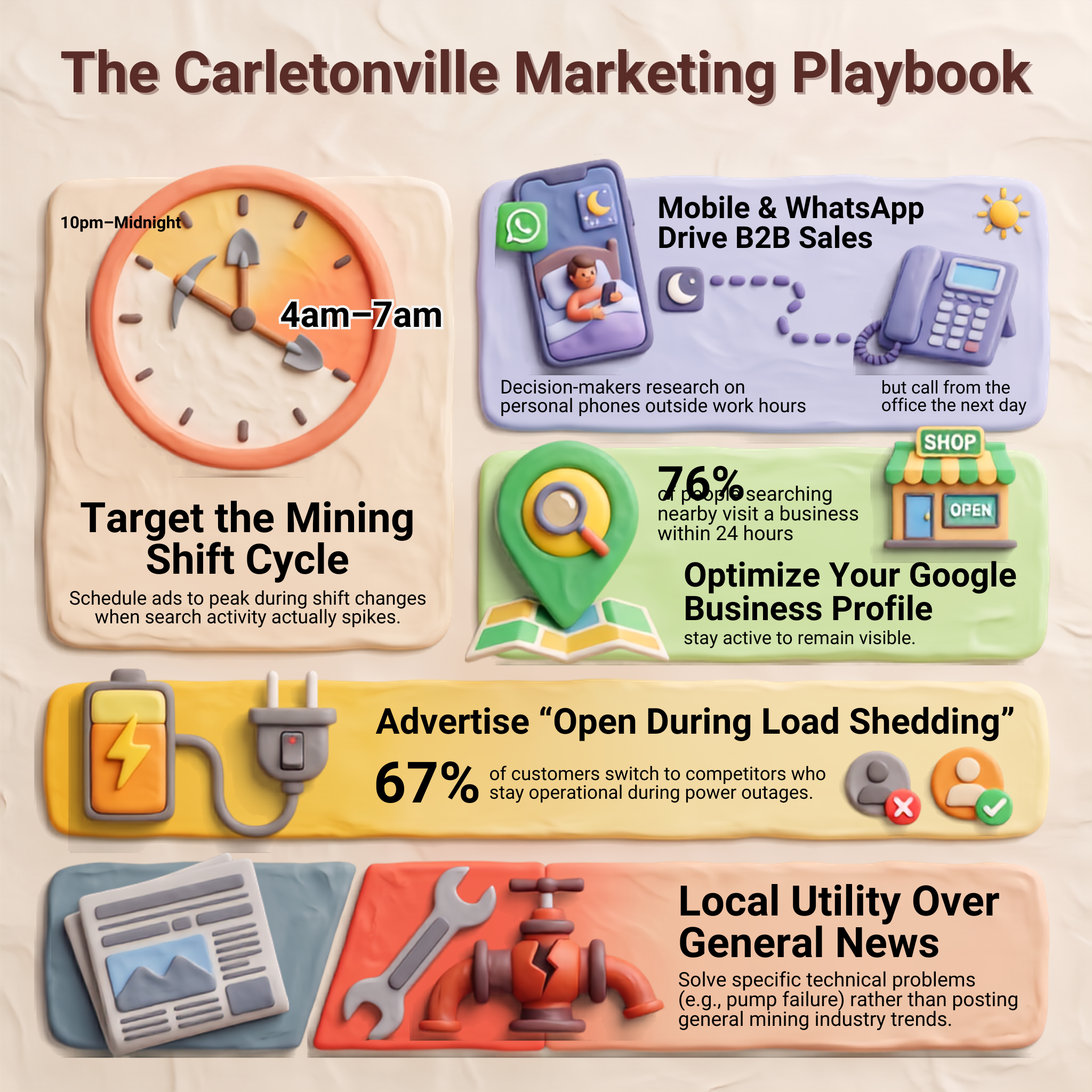
Fact one: Mining towns have inverted search patterns. When AngloGold Ashanti, Sibanye-Stillwater, and other mining operations run 24-hour shift cycles, your potential customers aren’t searching during conventional business hours. According to Google Trends data for the Merafong region, search activity for commercial keywords (“plumber near me”, “restaurant Carletonville”, “hydraulic repairs”) peaks between 5-7am and again from 10pm-midnight. That’s shift changeover time and post-shift downtime.
If you’re running Google Ads campaigns that dial down bids overnight because “nobody searches then,” you’re missing the exact moment when a mine supervisor with a burst geyser or a procurement officer chasing urgent hydraulic supplies is actually on their phone.
What to do differently: Adjust your Google Ads scheduling to maintain (or increase) bids during early morning and late evening hours. For local service businesses—plumbers, electricians, restaurants, accommodation—this is when Carletonville actually searches. Set up call tracking that works outside business hours, even if it’s just a WhatsApp Business number with auto-responses confirming you’ve received the enquiry.
The B2B Reality: Your Mining Clients Aren’t Searching Like You Think
Here’s the uncomfortable truth about marketing industrial supplies, engineering services, or B2B offerings in a mining town: the people with budget authority often have terrible internet access at work.
Underground operations, secure mine sites, and industrial areas have patchy connectivity that makes browsing supplier websites during work hours genuinely difficult. According to the Independent Communications Authority of South Africa (ICASA), mobile network performance in deep-level mining areas drops by up to 60% compared to residential zones due to infrastructure and geology.
Meanwhile, the procurement officers, engineering managers, and site supervisors making purchasing decisions are researching suppliers on their personal phones during commutes, at home in the evening, or during tea breaks in surface buildings.
The lesser-known fact: B2B decision-makers in Carletonville are researching you on mobile devices outside work hours, but they’re converting (calling, emailing RFQs) during work hours from desktop or landline. Google Analytics will show you mobile traffic that doesn’t convert, and you’ll wrongly conclude mobile doesn’t matter for your B2B offering.
What works instead:
1. Mobile-optimised sites are non-negotiable, even for heavy industrial suppliers. Your engineering manager is comparing you to three Johannesburg competitors while sitting in traffic on the R500. If your site takes 8 seconds to load or looks like it was built when Mandela was released, you’re eliminated before work even starts.
2. Make your phone number massive and click-to-call. The research happens on mobile at 9pm; the call happens from the mine office at 10am the next day. Both journeys need to be friction-free.
3. WhatsApp Business is your secret weapon. It bridges the gap between evening mobile research and next-day procurement follow-up. A 2023 study by World Wide Worx found that 89% of South African internet users use WhatsApp daily—higher than any other platform. In Carletonville’s B2B context, it’s where serious commercial conversations actually happen.

Facebook Still Owns the Residential Market (But Not How Agencies Tell You)
If you’re running a retail business, restaurant, salon, or residential service in Carletonville, Facebook advertising works. But the targeting approach that works in suburbs with diverse demographics falls apart here.
The lesser-known fact: Carletonville’s residential market is economically stratified in ways that don’t map neatly to Facebook’s interest-based targeting. Trying to target “high-income households interested in home improvement” will serve your ads to people in Fochville and Randfontein before efficiently reaching the established residential areas around Blybank or Oberholzer.
What works better: Geographic radius targeting centred on specific suburbs, combined with lookalike audiences built from your existing customer database. If you’ve been in business for more than a year, you know where your customers live. Upload those phone numbers (with consent) to Facebook, create a lookalike audience, and geo-fence it to Carletonville and immediate surrounds.
For restaurants and retail, Facebook posts showcasing actual faces—your regulars, your team, recognisable local scenes—outperform polished product photography by substantial margins. Carletonville’s social graph is dense and interconnected; when someone recognises a friend in your post, engagement (and foot traffic) follows.
Budget reality: R100-150/day in Facebook ad spend, properly targeted, will reach 3,000-5,000 people in Carletonville weekly. That’s meaningful penetration in a town of roughly 80,000 people.
Google My Business: The Channel Everyone Underestimates
Here’s a stat that should change how you think about local visibility: according to Google, 76% of people who search on their smartphone for something nearby visit a business within 24 hours, and 28% of those searches result in a purchase. In a regional centre like Carletonville, where shopping trips to bigger centres require planning, that local search intent is pure gold.
Yet most Carletonville businesses treat their Google My Business profile like a digital afterthought—outdated hours, no photos updated since 2019, reviews unanswered.
The opportunity: Your Google My Business profile is often the first (and sometimes only) thing a potential customer sees when searching for your category. “Restaurant Carletonville”, “doctor Carletonville”, “tyre fitment West Rand”—these searches trigger the local pack, and if you’re not optimised, you’re invisible.
What actually works:
- Post weekly updates with photos of new stock, menu specials, or project completions. Google rewards active profiles with better visibility.
- Respond to every review within 24 hours, good or bad. It signals to Google (and customers) that you’re responsive.
- Add operating hours for public holidays and load shedding. “Open during load shedding” or “Generator on site” in your business description is a competitive advantage in 2026’s South Africa.
- Upload new photos monthly. Businesses with recent photos get 42% more requests for driving directions and 35% more clicks through to their websites (Google internal data).
The businesses dominating local search in Carletonville right now aren’t necessarily the biggest—they’re the ones treating Google My Business like the shopfront it actually is.

The Content Trap: Why Blogging About Mining News Won’t Sell Your Hydraulics
Every few months, a Carletonville business owner gets sold on “content marketing” by an agency promising SEO magic. Six months later, they’ve published 20 blog posts about mining industry trends, gold prices, and West Rand history. Traffic hasn’t budged. Sales haven’t moved.
The lesser-known fact: Content marketing works in Carletonville, but only when it answers the commercial questions your customers are actually searching. “How to choose a reliable compressed air supplier” will bring you qualified leads. “The history of gold mining in the West Rand” will bring you school kids doing homework.
For B2B businesses, the content that converts focuses ruthlessly on technical problem-solving:
- “Common causes of hydraulic pump failure in high-temperature mining environments”
- “How to calculate compressed air requirements for a 500-person underground operation”
- “Load shedding contingency planning for industrial refrigeration”
For residential and retail, local utility wins:
- “Restaurants open during load shedding in Carletonville”
- “Same-day appliance repairs in the West Rand”
- “Where to buy [specific product] in Carletonville without driving to Joburg”
The goal isn’t to become a publishing house. It’s to capture the high-intent searches that signal someone is ready to buy, right now, from a local supplier.
Load Shedding Changed the Game (And Created Opportunities)
Since 2023, load shedding has moved from inconvenience to structural economic reality. For Carletonville businesses, it’s reshaped both digital marketing tactics and customer expectations.
The opportunity most businesses miss: “Open during load shedding” is a legitimate competitive advantage that should be plastered across every digital channel you occupy.
If you’ve invested in solar, a generator, or UPS systems that keep you operational during outages:
- Add it to your Google My Business description
- Make it a Facebook cover photo announcement
- Include it in every Google Ads headline variation
- Create a website banner that updates in real-time with current trading status
According to a 2024 survey by Mastercard Economics Institute South Africa, 67% of consumers have switched to a competitor specifically because that business was operational during load shedding when their usual provider wasn’t. In Carletonville’s tight-knit commercial environment, capturing that switching behaviour builds permanent market share.
For service businesses, advertising your ability to respond during load shedding (because you have vehicle-based equipment or battery backup for call handling) separates you from competitors who go dark for 4.5 hours at a time.

What Doesn’t Work in Carletonville (Stop Wasting Money Here)
Let’s be direct about channels that underperform in this market:
LinkedIn advertising for B2B mining supply: The decision-makers you’re trying to reach often don’t maintain active LinkedIn profiles. A mine shift supervisor or maintenance manager isn’t scrolling LinkedIn during tea break. Save the budget for Google Ads targeting commercial keywords.
Instagram influencer partnerships: Unless you’re in hospitality, food, or lifestyle retail, Instagram’s audience skew and engagement patterns don’t match Carletonville’s demographic reality. Facebook delivers better ROI for the same visual content.
Display advertising on news websites: Banner blindness is real, and the click-through rates on display campaigns targeting regional audiences rarely justify the spend. Put that budget into search advertising where intent is explicit.
SEO targeting Johannesburg keywords: Trying to rank for “hydraulic repairs Johannesburg” when you’re based in Carletonville is a fool’s errand. You’ll compete against 50 Joburg suppliers with bigger budgets and closer proximity. Own “hydraulic repairs West Rand”, “compressed air Carletonville”, and the long-tail commercial terms that signal local intent.
The Real Competition Isn’t Who You Think
Most Carletonville business owners see their competition as the other businesses in town. That’s partially true, but it misses the bigger threat.
Your real competition is the perception that people need to drive to Krugersdorp or Johannesburg for quality products and services.
This perception battle is fought and won on digital channels. When someone searches “industrial PPE suppliers near me” while standing in Carletonville, and the top three results are all Johannesburg businesses with better websites, faster-loading mobile experiences, and more reviews, they’re making the drive.
Your digital marketing job isn’t just to be visible—it’s to credibly demonstrate that local procurement is the smarter choice. That means:
- Website photography showing your actual Carletonville location, team, and stock
- Google reviews from recognisable local businesses and individuals
- Clear delivery and response time commitments that emphasise proximity advantage
- Local landmarks and references in your ad copy (not generic Gauteng positioning)
When your Google Ads headline reads “Hydraulic Repairs Carletonville – 45 Min Response Time West Rand” instead of “Professional Hydraulic Services Gauteng”, you’re speaking directly to the customer who’s weighing up whether to call you or drive to Krugersdorp.

The Budget Reality for Carletonville Businesses
Let’s talk money, because every marketing conversation eventually lands here.
Most Carletonville businesses can’t (and shouldn’t) spend R30,000/month on digital marketing like agencies pitch to corporates. But R5,000-8,000/month, properly allocated, produces measurable results.
A sensible monthly allocation for a growing Carletonville business looks like:
- R2,500-3,500 on Google Ads (search campaigns targeting high-intent commercial keywords)
- R1,500-2,000 on Facebook advertising (if you’re B2C or retail)
- R1,000-1,500 on website maintenance, hosting, and technical optimisation
- R1,000-1,500 on content creation and Google My Business management
That’s not Sandton money. It’s Carletonville-appropriate investment that fits the market size and competitive dynamics.
For B2B businesses with longer sales cycles and higher transaction values, the mix shifts—more budget to Google Ads, less to social, and investment in proper lead nurturing systems (even if that’s just a well-managed WhatsApp Business setup and CRM spreadsheet).
Why Local Expertise Actually Matters
Here’s the final lesser-known fact: **digital marketing agencies running campaigns for Carletonville businesses from Johannesburg offices often optimise for the wrong metrics because they don’t understand the market mechanics.**
They’ll celebrate a drop in cost-per-click without noticing they’ve shifted spend to keywords that bring traffic from Potchefstroom and Klerksdorp—wrong geography, wrong intent. They’ll run Facebook campaigns targeting “West Rand” that serve 60% of impressions to Roodepoort and Krugersdorp because those areas have denser populations.
An agency (or internal marketing person) who understands that Carletonville’s commercial heartbeat runs on shift cycles, that the R500 corridor is where your customers live and work, and that “local” means something specific here will build campaigns that actually convert.
They’ll know that “near me” searches in Carletonville often mean “within 50km” because that’s the practical service radius, not the 10km radius that works in dense urban areas. They’ll understand that a 4.2-star Google rating with 15 reviews from recognisable local businesses beats a 4.8-star rating with 150 reviews from all over Gauteng.
Context isn’t everything in digital marketing. But in regional markets like Carletonville, it’s the difference between campaigns that deliver and campaigns that just spend.
Frequently Asked Questions
Q: Does SEO work for small businesses in Carletonville, or is it only for big companies?
A: SEO works brilliantly for Carletonville businesses precisely because the competition is less sophisticated than in major centres. Ranking for “plumber Carletonville” or “industrial supplies West Rand” is dramatically easier (and cheaper) than competing for Johannesburg keywords. The search volume is lower, but the commercial intent is often higher—these are people looking for local suppliers right now.
Q: Should I be advertising on Google or Facebook for my Carletonville business?
A: It depends on what you’re selling and how people search for it. If customers search for your product or service when they need it (plumber, lawyer, spare parts, emergency repairs), Google Ads captures that high-intent moment. If your business relies on reminder marketing and social proof (restaurant, retail, salon, entertainment), Facebook reaches people before they’re actively searching. Many successful Carletonville businesses run both, with budget weighted toward whichever channel their customers actually use.
Q: How long does digital marketing take to show results in a smaller town like Carletonville?
A: Faster than in competitive metros, actually. Google Ads can deliver qualified leads within days of launching if campaigns are properly structured. SEO typically shows measurable ranking improvements within 2-3 months for local keywords. The smaller market means you’re not fighting through 50 competitors to get visible—you’re often competing against 5-10 businesses, many of whom aren’t doing digital marketing properly yet.
Q: What’s the single most important thing a Carletonville business can do for digital marketing?
A: Claim, verify, and fully optimise your Google My Business profile. It’s free, it takes 90 minutes to do properly, and it’s the foundation of local visibility. Add accurate hours, upload quality photos, respond to reviews, and post weekly updates. More Carletonville customers will discover you through Google My Business than any other single channel.
If you’re running a business in Carletonville and tired of digital marketing advice that ignores the West Rand reality, let’s talk. Thickrope Marketing builds campaigns that understand how regional SA markets actually work—shift patterns, mobile-first research, and local search behaviour included. [Get a free digital marketing audit](https://thickropemarketing.co.za/contact/) and we’ll show you exactly where your competitors are outranking you and what it’ll cost to fix it.