

Why Link Building in South Africa Is Harder, Scarcer — and Worth More Than You Think
Here’s something most South African businesses don’t realise: the very thing that makes link building difficult in SA is exactly what makes it so bloody valuable.
You’re not competing in the sprawling digital publishing landscape of the UK or US, where there are thousands of niche blogs, industry magazines, and news outlets just waiting to link to relevant businesses. In South Africa, the digital ecosystem is smaller, tighter, and more relationship-dependent. There are fewer high-authority .co.za domains. The network of credible industry publishers is compact. And Google’s local algorithm notices when you manage to earn links from them.
Which means when you do secure a quality South African backlink — from a respected local publication, an industry association, or a relevant .co.za domain with genuine authority — it moves your rankings in ways that would take a dozen links to achieve in London or New York.
This isn’t a disadvantage. It’s an opportunity hiding in plain sight. But only if you understand how link building actually works in the South African context.
The SA Digital Publishing Landscape: Smaller Pool, Bigger Impact
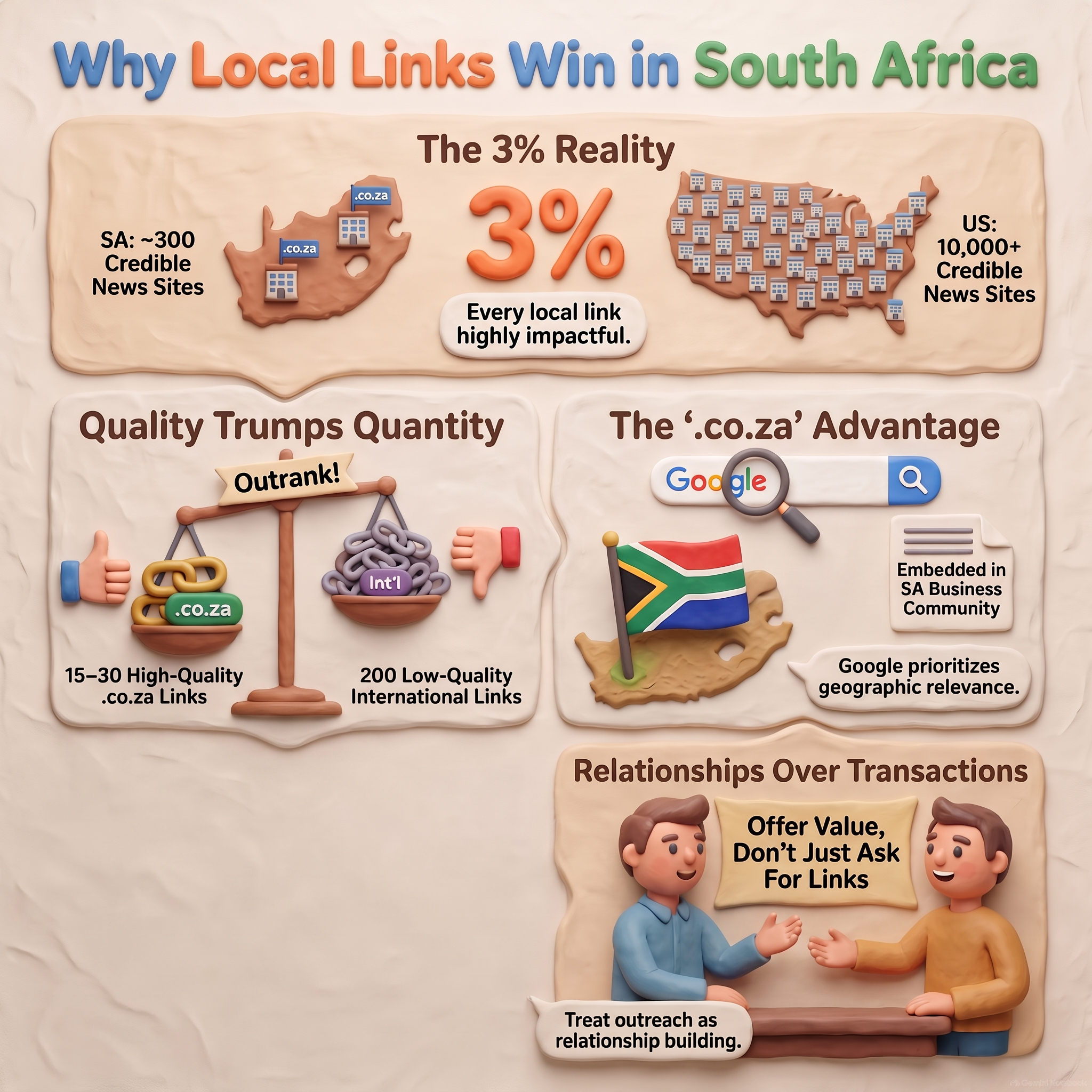
Let’s get specific. According to research from World Wide Worx, South Africa has roughly 200 to 300 credible online news and industry publications with meaningful domain authority — compared to over 10,000 in the United States. That’s not a typo. The pool of link-worthy publishers is about 3% the size.
What this means in practice: every quality link from a South African source carries disproportionate weight in local search rankings. Google’s algorithm understands geographic relevance. When you’re targeting “accounting software Johannesburg” or “logistics companies Cape Town”, a link from a South African business publication, a .co.za university, or a local industry body tells Google something that a link from a generic international directory simply cannot: that you’re embedded in the local business ecosystem.
The scarcity creates value. But it also creates a challenge.
Why International Link Building Advice Doesn’t Translate Here
Most link building guides you’ll find online are written for the US or UK markets. They’ll tell you to guest post on industry blogs, pitch journalists at trade magazines, or get listed in niche directories. All solid advice — if those resources exist in abundance in your market.
In South Africa, they often don’t. Or they exist in far smaller numbers, already saturated with requests, and operating with lean editorial teams that can’t process the volume of pitches they’d receive in larger markets.
Here’s what’s different:
The relationship layer matters more. In a smaller ecosystem, reputation travels fast. Journalists, editors, and industry influencers often know each other. A clumsy outreach email doesn’t just get ignored — it can close doors across multiple publications. The approach needs to be warmer, more personal, and grounded in genuine value exchange rather than transactional link requests.
Industry media is consolidated. Many South African industries are served by just one or two credible publications. Engineering news, mining publications, healthcare trade media — there might be a single dominant player. You can’t spray and pray. You need to earn your way into those specific publications with content that’s genuinely newsworthy or useful to their readership.
The DA ceiling is lower. A Domain Authority (DA) of 50 to 60 is considered strong for a South African publication. Internationally, that’s mid-tier. But in the SA context, a handful of links from DA 50+ .co.za domains can outperform dozens of links from international DA 70+ sites when you’re competing for local search terms. Google weighs local relevance heavily.

What Actually Works: Link Acquisition Strategies for the SA Market
If the playbook is different, what should you be doing instead?
1. Invest in Digital PR, Not Just “Link Building”
The most effective link builders in South Africa don’t treat it as a technical SEO task. They treat it as public relations. They create newsworthy angles, contribute expert commentary, and build relationships with journalists who cover their industries.
Example: A Durban-based logistics company we worked with secured links from Transport World Africa and Engineering News not by asking for links, but by offering data-driven insights on how load shedding was affecting supply chains. The journalists needed the story. The links were a byproduct of genuine value.
This approach works because South African business journalists are actively looking for local expertise and data. They’re tired of rehashing international press releases. If you can provide genuinely useful local insight, you become a source — not a supplicant.
2. Leverage Industry Associations and Academic Institutions
South Africa has a strong network of industry bodies, professional associations, and universities with high-authority .co.za domains. A link from the South African Institute of Chartered Accountants, a university research department, or an industry trade association carries serious weight.
These links are earned through participation: sponsoring research, contributing to industry reports, speaking at conferences, or offering scholarships. They’re harder to get than a guest post — but they’re also harder for your competitors to replicate, and they signal genuine industry standing.
3. Local Business Directories That Actually Matter
Not all directories are created equal, and most are worthless. But in South Africa, there are a handful of business directories and industry-specific listings that still carry authority and drive referral traffic.
The key is selectivity. A link from Hotfrog or a generic international directory does nothing. A listing in a curated, industry-specific directory maintained by a trade association or a well-established local platform like Property24 (for real estate) or AutoTrader (for automotive) can move needles.
4. Collaborate, Don’t Compete
In a small ecosystem, collaboration works better than competition. Co-marketing partnerships with complementary (not competing) businesses, joint webinars with industry bodies, or collaborative research reports create natural link opportunities from partners’ websites.
Because the business community is smaller and more interconnected, these relationships are easier to initiate in SA than they would be internationally — if you approach them with genuine intent rather than a transactional “swap links?” email.
The Economics: What Link Building Costs in South Africa
Let’s talk money, because this matters.
According to industry benchmarks published by SEMrush in 2024, the global average cost per quality backlink ranges from $300 to $1,500 (roughly R5,500 to R27,000) depending on the authority of the linking domain. In South Africa, ethical link building services typically charge between R5,000 and R20,000 per month for ongoing campaigns — but what you’re buying isn’t “X links per month.”
You’re buying strategy, relationships, content creation, and outreach that earns links as a byproduct. Any agency promising you “10 links for R3,000” is either buying low-quality links (which can get you penalised) or lying.
Quality link building in SA is labour-intensive because it’s relationship-driven. But the return on investment is measurable: businesses that invest in proper link acquisition typically see 12:1 ROI through improved rankings, increased organic traffic, and reduced reliance on paid ads.

The Risks: What to Avoid
Because the ecosystem is small and Google is increasingly sophisticated, the penalties for shortcuts are severe.
Buying links from link farms. Still happens. Still gets sites penalised. South Africa’s link marketplace includes plenty of operators offering “100 backlinks for R2,000.” These links come from spammy blog networks, scraped content sites, or overseas domains with zero relevance. Google’s algorithm spots them, and the penalty can drop your rankings by 50 positions overnight.
Over-optimising anchor text. If every link pointing to your site uses the exact match keyword “link building South Africa“, Google smells manipulation. Natural links use branded anchors, naked URLs, and varied phrases. This is especially visible in smaller link profiles, which most SA businesses have.
Ignoring mobile and page speed. This isn’t strictly about links, but it’s worth mentioning: South African internet infrastructure means that even with great backlinks, a slow-loading site will underperform. According to Google research, 53% of mobile users abandon sites that take longer than 3 seconds to load. Given SA’s network conditions and the fact that over 60% of local search traffic comes from mobile devices, page speed isn’t optional — it’s the foundation that makes your link building efforts pay off.
Why This Matters Now
The South African SEO landscape is maturing. Five years ago, you could rank a Johannesburg-based business with basic on-page optimisation and a Google My Business listing. Today, local competition has intensified. More businesses understand SEO. More are investing in content. And Google’s algorithm is increasingly favouring sites with strong, locally relevant backlink profiles.
The businesses that win in this environment are the ones that treat link building not as a technical checkbox, but as a strategic investment in their digital authority and local market positioning.
Because in a small ecosystem, authority is scarcer. And scarcity, when earned properly, creates compounding advantages that are very, very hard for competitors to catch up with.
Frequently Asked Questions
Q: How many backlinks does a South African business need to rank well locally?
A: Quality matters far more than quantity in SA’s link ecosystem. A well-optimised site with 15 to 30 high-quality, locally relevant backlinks from DA 40+ .co.za domains will typically outrank a site with 200 low-quality international links. Focus on earning links from credible South African sources rather than chasing numbers.
Q: Can I build links myself, or do I need an agency?
A: You can absolutely build links yourself if you have the time, relationships, and content creation capacity. Successful DIY link building requires consistent outreach, genuinely valuable content, and a network within your industry. Agencies bring established media relationships, scaled outreach processes, and experience navigating South Africa’s specific digital publishing landscape — which accelerates results for businesses without internal capacity.
Q: How long does it take to see results from link building in South Africa?
A: Most businesses start seeing measurable ranking improvements within 8 to 12 weeks of securing their first quality backlinks, though this varies based on competition level and existing site authority. Link building is cumulative — the benefits compound over time as your backlink profile strengthens, making it one of the few digital marketing investments that gets more valuable the longer you maintain it.
Q: Are international backlinks worthless for SA businesses?
A: Not worthless, but less valuable for local search terms. If you’re targeting “plumbing services Pretoria”, a link from a New York business blog carries minimal weight. But if you’re an exporter targeting international markets or competing for industry terms with global search intent, international links from relevant, authoritative sources can absolutely help. The key is alignment between your target market and your link sources.
If you’re ready to build a backlink profile that actually moves your rankings in South Africa’s tight digital ecosystem, let’s talk. Thickrope Marketing specialises in relationship-driven link acquisition that earns authority in the markets that matter to your business. [Book a free consultation](https://thickropemarketing.co.za/contact/) and we’ll show you exactly where your link opportunities are.