

Accountant Marketing in South Africa: Why Most Firms Are Still Relying on Referrals — and What Happens When That Pipeline Slows
There’s a moment every accounting firm owner recognises. You’re sitting at your desk, reviewing the year’s new client acquisitions, and you realise something uncomfortable: every single one came through a referral or existing relationship. Not one walked in from your website. Not one found you on Google.
For decades, that’s been perfectly fine. Accounting has always been a relationship business in South Africa. You do good work, your clients tell their mates, and the phone rings. It’s organic, it’s trust-based, and it doesn’t cost you a cent in ad spend. Why would you mess with what works?
The problem isn’t that referral marketing is bad. The problem is when it’s the only engine keeping your practice growing — and that engine starts to idle.
The Referral Pipeline: Brilliant Until It Isn’t
Let’s be clear: referrals are gold. A warm introduction carries more trust than any Google Ad ever will. According to Nielsen, 92% of consumers trust recommendations from people they know more than any other form of advertising. In professional services like accounting, that trust factor is even higher.
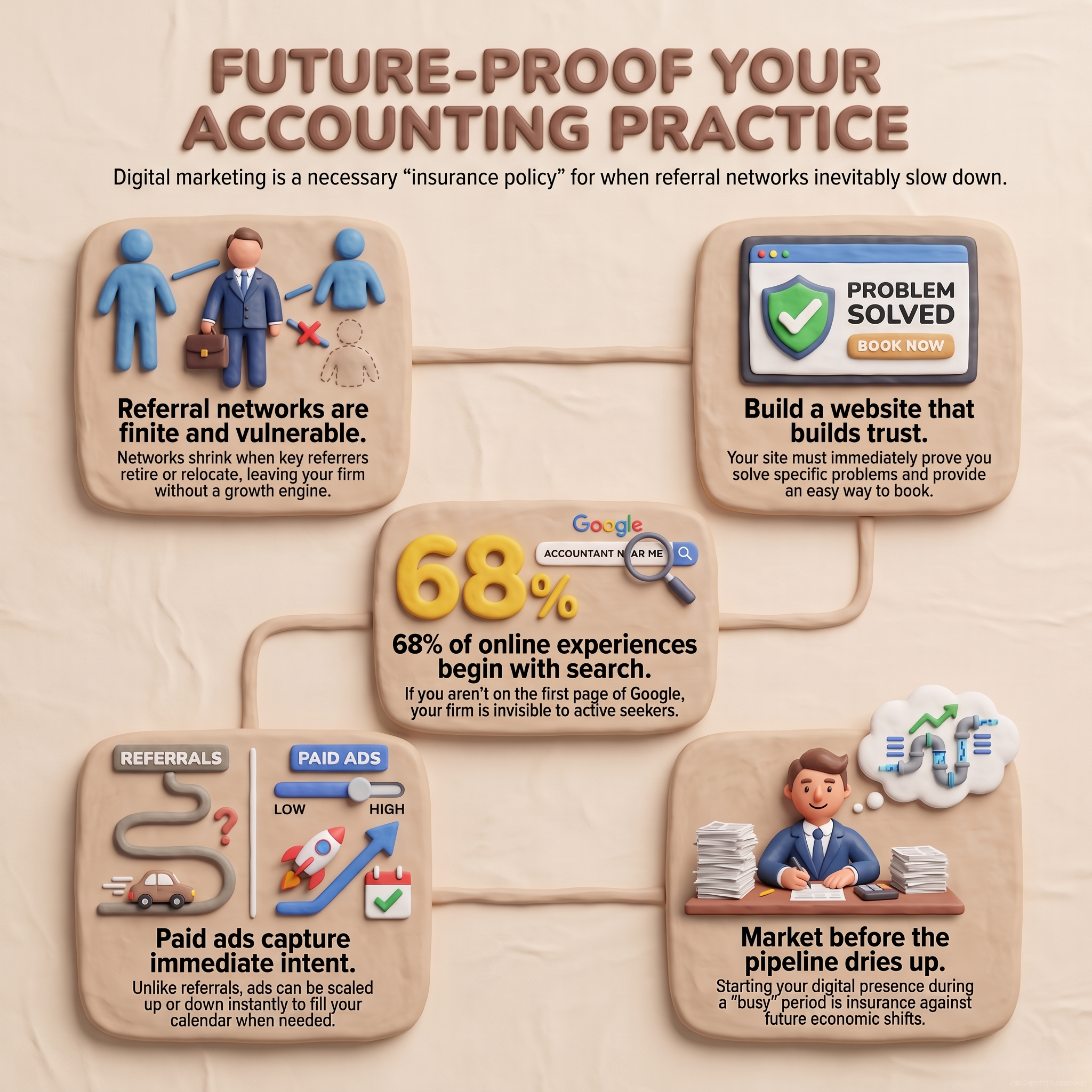
But here’s the uncomfortable truth most SA accounting firms don’t talk about: referral networks are finite, and they’re vulnerable.
Your best referrer retires. A key client relocates to Perth. The attorney who used to send you three clients a year joins a firm with an in-house bookkeeper. Your network doesn’t grow as fast as your ambitions do. And suddenly, without anyone doing anything wrong, the pipeline gets thinner.
When that happens, you’ve got two choices: wait it out and hope things pick up, or realise that you’ve been running a business without a marketing function — and that’s a risk you can’t afford anymore.
What Accountant Marketing Actually Looks Like (And Why Most Firms Get It Wrong)
Here’s where most accounting firms stumble when they finally decide to “do some marketing”: they treat it like a side project. Someone’s nephew builds a website. The firm creates a LinkedIn page and posts once every quarter. Maybe there’s a half-hearted attempt at a newsletter that dies after three editions.
None of that is accountant marketing. That’s digital procrastination with a business card.
Proper accountant marketing in South Africa means building a system that consistently puts your firm in front of people who are actively looking for accounting services — and then making it dead easy for them to choose you.
That system has three parts:
1. A Website That Answers the Question: “Why Should I Trust You?”
Your website isn’t a brochure. It’s the first conversation you’re having with a potential client who’s Googling “tax accountant near me” at 22:00 because SARS just sent them a scary letter.
That person needs to know three things immediately:
- Do you solve my specific problem? (Personal tax, small business accounting, BEE compliance, whatever it is)
- Are you credible? (Qualifications, years in practice, who you’ve helped)
- Can I reach you easily? (Phone number, contact form, ideally a booking link)
Most accounting firm websites bury this information under corporate jargon and stock photos of people shaking hands. Don’t be most firms.
2. SEO That Actually Gets You Found When It Matters
Here’s a stat worth remembering: according to BrightEdge, 68% of online experiences begin with a search engine. In South Africa, where load shedding has made mobile-first behaviour the norm, that search is happening on a phone, probably with patchy connectivity, and the person doing it has zero patience.
If your accounting firm doesn’t show up on the first page of Google when someone in your area searches for “small business accountant Johannesburg” or “tax consultant Cape Town,” you’re invisible. Not on page two. Invisible.
SEO for accountants isn’t complicated, but it is specific. It means:
- Targeting the exact search terms your ideal clients use (not “financial services,” but “help with SARS audit”)
- Creating content that answers real questions (e.g., “How much does a small business accountant cost in South Africa?”)
- Building local citations and Google Business Profile optimisation so you show up in map searches
- Making sure your site loads fast even when Eskom’s having a moment
3. Paid Advertising That Captures Intent When Referrals Go Quiet
Google Ads for accounting firms works because it captures people at the exact moment they need help. Someone searches “urgent tax return help,” your ad appears, they click, they book a consultation. It’s not brand-building. It’s pipeline-building.
And unlike referrals, you can turn it on when you need it. New financial year approaching and you want to fill your calendar? Turn up the ad spend. December’s quiet and you’re fine? Scale it back.
The key is targeting intent, not just demographics. You’re not trying to reach “business owners aged 35–55.” You’re trying to reach “business owners who just realised their books are a disaster and need help before tax season.”
According to WordStream, businesses make an average of R2 for every R1 they spend on Google Ads. For accounting firms with high lifetime client values, the return is often much higher — if the campaign is set up properly.

The Insurance Policy You Don’t Think You Need (Until You Do)
Here’s the contrarian bit: you might not need accountant marketing right now. If your referral pipeline is strong and your calendar is full, investing heavily in digital marketing might feel like solving a problem you don’t have.
But here’s what happens when you build your digital presence before you need it:
When your largest referral source dries up, you don’t panic. When the economy tightens and word-of-mouth slows, your enquiry rate stays steady. When a younger, more digitally savvy competitor opens down the road, you’re already ranking above them on Google.
Digital marketing isn’t a replacement for referrals. It’s the insurance policy that keeps your practice growing when referrals inevitably fluctuate.
And in South Africa’s current economic climate — where businesses are tightening belts, switching suppliers more readily, and doing far more research online before committing — having that insurance policy isn’t optional anymore. It’s business hygiene.
What This Looks Like in Practice: A Real SA Scenario
Let’s say you’re a small accounting firm in Pretoria. You’ve got 40 active clients, mostly SMEs and a few individuals. Your revenue is steady but hasn’t grown in two years. Most of your new business comes from one financial adviser who refers overflow work.
That financial adviser retires. Suddenly, your new client pipeline drops by 60%.
If you’ve got no digital marketing in place, you’re now scrambling. Calling old contacts, asking existing clients for introductions, maybe even considering cold outreach (which feels awful and rarely works for professional services).
If you do have digital marketing in place, here’s what happens instead:
Your website ranks on page one for “small business accountant Pretoria.” You’re getting 8–12 enquiries a month from search. Your Google Ads campaign targets “help with SARS submission” and “annual financial statements,” and it’s bringing in another 5–6 qualified leads. Your content marketing (blog posts, FAQs) positions you as the expert people find when they’re researching accounting help.
The referral pipeline slows, but your overall enquiry rate barely dips. You’re not in crisis mode. You’re just reallocating some capacity.
That’s the difference.

The Cost Question (Because You’re Definitely Thinking It)
Let’s talk numbers, because this is South Africa and we’re practical people.
Building a proper digital marketing system for an accounting firm typically involves:
- Website development/refresh: R15,000–R45,000 once-off, depending on complexity
- SEO (ongoing): R5,000–R15,000/month for local search optimisation, content creation, and technical work
- Google Ads (if you’re running them): R3,000–R10,000/month in ad spend, plus management fees
Is that cheap? No. But compare it to the lifetime value of even one or two new clients. If your average client stays with you for five years and generates R30,000 in annual revenue, acquiring that client for R5,000 in marketing spend is a bargain.
The firms that struggle with digital marketing are the ones who try to do it on the cheap — a nephew’s website, a R500/month “SEO package” from an overseas freelancer, no tracking, no strategy. That’s not marketing. That’s wasting money slowly.
The Moment to Start Isn’t When the Pipeline Dries Up
If there’s one thing to take away from this, it’s timing.
The best time to build your accountant marketing system is when you don’t desperately need it. When your referral pipeline is still flowing, you have the luxury of building something properly — testing what works, refining your messaging, getting your rankings up before you’re under pressure.
Waiting until the referral pipeline slows is like buying insurance after the house floods. You’ll get there eventually, but it’s more expensive, more stressful, and you’ll lose opportunities in the meantime.
Frequently Asked Questions
Q: Won’t digital marketing make my firm look too “salesy” or desperate?
A: Only if you do it badly. Good accountant marketing positions you as the obvious choice when someone needs help — it’s educational, trust-building, and helpful. Think of it as making yourself easier to find, not chasing people down the street with a business card.
Q: How long does it take before I start seeing enquiries from digital marketing?
A: Google Ads can generate enquiries within days if set up properly. SEO is slower — expect 3–6 months before you’re ranking consistently for competitive local terms. That’s why starting before you’re desperate matters.
Q: My clients are older business owners who don’t use the internet much. Does digital marketing even apply to me?
A: Their kids do. Their employees do. And increasingly, even older business owners are Googling “accountant near me” when they need help, especially after COVID normalised digital research. The shift is real, even in traditional sectors.
Q: Can’t I just boost my referrals by asking clients more often?
A: Absolutely, and you should. But there’s a ceiling to how much your existing network can grow, and you’re still vulnerable to concentration risk. Digital marketing doesn’t replace referrals — it diversifies your lead sources so you’re not dependent on any single channel.
If your accounting firm has been riding the referral wave for years and you’re starting to feel like it’s time to build something more predictable, let’s talk. Thickrope specialises in accountant marketing that complements your existing relationships with a steady stream of digital enquiries — no fluff, just practical SEO and PPC that works for SA firms. [Book a free strategy session](https://thickrope.co.za/contact) and let’s figure out what your firm actually needs.