
What a Vereeniging Business Discovered After Years of Online Marketing That Looked Busy But Delivered Nothing
I’m not going to name the business — partly because they’re still trading and doing well now, and partly because this story could be about half the companies in Vereeniging. Or Vanderbijlpark. Or any industrial town in Gauteng where practical people build real things and don’t have time for marketing nonsense.
Let’s call the owner Johan. He runs a manufacturing business just off Barrage Road. Been in operation since the early 2000s. Makes components for mining and agricultural equipment. Good margins when the orders come in. Proper Vaal Triangle grit.
For five years — five years — Johan paid for what he thought was online marketing.
There were Facebook posts. Regular ones. Some with stock photos of handshakes and gears. Some with motivational quotes about quality and commitment. A few product photos, usually taken on someone’s phone in the workshop.
There were occasional Google Ads. Launched during quiet months when panic set in. Paused when cash was tight. No one really knew if they worked, but the agency said “clicks are up,” so that sounded good.
There were a few boosted posts on Facebook, targeting “people interested in business” within 50 km of Vereeniging. Cost about R300 each time. Generated some likes from profiles with names like “Blessing Mokoena” and “Sarah-Jane van Rensburg,” none of whom ever enquired.
And there was a website. Built in 2016, never updated, still showing the old logo, with a contact form that may or may not have been sending emails to an inbox no one checked.
It looked like online marketing. It felt like online marketing. The invoice every month said “Digital Marketing Services — R4,500.”
Over five years, that’s R270,000.
And Johan could not name a single customer who’d come from it.
Not one.
What the Audit Actually Found
When Johan finally asked someone to do a proper audit — not the agency charging him R4,500, but an outside set of eyes — the picture got clearer and a lot more painful.
The Google Ads account had no conversion tracking. None. It had been running on and off for years, spending money on clicks, but no one had ever set up a way to see if those clicks turned into phone calls, form submissions, or sales. According to WordStream, 63% of small business Google Ads accounts have tracking errors or no tracking at all — Johan’s was in the majority, but that didn’t make the wasted spend any easier to swallow.
The Facebook page had 340 followers. After five years of regular posting. Engagement was almost entirely from the business owner’s family and the person running the page. Reach per post averaged 11 people. Eleven. In a town of over 70,000.
The website had 22 visitors in the previous month. Eight of those were Johan himself, checking if it was still online. The contact form had been broken for 18 months — it submitted, showed a thank-you message, but never actually sent the email anywhere. Three people had tried to use it. Three potential customers, gone.
There was no search engine optimisation. The website had a homepage title that read “Welcome to Our Website.” The meta description was blank. Google had indexed four pages. When you searched “mining equipment components Vereeniging” — the exact thing Johan sold — his site was nowhere. A competitor in Sasolburg, who’d done even basic SEO, appeared third.
No one had ever looked at where the traffic came from, what people searched for, or whether mobile users could actually navigate the site. Given that over 60% of South African internet users access the web primarily via mobile, and the site took 14 seconds to load on a 3G connection, this was a problem with a rand value attached.
The activity had been real. The posts went up. The ads ran. The invoice was paid.
But none of it was connected to a strategy. None of it was measured against business outcomes. And none of it was designed to turn a stranger in Vereeniging searching for mining components into a phone call, an email, or a sale.
It was motion without direction. Marketing theatre.

What Changed When the Strategy Actually Arrived
Johan did what a lot of business owners do when they realise they’ve been paying for air: he got angry, he swore a bit, he seriously considered giving up on online marketing altogether and just relying on word-of-mouth like the old days.
Then he did the maths. His average customer was worth around R45,000 over a year. He needed four new customers a year to grow. Just four.
If online marketing — proper online marketing for Vereeniging and the surrounding industrial corridor — could deliver that, it was worth ten times what he’d been spending.
So he started over. But this time, with a strategy.
First: conversion tracking went in. Every form submission, every phone call from a Google Ads click, every email from the website — tracked. Not perfectly, because SA business is messy and some customers still pitch up at the gate without warning, but well enough to see what was working.
Second: the Google Ads account got rebuilt from scratch. Tightly targeted keywords. “Mining component suppliers Vereeniging.” “Shaft collars Gauteng.” “Custom machining Vaal Triangle.” Local service ads for the workshop. Budget went down to R2,800 a month, but it was now aimed at people actually searching for what Johan sold, in the area he served.
Third: the website got unfancy but functional. New title tags that mentioned Vereeniging, mining, components, and machining. Mobile-friendly design. Fast load time, even during load shedding when people were tethering off their phones. A contact form that actually worked, tested by three different people before going live. Clear calls to action: “Request a quote,” “Call us now,” “Download our capability statement.”
Fourth: Facebook stopped being a daily chore. Instead of random posts about gears and sunrise motivation, the focus shifted to two things: remarketing ads to people who’d visited the website but hadn’t enquired, and posts that actually showcased completed projects, client problems solved, and the workshop in action. Engagement dropped. Followers barely grew. But enquiries started coming in — small ones at first, then a R80,000 contract from a farm in Parys that had seen a Facebook ad after Googling “custom pulleys.”
Fifth: monthly reporting that meant something. Not “impressions” or “reach.” Not vanity metrics. How many people searched and found the business. How many clicked. How many enquired. How many became customers. It was a short report. Three pages. But every number connected to the goal: more customers, more revenue.
Within four months, Johan had five solid enquiries. Two became customers. One was worth R60,000.
That’s one customer from online marketing in four months. After five years of nothing.
By month nine, he had another three. The ROI was undeniable, even to a man who’d rather trust a lathe than a landing page.
The Lessons Every Vereeniging Business Should Steal
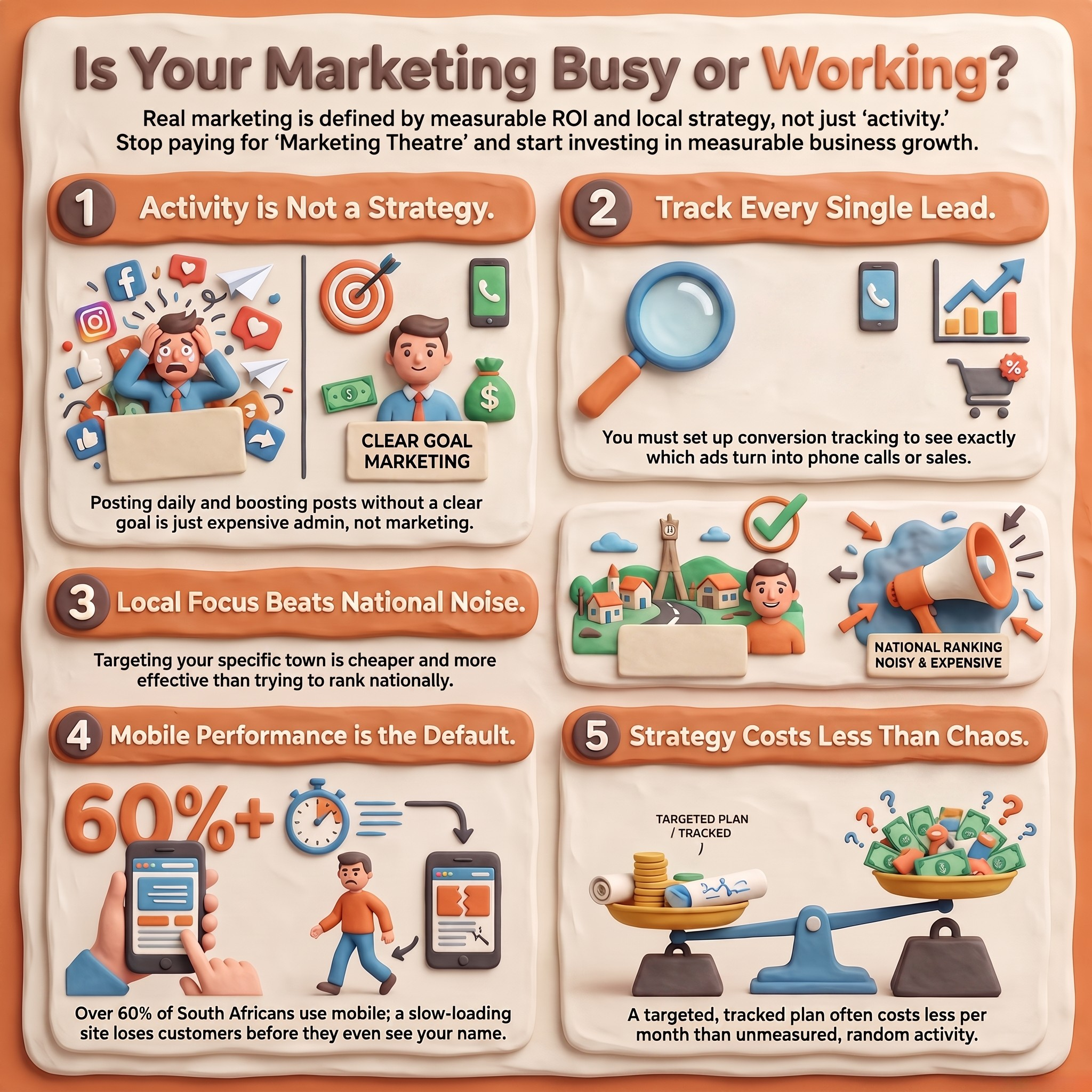
Looking busy is not the same as working. You can post every day, run ads every month, and spend money consistently — and still get nothing. Activity is not strategy. A feed full of posts that no one sees and no one acts on is not marketing. It’s expensive admin.
If you can’t track it, you can’t improve it. According to HubSpot, companies that track ROI are 1.6 times more likely to report higher revenue growth. In a South African context, where every rand counts and marketing budgets are tight, flying blind is a luxury no one can afford. Conversion tracking isn’t optional. It’s the difference between guessing and knowing.
Local SEO beats national noise every time. Johan’s competitors were trying to rank nationally. He focused on Vereeniging, Vanderbijlpark, Meyerton, and Sasolburg. Tighter geography, clearer intent, lower competition. For a business that serves a 50 km radius, national SEO is a waste. Local SEO is the point.
Mobile performance is not a nice-to-have. It’s the default. If your site is slow, clunky, or impossible to navigate on a phone, you’re losing customers before they even know who you are. South Africans search on mobile, enquire on mobile, and make decisions on mobile — often on expensive data. Respect that.
Strategy costs less than chaos. Johan’s original marketing budget was R4,500 a month for unfocused noise. His new budget was R3,200 a month for targeted, tracked, and measurable online marketing in Vereeniging. He spent less and earned more. That’s not magic. That’s what happens when someone actually thinks before they click “boost post.”

Frequently Asked Questions
Q: How long does it take for online marketing to actually work in a place like Vereeniging?
A: If it’s set up properly — tracking in place, local SEO sorted, ads targeting the right search terms — you should see enquiries within the first 60 days. Sales depend on your cycle, but if you’re not seeing measurable activity (clicks, calls, form fills) within two months, something’s wrong with the strategy, not the timeline.
Q: Can a Vereeniging business compete online with bigger agencies in Joburg or Pretoria?
A: Absolutely, and often more effectively. Bigger agencies target broader areas and vaguer terms. A Vereeniging business that optimises locally, uses geo-targeted ads, and speaks directly to Vaal Triangle industries has a major advantage: relevance. Local beats big when the strategy is sharp.
Q: What’s a realistic monthly budget for online marketing that actually delivers results?
A: For a small to mid-sized Vereeniging business, R3,000–R6,000 a month can deliver real results if it’s spent strategically: proper Google Ads with conversion tracking, local SEO, and a functional website. It’s not the size of the budget — it’s whether every rand is aimed at a measurable outcome.
Q: How do I know if my current marketing is just “looking busy” like Johan’s was?
A: Ask yourself one question: can you name a customer who came directly from your online marketing in the last three months? If the answer is no, or “I think maybe someone,” you’re paying for activity, not results. Request a proper audit, check your conversion tracking, and see if anyone’s actually measuring what matters.
If you’re running a business in Vereeniging and your online marketing feels like it’s ticking boxes but not ringing the till, it might be time for a proper look under the bonnet. Thickrope Marketing offers free strategy audits for Vaal Triangle businesses — no fluff, just a clear breakdown of what’s working, what’s wasting money, and what a real plan would look like.