

How to Choose a PPC Service in Cape Town That Actually Understands Your Two Audiences
If you’re running a business in Cape Town that relies on both local customers and international visitors—think hospitality, tours, wine estates, adventure activities, or even retail in the Waterfront—you’ve got a PPC challenge that Joburg and Durban don’t quite share.
Your highest-value customers might be searching from Berlin three months before they arrive. Your bread-and-butter regulars are searching on their phones during load shedding from Bellville. These two groups behave nothing alike online, yet most PPC services lump them together and wonder why the campaigns underperform.
According to Wesgro, international tourism contributed approximately R17 billion to the Western Cape economy in 2019 (pre-pandemic baseline), and by 2023, arrivals had recovered to near those levels. That’s not small change. But here’s the thing: if your PPC service in Cape Town doesn’t explicitly account for the difference between a German tourist planning a December holiday and a Capetonian looking for a last-minute weekend booking, you’re optimising for the wrong signals—and burning budget on the wrong clicks.
This guide will help you evaluate whether a PPC provider actually understands the Cape Town market, or whether they’re just running generic campaigns with a 021 area code.
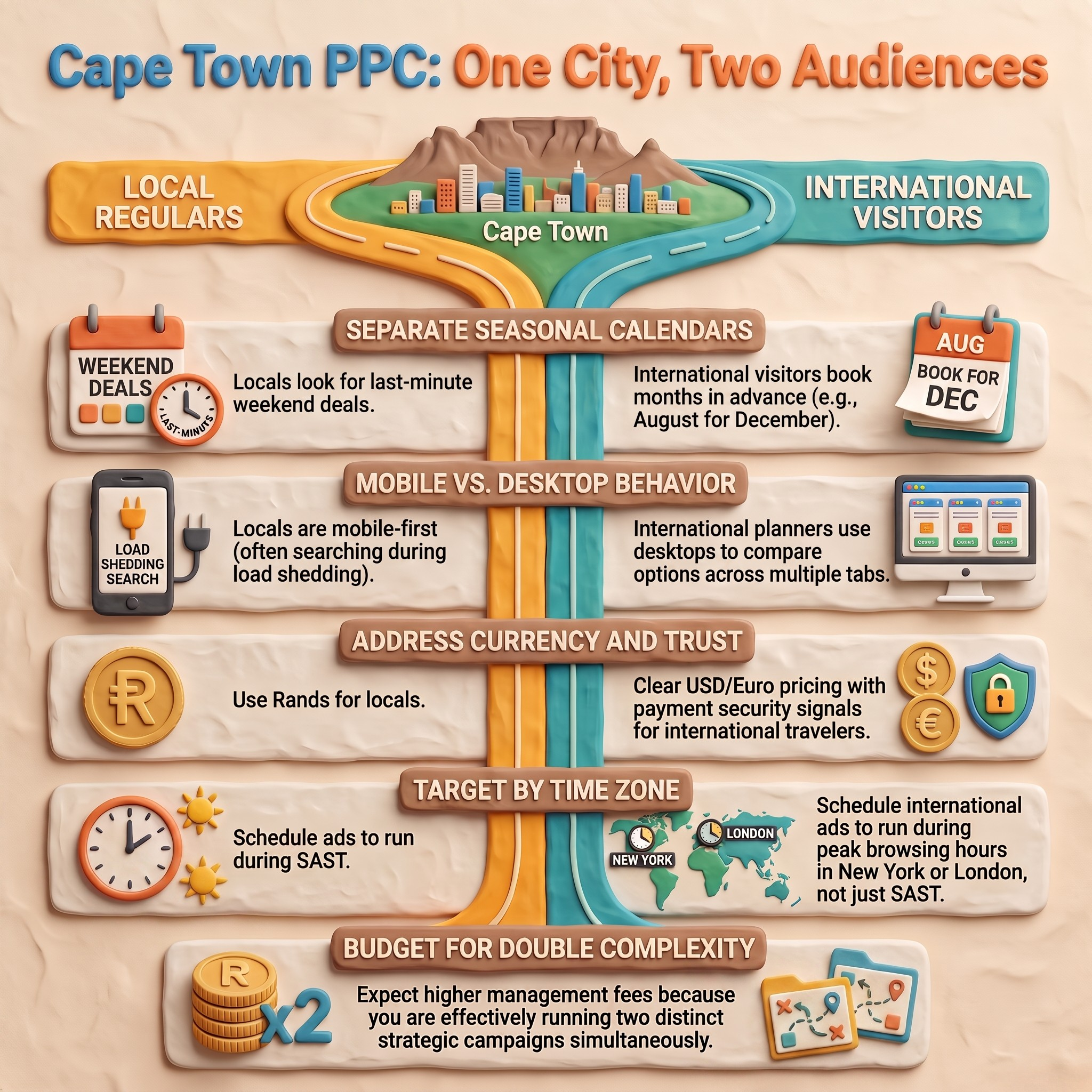
What Cape Town Market Understanding Actually Looks Like
Let’s start with what you should hear in a pitch or discovery call. If a PPC service truly gets the Cape Town context, they’ll ask you questions about audience splits before they talk about bid strategies.
They’ll Ask About Seasonality—Twice
Cape Town has two seasonal calendars running simultaneously. There’s the local calendar (school holidays, December shutdown, Easter weekend), and there’s the international visitor calendar (European summer holidays, American Thanksgiving travel, Australian winter escape).
A decent PPC provider will ask you which months matter most for local versus international revenue. A great one will already know that your December accommodation bookings from Europe start spiking in August, while your local wedding season searches peak in September for February events.
If they’re not separating campaigns by audience type and adjusting budgets seasonally for each, they’re leaving money on the table.
They’ll Talk About Device Behaviour Differently for Each Audience
South Africa is a mobile-first market—Google reports that over 60% of searches in South Africa happen on mobile devices. But international visitors planning a Cape Town trip three months out? They’re on desktops and tablets, often during work hours in their home time zones, comparing options across multiple tabs.
Your local customers are searching “restaurants near me V&A Waterfront” on a smartphone at 18:00 on a Friday. Your international visitor is searching “best Cape Town restaurants with ocean view” on a laptop at 14:00 GMT on a Tuesday.
If your PPC service isn’t segmenting campaigns by device and adjusting bids accordingly—mobiles for locals, desktops for planners—you’re either overpaying for the wrong clicks or missing high-intent traffic entirely.
They’ll Understand Currency Display and Conversion Anxiety
Here’s one that catches people out: international visitors searching for Cape Town services are hypersensitive to currency confusion. If your ads and landing pages don’t make it immediately clear whether pricing is in rands or dollars, bounce rates spike.
A Cape Town PPC service worth their salt will test ad copy that includes “from R950” versus “from $50 USD” and track which converts better for different geo-targeted audiences. They’ll also know that while international visitors love our weak rand, they need reassurance about payment security and transparent final pricing.
Locals, meanwhile, are price-sensitive in a different way—they’re comparing your offer against other local options and making faster decisions. Your ad copy and landing pages need to speak to both, often in separate campaigns.

Red Flags: What to Avoid When Choosing a PPC Provider
Not every agency pitching PPC services in Cape Town has actually thought through the dual-market reality. Here are the warning signs.
They Show You Vanity Metrics Without Audience Context
If a provider leads with “we generated 10,000 clicks last month” without breaking down who those clicks were, where they came from, and what they did next, walk away.
You don’t need clicks. You need bookings from high-value international visitors and repeat purchases from locals. Those are different conversion paths, different customer lifetime values, and different metrics.
Ask them: “What percentage of our PPC budget would you allocate to international versus local audiences, and why?” If they can’t answer that specifically for your business, they’re guessing.
They Don’t Mention Geo-Targeting or Time-of-Day Adjustments
Cape Town businesses serving international audiences need campaigns that run when those audiences are searching—which might be 02:00 SAST when it’s prime evening browsing time in New York.
If your PPC provider isn’t talking about dayparting (adjusting bids based on time of day) and geo-specific campaign structures, they’re treating Cape Town like it’s landlocked.
They Ignore the Load Shedding Effect on Local Behaviour
This one’s subtle but important. During periods of heavy load shedding, local search behaviour shifts—mobile usage spikes (because Wi-Fi routers are off), search times compress into “power windows,” and last-minute queries increase because people can’t plan as far ahead.
Your PPC service should be monitoring this and adjusting local campaign budgets and schedules accordingly. If they look confused when you mention load shedding’s impact on digital behaviour, they’re not close enough to the local market.
The Questions You Should Ask Before Signing Anything
Here’s your evaluation framework. Ask these questions in your discovery call or pitch meeting, and listen for specific, Cape Town-relevant answers.
“How would you split our PPC budget between local and international audiences?”
They should ask you about your revenue mix first, then propose a budget split that reflects both revenue and strategic goals. If they say “we’d start 50/50 and optimise from there” without asking about your business model, they’re not thinking it through.
“Show me an example of geo-targeted ad copy for a Cape Town business like ours.”
They should be able to show you different ad variations: one targeting “Cape Town + [service]” for locals, another targeting “Cape Town + [service]” for international visitors, with different messaging angles. The local ad might emphasise convenience, last-minute availability, or specials. The international ad might emphasise experience, exclusivity, or bucket-list appeal.
“How do you handle currency and pricing in campaigns targeting international visitors?”
The answer should involve landing page testing, currency display options, and possibly separate landing pages for different markets. If they shrug and say “we just link to your homepage,” you’ll be wasting budget on confused clicks.
“What does success look like in the first 60 days?”
For Cape Town businesses with dual audiences, early success isn’t just about conversions—it’s about learning which audience segments convert best, at what cost, and through which channels. A good provider will set up tracking, run split tests, and come back to you with data about who your best PPC customers are before they scale up spending.
“How do you report on campaign performance for different audience types?”
You need separate reporting for local versus international campaign performance. Different cost-per-acquisition, different conversion rates, different lifetime values. If they’re planning to lump everything into one dashboard, you won’t know which half of your budget is working.

What Fair Pricing Looks Like in the Cape Town Market
Let’s talk money, because budget is real and you need to know what you’re signing up for.
Most PPC services in South Africa charge either a percentage of ad spend (typically 10-20%) or a flat monthly management fee (anywhere from R5,000 to R25,000+, depending on complexity and scale).
For Cape Town businesses running dual-audience campaigns, expect to pay toward the higher end of that range—not because agencies are gouging, but because you’re essentially running two strategic campaigns with different optimisation goals, ad copy, landing pages, and reporting requirements.
A realistic starting budget for a Cape Town business wanting to test both local and international PPC audiences might look like:
- Ad spend: R15,000-R30,000/month (split between audiences based on your revenue mix)
- Management fee: R8,000-R15,000/month for an experienced provider who’ll actively optimise and report separately by audience
If someone quotes you R3,000/month to manage Cape Town PPC, they’re either very junior, very automated, or very unlikely to deliver the nuanced work this market needs.
Why Thickrope Gets the Cape Town Context
We work with businesses right across South Africa, but Cape Town clients have taught us something important: one-size-fits-all PPC doesn’t work when your customers are booking from two different hemispheres.
We structure campaigns by audience first, then by product or service. We track local versus international performance separately. And we adjust in real time when load shedding hits or when European search volumes spike ahead of summer holidays.
If you’re tired of PPC reports that don’t distinguish between a R200 local booking and a R15,000 international package, let’s talk about what targeted, audience-specific PPC actually looks like. Book a free PPC audit with Thickrope and we’ll show you exactly where your budget should be going—and who should be clicking.
Frequently Asked Questions
Q: Should I run separate Google Ads accounts for local versus international audiences?
A: Not separate accounts, but definitely separate campaigns within the same account. This gives you unified reporting while allowing different budgets, ad schedules, geo-targeting, and bidding strategies for each audience. It also makes it easier to shift budget between campaigns based on seasonal demand.
Q: How long does it take to see results from Cape Town PPC campaigns targeting international visitors?
A: International visitor campaigns often have longer lead times—you might see clicks and engagement within the first month, but actual conversions (bookings, enquiries) can take 60-90 days as visitors move through their planning cycle. Local campaigns typically convert faster, often within days or weeks. This is why separate tracking and patience for international ROI is critical.
Q: Do I need different landing pages for local versus international visitors?
A: In most cases, yes. International visitors need more context (location details, transport options, what makes you special), currency clarity, and trust signals (reviews, payment security). Local visitors need faster load times, mobile optimisation, and quick-hit information (price, availability, location). The same landing page rarely serves both well.
Q: What’s the biggest mistake Cape Town businesses make with PPC?
A: Treating all traffic the same. They optimise for overall cost-per-click or overall conversion rate without realising their international visitors might have 5x the lifetime value of local customers, even if they take longer to convert. This leads to under-investing in high-value international campaigns and over-investing in low-margin local clicks.