

Why Most Cape Town Businesses Are Running PPC at Exactly the Wrong Time
If you’re running the same Google Ads budget in June that you’re running in December, you’re either brilliantly strategic or leaving a fair chunk of money on the table. In Cape Town, where tourism contributes roughly R17 billion to the provincial economy annually, seasonal rhythms aren’t just felt in the queues at the Waterfront — they fundamentally reshape what people search for, when they search, and how much you’ll pay to show up.
The businesses consistently winning with PPC marketing in Cape Town aren’t necessarily the ones with the biggest budgets. They’re the ones timing their investment to match the city’s genuine search patterns — patterns that shift dramatically between high summer, shoulder months, and the winter push for domestic visitors.
Let’s talk about what seasonally intelligent PPC actually looks like here, and why most local businesses are flying blind.
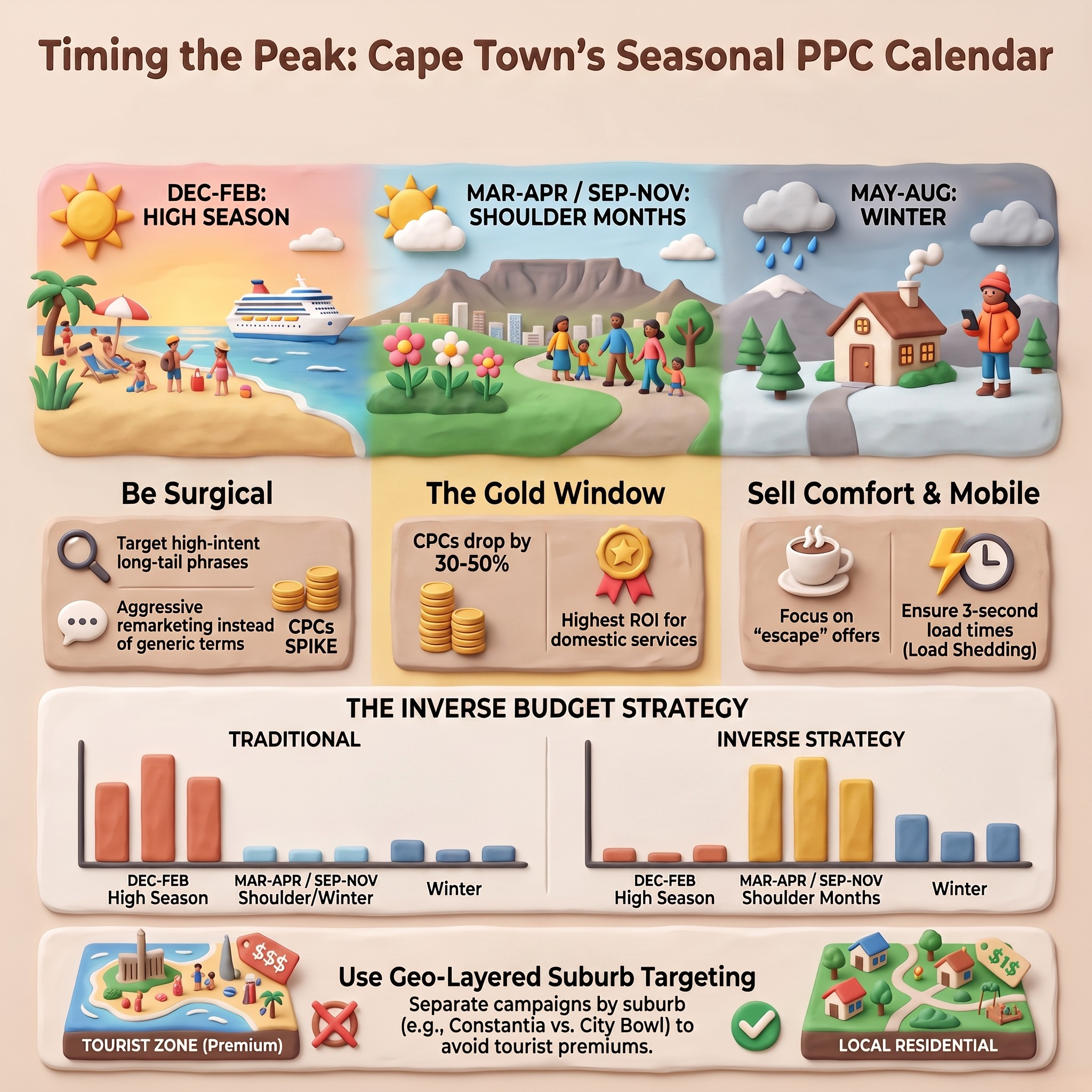
The Cape Town Search Calendar Nobody’s Using
Cape Town’s economy breathes. December through February, international tourists flood in and search volumes spike for accommodations, experiences, and “things to do” queries. March and April see the shoulder season — locals reclaim the city, and there’s a brief window where domestic searches for restaurants, services, and retail tick upward before winter hits.
Then comes May through August. Tourism doesn’t disappear, but it shifts. Domestic visitors dominate, budgets tighten, and the competition for local spend intensifies. September signals spring optimism, and November kicks off the pre-summer scramble.
Most Cape Town businesses run flat PPC campaigns that ignore all of this. Same daily budget. Same ad copy. Same targeting. And they wonder why their cost-per-click doubles in January or why nobody’s clicking in June.
Here’s the thing: Google Ads is an auction. When thousands of additional businesses (including international competitors with euro and dollar budgets) start bidding for Cape Town-related keywords in summer, your R50 daily budget gets trampled. But in the shoulder months, that same R50 can stretch beautifully — if you know what to target.

What Seasonal PPC Actually Looks Like for Different Cape Town Businesses
Hospitality and Tourism
The obvious players. If you’re running a guesthouse, restaurant, or tour operation, you’re living this seasonality already — you just might not be advertising it strategically.
High season (Dec-Feb): This is when search intent is highest, but CPCs are brutal. International searches dominate (“cape town wine tours,” “best restaurants waterfront”). Your play here isn’t necessarily to outbid everyone on generic terms. Instead, target long-tail, high-intent phrases (“family-friendly wine estate cape town,” “vegan restaurants camps bay”) and run remarketing hard to people who’ve already visited your site. Budget up, but be surgical.
Shoulder months (Mar-Apr, Sep-Nov): This is gold. Local and domestic searchers return. They’re searching differently — more “weekend getaway cape town,” “cape town restaurant specials,” “things to do this weekend.” Your CPCs drop by 30-50% compared to peak summer. Increase your budget here relative to competition, dominate the local searches, and you’ll pick up consistent bookings at a fraction of the summer cost.
Winter (May-Aug): Compete for the domestic market with aggressive offers. “Winter specials cape town,” “indoor activities rainy day,” “spa weekend cape town.” Budget down slightly, but sharpen your messaging. This is when ad copy matters most — you’re selling warmth, comfort, and escape.
Retail and E-commerce
You’d think retail is less seasonal, but Cape Town retail follows its own rhythm. December is obvious (though Black Friday in November increasingly steals thunder — South African Black Friday online spending hit R6.5 billion in 2023, and Cape Town contributes a healthy chunk).
January-February: Tourists are here, but they’re searching for experiences, not your homeware store. Unless you’re in souvenirs, beachwear, or sunscreen, pull your budget back. Exception: if you’re in Camps Bay, Sea Point, or the City Bowl and can target “near me” searches from tourists’ mobile devices. Which brings us to an important point: 68% of South African searches now happen on mobile devices, and in tourist-heavy areas, that percentage skews even higher in summer.
March-April: Capetonians are back. They’re nesting after the tourist chaos, sorting out their homes, buying for autumn, planning for winter. Ramp up PPC for homeware, clothing, services. Target local suburbs specifically — “furniture southern suburbs,” “plumber cape town northern suburbs.”
May-August: Hunker down or pivot. Winter searches shift to comfort goods, entertainment, and home improvement (because nobody wants to leave the house when it’s 12°C and raining sideways). If your product fits this mood, lean in. If not, reduce budget and save for spring.
Professional Services (Legal, Accounting, Consulting)
The least obvious seasonal players, but the pattern exists. Cape Town professionals follow the South African business calendar, which means:
January-February: Everyone’s just back from holiday. Decision-making is slow. PPC can work, but expect longer sales cycles.
March-May: Tax season (February-July, but urgency peaks around March-April). If you’re an accountant or tax consultant, this is your Super Bowl. Searches for “tax return help cape town,” “business accountant,” and “tax consultant near me” spike. Budget aggressively here. According to SARS, the Western Cape consistently has one of the highest rates of individual tax submissions in the country — people are searching for help.
June-August: Budget season for many businesses. B2B searches increase for consulting, legal structuring, HR services. Less competitive than summer tourism keywords, but high commercial intent.
September-November: Year-end planning. Businesses search for accountants, legal review, and strategic support before the December shutdown.
The Load Shedding Variable Nobody Talks About
Here’s a Cape Town-specific reality that affects PPC timing: load shedding impacts when people search and from where.
When Stage 4+ hits (and let’s be honest, we’re all just one Eskom press release away from that), mobile searches spike as Wi-Fi routers go dark and people default to their phones. Desktop searches drop. Conversion rates from mobile can suffer if your site isn’t genuinely mobile-optimised — not just responsive, but fast-loading and easy to navigate on a small screen with one thumb.
Seasonally, load shedding tends to worsen in winter (higher demand, maintenance backlogs). If you’re running PPC campaigns in June and July, ensure your landing pages are brutally optimised for mobile. Test them on a 3G connection during load shedding. If they don’t load in under 3 seconds, you’re burning budget on clicks that bounce.

Three Timing Strategies Most Cape Town Businesses Miss
1. The Inverse Budget Strategy
Most businesses increase PPC budgets when their industry is busiest. That’s exactly when costs are highest and competition is fiercest. The smarter play: budget aggressively during your shoulder months when CPCs are lower, then pull back (or shift to remarketing only) during peak competition.
Example: A Cape Town-based online furniture retailer spent 60% of their annual PPC budget during March-May and September-November (when locals are actually furnishing homes), cut budget by 40% in December-February (when tourists dominate search but aren’t buying couches), and saw a 34% increase in conversions year-on-year with the same total spend.
2. The Geo-Layered Approach
Cape Town isn’t one market. It’s the City Bowl vs. the Southern Suburbs vs. the Atlantic Seaboard vs. the Northern Suburbs — and they search differently, at different times, for different reasons.
In summer, weight your budget toward tourist-heavy areas (V&A, City Bowl, Camps Bay, Sea Point). In shoulder months, shift budget to residential suburbs where locals live and search from home.
Use Google Ads’ location targeting at the suburb level. Create separate campaigns for “cape town cbd” vs. “constantia” vs. “durbanville.” The search intent is different. A Constantia resident searching for “restaurant near me” in April is gold. A tourist in the City Bowl searching the same thing in January is competing with 47 other restaurants bidding on that exact term.
3. The Event-Triggered Campaign
Cape Town has a calendar of events that create search spikes most businesses ignore: Cape Town Cycle Tour (March), Cape Town International Jazz Festival (March/April), Design Indaba (Feb/March), Franschhoek Literary Festival (May), and dozens more.
Each event brings a specific audience to the city. Build PPC campaigns that launch two weeks before these events and target event-specific keywords plus local service searches. “Accommodation near CTICC,” “restaurants green point cape town cycle tour,” “car rental cape town jazz festival.”
These are high-intent, time-bound searches with lower ongoing competition (because most businesses aren’t thinking this granularly). A three-week campaign timed to an event can deliver more qualified leads than three months of generic “cape town hotels” bidding.
What You Should Actually Be Tracking
Seasonal PPC isn’t just about changing budgets. It’s about tracking the right metrics at the right times.
Summer (Dec-Feb):
- Track cost-per-acquisition aggressively. You’ll pay more per click; make sure you’re still profitable.
- Monitor impression share. Are you even showing up, or are bigger budgets crowning you out?
- Focus on remarketing conversion rates. If you can’t afford to compete on new clicks, convert the traffic you already have.
Shoulder months (Mar-Apr, Sep-Nov):
- Track click-through rate. Your ads should be resonating with local audiences — if CTR is low, your copy isn’t Cape Town enough.
- Watch your quality score. Lower competition means Google rewards better-targeted, more relevant ads with cheaper clicks.
- Measure lead quality, not just volume. Locals convert differently than tourists.
Winter (May-Aug):
- Conversion rate is king. Traffic will be lower; make every click count.
- Track search query reports religiously. Winter searches are different — find the queries that indicate real intent and build campaigns around them.

The Honest Commercial Bit
Look, you can absolutely run your own seasonal PPC campaigns. Google Ads isn’t a secret society. But here’s what we see from the businesses that thrive: they’re not just adjusting budgets seasonally — they’re rebuilding campaigns, rewriting ad copy, shifting geo-targeting, launching event-specific pushes, testing landing pages, tracking quality score fluctuations, and doing it all while running their actual business.
That’s the real cost of DIY PPC in a seasonal market like Cape Town: not the money, but the relentless attention it demands.
If you’re a Cape Town business that’s tried PPC and found it expensive or inconsistent, there’s a decent chance you were running it at the wrong time or against the wrong competition. Seasonal intelligence changes everything — but it requires someone watching the calendar, the data, and the auction dynamics week by week.
Frequently Asked Questions
Q: When is the cheapest time to run PPC in Cape Town?
A: Generally May through August (winter) and the shoulder months of March-April and September-November. Summer (December-February) sees the highest competition and CPCs, particularly for tourism-related keywords. However, “cheapest” doesn’t always mean “best” — focus on when your specific audience is searching with intent.
Q: Should I pause Google Ads completely during Cape Town’s peak tourist season if I’m targeting locals?
A: Not necessarily pause, but definitely adjust. Shift budget toward hyper-local, suburb-specific targeting and long-tail keywords that tourists won’t search. Use negative keywords aggressively to filter out tourist searches, and consider reducing budget by 30-40% during December-January if your product or service is purely for residents.
Q: How far in advance should I plan seasonal PPC campaigns in Cape Town?
A: At least 6-8 weeks. You’ll want time to build campaigns, test ad copy, optimise landing pages, and gather initial performance data before your target season hits. For major events like the Cape Town Cycle Tour or peak summer, start planning three months out — competition for ad space builds early.
Q: Does load shedding really affect PPC performance in Cape Town?
A: Yes, measurably. During heavy load shedding periods, mobile search increases while desktop drops, bounce rates can climb if your site isn’t optimised for slower mobile connections, and conversion times extend (people start a search on mobile during load shedding, but complete the purchase later on desktop). Monitor your mobile performance closely during Stage 4+ periods.
If you’re ready to stop competing at the wrong times and start timing your PPC to Cape Town’s actual rhythms, we’d be keen to chat. [Book a free PPC consultation](https://www.thickrope.co.za/contact) and we’ll walk through your business calendar, your current campaign performance, and where the seasonal opportunities actually sit.