

What a Cape Town Business Discovered When It Finally Moved Its Google Ads to a Specialist PPC Agency
I’ll be straight with you: for two years, I was convinced I had Google Ads figured out.
I run a mid-sized tourism and local services business in Cape Town — the kind that needs to show up when both international visitors and local customers are searching. I’d watched a few YouTube tutorials, read the Google support docs, and managed to get campaigns running. The dashboard showed clicks. The phone rang occasionally. Jobs came through. It felt like it was working.
Then I ran the numbers properly during a quiet January, and realised I’d spent just over R180,000 on Google Ads in the previous year. The return? Harder to pin down than I’d like to admit.
That’s when I finally agreed to let a proper PPC agency in Cape Town take a look under the bonnet. What they found wasn’t catastrophic — but it was expensive in ways I hadn’t seen.
The Audit: Where R180K Had Actually Gone
The agency (I went local, which mattered — more on that shortly) ran a full audit of my Google Ads account. It took them about a week, and the report was 14 pages I wish I’d read two years earlier.
Here’s what they found:
I Was Paying for Searches That Would Never Convert
My campaigns were set to “broad match” for most keywords. That meant when I bid on “Cape Town tours,” Google was happily showing my ads for things like “Cape Town tourism jobs,” “Cape Town tour guide salary,” and — I’m not making this up — “Cape Town toure Eiffel” (someone clearly confused their cities).
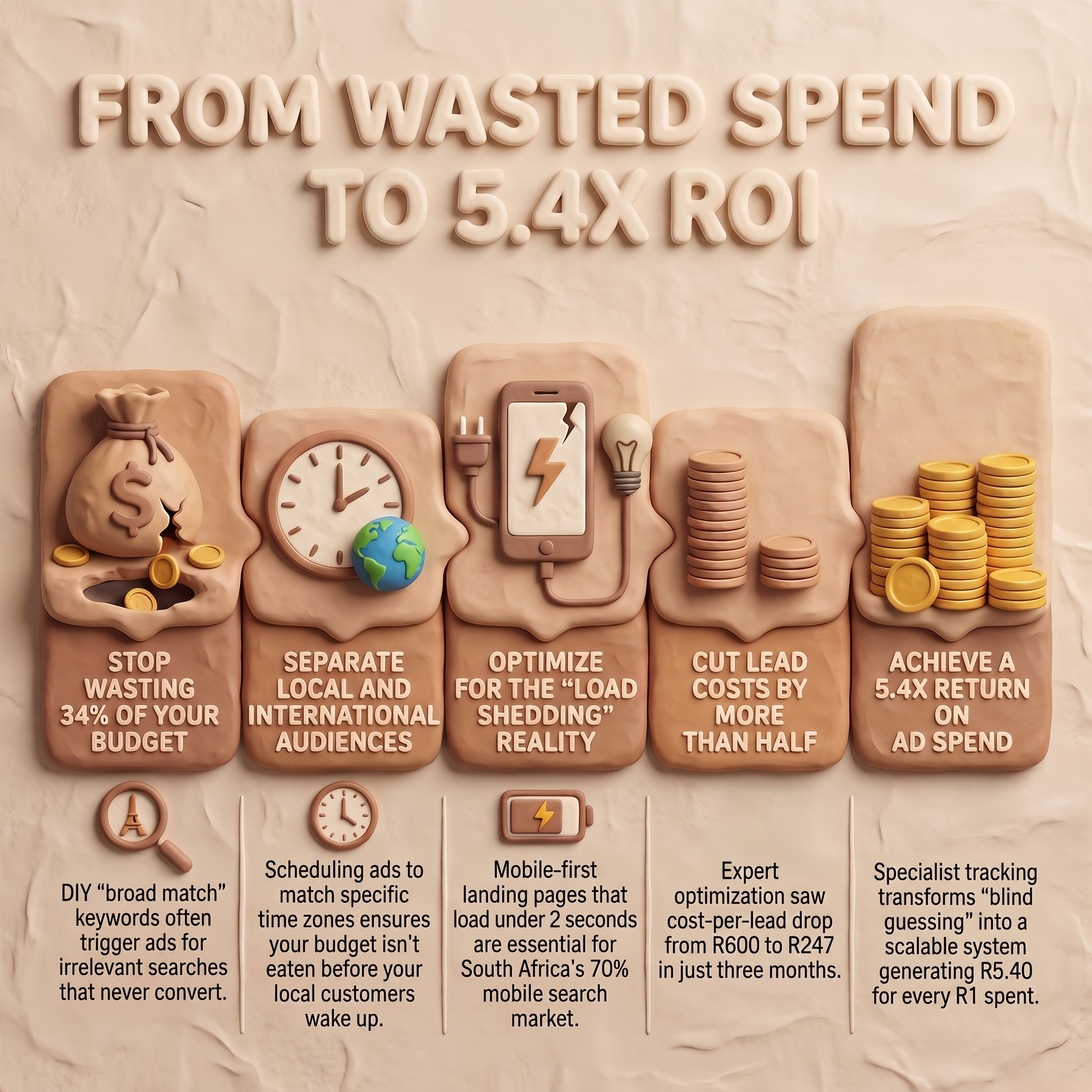
According to the audit, roughly 34% of my ad spend over the previous six months had gone to search terms that had zero commercial intent. That’s over R30,000 I’d essentially donated to Google for the privilege of appearing in front of people who were never going to buy.
My Tourist and Local Campaigns Were Cannibalising Each Other
Here’s a Cape Town-specific problem: if you serve both international tourists and local customers, your Google Ads need to reflect that those are two completely different audiences, with different search behaviour, different budgets, and different conversion points.
I’d been running everything in one campaign. My “Garden Route tours” ad was competing with my “plumber Northern Suburbs” ad for the same daily budget. During peak summer season, the tourist terms were eating the budget before lunchtime, which meant my local service ads barely ran when Capetonians were actually searching — evenings and weekends.
The agency showed me search pattern data: international tourists tend to search between 08:00–14:00 GMT (that’s 10:00–16:00 our time), while local customers search heaviest between 18:00–21:00. I’d been spending most of my budget in the wrong window for half my audience.
I Had No Idea What Was Actually Working
I’d installed Google Analytics, but I hadn’t set up conversion tracking properly. So while I could see that people clicked my ads, I genuinely didn’t know which campaigns led to actual bookings or inquiries.
The agency integrated proper conversion tracking, call tracking, and form submissions. Within two weeks, we had a clear view: three of my seven campaigns were performing brilliantly. Two were break-even. Two were actively losing money and had been for months.
Load Shedding Was Killing My Mobile Performance
This one stung because it was so obvious in hindsight.
South Africa has some of the highest mobile search rates in the world — Google’s own data shows that over 70% of searches in SA now happen on mobile devices. My landing pages were optimised for desktop, loaded slowly on mobile (we’re talking 6–8 seconds on a 4G connection), and during load shedding hours, when people were relying entirely on mobile data, my bounce rate was above 80%.
The agency rebuilt my landing pages with mobile-first design, cut the load time to under 2 seconds, and optimised for the reality that many Cape Town searchers are on prepaid data and won’t wait around.

What Properly Managed Cape Town PPC Campaigns Actually Looked Like
Once I handed the reins over, here’s what changed in the first three months:
Month One: Surgery
The agency paused the two losing campaigns, tightened keyword match types across the board, and split my campaigns into four clear audience segments: international tourists (pre-arrival), international tourists (in Cape Town), local service customers, and corporate/B2B.
They also set up ad scheduling so budget flowed to tourist campaigns during international search hours and local campaigns during evening peaks.
Ad spend that month: R14,200 (I’d reduced my budget while they rebuilt). Leads: 47. Cost per lead: R302.
For context, my previous average cost per lead — when I could even track it — had been somewhere north of R600.
Month Two: Optimisation
With conversion tracking in place, the agency started testing ad copy specific to Cape Town search behaviour. Turns out, international searchers respond to imagery and experience language (“award-winning Garden Route tour”), while local customers want speed, price clarity, and reliability (“same-day service, Northern Suburbs, from R750”).
They also set up remarketing campaigns targeting people who’d visited my site but hadn’t converted — a tactic I’d heard about but never implemented. Those remarketing ads ran across Google Display Network and YouTube, with creative that acknowledged the Cape Town context (one ad literally said, “Still thinking about it? We’re here, load shedding and all”).
Ad spend: R16,800. Leads: 64. Cost per lead: R262.
Month Three: Scale
By month three, we had enough data to know what was working. The agency increased spend on the high-performing campaigns, killed underperforming ad groups ruthlessly, and introduced A/B testing on landing pages.
They also optimised for seasonal shifts — March is when Cape Town moves out of peak tourist season, so we shifted more budget toward local service campaigns and started promoting autumn and winter offerings to international searchers planning ahead.
Ad spend: R19,500. Leads: 79. Cost per lead: R247.
Here’s the number that mattered most: my conversion rate from lead to paying customer was holding steady at around 42%. That meant those 79 leads translated to roughly 33 paying customers in a single month. My average customer value is around R3,200.
Do the maths: R19,500 spend, roughly R105,600 in revenue attributed directly to PPC. That’s an ROAS (return on ad spend) of about 5.4:1.
For two years, I’d been flying blind. In three months with a specialist PPC agency in Cape Town, I had clarity, profitability, and a system I could actually scale.
What I Wish I’d Done Earlier (And What It Cost Me Not To)
Looking back, here’s what I’d tell my two-years-ago self:
Stop Believing That “Close Enough” Is Good Enough
I thought because my campaigns were running and generating some business, they were fine. But “fine” was costing me tens of thousands in wasted spend and missed opportunity. According to WordStream’s 2024 benchmarks, the average small business wastes between 25–40% of its Google Ads budget on poor targeting, irrelevant clicks, and unoptimised campaigns. I was right in that range.
A specialist doesn’t just run your ads — they know what good performance actually looks like in your industry and location, and they’ll hold your campaigns to that standard.
Go Local, Especially in Cape Town
I briefly considered using an offshore agency (cheaper rates, flashy websites). I’m glad I didn’t.
A Cape Town-based PPC agency understands that our market is a strange hybrid: international tourism, local services, a multilingual audience, mobile-heavy search behaviour, connectivity issues, and economic volatility that changes how people search and buy.
They know that “Cape Town CBD” and “Cape Town City Centre” pull different search volumes. They know that Afrikaans search terms can be goldmines in certain suburbs. They know that December–February ad costs spike because every tourism operator is bidding aggressively, and they plan around it.
That local knowledge was worth every cent.
Track Everything, or You’re Just Guessing
If I’d set up proper conversion tracking from day one, I’d have known within weeks which campaigns were duds. Instead, I spent months funding campaigns that felt productive but were actually haemorrhaging money.
The Cost of Waiting
Here’s the uncomfortable bit: if I’d moved to a specialist PPC agency even just one year earlier, and if they’d delivered even half the improvement they actually did, I’d have saved approximately R40,000–R50,000 in wasted spend and generated an additional R150,000–R200,000 in revenue.
That’s not a small number when you’re running a business in South Africa’s current economic climate.

What Makes a Good PPC Agency in Cape Town (Now That I Know What to Look For)
If you’re in the position I was — running your own Google Ads, convinced it’s “fine,” but not entirely sure — here’s what to look for in an agency:
Transparency: You should have full access to your own Google Ads account. If an agency won’t give you admin access, walk away. It’s your data, your spend, your business.
Local expertise: Ask them about Cape Town-specific challenges — load shedding, mobile optimisation, tourist vs local audience splits, multilingual targeting. If they look confused, they’re not the right fit.
Conversion focus, not just clicks: Any agency can generate clicks. A good one obsesses over what happens after the click — do people convert, and at what cost?
Regular, readable reporting: You should get monthly reports that you can actually understand, with clear metrics tied to your business goals (leads, sales, ROI), not just vanity numbers (impressions, CTR).
Flexibility: Cape Town businesses face unpredictable challenges (hello, water crisis, pandemic, energy crisis). Your PPC agency should be able to pivot quickly when external conditions change.
Frequently Asked Questions
Q: How much does a PPC agency in Cape Town typically cost?
A: Most reputable agencies charge either a percentage of ad spend (usually 10–20%) or a flat monthly management fee (anywhere from R5,000 to R25,000+ depending on complexity). For a business spending R15,000–R25,000/month on ads, expect to budget R3,000–R6,000 for professional management. It sounds like a lot until you realise how much you’re currently wasting.
Q: Can’t I just learn to do this myself?
A: You can, and plenty of business owners do. But Google Ads is a full-time skill that changes constantly — new features, algorithm updates, bidding strategies, competitor behaviour. The question isn’t whether you can learn it; it’s whether your time is better spent running your business or managing ad campaigns. For most Cape Town business owners I know, the answer is clear.
Q: How long before I see results from a PPC agency?
A: A good agency will show measurable improvements within 4–8 weeks — better cost per lead, higher conversion rates, clearer reporting. Real scale and optimisation take 3–6 months as they gather data and refine. If an agency promises overnight miracles, they’re overselling.
Q: What’s the difference between SEO and PPC, and which should I prioritise?
A: SEO is long-term and builds organic visibility over months or years. PPC is immediate — you can be on page one tomorrow if your budget allows. For most Cape Town businesses, the answer is both: PPC for short-term leads and revenue while your SEO builds. But if you’re only doing one and need results this quarter, PPC is your play.
Q: Will a Cape Town PPC agency work with my existing marketing team?
A: Absolutely. A good agency complements your in-house efforts — they’ll collaborate with your web developer, your content team, and your sales staff to make sure the ads align with your broader strategy. If they try to work in a silo, that’s a red flag.
If this story sounds familiar — if you’ve been running your own Google Ads and quietly wondering whether you’re leaving money on the table — it’s worth getting a proper audit. Thickrope Marketing offers free, no-obligation PPC audits for Cape Town businesses, and we’ll tell you straight whether we can improve on what you’re doing. [Book your audit here](Thickrope Marketing) or give us a shout.