
Why Western Cape Businesses That Run SEO and PPC Together Consistently Outperform Those That Don’t
You’ve probably got two line items in your marketing budget: one for SEO, one for PPC. They sit there, neatly separated, like they’re different species that don’t interact. Most Western Cape businesses do the same. It feels sensible. Logical, even.
It’s also quietly costing you money.
Because here’s what most business owners don’t know: SEO and PPC aren’t separate channels — they’re two halves of the same conversation with Google. And when you run them together, properly integrated, they don’t just complement each other. They actively make each other better.
Let me show you what that looks like on the ground in the Western Cape, where load shedding means you can’t afford to waste a single rand on marketing that doesn’t pull its weight.
The Split That Undermines Both Channels
When SEO and PPC operate in silos, you end up with:
- PPC campaigns that burn budget on keywords your organic rankings could handle (or should be handling)
- SEO strategies that ignore the conversion data sitting right there in your paid search accounts
- No visibility during the 3–9 month gap while organic rankings build
- Duplication where both channels compete for the same click, driving up your overall cost per acquisition
And because most agencies in South Africa specialise in one or the other — rarely both, almost never integrated — you’re probably getting advice from people who only see half the picture.
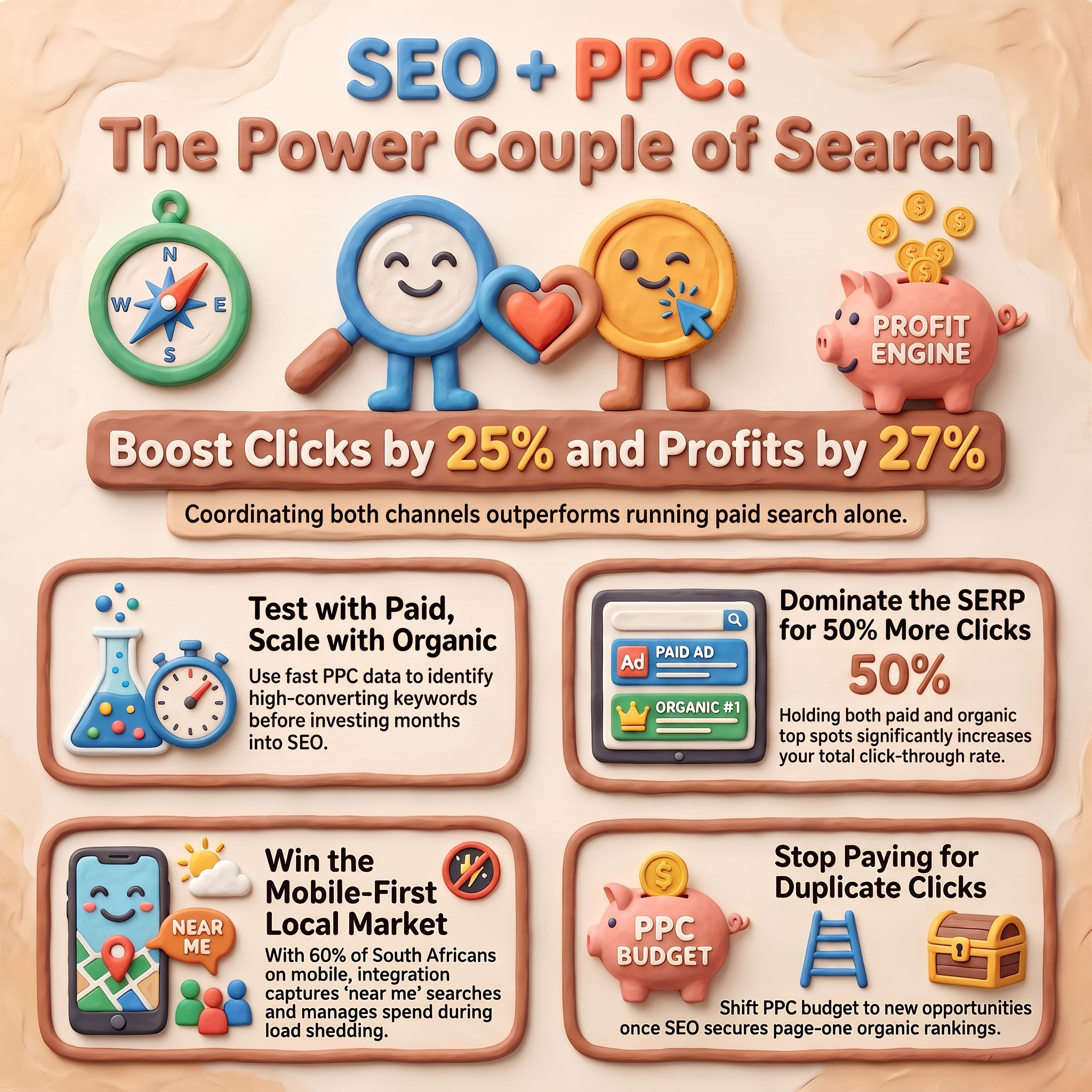
According to Google’s own research, businesses that coordinate SEO and PPC see an average 25% increase in clicks and a 27% boost in profits compared to running paid search alone. That’s not marginal. That’s the difference between growth and treading water.
What Integration Actually Looks Like (Not Theory — Practical Application)
Let’s take a Western Cape tourism operator — someone running boat trips out of Simon’s Town, targeting both Cape Town locals and upcountry visitors searching from Gauteng.
Without integration:
- They’re paying R40 per click on “boat trips Cape Town” via Google Ads
- Their SEO consultant is also targeting that phrase organically, but rankings are stuck on page two
- No one’s looking at which landing pages actually convert from paid traffic
- They pause PPC over winter to “save budget,” then wonder why enquiries flatline
With integration:
- PPC data shows “penguin boat tours Simon’s Town” converts 3× better than the generic phrase — so SEO pivots to target that
- Paid search holds position 1–3 while organic rankings build for high-intent terms
- Once organic hits page one for a keyword, PPC budget shifts to new opportunity areas (maybe “private charters” or “corporate team building boat trips”)
- During load shedding, when the website’s down, PPC gets paused automatically — no wasted spend
- Search Query Reports from PPC reveal what Western Cape customers actually type, which shapes content strategy, FAQ pages, and even service descriptions
The result? Lower cost per acquisition. More visibility when it matters. Faster adaptation to what the market’s actually searching for.
The Mobile Reality in the Western Cape (And Why It Demands Integration)
Here’s a number worth remembering: according to StatsSA, over 60% of South African internet users access the web exclusively via mobile. In the Western Cape, where network conditions swing wildly between fibre-fast in the City Bowl and intermittent 3G in the Overberg, your search strategy needs to account for that.
Mobile searchers behave differently. They click paid ads more readily (they’re right at the top, and scrolling is effort). They abandon slow sites faster. And they search with hyper-local intent: “plumber near me Stellenbosch” or “restaurant Hermanus open now.”
An integrated SEO and PPC approach lets you:
- Test mobile landing pages with PPC before committing SEO resources to them
- Prioritise local SEO based on which suburbs and towns your paid search actually converts from (spoiler: it’s often not where you think)
- Adjust bids and content based on time-of-day patterns that only show up when you’re watching both channels together
A Stellenbosch-based wine estate running tastings learned this the hard way. Their PPC was converting beautifully from Johannesburg searchers planning weekend trips. Their SEO was optimised for local traffic. Once they integrated strategy, they created separate landing pages and keyword clusters for each audience — and saw a 34% jump in bookings within two months.

The Data Exchange Most Agencies Never Mention
Here’s the lesser-known truth about why integration works:
PPC tells you what converts. Fast. You get data in days, not months. You see which phrases, which landing pages, which calls-to-action actually turn clicks into customers.
SEO builds on that certainty. Instead of guessing which keywords to target or what content to create, you use proven PPC data as your blueprint. You’re building organic visibility around phrases you know make money.
Then the loop closes:
SEO reduces your PPC costs. Once you’re ranking organically for high-value terms, you can lower bids, shift budget to exploratory campaigns, or dominate the SERP by holding both paid and organic positions (which, research from Wordstream shows, increases total click-through rate by up to 50% compared to appearing in just one position).
No Western Cape business can afford to treat digital marketing as a branding exercise anymore. Integration turns search into a feedback loop: test with paid, scale with organic, reinvest the savings.
What This Means for Businesses Serving the Broader Western Cape
If your market stretches beyond Cape Town metro — into the Winelands, Garden Route, West Coast, Overberg — integration becomes even more critical.
Why? Because search behaviour varies wildly by region. Someone in George searching for “accounting services” isn’t using the same modifiers or showing the same intent as someone in Paarl. PPC lets you test messaging and landing pages by location. SEO lets you build location-specific content that ranks long-term.
A Saldanha-based engineering firm discovered through their PPC campaigns that most of their qualified leads were coming from searches related to “mining equipment maintenance” — not the broader industrial services they’d been optimising for. They shifted their SEO content strategy, created case studies from their mining clients, and started ranking for phrases they’d never even considered. Their organic traffic from the Northern Cape (a region they served but hadn’t targeted) doubled in six months.
That insight came from PPC. The scale came from SEO. Neither happens if the channels don’t talk to each other.

The Load Shedding Advantage You’re Probably Missing
Here’s a Western Cape reality that shapes everything: load shedding isn’t going away anytime soon. Which means your website will be unreachable at times, even with a generator or UPS.
An integrated SEO and PPC strategy accounts for this:
- Pause PPC automatically when your site’s down (or redirect to a mobile-friendly “we’re offline but here’s our WhatsApp” page)
- Prioritise organic rankings for evergreen content that can be cached or served via CDN when power’s out
- Use PPC data to identify your highest-value hours and days, so SEO content is optimised for when uptime and search volume align
One Brackenfell-based online retailer used their PPC time-of-day data to discover that most conversions happened between 7 PM and 10 PM — after load shedding typically ended in their area. They adjusted their Google Shopping bids accordingly and created SEO content targeting “late-night delivery Cape Town.” Small shift. Big impact on ROI.
The Cost Argument (Because Let’s Be Honest, Budget Matters)
“But surely running both costs more?”
In the short term, yes. But here’s what most business owners miss: running SEO and PPC separately, without integration, costs more over 12 months because you’re duplicating effort, wasting budget on the wrong keywords, and waiting too long to learn what works.
An integrated approach costs less per result because:
- You stop bidding on keywords you already rank for
- You don’t waste 6 months doing SEO on terms that don’t convert (PPC proves intent first)
- You dominate SERPs with both paid and organic, capturing clicks your competitors split
- You adapt faster, which in the current SA economy is worth more than almost any other advantage
The alternative — running one channel, or running both without integration — is like trying to win a rugby match with only your forwards. Sure, they’re working hard. But you’re leaving half your team on the bench.

What You Should Actually Do Next
If you’re a Western Cape business still treating SEO and PPC as separate line items, here’s what integration looks like in practice:
1. Share the data. Your PPC Search Query Reports should inform your SEO keyword strategy. Your organic rankings should shape your PPC bidding.
2. Unify the team. If you’re working with separate providers, they need to be in the same room (or Zoom call). If you’re working with one provider, ask explicitly how they integrate the channels — not just run them in parallel.
3. Test paid, scale organic. Use PPC to validate new markets, product messaging, or service areas. Once you’ve got proof, build SEO around it.
4. Track together. Your reporting should show combined performance: total search visibility, blended cost per acquisition, overall return from search. Not two separate dashboards that never meet.
Most Western Cape businesses are already stretched thin. You don’t have budget or time to waste on marketing that’s half as effective as it should be. Integration isn’t a nice-to-have. It’s how you make search work hard enough to justify the investment.
Frequently Asked Questions
Q: Should I start with SEO or PPC first if I can’t afford both right now?
A: Start with PPC — it gives you faster data on what actually converts, which makes your SEO strategy smarter when budget allows. But don’t run PPC indefinitely without a plan to build organic; that’s just renting visibility forever.
Q: How do I know if my current SEO and PPC provider in the Western Cape is actually integrating the channels?
A: Ask to see specific examples: which PPC keywords informed their SEO strategy? How did organic rankings change their PPC bidding? If they can’t show you the feedback loop with your own account data, they’re running them separately.
Q: Does integration work for small local businesses, or only for bigger Western Cape companies?
A: It works even better for local businesses with tight budgets. A Parow plumber or Hermanus guesthouse can’t afford to waste spend — integration means every rand works harder and you learn faster what brings in customers.
Q: What’s a realistic timeframe to see results from an integrated SEO and PPC approach in South Africa?
A: PPC results show within days. SEO takes 3–6 months to build momentum. But the magic is in month 4–6, when organic starts ranking for terms PPC proved profitable, and your blended cost per acquisition drops visibly.
Q: Will I rank lower organically if I’m also running PPC on the same keywords?
A: No — that’s a myth that refuses to die. Google’s stated repeatedly that paid spend doesn’t influence organic rankings. What does happen: you capture more total clicks by appearing in both paid and organic results, which increases your overall visibility and conversions from search.
If you’re ready to stop treating SEO and PPC like distant cousins and start running them as the integrated search strategy your Western Cape business actually needs, let’s talk. Thickrope Marketing specialises in exactly this approach — not just running both channels, but making them work together to deliver results you can measure. [Book a free consultation](https://www.thickrope.co.za/contact) and we’ll show you what your search visibility could look like when both halves of the strategy are finally talking to each other.