
Why Vereeniging Businesses That Run SEO and PPC Together Consistently Outperform the Competition
Most business owners in Vereeniging treat SEO and PPC like you’d treat rivals in a Derby — pick a side, stick with it, and hope for the best. You’ll either invest in organic rankings (the slow burn), or you’ll punt for Google Ads (the instant hit). Rarely both. Almost never strategically combined.
And that’s leaving a stack of revenue on the table.
Here’s the truth most digital agencies won’t tell you: SEO and PPC aren’t competing channels. They’re two halves of the same engine. When you run them together — not just simultaneously, but strategically integrated — the results compound in ways that neither channel can achieve alone. And for a business operating in the Vaal Triangle, where competition is heating up and consumers are savvier than ever, that compounding effect is the difference between surviving and absolutely dominating your category.
Let’s unpack why this works, what it looks like in practice for a Vereeniging business, and what you can expect over the next twelve months if you stop choosing and start combining.
The Visibility Gap Most Vaal Businesses Don’t Even Know Exists
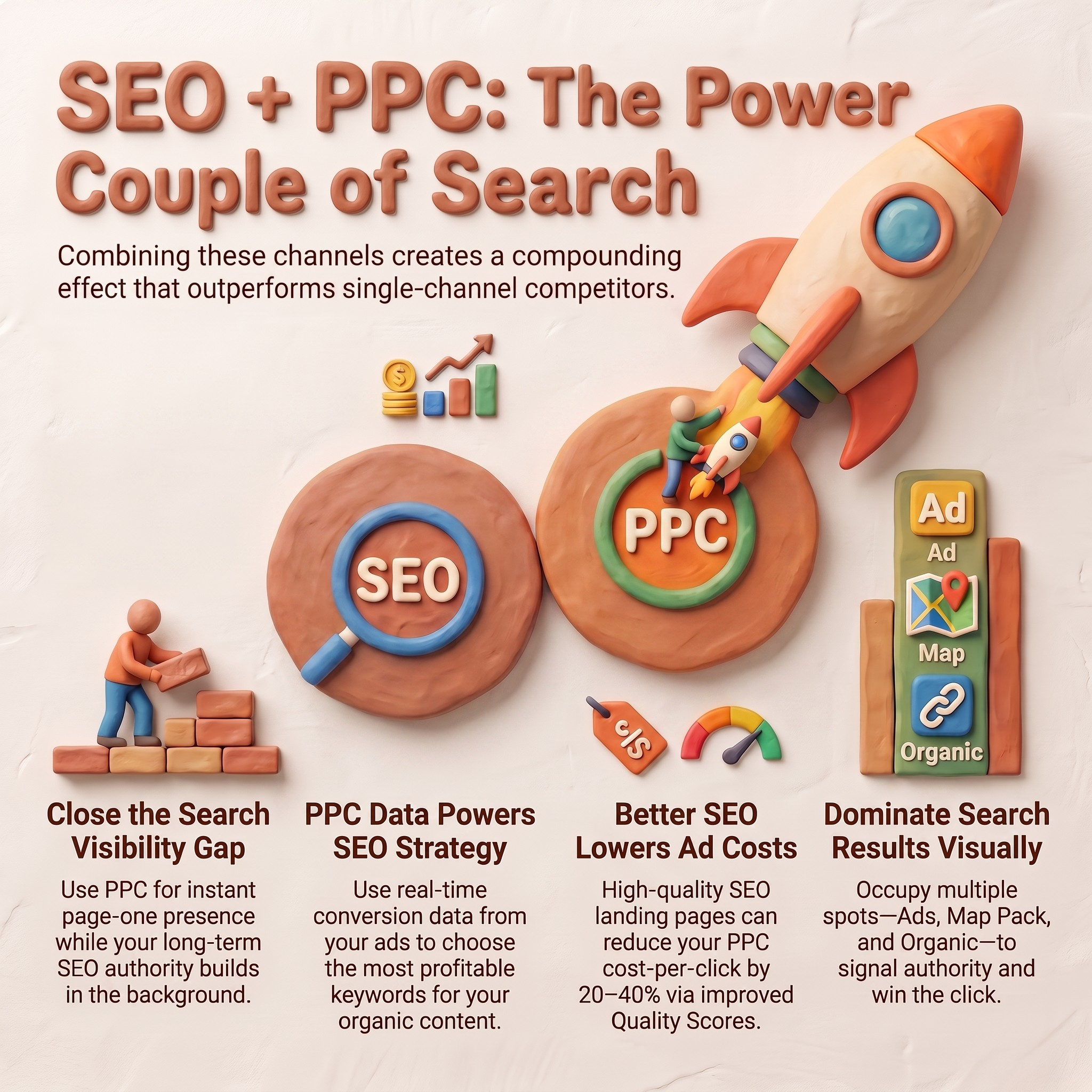
Here’s something you won’t hear at the local chamber meeting: Google’s first page captures 91.5% of all search traffic. The second page? About as useful as a chocolate teapot.
Now, if you’re investing in SEO, you’re building toward that first-page position. But rankings take time — anywhere from three to nine months depending on your market, your competition, and how aggressive your content strategy is. That’s the reality, and there’s no hacking around it.
If you’re running PPC, you’re on page one tomorrow morning. But the moment your budget runs dry, you vanish. And in a town like Vereeniging, where customers search for “plumbers near me,” “panel beaters Vereeniging,” or “boerewors delivery Vanderbijlpark” with serious commercial intent, disappearing for even a week means lost jobs, lost sales, lost ground.
The visibility gap happens when you choose one or the other.
SEO-only businesses spend months invisible while they build authority. By the time they rank, competitors have already claimed the customers.
PPC-only businesses pay for every single click forever, with no asset being built. The day you pause the campaign is the day you go dark.
Businesses running both? They own the top of the page — today and six months from now. They’re present during the expensive early months, and they’re still there (paying less per lead) when the organic rankings mature.
What Integration Actually Looks like for a Vereeniging Business
Let’s talk specifics, because “integration” gets thrown around like confetti at a wedding, and most of the time it means nothing.
True integration between SEO and PPC means your campaigns are feeding each other data, insights, and momentum. Here’s what that looks like in practice for a local business:
Your PPC Campaign Tells You What to Write About
Google Ads gives you data fast. Within two weeks of launching a campaign, you know exactly which keywords convert, which ad copy gets clicks, and what your Vereeniging audience actually responds to.
Now here’s the bit most people miss: that PPC data is gold for your SEO strategy.
Let’s say you run a fitment centre in Three Rivers. You launch a Google Ads campaign targeting “mag wheels Vereeniging,” “tyres Vereeniging,” and “wheel alignment near me.” After a fortnight, you notice that “wheel alignment” has a conversion rate three times higher than the other terms — and the cost-per-click is half the price.
That’s not just a PPC insight. That’s a content roadmap. You now know to prioritise blogs, service pages, and local landing pages around wheel alignment, because your audience has told you — with their wallets — that this is what they need.
You write the content. It ranks. Months later, you’re getting organic traffic for the exact terms that converted best in your paid campaigns. And your PPC budget? It’s now funding the next experiment, not subsidising the same traffic forever.
Your SEO Data Makes Your PPC Campaigns Cheaper
It works the other way, too.
Google rewards websites with high-quality, relevant content by improving their Quality Score — the metric that determines how much you pay per click. If your landing pages are thin, slow, or irrelevant, your Quality Score tanks and your cost-per-click skyrockets.
But if you’ve invested in proper SEO — fast-loading pages, well-structured content, strong local signals — your PPC campaigns inherit that quality. Your ads cost less. Your ad position improves. You stretch your budget further.
A Vereeniging business with solid SEO foundations can often cut their PPC costs by 20–40% compared to a competitor with a neglected website. That’s not theory — that’s how Google’s auction system works. According to WordStream, advertisers in the top 10% by Quality Score pay up to 50% less per click than those in the bottom quartile.
Think about that. Same keyword. Same town. Half the cost — just because your website is better optimised.
You Dominate the Search Results Visually
Load shedding might dim the lights, but your search presence doesn’t have to.
When you run SEO and PPC together, you can occupy multiple positions on the same search results page. Picture this: a potential customer in Vanderbijlpark searches “electrician Vereeniging.” They see:
- Your Google Ad at the very top
- Your Google Business Profile in the map pack
- Your organic listing in positions 2 or 3
That’s three bites at the same apple. Three chances to win the click. And psychologically? It signals authority. You’re not just a business — you’re the business.
This kind of omnichannel visibility is especially powerful in competitive local markets. Even if a user doesn’t click your ad, seeing your brand multiple times builds recognition. When they’re finally ready to buy, you’re the name they remember.

The Twelve-Month Reality for a Vereeniging Business Running Both
Let’s ground this in what actually happens when a local business commits to integrated SEO and PPC over a year.
Months 1–3: PPC carries the load
You’re spending on ads, but you’re also gathering data. Your SEO work is happening in the background — site structure, content creation, local citations, backlinks. You’re visible, you’re converting, and you’re learning fast.
Months 4–6: Organic rankings start appearing
Your best-performing PPC keywords begin showing up in organic search. You’re still running ads, but now you’re also earning “free” clicks. Your blended cost-per-lead drops noticeably.
Months 7–9: The compounding effect kicks in
You’re ranking well for your core services. PPC spend shifts toward experimental keywords and seasonal campaigns (think Black Friday, end-of-year sales, back-to-school). Your overall visibility is consistently high, and competitors are struggling to keep up.
Months 10–12: You own your category locally
Organic traffic is strong and reliable. PPC budget is leaner and more strategic. You’ve built a moat that’s expensive for competitors to cross — because they’d need to replicate both channels to catch you.
This isn’t marketing fantasy. It’s the documented pattern for businesses that integrate properly. And in a town like Vereeniging, where the business landscape is tightly knit and competition is fierce, being six months ahead is often all it takes to become the default choice.
The Lesser-Known Truths About Running Both Channels in the Vaal Triangle
Here are a few things most Vereeniging business owners don’t realise — but should:
1. Your competitors probably aren’t doing this
Most local businesses are running one channel, inconsistently, with no strategic oversight. If you commit to both, you’re not competing — you’re operating in a different league entirely.
2. Integration doesn’t mean doubling your budget
A smart agency will shift budget dynamically. Heavy on PPC early while SEO builds. Lighter on PPC later as organic delivers. The total marketing spend often stays flat — it’s just deployed smarter.
3. Load shedding has made search behaviour more mobile and more urgent
South African consumers increasingly search on mobile, often during power cuts, looking for immediate solutions. PPC captures that urgency. SEO ensures you’re there when they search again the next day, on desktop, ready to compare properly.
4. Local intent is worth more than you think
A search for “accountant Vereeniging” is worth infinitely more than “accountant South Africa.” Local searchers convert at significantly higher rates — sometimes 5–10 times higher than generic traffic. Running both SEO and PPC lets you dominate those high-intent, high-value local queries.
Frequently Asked Questions
Q: Can’t I just focus on SEO and save money?
A: You can, but you’ll spend 6–12 months building visibility while competitors with PPC claim your customers. SEO is essential for long-term success, but PPC funds the gap and accelerates learning. Together, they protect your market position during the vulnerable early phase.
Q: Is PPC worth it if I’m already ranking organically?
A: Absolutely. Even if you rank #1 organically, a competitor’s ad can still appear above you. Running both lets you own multiple positions and block competitors. Plus, PPC data helps you refine your organic strategy and test new services before committing heavy SEO resources.
Q: How much should a Vereeniging business budget for integrated SEO and PPC?
A: It depends on your industry and goals, but a realistic starting point is R8,000–R15,000 per month combined. That typically includes foundational SEO (content, technical optimisation, local signals) and enough PPC budget to test, learn, and convert in a local market. Agencies that know the Vaal market will tailor this to your sector.
Q: How long before I see results from both channels?
A: PPC delivers visibility and leads within days. SEO takes 3–6 months to show meaningful organic rankings. The magic happens around month 4–6 when both channels start working together — your cost-per-lead drops, your visibility compounds, and your market position strengthens fast.
If you’re operating in Vereeniging and you’ve been sitting on the fence about SEO or PPC, it’s time to stop choosing. The businesses winning in the Vaal Triangle aren’t picking sides — they’re running both, intelligently, with a strategy that treats digital marketing as an integrated growth engine, not a set of disconnected tactics. Keen to see what integrated SEO and PPC services could do for your Vereeniging business? Let’s have a no-obligation chat about your goals and map out a campaign that actually fits your market. Visit Thickrope Marketing or get in touch — we speak Vaal, and we build strategies that work here.