

How to Choose a Marketing Agency for Your Carletonville Business — Without Paying for a Joburg Strategy That Doesn’t Fit
You’ve seen the proposals. Slick decks full of “geo-targeted campaigns” and “audience segmentation” that somehow manage to mention Sandton three times but Fochville not once. You’re based in Carletonville, running a business that serves mine workers, West Rand families, and local trade — and the R15,000/month strategy you’ve just been quoted feels like it was written for a Rosebank coffee shop.
You’re not imagining it. Many Carletonville businesses hire Johannesburg marketing agencies and end up with campaigns that miss the mark entirely — because the strategist has never set foot west of Krugersdorp, doesn’t understand your customer base, and is charging metro rates for generic Gauteng thinking.
Here’s how to evaluate a marketing agency properly when you’re operating in a mining town with its own rhythm, economy, and audience — and how to avoid paying for someone else’s postcode.
What “Local Market Knowledge” Actually Looks Like in a Marketing Proposal
When a marketing agency says they understand Carletonville, don’t take their word for it. Look for these signals in their proposal or discovery call:
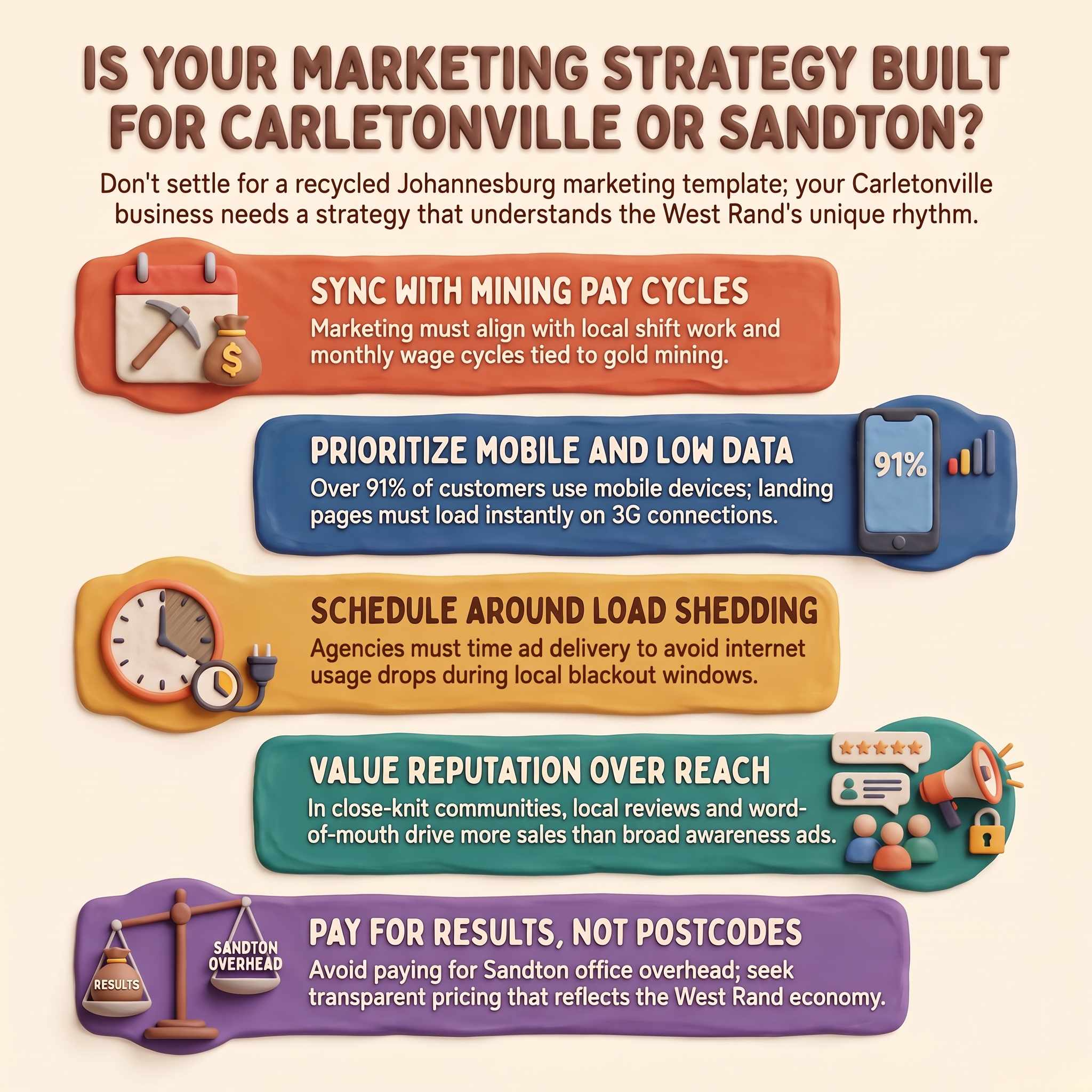
They ask about your customers’ employment patterns. Carletonville’s economy revolves around gold mining. That means shift work, pay cycles tied to monthly wages, and discretionary spending that ebbs and flows with commodity prices. If an agency pitches you a Facebook campaign without asking when your customers get paid or what shifts they work, they’re guessing.
They reference mobile behaviour specifically. According to ICASA’s 2023 State of the ICT Sector Report, 91% of South Africans access the internet primarily via mobile devices — but in towns like Carletonville, that figure is even higher, and data costs matter more. A proper local strategy accounts for this: faster-loading pages, WhatsApp as a conversion channel, and ad creative that works on a small screen with limited data. If the proposal talks about “rich media experiences” without mentioning file size, run.
They know the competitive landscape. Who are your actual competitors? Not just the business two doors down, but the Joburg suppliers your customers can reach on the R500, the online retailers shipping to 2500, and the informal traders at the taxi rank. An agency that understands Carletonville will map this properly — not just hand you a list of businesses with the same SIC code.
They speak to trust-building, not just awareness. Carletonville is a close community. Word of mouth still drives purchase decisions here in ways that don’t show up in a standard funnel model. If the agency’s strategy doesn’t include review management, local testimonials, and community credibility signals, they’re thinking like a metro marketer in a town where reputation is currency.
The Questions That Reveal Whether They Actually Get It
During your evaluation, ask these. The answers will tell you everything:
“What radius would you set for our local campaigns, and why?” If they default to 20km without asking where your customers live and work, they don’t know the West Rand geography. Carletonville sits in a specific catchment that includes Khutsong, Wedela, and parts of Fochville — but excludes plenty of Gauteng postcodes that are technically closer. The right answer involves questions, not assumptions.
“How would load shedding affect our campaign performance, and what’s your mitigation plan?” This is non-negotiable. According to Eskom’s own data, Stage 4–6 load shedding reduces mobile internet usage by up to 40% in certain areas during blackout windows. An agency that understands Carletonville will schedule ad delivery around typical load shedding patterns, prioritise offline-capable content, and track conversions with power cuts in mind. If they look confused, they’re not ready for the West Rand.
“What does success look like for a business our size in this area?” Metro agencies love to talk about “scale” and “exponential growth.” But a Carletonville plumbing business doesn’t need 10,000 impressions — it needs 47 phone calls from homeowners within 15km who have a geyser emergency. The right agency will frame success in terms that match your actual commercial reality, not a Silicon Valley growth chart.
“Can you show me a campaign you’ve run for a West Rand or mining-town business?” If they can’t, that’s not automatically disqualifying — but it means you’re their experiment. Price accordingly, and expect a learning curve on your dime.

What Fair Pricing Looks Like (and What You’re Actually Paying For)
Let’s talk numbers, because this is where the mismatch often stings hardest.
A Johannesburg agency charging R18,000/month for “full-service digital marketing” is pricing for Sandton overhead, Parkhurst office space, and metro client expectations. That’s fine if you’re a Rosebank fintech startup — less fine if you’re a Carletonville auto parts supplier doing R80,000/month in revenue.
Realistic investment range for a Carletonville SME: R5,500–R12,000/month, depending on scope. That should buy you proper local SEO, targeted Google Ads or Meta campaigns, monthly reporting, and someone who answers the phone when you call. Anything above R15,000 needs to come with a very clear explanation of what the extra spend is delivering — and “premium strategy” is not an explanation.
What you’re actually paying for
- Time in your market. Literally. An agency that drives to Carletonville, meets your customers, visits your location, and understands your operating context is worth more than one that Zooms in from Bryanston.
- Campaign localisation, not just translation. Writing ad copy that resonates with a Khutsong resident is different from writing for a Sandton exec. Same language, different world. You’re paying for that nuance.
- Accountability on your terms. Monthly reports are standard. But are they showing you foot traffic? Phone calls? Showroom visits? Or just “engagement” and “reach”? Make sure the reporting matches how your business actually makes money.
Red Flags That Mean You’re About to Pay for a Joburg Strategy
Watch for these warning signs during the pitch process:
They use the same case study for every town. If the success story is about a Pretoria gym and you run a Carletonville tool hire business, ask how the strategy translates. If they can’t explain it, it doesn’t.
The contract is identical to what a Sandton business would sign. Retainer terms, deliverables, even KPIs — if nothing has been tailored to your location, size, or market, you’re buying off the rack.
They’ve never heard of your competitors. Not the national chains — your actual local competitors. If they don’t know who you’re up against on the ground, their strategy is theoretical.
Everything is “best practice” with no local adaptation. Best practice is a starting point, not a finishing line. In Carletonville, best practice might mean WhatsApp Business over email automation, or optimising for 3G load times instead of fibre. If the agency is regurgitating international playbooks without asking how they apply here, you’re being sold a template.

What Good Looks Like: A Proper Carletonville Marketing Strategy
Here’s what a marketing agency that actually understands Carletonville should deliver:
Google Business Profile optimised for real local search behaviour. That means showing up when someone in Khutsong searches “plumber near me” at 22:00 on a Sunday (because the geyser just burst), not just ranking for generic terms during office hours.
Ad campaigns that acknowledge your customers’ reality. If you’re a furniture store, your ads should align with month-end pay cycles. If you’re a training provider, they should speak to miners looking to upskill or transition. Generic “shop now” messaging won’t cut it.
Mobile-first everything. According to a 2024 Surf survey, the average South African mobile user has 1.2GB of data per month — and Carletonville consumers are price-sensitive. Your landing pages need to load in under 3 seconds on a 3G connection, or you’re losing customers before they even see your offer.
Review and reputation strategy. Carletonville customers check reviews, ask neighbours, and trust local voices. A proper agency will help you build that credibility systematically — not just chase 5-star ratings, but create genuine social proof that resonates in your community.
Reporting that ties to revenue. Not vanity metrics. If you’re paying R8,000/month, you should see a clear line between the marketing spend and customers walking through your door, calling your office, or placing orders. Demand it.
How to Run the Evaluation Process Without Wasting Time
You’re busy. You don’t have six weeks to interview agencies. Here’s a streamlined approach:
Step 1: Shortlist based on proximity and portfolio. Prioritise agencies that have worked in the West Rand, mining towns, or similar-sized communities. If they’ve only ever serviced metro clients, you’re their guinea pig.
Step 2: Ask for a 20-minute discovery call, not a full proposal. Use the questions listed earlier. If they can’t demonstrate basic Carletonville market knowledge in conversation, don’t waste time on a written proposal.
Step 3: Request a 90-day pilot, not a 12-month lock-in. Any agency confident in their local approach should be willing to prove it over a quarter. If they insist on annual contracts up front, ask why.
Step 4: Check local references. Not testimonials on their website — actual phone numbers of West Rand businesses they’ve worked with. Call them. Ask what worked and what didn’t.

Why Carletonville Businesses Deserve Better Than Recycled Joburg Strategies
Here’s the truth: Carletonville is not a satellite office of Johannesburg. It’s a town with its own economy, its own consumer behaviour, and its own commercial logic. Your customers aren’t Sandton execs scrolling Instagram between meetings — they’re shift workers checking Facebook on lunch breaks, families planning purchases around month-end, and small business owners who need their suppliers to actually understand the West Rand.
You deserve a marketing strategy built for that reality — not a Joburg template with your postcode swapped in.
The right agency won’t just take your money and run generic Google Ads. They’ll ask hard questions, visit your town, meet your customers, and build campaigns that actually work in Carletonville — not in theory, but in practice, on the ground, where your business operates.
Frequently Asked Questions
Q: Should I only hire a Carletonville-based agency, or can a Joburg agency work?
A: Location matters less than local knowledge. A Johannesburg agency that’s done serious work in the West Rand and understands your market can be excellent — but make them prove it during the pitch. A Carletonville-based agency has proximity advantage, but still evaluate on strategy and results, not just geography.
Q: What’s a realistic timeline to see results from a local marketing campaign?
A: For local SEO and Google Business Profile optimisation, expect 6–8 weeks before you see meaningful movement. For Google Ads or Meta campaigns, you should see initial data within 2–3 weeks — but give it 60–90 days to properly optimise and stabilise. Any agency promising overnight results is overselling.
Q: How do I know if the agency is actually doing the work or just taking my money?
A: Demand monthly reporting calls (not just emailed PDFs), access to your own ad accounts (you should own the login credentials), and clear documentation of what was done each month. If they’re precious about transparency or insist on keeping everything locked in their systems, that’s a red flag.
Q: Can I run my own marketing instead of hiring an agency?
A: Absolutely — if you have the time and skill. But most Carletonville business owners are already running operations, managing staff, and handling suppliers. Marketing done badly wastes more money than hiring help. If you’re going the DIY route, commit properly or don’t bother. Half-hearted Facebook posts won’t move the needle.
If you’re tired of paying for Joburg strategies that don’t fit Carletonville realities, let’s talk. Thickrope Marketing builds campaigns for West Rand businesses that actually understand your customers, your market, and your commercial pressures — not templates with your postcode swapped in. Book a free 20-minute consultation and let’s see if we’re the right fit.