

What a Carletonville Business Discovered When It Finally Invested in Online Marketing — and Why It Wishes It Had Done It Sooner
For seventeen years, the workshop ran on handshakes and phone calls.
The owner — let’s call him Johan — had built a solid automotive repair business in Carletonville the old-fashioned way: quality work, fair prices, and word of mouth that travelled through the West Rand like veld fire. His phone rang. His bays stayed full. He never saw the point in “all that online nonsense.”
Until, gradually, the phone stopped ringing quite as often.
It wasn’t dramatic. No single moment. Just a slow erosion that coincided with his regulars retiring, relocating, or — Johan admitted this reluctantly — googling “mechanic near me” instead of remembering his number.
By early 2025, he was watching younger competitors show up first on Google Maps while his decades of reputation sat invisible to anyone under forty. He knew something had to shift. What he didn’t know was how much would change in six months once he finally committed to online marketing in Carletonville properly.
This is what happened — and what he learned.
The Scepticism Was Real (and Justified)
Johan’s hesitation wasn’t stubbornness. It was pattern recognition.
He’d been approached by “digital agencies” before — usually someone’s nephew with a Canva account promising to “make him go viral” for R15,000 a month. He’d seen competitors throw money at Facebook ads that generated likes but zero bookings. He’d watched a mate pay for a beautiful website that nobody visited.
So when he finally sat down with a proper marketing partner, his first question was blunt: “How do I know this isn’t just burning money?”
Fair question. According to research by World Wide Worx, 61% of South African small businesses don’t have a functional digital marketing strategy — not because they’re luddites, but because they’ve been burned by providers who overpromise and underdeliver. Johan had seen enough smoke to expect fire.
The breakthrough came when the strategy was explained in his language: not impressions and engagement rates, but enquiries, bookings, and measurable return on spend. No fluff. Just a plan to make his phone ring with the right kind of customer.

What the Process Actually Looked Like
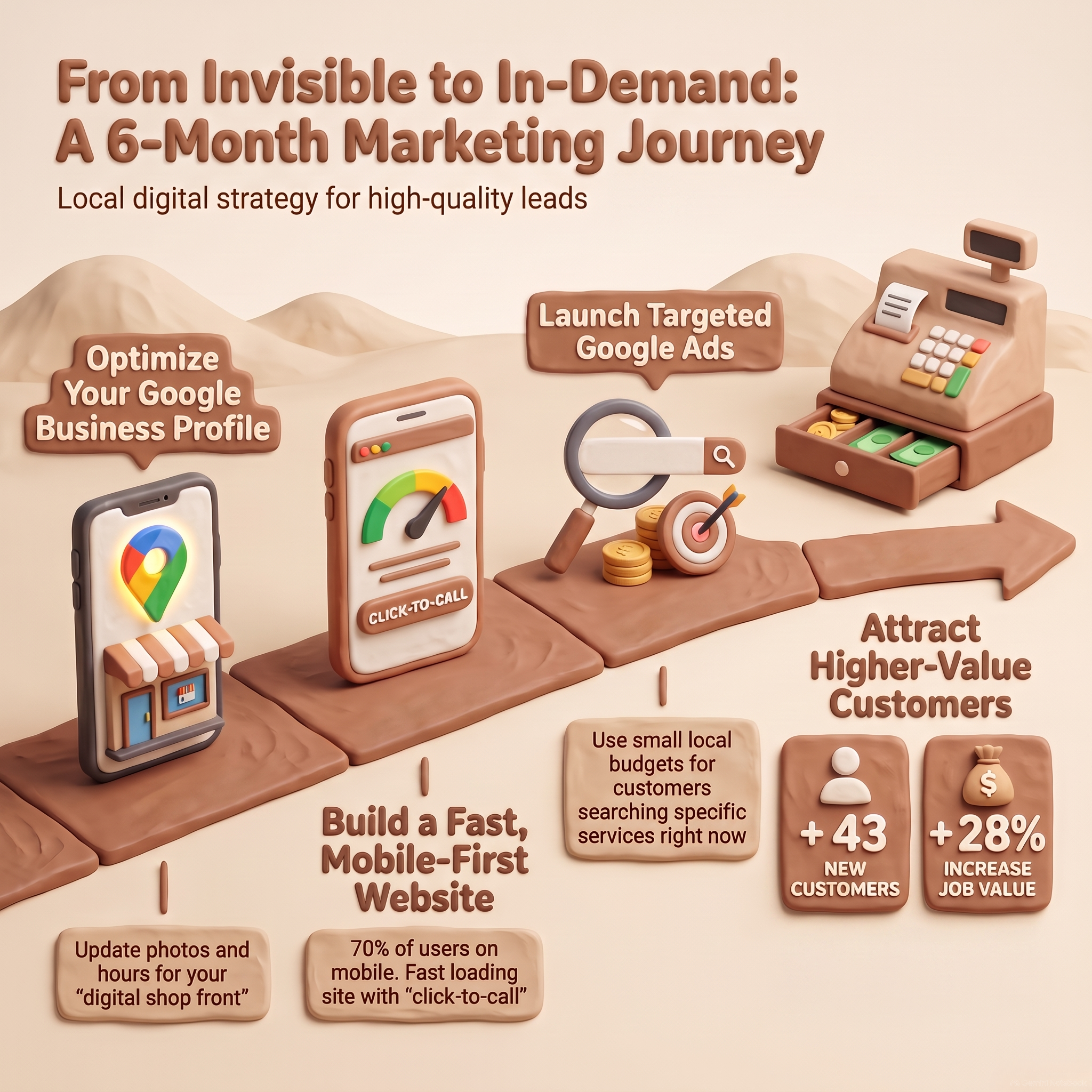
Here’s what Johan’s first six months of online marketing in Carletonville involved — and what genuinely surprised him:
Month One: The Foundations (Less Glamorous Than Expected)
The agency started with Google Business Profile optimisation. Johan had claimed his listing years ago and forgotten about it. It had three reviews, incorrect opening hours, and photos that looked like they were taken on a Nokia 3310.
Within two weeks:
- Fresh photos of the workshop, the team, actual work being done
- Accurate service descriptions with Carletonville-specific keywords
- A system to request reviews from satisfied customers (which, it turned out, he had plenty of — they’d just never been asked)
Cost so far: minimal. Impact: his Google Maps listing started appearing when locals searched for automotive services.
Months Two to Three: The Website That Actually Worked
Johan’s old site was a relic — a single page that took nine seconds to load and looked broken on mobile. Given that 70% of South African internet users access the web primarily via smartphone (according to the 2024 ICASA State of the ICT Sector report), this was like locking the front door and wondering why nobody came in.
The new site wasn’t fancy. It was functional:
- Mobile-first design that loaded fast even on patchy West Rand connectivity
- Clear service pages targeting what people actually searched for (“gearbox repair Carletonville”, “diesel service near me”)
- A click-to-call button that worked during load shedding (because the phone still rings when the power’s off)
- A simple contact form for after-hours enquiries
The designer asked questions about his actual customers, not abstract “user journeys.” What do they need fixed? What are they worried about? What makes them choose one workshop over another?
Months Four to Six: Google Ads and the Quality Shift
This is where Johan’s scepticism finally evaporated.
The agency set up a modest Google Ads campaign — R4,500 a month — targeting high-intent searches within a 20km radius. “Clutch replacement Carletonville.” “Engine diagnostics Fochville.” “Reliable mechanic West Rand.”
Within three weeks, the workshop started getting calls from people Johan had never met. They’d found him on Google, read his reviews, and were ready to book. No negotiating. No tyre-kicking. Just: “Can you fit me in this week?”
The numbers over six months:
- 43 new customers directly attributed to online channels
- Average job value 28% higher than walk-ins (because they’d researched and chosen him specifically, not just stopped because they drove past)
- 19 Google reviews added, lifting his rating from 3.8 to 4.6 stars
- Website traffic increased from roughly 30 visits a month to 340
But here’s what really changed Johan’s mind: the type of customer. These weren’t price shoppers. They were people who’d done their homework, valued expertise, and were willing to pay for quality. Exactly the customers he wanted.
What He Wishes He’d Known Sooner
Looking back, Johan admits he cost himself at least two years of growth by waiting.
“I thought I couldn’t afford it,” he says. “Turns out I couldn’t afford not to do it. Every month I delayed was another month my competitors were collecting reviews and showing up first on Google.”
Three insights stand out:
You Don’t Need to Be Everywhere
Johan didn’t touch TikTok. He didn’t “build a brand” on Instagram. He focused on the channels where his customers actually looked for services: Google Search, Google Maps, and a functional website.
For most Carletonville businesses, that’s the trinity. Not sexy. Extremely effective.
The Reviews Mattered More Than the Marketing
Once Johan had a system for collecting reviews, they became his best sales tool. According to BrightLocal’s 2024 research, 87% of consumers read online reviews for local businesses — and in a town like Carletonville, where competition is tight and reputation is everything, a strong Google review profile is worth more than any ad.
Local Expertise Made the Difference
The agency Johan chose understood Carletonville. They knew the West Rand economy. They knew mining families don’t search the same way Sandton corporates do. They knew load shedding affects when people browse (hint: evenings on mobile, when the power’s back and the kids are asleep).
Generic “digital marketing” doesn’t cut it. Online marketing in Carletonville has to account for local search behaviour, economic realities, and the specific way communities here make decisions.

The Six-Month Reality Check
Was it all sunshine and five-star reviews? Not quite.
Johan still gets the occasional price shopper. His competitors didn’t vanish. And there was a learning curve — understanding the reporting, trusting the process, resisting the urge to change everything after two weeks.
But his pipeline is full. His calendar is booked two weeks out. And for the first time in years, he’s getting enquiries from customers he didn’t have to chase.
“I thought online marketing was for restaurants and retail,” he says. “Turns out, it’s for anyone who wants their phone to ring with the right people on the other end.”
Frequently Asked Questions
Q: How much should a Carletonville business budget for online marketing?
A: It depends on your goals and industry, but a realistic starting point is R3,500–R7,500 per month for a combined strategy (Google Ads, SEO, and basic content). You don’t need enterprise budgets — you need consistency and local expertise.
Q: How long before you see results from online marketing?
A: Google Ads can generate enquiries within days. SEO and organic growth take 3–6 months to build momentum. The businesses that succeed are the ones that commit to at least six months and measure properly from the start.
Q: Do I need social media if I’m just a local Carletonville business?
A: Not necessarily. Focus first on Google Business Profile, local SEO, and your website. Social media can support your strategy, but most local service businesses get better ROI from search-based channels where people actively look for what you offer.
Q: What if my competitors are already ranking on Google?
A: Good. That means there’s search demand. You’re not trying to create a market — you’re claiming your share of it. With the right strategy, better reviews, and consistent optimisation, you can outrank competitors even if they had a head start.
If you’re running a business in Carletonville and watching your competitors show up on Google while you’re still waiting for the phone to ring, let’s have a conversation. Thickrope Marketing works with West Rand businesses to build online marketing strategies that actually generate enquiries — no fluff, just measurable results. [Book a free consultation](https://thickropemarketing.co.za/contact/) and let’s map out what six months could look like for you.