
What Happened When a Vanderbijlpark Business Finally Got a Website Built for Its Actual Market
For three years, I told myself our website was “fine.”
It existed. It had our logo at the top, a contact form somewhere near the bottom, and a few paragraphs about what we do. The designer who built it in 2020 used a standard template, charged a reasonable price, and handed over the login details. Job done, right?
Except the enquiries never really came through. Maybe one every few weeks, usually someone asking if we delivered to Johannesburg (we’re based in Vanderbijlpark, so… yes, but not ideal). Meanwhile, I’d see competitors — some of whom I knew were newer or smaller than us — showing up everywhere online. Google reviews, Facebook ads, websites that actually loaded properly on my phone.
I convinced myself it was the economy. Load shedding. The Vaal market being what it is. Anything but admitting the obvious: our website wasn’t built for anyone specific. It was built to tick a box.
Then a mate who runs a panel-beating shop in Three Rivers mentioned he’d just redone his site with a local agency. “Focused on Vaal customers,” he said. “Mobile-first, optimised for the searches people actually do around here. It’s been two months and I’m fielding enquiries I didn’t even know existed.”
That conversation cost me sleep. And eventually, it cost me my complacency.
What “Built for Our Market” Actually Meant
When I started talking to the web design team, I expected the usual: pick a colour scheme, upload some photos, done by Friday. Instead, they asked questions I’d never been asked before.
Who’s your actual customer? Not “businesses” or “the public” — specifically, who’s searching for what you do in Vanderbijlpark, Vereeniging, and Sasolburg?
What do they type into Google when they need you? (Spoiler: it’s not the industry jargon I’d plastered all over the old site.)
What happens when they visit your site on a Vodacom connection during load shedding, on a phone with 15% battery left?
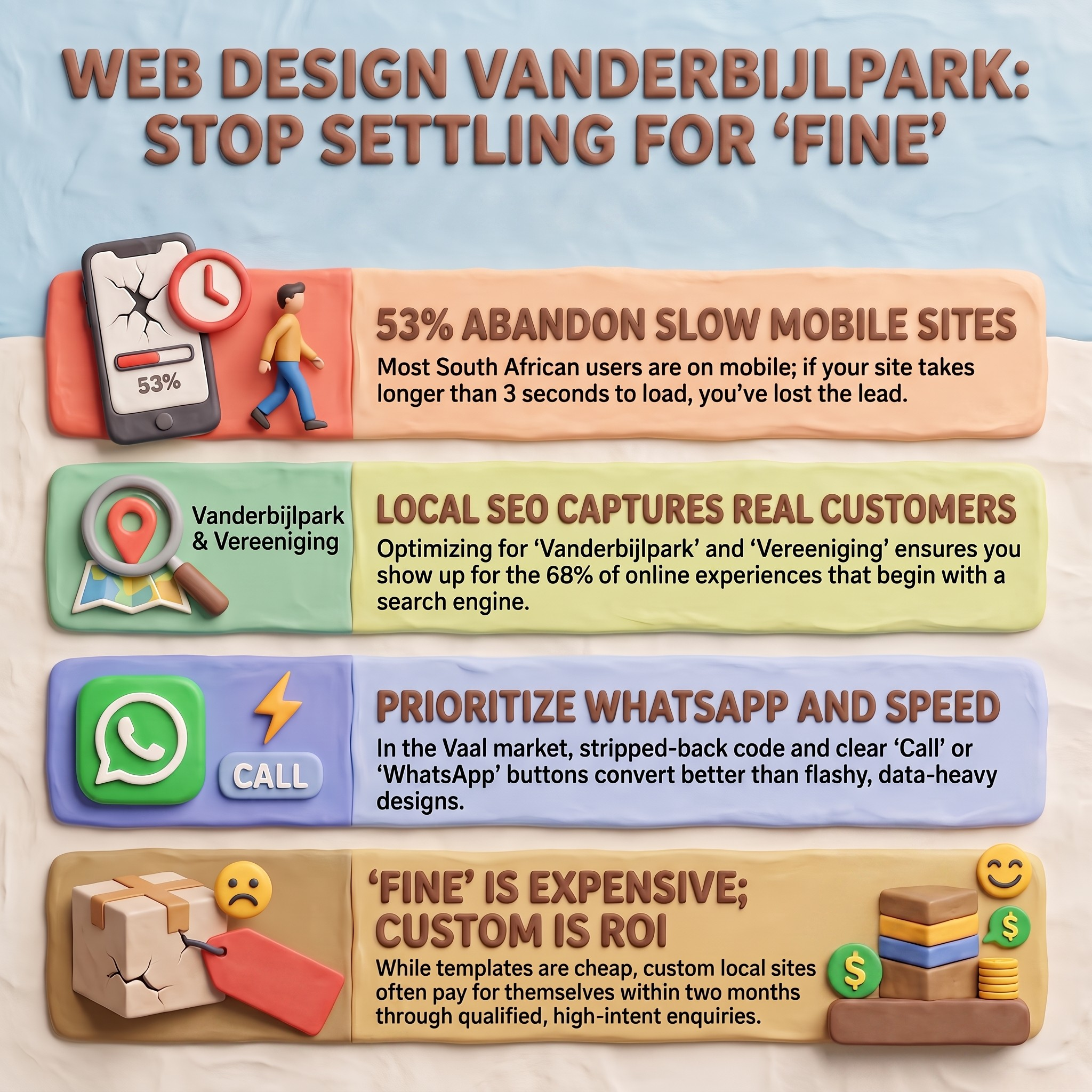
Turns out, none of that had been considered the first time around. The template looked decent on a laptop in a well-lit office, but according to Google, 53% of mobile users abandon sites that take longer than three seconds to load — and our old site clocked in at nearly eight seconds on 3G. Given that mobile accounts for the majority of web traffic in South Africa now, we’d essentially been turning people away at the door.
The new site was designed with Vanderbijlpark web design principles that actually acknowledged local realities:
- Fast loading, even on slower networks — stripped-back code, optimised images, nothing flashy that chews through data
- Mobile-first layout, because that’s how most of our customers find us
- Local SEO baked in — not as an afterthought, but from day one. Service pages mentioned Vanderbijlpark, Vereeniging, the Vaal Triangle. The blog covered topics our customers were actually Googling.
- Clear calls to action — “Get a quote,” “Call us now,” “WhatsApp us” (because let’s be honest, half our enquiries come through WhatsApp anyway)
What Changed (And How Quickly)
I’m not going to pretend it was overnight magic. The site went live on a Tuesday. By Friday, nothing dramatic had shifted. But within three weeks, I started noticing things.
Our Google My Business profile — which we’d barely touched in years — suddenly had more views. The phone rang more often, and when I asked how people found us, they said “Google” instead of “my boet recommended you.”
The enquiries were better, too. People who’d clearly spent time on the site, read about what we do, and were ready to talk specifics instead of just tyre-kicking. According to research from BrightEdge, 68% of online experiences begin with a search engine, and for the first time, we were showing up for the searches that mattered in our area.
Two months in, we’d had more qualified leads than in the previous six months combined. Not Johannesburg tyre-kickers or random spam — actual Vanderbijlpark and Vereeniging customers who needed exactly what we offer.
The part that surprised me? How much the website became a working tool for the business, not just a digital business card. Our team started sending links to specific service pages when quoting. Customers would reference things they’d read in our FAQ section. We even had someone mention a blog post about dealing with supply delays during load shedding — something the previous site never would’ve covered, because it wasn’t built to speak to real people in a real place.
What the Process Actually Looked Like
I won’t lie: there were moments I wondered if we should’ve just stuck with “fine.”
The discovery phase felt long. Lots of questions, worksheets about our customers, discussions about competitors I’d never really analysed properly. But that’s where the value was. The designer wasn’t just taking orders — they were digging into what would actually work for a Vanderbijlpark business trying to reach Vaal customers.
They handled the technical side (hosting, security, mobile optimisation), but also pushed us on content. What makes you different from the guy in Meyerton doing the same thing? Why should someone choose you over a bigger Joburg operation?
We had to answer those questions honestly, and once we did, the website basically wrote itself.
The whole process — from first meeting to launch — took about six weeks. Not instant, but not dragged out either. And crucially, they trained us to update basic content ourselves, so we’re not held hostage every time we want to change a phone number or add a service.
What I Wish I’d Known Three Years Ago
That “fine” is expensive.
Every month we had that template site sitting there, generating nothing, we were losing ground. Not just to competitors with better websites, but to the basic reality that Google prioritises sites that load fast, work on mobile, and actually answer what people are searching for. Our old site did none of that.
I also wish I’d known that web design for Vanderbijlpark businesses isn’t the same as web design for everywhere. The Vaal market has its own search patterns, its own economic realities, its own mix of industries and demographics. A site built by someone who understands that — and who optimises for “web design Vanderbijlpark” or “panel beaters Vereeniging” or whatever your niche is — performs differently than a generic template.
And I wish I’d known how much easier business gets when your website actually works for you. Fewer time-wasters, more serious enquiries, customers who arrive half-sold because they’ve already seen what you do and how you do it.
Would I Do It Again?
Without hesitation. And I’d do it sooner.
The return on investment wasn’t just the extra enquiries (though that alone justified the cost within two months). It was the credibility. The confidence of sending someone to our site and knowing they’d see something professional, fast, and relevant. The relief of not losing customers to a slow-loading mobile mess.
If you’re a Vanderbijlpark business owner reading this and thinking, “Our site is… fine,” I’d gently suggest you’re probably wrong. Or at least, you’re leaving money on the table.
The web design landscape has shifted. What worked in 2019 doesn’t work now, especially not in a market where mobile dominates, attention spans are short, and local competition is fiercer than ever. According to Statista, South Africa’s internet penetration reached over 70% in recent years, meaning your customers are online — the question is whether they’re finding you or your competitors.
Frequently Asked Questions
Q: How much should a proper Vanderbijlpark web design actually cost?
A: It varies depending on complexity, but expect to invest anywhere from R8,000 to R25,000 for a professional, locally-optimised small business site. Cheaper options exist, but they’re usually templates that won’t perform in local search. If someone quotes you R2,000 for a full custom site, you’re getting a template with your logo slapped on it.
Q: How long before a new website starts generating enquiries?
A: If it’s built with proper local SEO from the start, you’ll typically see increased visibility within 4–8 weeks. Enquiries depend on your industry and competition, but most Vaal businesses notice a measurable uptick within the first two months. It’s not instant, but it’s also not a year-long wait.
Q: Can’t I just use a DIY website builder and save money?
A: You can, and some business owners do — but you’ll spend hours learning the platform, you won’t have local SEO expertise, and you’ll likely end up with a site that looks “homemade” (because it is). For a business serious about competing in Vanderbijlpark, Vereeniging, or the broader Vaal market, a professionally built site pays for itself quickly.
Q: What’s the difference between a template site and a custom-built one?
A: Templates are pre-designed layouts you adapt to your business — fast and cheap, but generic and often not optimised for local search or mobile performance. Custom builds are designed specifically for your business, your market, and your customers. They load faster, rank better, and convert more visitors into enquiries.
Q: Do I need to know anything technical to manage the site afterwards?
A: Not if it’s built properly. A good web design team will train you to update basic content (text, images, contact details) yourself, while handling the technical stuff (security, hosting, updates) on your behalf. You shouldn’t need a developer just to change your opening hours.
If your website’s been sitting there doing nothing — or worse, actively losing you business — it might be time for a proper conversation about web design that’s built for Vanderbijlpark, not just borrowed from a template library in California. Thickrope Marketing works with Vaal businesses to build fast, locally optimised sites that actually generate enquiries. [Get in touch](https://thickrope.co.za/contact) and let’s talk about what a site built for your actual market could do for you.