

Why Your Vanderbijlpark Ads Are Bleeding Money (And What the Vaal Triangle Actually Needs)
You’re running digital ads. The dashboard shows “impressions.” The invoice shows rand signs. But the till? Crickets.
If you’re a Vanderbijlpark business owner watching your ad budget disappear into the digital void, you’re not alone — and you’re definitely not imagining it. There are specific, fixable reasons why Vanderbijlpark ads fail, and most of them have nothing to do with your product or your market. They have everything to do with how those campaigns were set up in the first place.
Let’s talk about what’s actually going wrong.
The Geographic Targeting Disaster No One Mentions
Here’s a fact that’ll make you wince: most “local” ad campaigns targeting Vanderbijlpark are actually showing ads to people in Johannesburg, Pretoria, and sometimes even Bloemfontein.
Why? Because the person setting up the campaign selected “Gauteng” as the target region, or chose a radius around Vanderbijlpark without excluding “people interested in this location” — which, in Google Ads speak, means anyone who’s ever Googled “Vereeniging industrial supplies” from their couch in Sandton.
According to WordStream’s benchmarking data, poorly targeted geographic campaigns can waste up to 61% of total ad spend on irrelevant clicks. In a South African context, where your ad budget might be R5,000 a month (not R50,000), that’s R3,050 you’ve just handed to people who will never walk through your door.
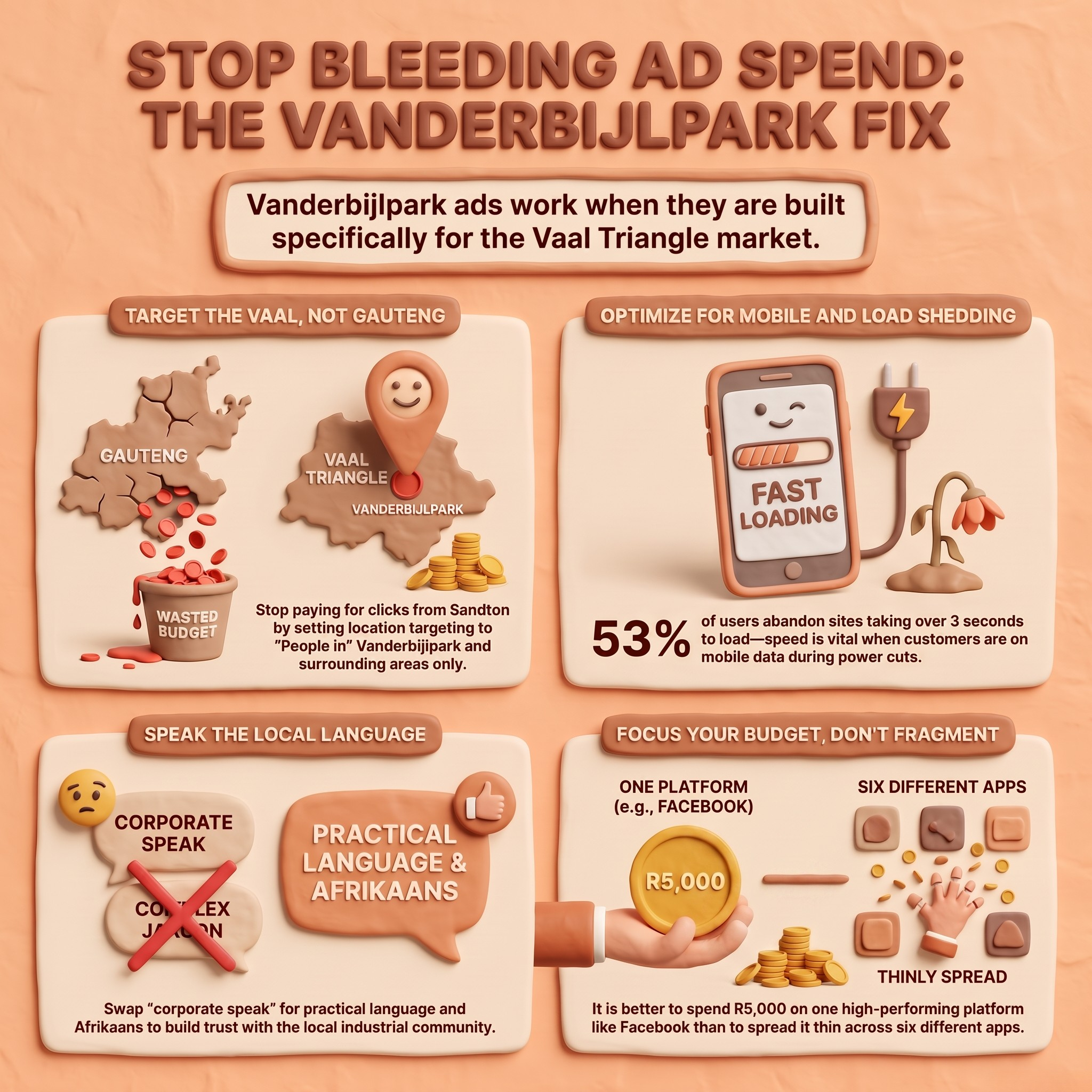
The Vanderbijlpark-specific problem: The Vaal Triangle isn’t Johannesburg. Your customers are coming from Vereeniging, Sasolburg, Three Rivers, and the surrounding industrial areas. They’re not coming from Sandton. But if your campaign is set to “People in, regularly in, or who’ve shown interest in Vanderbijlpark,” you’re paying for clicks from people planning a day trip to the Vaal River — not buying your service.
What proper geographic targeting looks like
Set your campaigns to target “People in or regularly in” only — not “people interested in.” Then be specific: Vanderbijlpark, Vereeniging, Sasolburg, Three Rivers, and Meyerton if it’s relevant. Exclude Johannesburg metro, Pretoria, and other major centres unless you actually service them.
And here’s the kicker: use location bid adjustments. If you know 70% of your customers come from Vanderbijlpark itself, increase your bids by 30% for that area. Decrease them by 20% for Sasolburg if that’s further out. You’re not trying to reach everyone. You’re trying to reach the right everyone.
The “One Size Fits Gauteng” Messaging Problem
Let’s be honest: Vanderbijlpark doesn’t talk like Sandton. It doesn’t think like Rosebank. And it sure as hell doesn’t spend like Constantia.
Yet most ad campaigns for Vaal Triangle businesses use generic, corporate-sounding copy that could’ve been written for any suburb in any province. “Premium solutions.” “Industry-leading service.” “Your trusted partner.”
Cool. But does it land here?
Vanderbijlpark is an industrial town with a strong working-class backbone, Afrikaans and English linguistic mix, and a healthy scepticism toward anything that sounds too fancy. According to Stats SA’s 2022 census data, the median household income in the Emfuleni Local Municipality (which includes Vanderbijlpark) is significantly lower than Johannesburg’s northern suburbs — and your ad copy needs to reflect the value conversation your actual customers are having.
What works better:
- Price transparency. Don’t make people click three times to find out what you charge.
- Practical language. “Fast turnaround” beats “agile workflow optimisation.”
- Local reference points. “Serving Vanderbijlpark and the Vaal Triangle since 2015” beats “Gauteng’s premier provider.”
- Afrikaans consideration. If a significant portion of your market speaks Afrikaans as a first language, test bilingual ads or dedicated Afrikaans campaigns. You’d be surprised how much trust that builds.
If your ad sounds like it was written by a Johannesburg agency for a Johannesburg audience, Vanderbijlpark will scroll right past it.

The Platform Mismatch: Where Vanderbijlpark Actually Scrolls
Here’s a lesser-known reality: Facebook still dominates in smaller South African towns in a way it doesn’t in metropolitan areas anymore.
According to Hootsuite’s 2023 Digital Report for South Africa, Facebook remains the most-used social platform nationally, with 24.5 million users. But the breakdown matters: in urban centres like Cape Town and Johannesburg, Instagram and TikTok have steadily eaten into Facebook’s dominance among younger demographics. In places like Vanderbijlpark? Facebook is still where your customers are spending their evening scroll time.
Yet many businesses are pouring money into Google Ads (which can work brilliantly for high-intent searches) while completely ignoring Facebook and Instagram, or vice versa — dumping budget into Instagram when their actual customer base is 45-year-old tradespeople who haven’t opened Instagram in a month.
The fix is boring but effective: ask your existing customers where they heard about you, and where they spend time online. Then weight your budget accordingly.
The load shedding layer
And here’s the Vanderbijlpark-specific wrinkle: mobile data consumption spikes during load shedding. When the power’s out and the Wi-Fi’s down, your customers are on their phones, scrolling on data. If your ads aren’t optimised for mobile, or if your landing page takes 8 seconds to load on a 3G connection, you’ve just wasted another chunk of budget.
Google’s research shows that 53% of mobile users abandon sites that take longer than 3 seconds to load. In South Africa, where load shedding has pushed more people onto mobile-first behaviour, that number is likely even higher. Your Vanderbijlpark ads might be working — but your landing page is letting you down before the customer even sees your offer.
The Budget Allocation Blindspot
Let’s talk money. Most small Vanderbijlpark businesses are running digital ads on a monthly budget of between R3,000 and R8,000. That’s not a criticism — it’s reality. But here’s what often happens with that budget:
- R2,000 goes to a Google Search campaign targeting 47 different keywords (so you’re getting 3 clicks per keyword per month, none of which convert)
- R2,000 goes to a Facebook campaign with no clear objective, just “boost this post”
- R1,500 goes to an Instagram campaign because “we should be on Instagram”
- R500 goes to a Google Display campaign that’s showing your ad on random news sites
You’ve just split your budget six ways, none of which have enough volume to generate meaningful data or results.
The better approach for smaller budgets: focus. Pick one platform where your audience actually is, and *one* campaign type that matches your goal. If you’re a Vanderbijlpark plumber, you don’t need Instagram. You need Google Search ads for “emergency plumber Vanderbijlpark” and maybe a Facebook campaign targeting homeowners within 15km. That’s it. Spend your full R5,000 there, get enough data to optimise, and expand only once that’s working.
Splitting a small budget across multiple platforms is like watering six plants with a teaspoon. Nothing grows.

The Tracking Gap That’s Costing You Conversions
Here’s a question: when someone clicks your ad, can you tell what they did next?
Did they call you? Fill in a form? Visit your location? Or did they bounce because your “Contact Us” page is actually just a Google Form that doesn’t work on mobile?
Most Vanderbijlpark businesses we’ve worked with have no conversion tracking set up. None. They’re running ads, seeing clicks, and then… hoping. They don’t know which keywords led to sales, which audiences actually converted, or whether their Monday morning ads perform better than their Friday afternoon ones.
Without conversion tracking, you’re flying blind. You can’t optimise what you can’t measure. And in a tough economy, that’s not a luxury — it’s a death sentence for your marketing budget.
What proper tracking looks like
- Google Ads conversion tracking installed (tracking form submissions, phone calls, and button clicks)
- Facebook Pixel installed and firing correctly (yes, even post-iOS 14)
- Google Analytics 4 set up with goals that match your business outcomes
- Call tracking numbers if phone calls are a primary conversion path
It’s not sexy. But it’s the difference between “we got 200 clicks this month” and “we got 200 clicks, 14 phone calls, and 3 jobs worth R22,000.”
The Agency Problem: Johannesburg Solutions for Vaal Triangle Businesses
Let’s be diplomatic: many Johannesburg-based agencies don’t understand the Vanderbijlpark market. They’ll apply the same campaign structure, keyword strategy, and ad copy they use for a Sandton restaurant to your Vanderbijlpark engineering firm.
The result? Impressions, clicks, and invoices — but no customers.
You don’t need someone who’s run campaigns for multinational brands. You need someone who understands that “affordable” matters more than “premium” in your market, that R500 is a real objection (not a rounding error), and that your customer’s decision-making process involves word-of-mouth, local reputation, and whether your oom played rugby with their oom in the ’90s.
Vanderbijlpark ads work when they’re built for Vanderbijlpark. Not Johannesburg. Not Cape Town. Here.

What Good Vanderbijlpark Ads Actually Look Like
So what does success look like?
Let’s say you’re a Vanderbijlpark-based auto repair shop. Here’s what a properly structured campaign might include:
Google Search Campaign
- Tightly themed ad groups: “brake repair Vanderbijlpark,” “car service Vaal Triangle,” “auto electrical Vereeniging”
- Location extensions showing your exact address
- Call extensions with a local number (not a Johannesburg code)
- Ad copy mentioning your location and turnaround time: “Same-day brake repairs in Vanderbijlpark. Free quotes. Call now.”
- Negative keywords excluding “jobs,” “training,” “courses” (unless you offer those)
Facebook Campaign
- Audience: 25-65, within 15km of Vanderbijlpark, interests in automotive, DIY, and local business pages
- Ad creative: photo of your actual workshop (not stock images), testimonial from a local customer
- Offer: “R200 off your next service – mention this ad”
- Landing page: mobile-friendly, loads fast, shows pricing upfront
Budget allocation
- 70% to Google Search (high intent, people actively searching for your service)
- 30% to Facebook (brand awareness, retargeting, special offers)
- R0 to Instagram, TikTok, or LinkedIn unless your specific business case demands it
That’s a campaign built for the local market. It respects the audience, speaks their language, and doesn’t waste money on people in Pretoria who will never become customers.
Frequently Asked Questions
Q: How much should a Vanderbijlpark business spend on digital ads per month?
A: It depends on your industry and goals, but most local businesses see meaningful results starting at R4,000–R6,000 per month when campaigns are properly targeted. Less than R3,000 often doesn’t provide enough volume to optimise effectively. More important than the amount is how it’s allocated — focus beats fragmentation.
Q: Should I run ads in Afrikaans or English for the Vanderbijlpark market?
A: Test both, but lean toward bilingual or Afrikaans-heavy campaigns if your customer base is predominantly Afrikaans-speaking. Language builds trust. If you’re unsure, start with English ads and monitor performance, then add Afrikaans variants to see if engagement or conversion rates improve. Often, they do.
Q: Why are my Google Ads getting clicks but no phone calls?
A: Three common reasons: your ad is attracting the wrong audience (poor keyword targeting or geographic settings), your landing page isn’t mobile-friendly or loads too slowly, or you’re not making it easy to contact you (hidden phone number, complicated forms). Check your mobile experience first — that’s where most Vanderbijlpark clicks are happening.
Q: Is Facebook still worth it for Vanderbijlpark businesses, or should I focus on Google?
A: Facebook still works exceptionally well in the Vaal Triangle, especially for businesses targeting local consumers (retail, restaurants, home services). Google is better for high-intent searches (“plumber near me”), while Facebook excels at building awareness and reaching people who aren’t actively searching yet. For most Vanderbijlpark businesses, a combination of both — weighted toward where your customers actually spend time — is ideal.
—
If you’re a Vanderbijlpark business owner tired of watching ad budgets evaporate without results, let’s fix it. Thickrope Marketing specialises in local ad campaigns that actually work for Vaal Triangle businesses — proper targeting, smart budgets, and messaging that resonates here. Book a free 30-minute ad audit and let’s see where your money’s really going.