

Why Your Roodepoort Business Website Needs More Than a Shopify Template and a Postcode
Here’s the uncomfortable truth: most Roodepoort business websites are indistinguishable from their Johannesburg North competitors, their Cape Town counterparts, or that bloke in Ballito selling roughly the same thing.
Same template. Same stock photos of diverse people shaking hands in suspiciously clean boardrooms. Same “Contact Us” form that leads nowhere fast.
And then business owners wonder why the enquiries aren’t flowing, why the bounce rate looks like load shedding frequency, and why that R15,000 spent on a “professional website” hasn’t translated into a single qualified lead from Florida, Wilgeheuwel, or Honeydew.
The problem isn’t that templates are inherently rubbish. It’s that a website built for anywhere is optimised for nowhere — and in the hyper-competitive West Rand market, generic doesn’t cut it anymore.
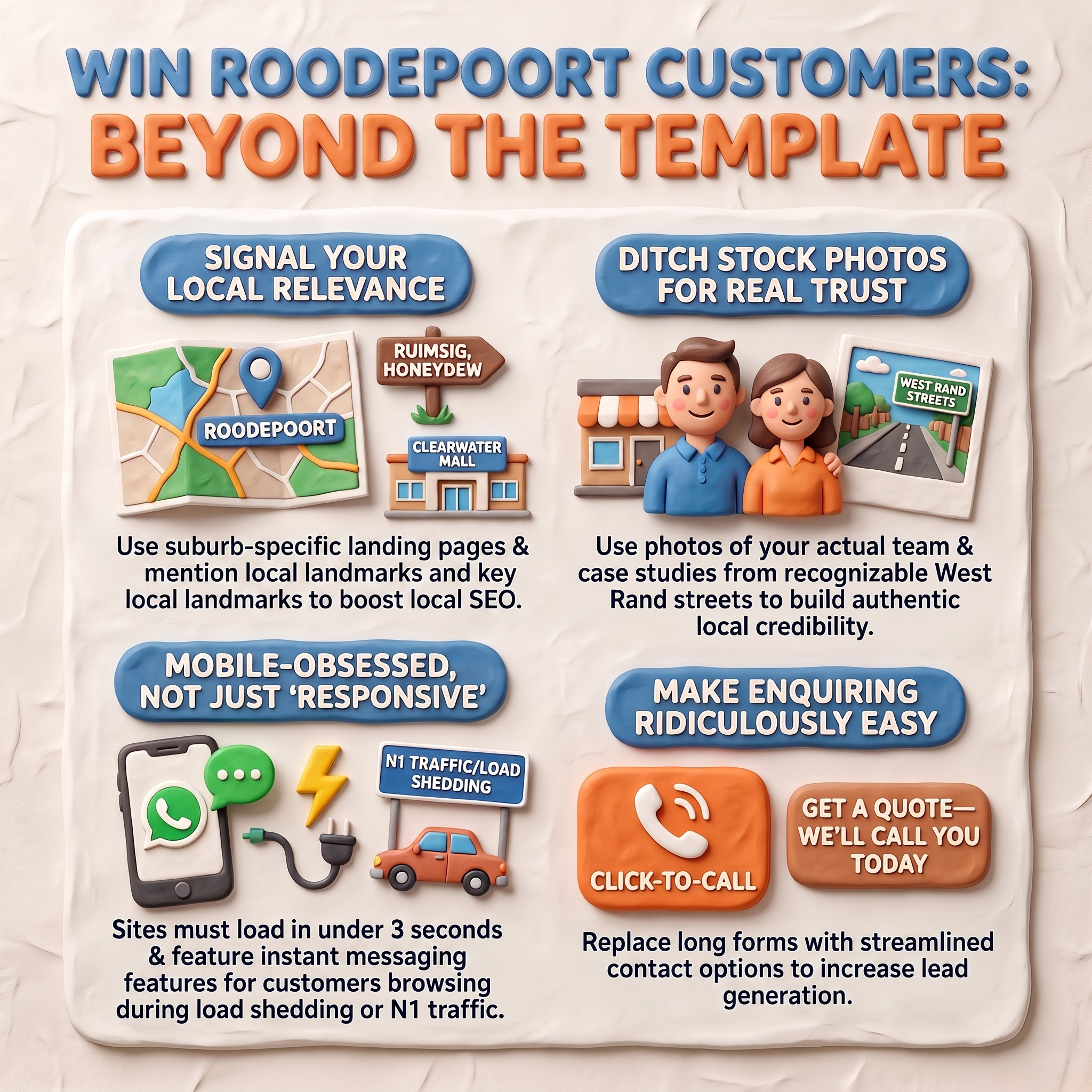
The Geographic Blind Spot That’s Costing You Roodepoort Customers
Let’s start with the obvious bit that most template websites completely miss: service area clarity.
When someone in Roodepoort searches “electrician near me” or “web design in Roodepoort,” Google’s local algorithm is looking for signals that you actually serve that area. Not just that your business address happens to be there, but that your website demonstrates relevance to that specific geography.
According to Google’s own research, 76% of people who search for something nearby on their smartphone visit a related business within a day. That’s enormous intent. But here’s the kicker: if your website doesn’t clearly communicate where you operate, what suburbs you cover, and why someone in Ruimsig or Honeydew should choose you over the crowd, Google won’t surface you — and the customer certainly won’t convert.
A generic template gives you one “Contact” page with a Google Map embed. A Roodepoort-focused website includes:
- Explicit service area mentions in body copy, headers, and metadata (not keyword-stuffed, but naturally woven in)
- Suburb-specific landing pages or content blocks for Florida, Wilgeheuwel, Laser Park, Constantia Kloof — wherever your vans actually go
- Local landmark references that signal genuine familiarity (Clearwater Mall, the N1 Western Bypass, Silverstar Casino)
- Testimonials from recognisable areas — “Thanks for sorting our plumbing disaster in Weltevredenpark” beats “Great service!” every time
This isn’t about tricking Google. It’s about making it dead easy for both the algorithm and the human to understand: you’re here, you operate here, and you know this market.
Trust Signals That Matter on the West Rand (And Why Templates Ignore Them)
Roodepoort and the broader West Rand aren’t Sandton. The buying psychology is different. The trust threshold is higher. Your website needs to acknowledge that.
A 2023 BrightLocal study found that 98% of consumers read online reviews for local businesses, and 76% trust online reviews as much as personal recommendations. But in South Africa’s digital landscape — where scam ads proliferate and dodgy operators vanish faster than Eskom’s promises — local trust signals carry even more weight.
Your website needs:
Real Faces, Real Names, Real Roodepoort Context
Templates give you a “Meet the Team” page with first names and job titles. A Roodepoort business website shows who you actually are: surnames, photos taken locally (not stock images), maybe even a casual mention of where you grab your morning coffee or which school your kids attend. It’s the digital equivalent of seeing someone at Spar on a Saturday — familiarity breeds trust.
Proof You’ve Been Around the Block
How long have you been operating? Have you survived multiple load shedding stages, a pandemic, and the petrol price rollercoaster? Say so. Longevity matters in a market where fly-by-night operators are common. If you’ve been serving the West Rand for ten years, that’s a competitive advantage — put it front and centre.
Case Studies That Sound Like Your Street
“We helped a manufacturing client in Johannesburg increase revenue by 300%” means nothing to the panel beater in Horizon View. But “We redesigned the website for a Krugersdorp engineering firm and their qualified leads from Mogale City tripled in four months” — now you’re speaking Roodepoort.

Mobile-First Isn’t a Buzzword When Your Customers Are Sitting in N1 Traffic
Google reports that 61% of users are unlikely to return to a mobile site they had trouble accessing, and 40% visit a competitor’s site instead. In South Africa, where mobile is the primary (and often only) way people access the internet, this isn’t a nice-to-have — it’s existential.
Your Roodepoort customer is probably viewing your website:
- While stuck in traffic on the N1 between Krugersdorp and Johannesburg
- During load shedding, relying on mobile data because the fibre is out
- On an entry-level Android device with limited processing power
- On a patchy 3G connection in parts of Honeydew or Featherbrooke Estate
A template website gives you “responsive design” — which usually means it technically fits on a mobile screen, but loads slowly, buries the phone number three taps deep, and makes filling in a form feel like a punishment.
A proper Roodepoort business website is mobile-obsessed:
- Click-to-call phone number prominently displayed (not hidden in a hamburger menu)
- WhatsApp button for instant contact (because that’s how South Africans actually communicate)
- Forms with minimal fields — name, number, and one-line description is enough
- Ruthlessly optimised images and code so the site loads in under three seconds, even on slow connections
- Service area map that’s finger-friendly, not microscopic
The difference shows up in bounce rate, time on site, and — most importantly — actual enquiries from actual West Rand customers with actual budgets.
The SEO Layer Templates Can’t Replicate
Here’s where the gap between a R5,000 template and proper web design in Roodepoort becomes a chasm.
Generic templates are built for global flexibility, which means they’re optimised for nothing specific. The metadata is generic. The heading structure is an afterthought. The internal linking is random. And the schema markup — the code that tells Google what your business actually does and where you do it — is either absent or badly implemented.
A Roodepoort-focused website is built with local search intent baked in:
Schema Markup for Local Business
This tells Google: here’s our business name, here’s our exact service area (Roodepoort, Krugersdorp, Mogale City, Randburg West), here’s our phone number, here’s our review rating. It’s the difference between appearing in the local pack (those three businesses with map pins) and disappearing into page two oblivion.
Content That Answers Roodepoort-Specific Searches
Your potential customers aren’t just searching “plumber” or “accountant.” They’re searching:
- “Emergency plumber Ruimsig”
- “Affordable web design Roodepoort”
- “Accountant for small business Honeydew”
- “Panel beater near Clearwater Mall”
A template website has a generic “Services” page. A Roodepoort website has content that specifically addresses these searches — not through keyword stuffing, but through genuinely useful information about what you do, where you do it, and why it matters.
Internal Linking That Guides the User Journey
Templates drop pages into a navigation menu and call it a day. Strategic web design in Roodepoort creates a flow: service page links to relevant case study, which links to suburb-specific content, which links to contact page with clear next steps. This keeps users engaged, reduces bounce rate, and signals to Google that your site is worth ranking.

What “Conversion Optimisation” Actually Means in Roodepoort
Let’s talk about what happens when someone lands on your website — assuming your SEO is working and you’re getting traffic.
According to research by HubSpot, the average website conversion rate across industries is between 2-3%. That means for every 100 visitors, you’re converting two or three into enquiries or sales. Improve that to 5%, and you’ve more than doubled your return on every rand spent driving traffic.
But here’s what templates get wrong about conversion optimisation for Roodepoort businesses:
The “Contact Us” Black Hole
Most template websites have a contact form that asks for: name, email, phone, company name, message, budget, timeline, preferred contact method, shoe size, and blood type. Then it submits into a generic inbox that gets checked twice a week.
A Roodepoort business website makes enquiry ridiculously easy:
- Phone number clickable from mobile (one tap to call)
- WhatsApp integration (because that’s where the conversation actually happens)
- Short form with just the essentials — you can get the details later
- Immediate confirmation: “Thanks, we’ll call you within 2 hours” (and then actually doing that)
The Call-to-Action That Actually Reflects How West Rand Customers Buy
“Schedule a Consultation” might work in Sandton. In Roodepoort, your CTA needs to be more direct:
- “Get a Free Quote — We’ll Call You Today”
- “WhatsApp Us Now for Same-Day Response”
- “Call Now: 011 XXX XXXX — We Answer, Even During Load Shedding”
It’s not about dumbing it down. It’s about respecting that your customer is time-poor, sceptical of corporate waffle, and wants to know you’re a real business that answers the bloody phone.
Social Proof in the Right Places
Templates put testimonials on a dedicated page that nobody visits. Smart Roodepoort web design sprinkles proof throughout:
- Review snippets on the homepage
- Star ratings in the header
- Case study callouts on service pages
- “As Featured In” logos if you’ve been in local media or industry publications
Every page should answer the unspoken question: “Why should I trust you with my money?”
The Cost of Getting It Wrong (And Why “Cheap” Is Expensive)
Here’s the maths that most Roodepoort business owners don’t do:
You pay R8,000 for a template website. It looks fine. It’s online. Box ticked.
But it converts at 1% instead of 4% because the trust signals are missing, the mobile experience is clunky, and the local SEO is non-existent.
If you’re spending R5,000 a month on Google Ads or any form of marketing, that’s the difference between 10 enquiries and 40 enquiries. Over a year, that “cheap” website has cost you 360 potential customers.
Now factor in that each customer might be worth R5,000, R10,000, or R50,000 in lifetime value depending on your business. The real cost of that template isn’t R8,000. It’s hundreds of thousands in lost opportunity.
This isn’t about vanity. It’s about return on investment — and in a tough economy, every click, every visit, and every enquiry needs to count.

What “Web Design in Roodepoort” Actually Means for Your Business
When you’re looking for web design in Roodepoort, you’re not just buying a website. You’re investing in a digital asset that:
- Shows up when West Rand customers search for what you do
- Builds trust fast with people who’ve never heard of you
- Converts mobile traffic into actual enquiries
- Reflects the reality of how business works on the West Rand — direct, practical, results-focused
A template can’t do that. A contractor in the Philippines working off a brief can’t do that. Even a Johannesburg agency that’s never set foot west of the N1 will struggle to capture the nuance.
You need someone who understands that Roodepoort isn’t just a postcode — it’s a market with its own rhythm, its own trust signals, and its own way of doing business.
Frequently Asked Questions
Q: Can’t I just use a template and optimise it myself for Roodepoort?
A: Technically, yes — but it’s like trying to turn a Corolla into a bakkie by adding a trailer. The foundation matters. Templates lack the schema markup, internal linking structure, and mobile optimisation needed for local SEO. You’ll spend more time and money retrofitting than building it properly from scratch.
Q: How much should proper web design cost for a Roodepoort business?
A: For a professional, conversion-focused website with local SEO built in, expect R15,000 to R40,000 depending on complexity. Anything significantly cheaper is likely a template with minimal customisation. Anything significantly more expensive should come with very clear justification — custom functionality, e-commerce integration, or extensive content creation.
Q: How long does it take to see results from a new Roodepoort-focused website?
A: Local SEO improvements typically show within 4-8 weeks once the site is live and properly indexed. Conversion rate improvements are immediate if the user experience is significantly better. If you’re combining the new website with Google Ads or other traffic sources, you’ll see impact within days — better conversion rate means better cost-per-lead instantly.
Q: Do I need separate pages for every suburb I serve on the West Rand?
A: Not necessarily individual pages, but your service areas should be clearly mentioned throughout the site. For competitive industries (plumbers, electricians, web designers), dedicated suburb pages can help. For niche B2B services, a well-optimised “Areas We Serve” section with proper schema markup is often enough.
Q: What’s the biggest mistake Roodepoort businesses make with their websites?
A: Treating the website as a one-time project instead of an ongoing asset. Your competitors are improving their sites, Google’s algorithm is evolving, and customer expectations are rising. A website that isn’t regularly updated with fresh content, new testimonials, and technical improvements will steadily lose ground — no matter how good it was on launch day.
If your current website feels more like a business card than a sales tool, let’s talk. Thickrope builds websites for West Rand businesses that need to show up locally, convert consistently, and deliver measurable return — [get in touch for a free website audit](https://thickrope.co.za/contact) and we’ll show you exactly where the gaps are.