

Digital PR and Link Building Work Better Together — Here’s What That Actually Looks Like for SA Businesses
Here’s something most South African businesses don’t know: the best links you’ll ever build won’t come from outreach emails or guest post pitches. They’ll come from journalists writing about you.
And the best PR coverage you’ll ever get won’t just boost your brand — it’ll drop authoritative backlinks into your site that Google treats like gold.
Most businesses treat digital PR and link building as separate line items, separate agencies, separate budgets. That separation is costing you money. More importantly, it’s costing you compounding momentum in a digital ecosystem where South African businesses are already fighting for visibility against international competition with bigger budgets.
Let’s talk about what happens when you stop treating these two as strangers at a braai and start letting them work together.
The Problem: Link Building Without PR Is Just Begging, and PR Without Links Is Just Noise
Traditional link building in South Africa looks like this: you (or your agency) send cold emails to website owners asking if they’d kindly link to your brilliant content. Most ignore you. Some ask for money. A few say yes if your content is genuinely useful.
It works. Slowly. And it produces links that range from “decent” to “meh, it’ll do.”
Traditional PR looks like this: you send press releases or pitch stories to journalists. If you’re lucky and the story’s good, you get coverage in News24, Business Tech, Daily Maverick, or a trade publication. Your CEO gets to share the article on LinkedIn. Your brand gets a visibility bump.
But here’s what most SA businesses miss: that media coverage almost always includes a link back to your website. And because it’s coming from a high-authority South African news site or industry publication, Google treats it very differently than a link from a random blog that accepted your guest post.
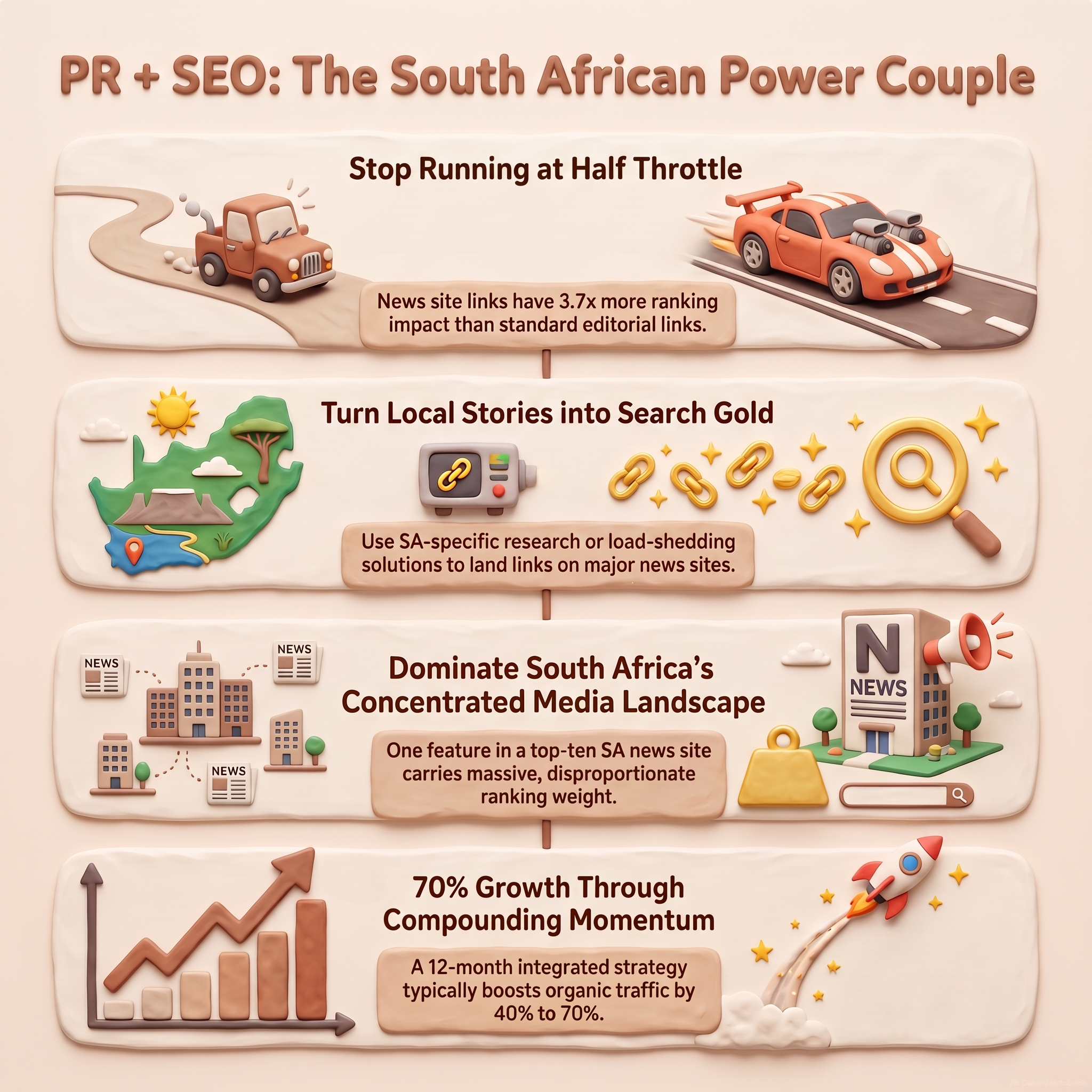
According to Moz’s 2024 Link Building Survey, links from news and media sites have 3.7 times more ranking impact than standard editorial links — and that gap is even wider in smaller digital ecosystems like South Africa, where authoritative local domains carry disproportionate weight in local search rankings.
When you separate PR and link building, you’re running two engines at half throttle. When you combine them, you’re not just adding — you’re multiplying.
What an Integrated Strategy Actually Looks Like in the South African Market
Let’s get practical. Here’s what it looks like when a digital PR link building agency runs both strategies as one campaign for a South African business.
Step One: Build a Story That Journalists Want and Google Rewards
You’re not writing a press release about your new product feature. You’re building a story angle that local media will actually cover — and that naturally includes links to your site.
Examples that work in SA:
- Original research or survey data about South African consumer behaviour
- Local business resilience stories (how you’ve navigated load shedding, logistics challenges, economic headwinds)
- Commentary on regulatory changes, industry shifts, or economic trends with a clear SA angle
- Seasonal hooks tied to local events (Black Friday SA shopping trends, festive season logistics, back-to-school spending patterns)
The key: the story has to be genuinely newsworthy. Journalists aren’t going to write about your company just because you asked nicely. But if you’ve surveyed 500 South African SMEs about their digital marketing challenges, or if you’ve developed a workaround for load shedding that other businesses can learn from — that’s a story.
Step Two: Pitch to SA Media with Link-Worthy Assets Attached
This is where most businesses fumble. They pitch the story but forget to give the journalist everything they need to link properly.
Your agency should be pitching with:
- The story angle clearly articulated
- Supporting data, quotes, or expert commentary
- High-quality visuals (infographics, charts, photos) that make the piece more shareable
- Clear, specific URLs for the journalist to reference
When Daily Maverick or Business Tech runs your story, that link isn’t just a vanity metric. It’s a trust signal to Google that says, “This SA business is being recognised by authoritative local sources.” That signal doesn’t just help your rankings — it helps every other piece of content on your site.
Step Three: Amplify the Coverage and Layer In Strategic Link Building
Once the PR coverage lands, your agency should be:
- Sharing it across your owned channels (email, social, website blog)
- Using the credibility boost to support outreach for related link placements (“We were recently featured in Business Tech discussing X — thought you might find our guide on Y useful for your audience”)
- Building follow-up content that references the coverage and naturally attracts links
This is where the compounding effect kicks in. That Business Tech feature doesn’t just give you one link — it gives you a credibility anchor that makes every subsequent link building conversation easier.
Why This Combination Is Especially Powerful in South Africa’s Smaller Digital Ecosystem
South Africa’s digital landscape is different from the US or UK in ways that make integrated PR and link building more valuable, not less.
The SA media ecosystem is concentrated. There are fewer major publications, which means a single piece of coverage in News24, Moneyweb, or TechCentral has disproportionate reach and link value. In the UK, a mention in a regional publication might not move the needle. In SA, a feature in any of the top ten news sites is a big deal.
Local search intent is strong. South African consumers search with local intent baked in — they’re looking for SA businesses, SA solutions, SA context. According to Google’s 2023 Year in Search data for South Africa, searches containing “South Africa,” “near me,” or city names grew 34% year-over-year. When your link profile includes authoritative SA domains, Google’s local ranking signals fire on all cylinders.
International link building is harder from SA. If you’re trying to build links from US or UK sites while operating from Cape Town or Joburg, you’re fighting timezone challenges, currency conversion friction, and relevance questions. But local PR naturally generates local links — and those are exactly the links that help you dominate local search.
The combined approach stretches budget further. Let’s be honest: most SA businesses don’t have the marketing budgets of their international counterparts. Running PR and link building as one integrated campaign means you’re not paying two agencies, managing two strategies, or diluting your story across disconnected tactics.
The Compounding Effect Over Twelve Months
Here’s what a combined digital PR and link building strategy typically produces for a South African business over a year:
Months 1-3: Initial PR placements land (2-4 pieces of media coverage), producing 5-10 high-authority backlinks from SA news and industry sites. Domain authority begins climbing. Organic visibility improves for brand and category terms.
Months 4-6: Follow-up stories and strategic link building outreach (using PR credibility as leverage) produce another 8-12 quality links. You start ranking on page one for commercial keywords you weren’t touching before.
Months 7-9: Compounding kicks in. Earlier PR coverage continues attracting passive links (other sites reference your story without you asking). New PR pitches land faster because journalists recognise your name. Link building outreach acceptance rates improve because your domain authority is higher.
Months 10-12: You’ve built a defensible moat. Competitors running pure link building can’t catch up without similar PR credibility. Your organic traffic has grown 40-70% (typical range for a well-executed integrated campaign). Your cost per acquisition from organic search has dropped because you’re ranking for terms that convert.
This isn’t theory. This is the pattern we see repeatedly when SA businesses stop treating PR and link building as separate games and start playing them as one.
What to Look for in a Digital PR Link Building Agency (That Actually Understands the SA Market)
Not every agency that says they do “digital PR” or “link building” can actually do both well — or understands how to do either in the South African context.
They should have relationships with SA journalists and editors. If they’re pitching cold to every publication, your success rate will be dismal. The best agencies have years of relationship-building with local media.
They should think story-first, not link-first. Journalists can smell a link scheme from kilometres away. Your agency should be building genuinely newsworthy stories that happen to generate links — not manufacturing weak stories as an excuse to beg for coverage.
They should understand SA search behaviour and local competition. What works for link building in London doesn’t always work in Johannesburg. Your agency should know which SA publications carry the most SEO weight, which local directories still matter, and how to navigate the specific dynamics of ranking in Google SA.
They should be able to show you the links, not just the coverage. It’s easy to claim PR success by pointing to media mentions. The real question: did that coverage include a dofollow link to your site? Is it from a domain with genuine authority? Can you see the ranking impact? Your agency should be tracking this obsessively.
Frequently Asked Questions
Q: How much does an integrated digital PR and link building campaign cost in South Africa?
A: Expect to invest between R15,000 and R40,000 per month depending on campaign scope, industry competitiveness, and the volume of coverage you’re targeting. One-off PR campaigns start around R25,000 but lack the compounding momentum of ongoing work. Budget should match ambition — if you’re trying to outrank established competitors, the low end won’t cut it.
Q: How long before we see ranking improvements from PR-driven links?
A: Quality links from SA news sites typically start influencing rankings within 4-8 weeks, but the real momentum builds over months 3-6 as coverage accumulates and Google recognises the pattern of authoritative sites referencing you. Unlike paid ads that stop the moment you pause spend, these links keep working indefinitely.
Q: Can’t we just do PR in-house and hire a separate link building agency?
A: You can, but you’ll lose the integration advantage. When the same team is crafting stories for journalists and executing link strategy, they’re optimising for both simultaneously — ensuring the PR stories include the right anchor text, target the publications with the strongest domain authority, and create follow-up opportunities for strategic link placements. Split teams rarely coordinate that tightly, and the compounding effect suffers.
Q: What if our industry isn’t “newsworthy” enough for media coverage?
A: Every industry has story angles — they’re just not always obvious. B2B manufacturing, logistics, fintech, professional services, even accounting firms have secured national SA media coverage when the story is framed around broader business trends, local economic challenges, or data insights. A good digital PR link building agency finds the angle, even in “boring” industries.
If you’ve been running link building and PR as separate efforts — or if you’ve been doing one without the other — you’re leaving momentum on the table. The South African digital ecosystem rewards businesses that build authority the way media actually works: through stories that matter, covered by publications that count, producing links that compound over time. Let’s talk about what an integrated digital PR and link building strategy could look like for your business. Get in touch with Thickrope (https://thickropemarketing.co.za/contact/) and let’s map it out.