

What Professional Link Building Services Actually Deliver — And How to Tell If You’re Getting Them
You’ve probably received the cold email. “500 backlinks for R2,500!” or “Premium directory submissions — boost your rankings fast!”
And if you’re like most South African business owners navigating digital marketing for the first time, you might have thought: “Well, that sounds reasonable. Links are links, right?”
Wrong. Spectacularly, expensively wrong.
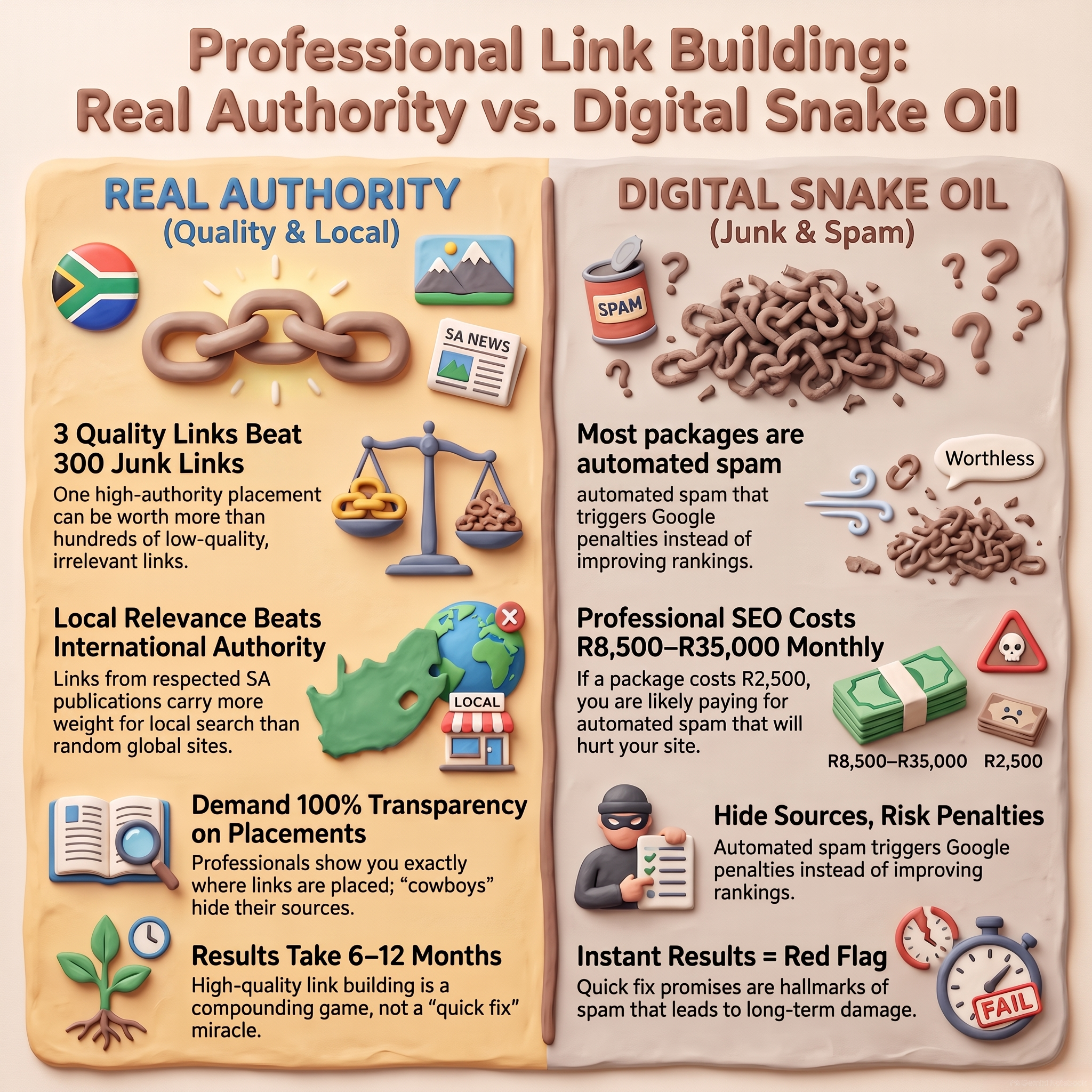
The SA link building market is absolutely crawling with providers flogging packages that’ll do more damage than good — and most business owners don’t know how to tell the difference between professional link building and digital snake oil until Google’s already penalised their site.
Let’s fix that. Here’s what professional link building services actually deliver, what separates them from the cowboys, and how to evaluate what you’re being sold.
The Business Problem: Why Links Matter (And Why Bad Ones Hurt)
Backlinks — other websites linking to yours — remain one of Google’s strongest ranking signals. According to research by Backlinko analysing 11.8 million Google search results, the number one result in Google has an average of 3.8 times more backlinks than positions two through ten.
In the South African market, where you’re competing against established brands with deeper pockets and longer digital histories, quality backlinks can be the difference between page one visibility and digital obscurity.
But here’s the catch: Google’s algorithms have become sophisticated enough to distinguish between links you’ve earned because your content is genuinely valuable, and links you’ve purchased from irrelevant, low-quality sources.
A bad link — from a spammy directory, a link farm, or an irrelevant foreign website — doesn’t just fail to help you. It actively triggers red flags. Google’s Penguin algorithm update specifically targets manipulative link schemes, and recovering from a penalty can take months of work and lost revenue.
So when you’re evaluating link building services, you’re not just deciding whether to invest. You’re deciding whether to help or hurt your site’s long-term viability.
What Professional Link Building Actually Involves
Professional link building isn’t about quantity. It’s about acquiring links that signal genuine authority and relevance to search engines.
Here’s what that looks like in practice:
Earned Links vs. Purchased Links
Earned links come from creating content or resources so useful that other sites naturally reference them. Think original research, comprehensive guides, tools, or newsworthy company developments.
Purchased links (more accurately: paid placements) involve paying for sponsored content, advertorials, or placements on relevant industry sites — but disclosed properly so they don’t violate Google’s guidelines.
Professional services focus heavily on earned links because they’re more valuable and sustainable. When paid placements are used, they’re on genuinely relevant sites with real traffic, properly disclosed (often with rel=”sponsored” attributes), and valuable for the traffic and brand exposure — not just the SEO juice.
Relevance and Authority
A professional service evaluates potential link sources on two critical dimensions:
Relevance: Does this site operate in your industry or serve your audience? A link from a South African business publication matters infinitely more to a Johannesburg accounting firm than a link from a random Argentinian recipe blog.
Authority: Does this site have genuine traffic, engagement, and trust signals? A professional service uses tools to evaluate domain authority metrics, organic traffic, and editorial standards before pursuing a link.
According to Moz, high-authority backlinks can be worth significantly more than dozens of low-quality ones — their research suggests that a single link from a domain with a Domain Authority above 80 can be worth more than hundreds of links from sites below DA 20.
The Actual Work Process
Here’s what you should expect from a professional link building service:
1. Site and competitor audit: They analyse your existing backlink profile and reverse-engineer what’s working for your competitors in the SA market.
2. Link opportunity research: They identify specific websites, publications, and platforms where a link would be both achievable and valuable.
3. Content creation or ideation: They either create linkable assets (research, tools, guides) or help you identify what you already have that’s worth promoting.
4. Outreach and relationship building: They pitch journalists, editors, and site owners with genuine value propositions — not spam templates.
5. Placement and documentation: They secure the links, ensure they’re implemented correctly, and provide you with transparent reporting on what was built and why it matters.
6. Ongoing monitoring: They track the links over time to ensure they remain live and haven’t been altered to include harmful attributes.
Notice what’s missing? Mass directory submissions. Blog comment spam. Link exchanges with irrelevant sites. Anything automated or scalable to the point of being worthless.

What Professional Link Building Costs in South Africa
Let’s talk numbers, because this is where the cowboys reveal themselves.
A legitimate professional link building service in South Africa typically costs between R8,500 and R35,000 per month, depending on your industry competitiveness, target volume, and the authority level you’re pursuing.
That might sound expensive compared to the R2,500 packages flooding your inbox. But consider what you’re actually paying for:
- Strategic planning: 3-5 hours of research and competitor analysis
- Content creation: Original assets worth linking to
- Manual outreach: Personalised pitches to real decision-makers
- Relationship building: Ongoing connections with editors and site owners
- Quality assurance: Vetting every link source against professional standards
A single high-quality link from a respected SA business publication or industry site can take 10-15 hours of work to secure — from research to outreach to content creation to placement.
The R2,500 package? That’s buying bulk submissions to automated directories that Google stopped valuing in 2012. You’re paying for spam.
What Determines Fit
Professional link building makes sense for SA businesses when:
- You’re in a competitive industry where rankings directly impact revenue (legal, finance, property, e-commerce)
- – You’ve already got the basics right (decent site speed despite load shedding, mobile-optimised, solid on-page SEO)
- You’re playing a 6-12 month game, not expecting miracles in week two
- You understand that three quality links often outperform three hundred junk ones
- It’s probably not the right investment yet if:
- Your website has fundamental technical issues that need addressing first
- You’re operating in a very niche local market where Google My Business optimisation would deliver faster returns
- You don’t have the budget to sustain it for at least 3-6 months (link building is cumulative; stopping and starting kills momentum)

Red Flags: How to Spot a Low-Quality Service
When evaluating link building providers — whether local SA agencies or international services — watch for these warning signs:
They Promise Specific Rankings
“We’ll get you to position one for ‘insurance broker Johannesburg’ in 90 days!”
No credible provider makes ranking guarantees. Google’s algorithms consider over 200 factors, many outside any agency’s control. What professionals promise instead: quality links that improve your authority over time.
They Don’t Show You the Links First
“We’ll build 50 links this month. Trust us.”
Professional services provide detailed reports showing exactly where links were placed, what anchor text was used, and why each source was selected. If they’re secretive about sources, they’re hiding something.
The Price Seems Too Good to Be True
That R2,500 package? It’s either automated spam or links from networks Google will eventually identify and devalue. Remember: a single journalist pitch that results in a Mail & Guardian or BusinessTech link can require hours of relationship building and content creation.
They Use Lots of Exact-Match Anchor Text
If every link pointing to your site says “best plumber Cape Town” or whatever your target keyword is, that’s a massive red flag. Natural link profiles include branded anchors, generic phrases, and variations. Over-optimised anchor text screams manipulation.
They Can’t Explain Their Vetting Process
Ask how they evaluate link opportunities. If they can’t articulate specific criteria around relevance, authority, traffic, and editorial standards, they’re not actually vetting anything.
What Accountability Should Look Like
Professional link building services should provide transparent, detailed reporting that lets you evaluate ROI. Here’s what to expect:
Monthly Reporting Should Include:
- Link placements: Exact URLs of both the linking page and your page being linked to
- Source metrics: Domain authority, organic traffic estimates, relevance scores
- Anchor text: What phrase was used, and why it fits your overall profile
- Context: Why this particular link matters strategically
- Traffic impact: Analytics data showing referral traffic from acquired links
Quarterly Reviews Should Cover:
- Profile health: Overall assessment of your backlink profile’s quality and diversity
- Competitor comparison: How your link profile stacks up against key SA competitors
- Strategy adjustments: What’s working, what’s not, and where to focus next
If a provider delivers a spreadsheet with just URLs and domain authority scores, they’re not giving you the context to understand what you’re actually buying.

The SA-Specific Angle
Link building in the South African market has unique characteristics worth understanding:
Local publications matter disproportionately: A link from News24, BusinessTech, or industry-specific SA publications carries more weight for local search visibility than international sources. Professional services understand which local platforms actually move the needle.
Mobile referral traffic is critical: With South Africa’s mobile-first internet usage — StatsSA reported that 91.2% of South African internet users access the web via mobile devices — links need to be on mobile-optimised sites that actually send usable traffic, not just SEO value.
Load shedding affects link value: Sites that go offline during power cuts or have terrible mobile performance because they’re not optimised for SA network conditions deliver less value. Professional services vet for technical reliability, not just domain metrics.
Local relevance beats international authority: A link from a respected SA industry association or business directory often outperforms one from a higher-authority international site with no SA connection — because Google understands geographic relevance.
How to Evaluate What You’re Currently Getting
If you’re already working with a link building provider, here’s a quick health check:
1. Export your recent backlinks using Google Search Console or a tool like Ahrefs/SEMrush
2. Check the linking sites manually: Visit them. Do they look like real businesses or publications? Is there actual content? Real traffic?
3. Evaluate relevance: Are they in your industry or geography, or completely random?
4. Check anchor text distribution: Is it natural and varied, or keyword-stuffed?
5. Monitor your traffic: Are the links actually sending visitors, or just sitting there?
If you’re seeing links from sites with names like “best-seo-links-2024.info” or directories in countries you’ve never targeted, you’re getting garbage. Time to have a conversation with your provider — or find a new one.
What Success Actually Looks Like
Professional link building delivers results, but they accumulate over time rather than overnight. Here’s a realistic timeline:
Months 1-2: Links start appearing, but ranking impact is minimal. You’re building the foundation.
Months 3-4: You begin seeing movement on competitive keywords. Referral traffic ticks up.
Months 5-6: Compounding effects kick in. Your domain authority increases, making future links easier to acquire. Rankings improve noticeably.
Months 7-12: You’ve built enough authority that some links come inbound naturally. Your investment starts requiring less effort to maintain momentum.
A professional service sets these expectations upfront. They’re not selling miracles; they’re building sustainable authority.

The Recommendation
If you’re serious about competing for visibility in your SA market, professional link building is one of the few SEO investments that delivers compounding returns — but only if done properly.
Here’s the buying framework:
Invest in professional link building when:
- You’re ready to commit 6+ months and R8,500+ per month
- Your site’s technical foundation is solid
- You’re in a competitive industry where organic visibility drives revenue
- You can evaluate quality and hold providers accountable
Stay away from:
- Any package promising hundreds of links for thousands of rands
- Providers who won’t show you exactly where links will be placed
- Services that guarantee specific rankings
- Anyone using “proprietary networks” (code for link schemes)
Questions to ask before signing:
1. Can you show me examples of links you’ve built for similar SA businesses?
2. What’s your process for vetting link opportunities?
3. How do you handle links that get removed or devalued?
4. What happens if Google updates its algorithm mid-campaign?
5. Can I see monthly reports before committing?
Professional providers answer these clearly and specifically. Cowboys dodge or deflect.
Frequently Asked Questions
Q: How many links should I expect per month from a professional service?
A: Quality matters infinitely more than quantity. A professional service might deliver 3-8 high-authority, relevant links per month rather than 50 low-quality ones. Those 3-8 links from respected SA publications or industry sites will outperform hundreds of directory submissions. If a provider emphasises volume over placement quality, that’s a red flag.
Q: Can I just build links myself instead of paying for a service?
A: Absolutely — if you have the time and expertise. Successful DIY link building requires identifying opportunities, creating linkable content, personalised outreach, relationship building, and ongoing monitoring. Most SA business owners find that the 20-40 hours per month required is better spent running their actual business. Professional services make sense when your time is worth more than the cost.
Q: What’s the difference between link building and just creating good content?
A: Great content is necessary but not sufficient. You can publish brilliant resources that nobody links to because nobody knows they exist. Professional link building actively promotes your content to relevant sites, journalists, and influencers who can amplify it. It’s the distribution strategy that makes content work harder.
Q: Will link building work if my competitors are also doing it?
A: Yes, because link building isn’t winner-takes-all — it’s about reaching threshold authority levels. If your top three competitors each have 200 quality backlinks and you have 40, professional link building helps you close that gap. The question isn’t whether competitors are doing it, but whether you can afford not to while they are.
Q: How do I know if a link is actually helping my rankings?
A: Track correlation, not causation. Monitor your rankings for target keywords before and after link building campaigns, and watch for movement 4-8 weeks after links go live (Google needs time to crawl and process them). Professional services should show you ranking progress alongside link placements. Also monitor referral traffic in Google Analytics — quality links send actual visitors, not just SEO value.
If you’re tired of being sold link building packages that sound impressive but deliver nothing measurable, let’s talk about what professional link building actually looks like for your SA business. Book a free link building audit (https://thickropemarketing.co.za/contact/) and we’ll show you exactly what’s working in your market — and what you’re competing against.