
Why South African Businesses That Treat Link Building and SEO as One System Win (And Those That Don’t, Don’t)
Here’s the belief costing SA businesses thousands every month: link building is something you do *after* SEO, or alongside it, or when you remember to budget for it. Two separate line items. Two different agencies, sometimes. Two sets of reports that never quite talk to each other.
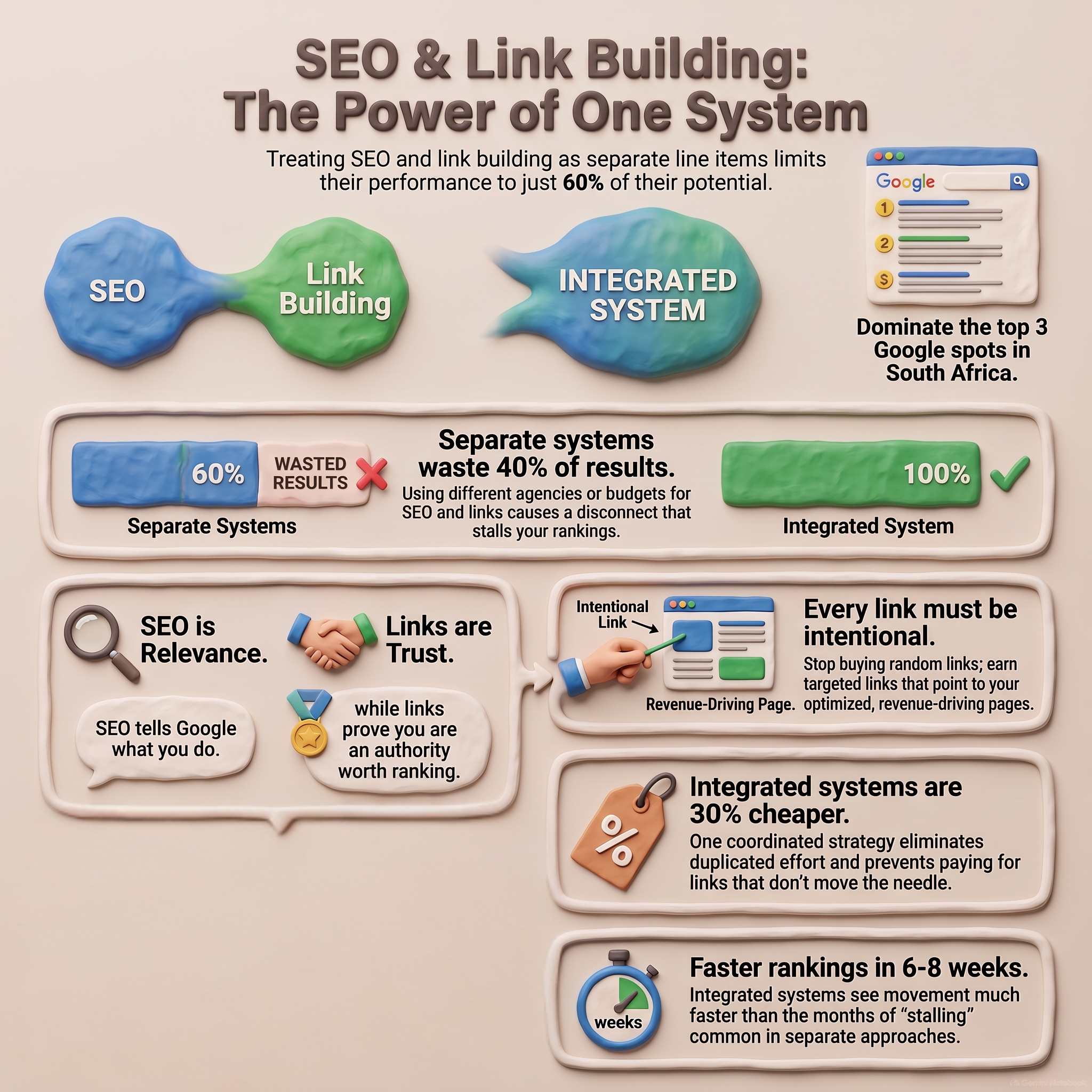
And here’s the truth: when you separate link building from SEO, both deliver maybe 60% of what they could. You’re paying twice to get less than you would if they worked as one system.
The businesses ranking in the top three spots for competitive keywords in South Africa? They’re not treating these as separate tactics. They’ve figured out that link building accelerates what SEO starts, and that SEO makes every link you earn work harder. It’s not synergy (we promised no agency-speak). It’s mechanics. And the disconnect is measurable, fixable, and — once you see it — impossible to ignore.
The Expensive Problem With Treating Them Separately
Let’s say you hire an SEO agency. They optimise your site, fix your technical issues, sort out your content, clean up your internal linking. You start seeing movement. Page two becomes page one. Position eight becomes position five.
Then it stalls. Because without authority — the kind that comes from quality backlinks — Google doesn’t trust you enough to put you in the top three. You’ve done the on-page work, but you’re stuck behind competitors who have that authority signal.
So you hire a link building service. They start earning backlinks. But if those links point to pages that aren’t optimised, or your site structure doesn’t distribute that authority properly, or your content doesn’t match what the link implies you’re about, those links underperform. Google sees the disconnect. The rankings bump you get is smaller than it should be, and it doesn’t stick.
According to Backlinko’s analysis of 11.8 million Google search results, the number one result in Google has an average of 3.8 times more backlinks than positions two through ten. Authority matters. But authority without optimisation is a Ferrari with no petrol. And optimisation without authority is a bicycle on the N1 — technically moving, but never getting where you need to go at the speed your business requires.
What Integration Actually Looks Like (And Why It Changes Everything)
When link building and SEO work as one system, three things happen that don’t happen when they’re separate:
1. Link acquisition becomes strategic, not transactional
Instead of chasing any link from any site, you’re earning links that support specific ranking goals. If you’re trying to rank for “industrial pumps Johannesburg,” you’re not just getting a backlink from a general business directory. You’re earning links from industry publications, supplier networks, and local trade associations — sites that reinforce topical relevance *and* pass authority to the exact pages you’ve optimised for that keyword.
The link and the page work together. The page gives the link context. The link gives the page credibility. Google sees both signals at once, and the ranking lift is faster and more durable.
2. On-page SEO makes every link you earn worth more
Here’s what most SA businesses don’t realise: a backlink to a well-optimised page is worth significantly more than a backlink to a poorly optimised one. If your target page has clear topic focus, proper internal linking, strong content depth, and user signals that say “people find what they need here,” Google trusts that link more.
You’re not just collecting links. You’re building a site where each link compounds in value because the foundation is solid. That’s the difference between ranking on page one and owning position one or two — the spots that actually drive enquiries.
3. You stop wasting money on links that don’t move the needle
When SEO and link building are managed separately, you’ll often see agencies building links to pages that don’t matter, or worse, pages that aren’t even optimised yet. It’s not malicious. It’s just that the left hand doesn’t know what the right hand is doing.
In an integrated system, every link is intentional. You know which pages need authority, when they need it, and what kind of links will move those pages up the rankings. You’re not guessing. You’re not duplicating effort. And you’re not spending budget on links that end up being irrelevant six months later because your site structure changed.
A study by Ahrefs found that 90.63% of pages get zero organic traffic from Google — and one of the primary reasons is a lack of backlinks. But it’s not *just* a lack of backlinks. It’s backlinks pointing to the wrong pages, or backlinks that don’t align with what the page is actually about, or backlinks earned with no SEO foundation to capitalise on them.
The South African Reality: Why Integration Matters Even More Here
South African businesses face conditions that make the integrated approach not just better, but essential.
Budget constraints mean you can’t afford inefficiency
Most SA businesses don’t have unlimited marketing budgets. You’re not going to spend R50,000 a month on SEO and another R50,000 on link building just to see what happens. You need every rand to work. That means no wasted links. No optimisation that sits there waiting for authority it never gets. You need both systems feeding each other from day one.
Local competition is getting sharper
Ten years ago, basic SEO was enough to rank in South Africa. Not anymore. Your competitors have figured out that links matter. They’re investing in content, in outreach, in digital PR. If you’re still treating SEO and link building as separate projects, you’re bringing a butter knife to a gunfight.
According to research from BrightEdge, organic search drives 53% of all website traffic — more than any other channel. In South Africa, where paid media costs are rising and load shedding makes consistent ad delivery harder, organic visibility isn’t optional. It’s your most reliable growth lever. But only if it’s built properly.
Mobile-first consumers demand fast, trusted results
South Africa is a mobile-first market. Your customers are searching on their phones, often on slow networks, and they’re clicking the top three results because they don’t have time or data to scroll. If you’re not in those top spots, you’re invisible. And getting there requires both technical excellence (SEO) and authority signals (links) working together.
What This Looks Like in Practice: A System, Not a Checklist
An integrated link building and SEO service doesn’t just do both things. It sequences them, coordinates them, and uses insights from one to improve the other.
Month one: Technical SEO audit, keyword research, and content gap analysis. But also: link opportunity research. What sites link to your competitors? What content assets could attract links? What local partnerships or industry connections exist that SEO alone wouldn’t uncover?
Month two: On-page optimisation begins. Pages are built or rebuilt with both user intent *and* link potential in mind. You’re not just optimising for keywords. You’re creating pages that are worth linking to, that solve a problem clearly enough that other sites will reference them.
Month three: Link acquisition starts, but it’s targeted. You’re earning links to the pages you’ve optimised, in the sequence that supports your ranking goals. If you’re going after a competitive keyword, you’re building authority to that page first. If you’re trying to lift domain authority overall, you’re diversifying across multiple strong pages.
Ongoing: Reporting isn’t two separate dashboards. It’s one view: keyword movement, link growth, traffic increases, and — most importantly — business outcomes. Enquiries. Conversions. Revenue. The stuff that pays the bills.
The Trust Factor: Why Google Rewards the Integrated Approach
Google’s algorithm has one overarching goal: show users the most relevant, trustworthy result. Relevance comes from SEO — the right keywords, the right content, the right structure. Trust comes from links — other sites vouching for you.
When both signals are strong and aligned, Google has no reason to doubt you. When they’re mismatched — great links to weak pages, or great pages with no authority — Google hesitates. And hesitation means you rank on page two, not page one.
John Mueller from Google has said it explicitly in webmaster hangouts: backlinks remain one of the top ranking factors. But context matters. A link from a trusted, relevant site to a well-optimised page carries more weight than ten links from random blogs to pages with thin content.
You’re not gaming the system. You’re giving Google exactly what it’s looking for: evidence that you’re both relevant *and* trusted. That’s the integrated approach. That’s what wins.

What You Should Actually Do (And When)
If you’re currently running SEO and link building separately, or if you’re only doing one, here’s the path forward:
Step one: Audit what you have. How many quality backlinks do you have, and where are they pointing? Are your highest-authority pages also your most optimised pages? If not, you’ve found the disconnect.
Step two: Prioritise pages that matter for revenue. Not every page needs links. Focus on the pages that rank for keywords your customers actually search, and that lead to enquiries or sales.
Step three: Build a plan that sequences both. Don’t try to do everything at once. Start with a few high-value pages, optimise them properly, then earn targeted links to them. Measure movement. Adjust. Repeat.
Step four: Work with a team that manages both, or at minimum, coordinates closely. If your SEO agency and your link builder never talk, you’re leaving money on the table. Every month.
This isn’t a six-month project. It’s an ongoing system. But the results — real, measurable ranking improvements and the traffic that comes with them — start showing within weeks when it’s done right.
Frequently Asked Questions
Q: How long does it take to see results from an integrated link building and SEO approach?
A: Most businesses see initial ranking movement within 6-8 weeks, with meaningful traffic increases by month three. That’s faster than treating them separately, where SEO improvements often stall without authority, and link building takes longer to impact rankings without optimisation. The compounding effect is where the real gains happen — month six looks very different from month three.
Q: Is this approach more expensive than hiring separate SEO and link building services?
A: It’s typically 20-30% less expensive than paying two separate agencies, and delivers significantly better ROI because there’s no wasted effort or duplication. You’re paying for strategy, execution, and coordination — not for two teams working in silos. For most SA businesses, an integrated service costs between R15,000 and R35,000 per month depending on competition and scale, compared to R12,000 + R12,000 for separate services that don’t talk to each other.
Q: Can I do link building and SEO in-house, or do I need an agency?
A: You can, but it requires specific expertise in both disciplines *and* the time to coordinate them properly. Most SA business owners find that the opportunity cost of doing it themselves — time away from running the business — outweighs the saving. If you have a strong in-house marketer, they can manage strategy while outsourcing execution. But treating it as a side project rarely works. The businesses winning in search are treating this as a core investment, not a side hustle.
Q: What if I’ve already invested in SEO but haven’t done link building?
A: You’re in a strong position, actually. Your foundation is there. Adding targeted link building to an already-optimised site often produces faster results than starting from scratch, because Google already understands what your pages are about. The authority signal from quality links is the accelerant you need. Expect to see movement within weeks if the optimisation work was solid.
Q: How many backlinks do I actually need to rank in South Africa?
A: It varies wildly by industry and keyword competition. A local service business in a small town might rank with 10-15 quality links. A national e-commerce site competing for commercial keywords might need hundreds. What matters more than volume is relevance, authority of the linking site, and how well those links align with your optimised pages. A single link from a trusted industry publication can move the needle more than fifty low-quality directory links.
If you’re tired of treating link building and SEO as separate projects and wondering why the results never quite match the investment, let’s talk. Thickrope designs integrated link building and SEO services for South African businesses that need search visibility to work — not as a vanity metric, but as a revenue driver. Book a free strategy session and we’ll show you exactly where the disconnect is costing you, and what an integrated approach would deliver for your specific business.