

Why Ranking for “Builder Near Me” Is Costing Your Construction Company Actual Money
If you’re a construction company investing in SEO, there’s a good chance you’ve been told the goal is to rank for things like “builder near me,” “construction company Johannesburg,” or “contractors Cape Town.”
It sounds logical. High search volume, local intent, clear commercial signal. Box ticked.
Except here’s the problem: those searches are almost worthless.
Not completely worthless — let’s not throw the baby out with the rubble — but dramatically less valuable than what most South African construction companies actually need to rank for. And if your SEO strategy is built around chasing generic local terms, you’re likely spending money to attract the wrong traffic, field the wrong enquiries, and compete with every other builder who’s read the same beginner’s guide to local SEO.
Let’s talk about what actually works — and why the highest search volume isn’t always where the highest value sits.
The Problem with “Builder Near Me” (and Every Other Generic Local Term)
When someone searches “builder near me,” what are they actually looking for?
You don’t know. And neither does Google, really.
They could be:
- A homeowner who wants a quote to build a boundary wall
- Someone researching builders for a possible extension in two years
- A tenant trying to find out who built the complex they live in
- A commercial developer looking for a tier-one contractor for a multi-million-rand project
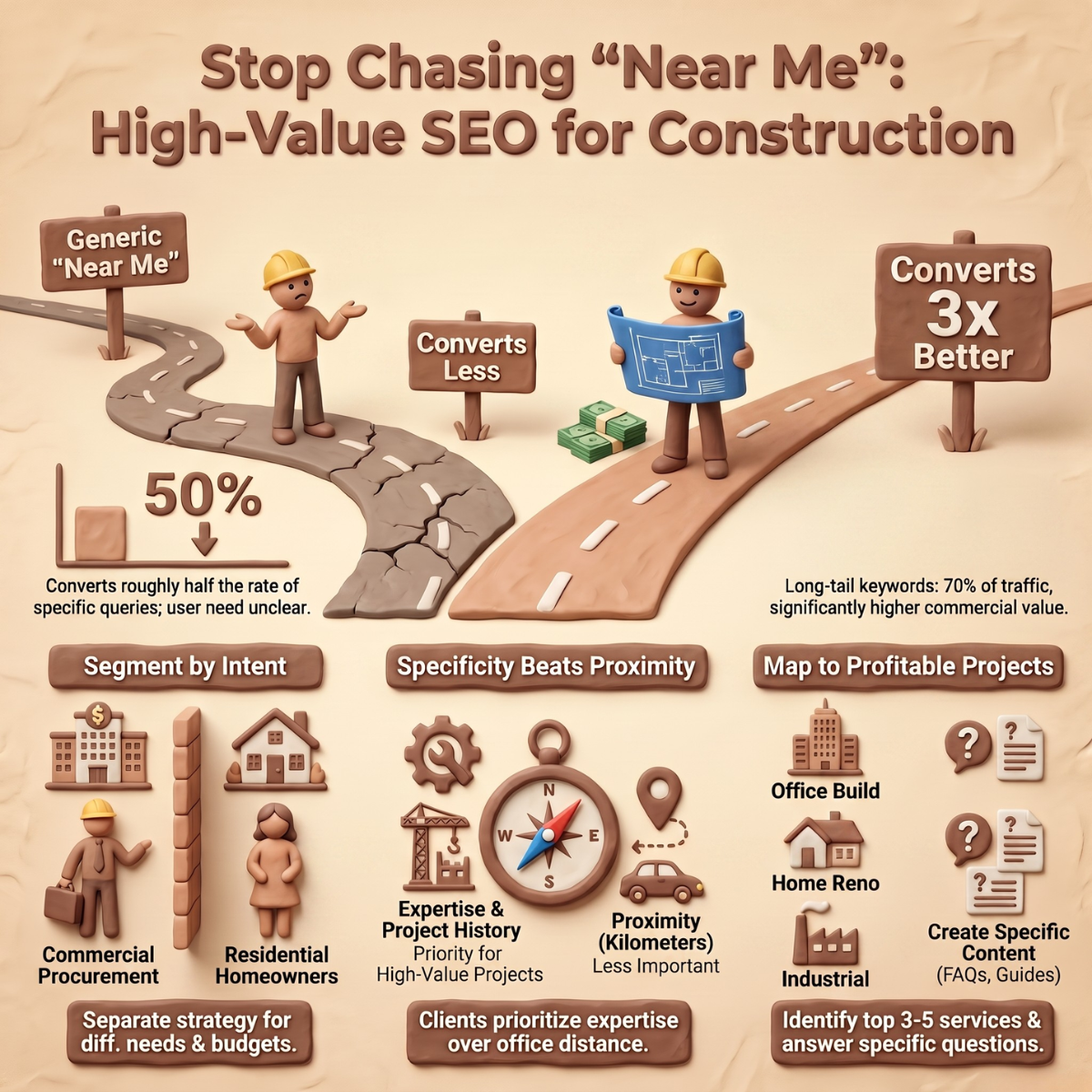
That lack of specificity is the issue. According to research from Ahrefs, generic “near me” searches convert at roughly half the rate of specific, intent-heavy queries — because the intent is all over the place. You’re competing with everyone, and the person searching hasn’t told you what they actually need yet.
In the South African context, this problem gets worse. Load shedding means many of your potential clients are searching on mobile, often with limited time and patience. If your site ranks for a generic term and they land on a homepage that doesn’t immediately speak to their specific project type, they’re gone. Back to the SERP, on to the next result.
You’ve paid for that traffic — in SEO investment, in time, in content — and it evaporated because the search term was too broad to mean anything.

What High-Value Construction Searches Actually Look Like
Here’s what separates a serious buyer from a tyre-kicker in construction search behaviour: specificity.
The person searching “steel structure warehouse builder Gauteng” knows what they want. They’ve moved past the awareness phase. They’re not browsing — they’re comparing and evaluating. And the commercial value of that search, even if the monthly volume is only 30 searches versus 1,200 for “builder near me,” is exponentially higher.
Same goes for:
- “Double-storey extension cost Cape Town”
- “Industrial concrete flooring contractors Durban”
- “Nutec house builders Limpopo”
- “Office fit-out construction Sandton”
These searches tell you three things immediately:
- What they need (the project type)
- Where they are (the location, often more granular than city-level)
- What phase they’re in (researching costs means they’re close to committing)
A 2022 study by BrightEdge found that long-tail keywords — specific, multi-word search queries — account for roughly 70% of all search traffic and convert at nearly three times the rate of short, generic terms. In construction, where project values range from R50,000 to R50 million, that conversion gap is the difference between fielding ten useless enquiries and landing two serious ones.
Commercial vs Residential: Why Intent Segmentation Matters
One of the biggest mistakes in construction SEO is treating “construction” as a single category.
It’s not.
A residential client searching for a builder to add a bedroom is not the same as a procurement manager searching for a contractor to build a factory. The budget is different, the decision-making process is different, the timeline is different, and the content they need to see before they’ll trust you is radically different.
If your SEO strategy doesn’t segment by project type and intent, you’re optimising for noise.
Let’s say you’re a mid-sized construction company in Gauteng. You handle both residential extensions and light commercial work. Ranking for “builders Johannesburg” will send you traffic from both — and from people who want garden walls, boundary disputes sorted, and quotes for jobs you’d never touch.
But if you rank for “commercial office renovations Johannesburg” and “residential additions Randburg,” you’re speaking directly to two different audiences with two different content experiences. You can show the commercial searcher your portfolio of office fit-outs, your BEE credentials, your project management systems. You can show the residential searcher testimonials from homeowners, before-and-after galleries, and a breakdown of the typical extension process.
Same company. Different intent. Different content. Higher conversion.

The “Near Me” Trap: Why Proximity Isn’t Always the Priority
Here’s another uncomfortable truth: not everyone searching for construction services wants the closest option.
They want the right option.
If you’re building a R15 million commercial facility, you’re not choosing a contractor based on who’s 3km closer. You’re choosing based on experience, portfolio, reputation, and whether they’ve done this type of project before. Proximity matters for logistics, sure — but it’s not the deciding factor.
In South Africa, this is especially true for specialised construction work. If you’re one of the few contractors in the country who does cold storage facilities, or petrol station builds, or solar farm infrastructure, your clients will find you even if you’re in Bloemfontein and they’re in Nelspruit. The search term that matters isn’t “builder near me” — it’s “cold storage construction South Africa” or “solar farm contractors.”
Google’s own data shows that “near me” searches have grown by over 900% in the last few years — but the same report notes that users are increasingly refining those searches with specific qualifiers. “Coffee shop near me” becomes “coffee shop with wifi near me.” “Builder near me” becomes “eco-friendly builder near me” or “RDP housing contractor near me.”
The shift is toward intent, not just proximity.
What a Smarter Construction SEO Strategy Looks Like
So if you’re not chasing “builder near me,” what are you doing instead?
You’re building a keyword and content strategy around project types, buyer intent, and commercial value — not search volume.
Here’s how that looks in practice:

Map Your High-Value Project Types
Start by identifying the 3–5 types of projects that make you the most money. Not the ones you do most often — the ones that are actually profitable and that you want more of.
For each project type, research the specific search terms people use when they’re looking for that service. Use tools like Google’s Keyword Planner, Answer the Public, or (if you’re working with an agency) more advanced platforms like Ahrefs or SEMrush.
You’re looking for searches like:
- “Cost to build a Nutec house”
- “Warehouse construction cost per square metre”
- “How long does a double-storey extension take”
These are research-phase searches with clear intent. Create content that answers them — and positions your business as the one to call when they’re ready.
Segment by Commercial vs Residential Intent
Create separate landing pages (or even separate sections of your site) for commercial and residential work. Optimise each for the search terms that signal that intent.
On the commercial side, you’re targeting procurement managers, developers, and facilities teams. They’re searching for things like compliance, timelines, BEE status, and portfolio proof.
On the residential side, you’re speaking to homeowners. They want reassurance, transparency, and a sense that you’re not going to disappear halfway through the job (a very real fear in the SA construction industry).
Different audiences, different content, different keywords.
Focus on Location + Qualifier, Not Just Location
Instead of trying to rank for “builders Durban,” go after “new home builders Durban North” or “industrial construction company Durban.” The extra qualifier dramatically improves intent matching — and lowers competition.
In smaller towns and cities, this strategy is even more effective. If you’re operating in Polokwane or George, you can own very specific local search terms without the bruising competition you’d face in Joburg or Cape Town.
Create Content That Matches the Buyer Journey
Most construction company websites have a homepage, an about page, a gallery, and a contact form.
That’s fine — but it’s not a content strategy.
If someone is searching “should I use nutec or brick for my house,” they’re early in the research phase. Create a blog post or guide that answers that question thoroughly, then links to your nutec building service page.
If someone is searching “construction contract template South Africa,” they’re further along. Offer a free downloadable template in exchange for their email, then follow up with case studies and a consultation offer.
Match your content to the search intent, and you’ll convert traffic that other builders are letting slip away.

Why This Actually Matters in the SA Market
South Africa’s construction industry is tough right now. According to Statistics SA, the sector has faced significant contraction in recent years, and competition for the projects that are moving forward is fierce.
That means every lead matters. Every rand spent on marketing needs to pull its weight.
If your SEO strategy is built around vanity metrics — rankings for generic terms, traffic volume that doesn’t convert — you’re wasting money you don’t have. The businesses that are winning in this environment are the ones that understand the difference between traffic and qualified traffic.
And in an economy where cash flow is everything, the ability to predictably generate high-value enquiries from search — rather than fielding fifty “how much to build a wall” questions — is the difference between surviving and scaling.
Frequently Asked Questions
Q: Does this mean I shouldn’t try to rank for local search terms at all?
A: Not at all. Local SEO still matters — but the goal should be to rank for specific local terms that match your ideal projects, not the broadest possible terms. “Residential builder Constantia” is better than “builder Cape Town” if you specialise in high-end residential work in the Southern Suburbs.
Q: How do I know which keywords are actually valuable for my business?
A: Start with your own data. Look at the last 20 projects you completed — what would someone have searched for to find a business that does that work? Then use keyword research tools to see search volume and competition. Focus on terms where intent is clear and competition is manageable.
Q: What if I do want to attract smaller residential jobs, not just big commercial work?
A: Then optimise for the search terms those clients use — but be specific. “Boundary wall construction Pretoria East” or “granny flat builder Durban North” will outperform “builder near me” every time, even for smaller projects. The principle is the same: specificity beats volume.
Q: How long does it take to rank for these more specific terms?
A: Generally faster than ranking for ultra-competitive generic terms. If you’re targeting “steel structure warehouse builder Gauteng” instead of “builder Johannesburg,” you’re facing less competition and Google can understand your relevance more clearly. Depending on your site’s current authority, you could see movement in 3–6 months. Generic terms can take a year or more — if you ever rank at all.
If your construction company is ready to move beyond chasing generic search terms and build an SEO strategy that actually brings in the projects you want, let’s talk. Thickrope Marketing works with South African construction businesses to identify high-value search opportunities and create content that converts. Get in touch for a free SEO audit — we’ll show you exactly where the real opportunity sits.