

What a South African Financial Services Firm Discovered When It Finally Took SEO Seriously
For eighteen years, I built my financial advisory practice the old-fashioned way: referrals, industry events, the occasional round of golf with accountants who sent business my way. Our website was a digital business card — clean, professional, and about as optimised for search as a brick.
Then something shifted.
A competitor — newer, smaller, frankly less experienced — started showing up everywhere. Google searches for “retirement planning Johannesburg.” “Tax-efficient investment strategies.” “Cross-border financial planning South Africa.” Every single search that should have led prospects to firms like ours led them instead to this upstart who’d been in business for all of three years.
At first, I dismissed it. Our clients came from relationships, not search engines. Except they didn’t anymore. Three mandates in four months — substantial ones — went to this competitor. When I finally asked one prospect why they’d chosen them, the answer stung: “They came up first when I searched. I figured they must be the leading firm in this space.”
That’s when I stopped being clever about it and admitted we had a problem.
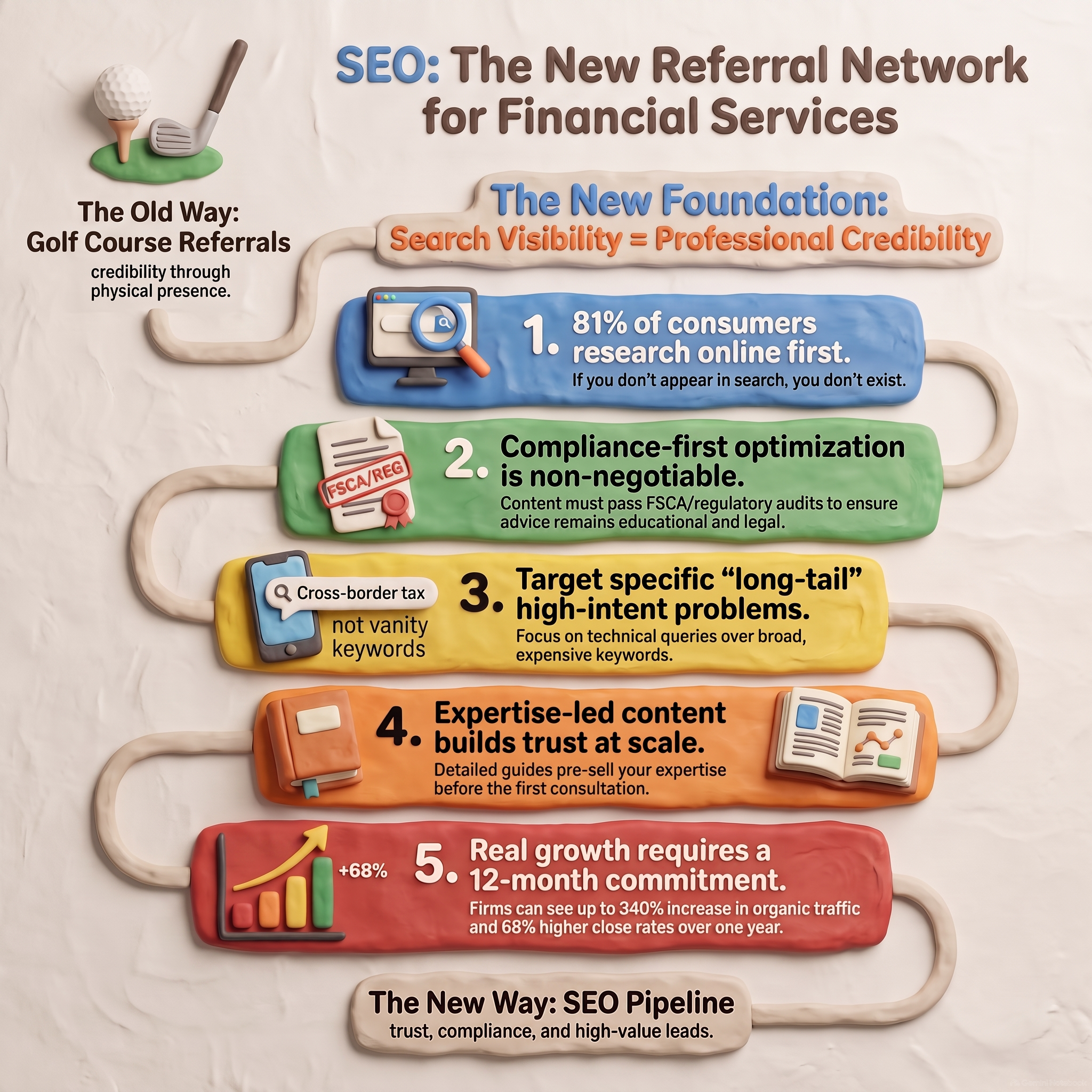
The Wake-Up Call: Search Visibility Is Professional Credibility
Here’s what I hadn’t grasped: by 2026, roughly 81% of consumers research services online before making contact, according to research from GWI. For financial services — where trust is the entire product — that percentage is even higher. If you don’t appear in search results, you don’t exist in the consideration set. Full stop.
Our competitor understood something I’d been too stubborn to accept: an SEO company for financial companies isn’t selling you traffic. They’re selling you relevance.
In South Africa’s financial services landscape, where regulatory complexity meets a digitally-savvy client base (many of whom now research financial products on mobile while load shedding turns their office into a sauna), search visibility has become the new referral network.
The moment I realised we were haemorrhaging pipeline to a firm that simply showed up in the right searches, I picked up the phone.

What a Financial Services SEO Engagement Actually Looks Like
I’ll be honest: I expected smoke and mirrors. What I got was considerably more mundane and infinitely more useful.
The Compliance Layer
Financial services in South Africa operates under FSCA regulations, FICA requirements, and a regulatory environment that doesn’t mess about. The first thing our SEO partner did — and this is non-negotiable — was conduct a full compliance audit of our existing site content.
Every claim had to be supportable. Every investment mention needed appropriate risk disclaimers. Every piece of advice-adjacent content required careful positioning to avoid crossing into unregulated advisory territory without the proper context.
A good SEO company for financial companies knows that ranking well means nothing if FSCA comes knocking because your blog post about unit trusts read like specific product advice. The compliance framework came first. The optimisation happened within it.
The Keyword Reality Check
Our initial keyword wishlist was ambitious: “best financial advisor South Africa,” “wealth management,” “investment advice.” These are what the industry calls “vanity keywords” — high volume, low conversion, and dominated by the big banks with marketing budgets that could fund a small suburb.
Instead, we focused on what actually drove our business: “cross-border tax planning South Africa,” “retirement annuity vs preservation fund,” “Section 12J investment Cape Town,” “offshore investment SARS compliance.”
Specific. Technical. Exactly what someone with a R5 million portfolio problem types into Google at 11 PM when they can’t sleep.
These weren’t high-volume searches — maybe 50 to 200 searches per month each — but every single person searching them was a qualified prospect. According to research from Ahrefs, long-tail keywords (those highly specific search phrases) account for roughly 92% of all search queries, and they convert at significantly higher rates than broad terms.
The Content Programme
Here’s where it got interesting. We couldn’t just stuff keywords into our existing “About Us” and “Services” pages and call it optimised. Financial services SEO requires content that demonstrates expertise, builds trust, and — critically — answers the exact questions prospects are searching for.
We published:
- Regulatory explainers: “What the 2025 SARS Changes Mean for Your Retirement Annuity”
- Process guides: “How Cross-Border Financial Planning Actually Works Between SA and the UK”
- Decision frameworks: “5 Questions to Ask Before Moving Your Retirement Fund”
- Local context pieces: “Navigating Offshore Investment Limits: What the R10 Million Single Discretionary Allowance Really Means”
Each piece was written to rank for specific search queries, but more importantly, each one positioned us as the firm that understood both the regulation and the client’s actual circumstance.
Every article included proper schema markup, clear internal linking to our service pages, and — this matters enormously in financial services — author credentials and transparency about our FSCA authorisation.
The Technical Foundation
You can write brilliant content all day, but if your site loads like a dial-up modem during load shedding, you’re wasting your time. Google’s data shows that 53% of mobile visitors abandon sites that take longer than three seconds to load — and in South Africa, where mobile-first browsing dominates and network speeds are… variable… that’s a business-critical metric.
We optimised:
- Page speed: Image compression, lazy loading, content delivery network implementation
- Mobile responsiveness: Our original site was “mobile-friendly” in the sense that it didn’t break on a phone, but the experience was clunky
- Site architecture: Clear service categorisation, logical URL structure, breadcrumb navigation
- Schema markup: LocalBusiness, FinancialService, and FAQPage schema to help Google understand exactly what we offer and where
Nothing glamorous. All of it essential.
The Link-Building Strategy (That Actually Worked)
In financial services, link building is tricky. You can’t buy links (Google will punish you). You can’t participate in link schemes (FSCA will have opinions). What you can do is earn links through genuine authority.
We contributed:
- Guest articles for reputable SA finance publications (with proper disclosure and FSCA-compliant bios)
- Data and insights that journalists covering financial planning could cite
- Industry commentary during regulatory changes (when SARS or FSCA announced new rules, we published clear explainers that got picked up)
Each earned link signaled to Google that we were a credible voice in the space. More importantly, they drove referral traffic from exactly the audience we served.

What Changed Over Twelve Months
I’m not going to pretend it was overnight magic. The first three months felt like we were shouting into the void. But around month four, something shifted.
The Numbers
- Organic search traffic: Up 340% year-on-year
- Enquiries from organic search: From 2-3 per month to 18-22 per month
- Conversion rate from enquiry to client: Actually increased — because the people finding us through search had already self-qualified by reading our content
But here’s what mattered more than the numbers:
The Quality Shift
The enquiries we received changed. Instead of “Can you help me invest some money?” we got “I read your article on cross-border retirement planning. I’m a South African working in Dubai and need to understand my options for when I return. Can we talk?”
They’d already consumed 4-6 pieces of our content before reaching out. They trusted us before we’d spoken. The sales conversation became a fit conversation — are we the right firm for your specific circumstance? — rather than a pitch.
Our average client value increased by about 35%, and our close rate on initial consultations went from roughly 40% to 68%.
The Competitive Position
That competitor who’d been eating our lunch? They’re still doing well — credit where it’s due, they saw the opportunity before we did. But we’re now showing up in the same searches, and we’re often ranking higher for the more technical, higher-value queries.
More importantly, we’re not invisible anymore. When prospects search for the services we actually provide, we’re in the conversation.
What I Wish I’d Understood Earlier
Looking back, three things stand out:
1. SEO isn’t a campaign; it’s infrastructure. You don’t “do SEO for six months” and then stop. It’s the digital equivalent of maintaining your office: ongoing, necessary, and foundational to how your business is found.
2. In professional services, SEO is trust-building at scale. Every piece of optimised content is a proxy for the conversation you’d have with a prospect over coffee — except you’re having it with 200 people simultaneously, many of whom will never contact you but will remember your firm when the time comes.
3. The regulatory environment is a feature, not a bug. Yes, FSCA compliance makes content creation more complex. But it also means your competitors face the same constraints. An SEO company for financial companies that understands this regulatory landscape gives you an enormous advantage — they know what you can say, how to say it compliantly, and how to turn regulatory expertise into rankable content.

The Practical Takeaway for SA Financial Services Firms
If you’re running a financial advisory, wealth management, or insurance brokerage in South Africa and you’re still relying primarily on referrals, here’s the uncomfortable truth: your future clients are searching for help right now. If you’re not showing up, someone else is building the relationship before you even know the prospect exists.
Working with an SEO company for financial companies that understands both the technical requirements of search optimisation and the regulatory requirements of South African financial services isn’t a marketing luxury. It’s a pipeline strategy.
You don’t need to rank for everything. You need to rank for the specific, high-intent searches that indicate someone has the exact problem your firm solves — and you need content that demonstrates you understand both their problem and the regulatory environment they’re navigating.
The firms that figure this out aren’t just winning more business. They’re winning better business — clients who’ve self-educated, who understand value, and who come to the relationship with trust already established.
Frequently Asked Questions
Q: How long does SEO take to show results for a financial services firm in South Africa?
A: Realistically, expect 4-6 months before you see meaningful traffic increases, and 8-12 months before that traffic translates to consistent enquiry volume. Financial services SEO is a long game because you’re building authority in a heavily regulated, high-trust sector. Quick wins exist (technical optimisation, low-competition keywords), but sustainable pipeline growth takes patience.
Q: Can financial services firms do SEO in-house, or do you need a specialist agency?
A: You can do it in-house if you have someone who understands both technical SEO and FSCA compliance — but that’s a rare combination. Most firms find better ROI working with an SEO company for financial companies that already knows the regulatory landscape, can audit content for compliance, and has relationships with finance publications for link building. The cost of getting compliance wrong typically exceeds the cost of hiring specialists.
Q: What’s a realistic budget for financial services SEO in South Africa?
A: For a credible engagement with a specialist agency, expect R15,000-R35,000 per month depending on competition in your niche and the scope of content required. One-off technical audits and setup might run R25,000-R50,000. Anything significantly cheaper usually means you’re getting generic SEO (not tailored to financial services compliance) or offshore content that doesn’t understand SA regulatory context. This is an investment in pipeline infrastructure — evaluate it against client lifetime value, not as a marketing expense.
Q: How do you balance SEO content with FSCA compliance requirements?
A: Every piece of content needs compliance review before publication, which is why working with an SEO partner familiar with FSCA regulations matters. The key is positioning content as educational rather than advice, including appropriate disclaimers, avoiding specific product recommendations without context, and ensuring any performance claims are supportable and appropriately caveated. Good financial services SEO enhances compliance by creating a clear content governance process.
Q: What happens if my competitor is already ranking well — is there still opportunity?
A: Absolutely. Search isn’t winner-takes-all, especially in financial services where prospects often compare multiple firms. Focus on long-tail, high-intent keywords your competitor might be missing, create deeper content on specific niches you serve well, and optimise for local search if you have a geographic focus. There are typically hundreds of valuable search queries in any financial services niche — your competitor won’t (and can’t) own them all.
If you’re ready to stop losing prospects to competitors who simply show up in search, Thickrope Marketing specialises in SEO for South African financial services firms — we understand both the rankings and the regulations. Let’s talk about what’s actually possible for your practice.