

The Real Pitfalls of AI-Based SEO That Most South African Businesses Discover Too Late
Let’s clear the air: AI isn’t the villain in your SEO story. It’s brilliant at certain things — generating first drafts faster than your cousin can WhatsApp forward conspiracy theories, identifying patterns in search data, and handling repetitive content tasks that would otherwise melt your brain.
But here’s the lesser-known truth: AI-based SEO creates completely different failure modes than traditional SEO. And South African businesses that went all-in on AI-first content production over the past 18 months are starting to encounter them in ways that hurt rankings, waste budget, and create recovery work that costs more than doing it properly in the first place.
This isn’t about whether you should use AI. You probably should — strategically. This is about the specific, avoidable pitfalls that emerge when AI becomes your entire SEO strategy rather than one tool in a proper approach.
The “Scores 98% But Ranks on Page 4” Problem
Here’s what’s happening: businesses are running AI-generated content through readability tools, SEO checkers, and optimisation platforms. Everything comes back green. Flesch reading score? Excellent. Keyword density? Perfect. Meta descriptions? Optimised.
Then the content goes live and… nothing. Or worse, it ranks for two weeks, then drops like a stone.
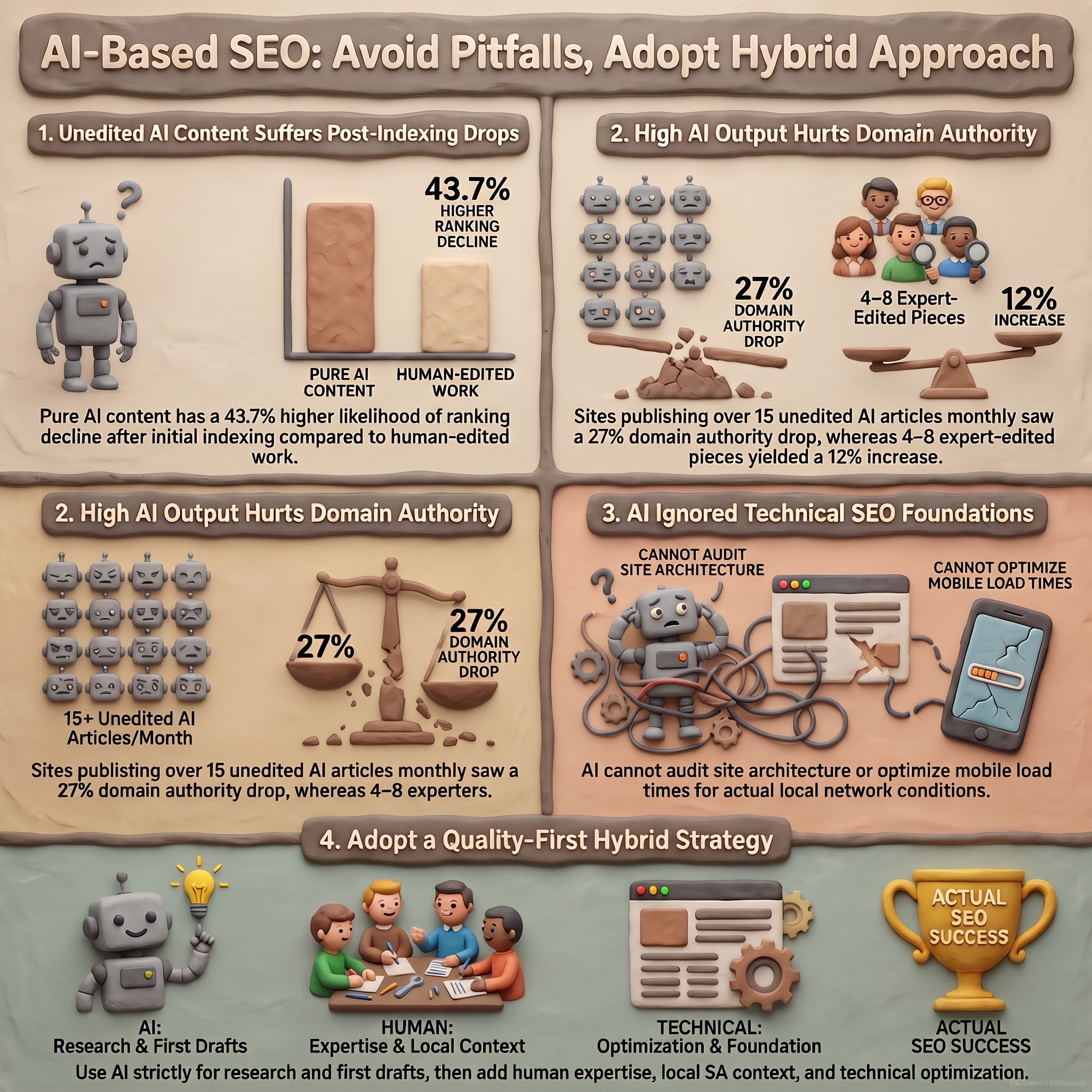
According to research from Originality.ai published in early 2025, Google’s algorithms have become increasingly sophisticated at identifying content that checks technical boxes but lacks genuine authority signals. The study found that AI-generated content without substantial human editing saw a 43.7% higher likelihood of ranking decline after the initial indexing period compared to human-written or heavily human-edited content.
The issue isn’t that Google hates AI content — Google’s own John Mueller clarified in 2023 that content creation method doesn’t matter if the output is genuinely useful. The problem is that AI excels at mimicking surface-level SEO correctness whilst completely missing the authority signals that actually move the needle in competitive South African search environments.
What those authority signals look like in practice:
- Specific references to local business conditions (like load shedding impact on operating hours, POPIA compliance requirements, or rand-dollar currency considerations)
- Original examples drawn from actual SA case studies or market data
- Technical detail that demonstrates hands-on expertise rather than general knowledge synthesis
- Content structure that answers the actual intent behind SA searches, which often differs from US or UK search behaviour on the same keywords
AI can’t fake these because it doesn’t have them. It can approximate them if your prompts are exceptionally detailed, but most businesses are using relatively generic briefs — which brings us to the next pitfall.
When You and Your Three Competitors All Use the Same AI Tool With Similar Briefs
Picture this: you’re a Johannesburg-based accounting firm. You’ve discovered ChatGPT or Jasper or Copy.ai. Brilliant — you’re going to publish weekly blog posts about tax compliance, financial planning, and small business accounting.
So is every other accounting firm in your competitive set. Using the same tools. Targeting the same keywords. Often with remarkably similar prompting strategies because everyone’s watching the same “how to use AI for SEO” YouTube videos.
The result? Near-duplicate content at scale.
Google’s quality systems, particularly post-March 2024’s core updates, have become significantly better at detecting when multiple sites publish structurally similar content on the same topics within short timeframes. A 2024 study by Search Engine Journal found that when five or more sites in the same niche published AI-generated content on identical topics within a 30-day window, average rankings for those pieces dropped by 34% compared to earlier-published or substantially differentiated content.
In the SA context, where many industries have relatively small competitive pools (there’s only so many players in specialised B2B sectors), this duplication problem hits harder and faster than in massive international markets.
The practical consequence:
You’re spending money to create content that actively confuses Google about which version deserves to rank. Nobody wins. Everyone’s stuck on page two or three, wondering why their “optimised” content isn’t performing.
The fix isn’t to abandon AI — it’s to use it as a research and drafting tool, then add the layer that actually differentiates: your specific expertise, local examples, original data, and the perspective that comes from actually running a business in South Africa rather than synthesising information about it.

The Speed Trap: When “Publishing Velocity” Becomes “Quality Velocity Away From Your Site”
One of AI’s biggest selling points is speed. You can go from zero to 50 blog posts in a weekend. Some SA agencies are selling this as a feature: “We’ll publish 100 SEO-optimised articles in your first month!”
And if this were 2018, that might have worked.
But Google’s helpful content system, rolled out fully in 2023 and refined throughout 2024 and 2025, specifically targets sites that publish large volumes of content without corresponding expertise signals. Publishing 100 thin articles signals exactly what you don’t want to signal: that you’re optimising for search engines rather than humans.
Research from Detailed (a content marketing analytics firm) published in late 2025 found that sites publishing more than 15 AI-generated articles per month without substantial human expertise input saw a 27% average decline in domain authority over six-month periods, whilst sites publishing 4-8 deeply researched, expert-edited pieces monthly saw average authority increases of 12%.
The South African consideration:
SA businesses often operate in high-trust industries where expertise and credibility matter enormously — financial services, legal, medical, property, education. In these sectors, thin AI content doesn’t just fail to rank; it actively damages brand perception with the exact audience you’re trying to reach.
Your potential client lands on a generic, obviously AI-generated article about “Top 10 Investment Strategies for 2026” that doesn’t mention the rand’s performance, South African tax law, or local market conditions. What does that tell them about whether you understand their specific needs?
The Technical SEO Blind Spot
Here’s what AI does exceptionally poorly: technical SEO implementation.
It can tell you what to do. It can generate a checklist. It can even write schema markup if you prompt it correctly. But it cannot:
- Audit your actual site architecture and identify crawl issues
- Diagnose why Google isn’t indexing your mobile pages properly
- Fix redirect chains that developed over three years of platform changes
- Optimise Core Web Vitals for your specific hosting environment and SA network conditions
- Implement proper canonical tags across a complex multi-regional site structure
Many SA businesses have invested heavily in AI content creation whilst completely ignoring technical foundations. According to Google’s own data, 53% of mobile users abandon sites that take longer than three seconds to load — and given South African network conditions and the reality that most SA searches happen on mobile devices, that number should be tattooed on every business owner’s dashboard.
You can have the most perfectly AI-optimised content in your industry. If your site loads in seven seconds over a 3G connection in Polokwane, you’ve already lost.

What Actually Works: The Hybrid Approach
The businesses getting AI-based SEO right in South Africa aren’t choosing between AI and human expertise. They’re using AI strategically within a quality-first framework:
Research and ideation: AI is brilliant at analysing search trends, identifying content gaps, and suggesting topic clusters based on keyword research.
First-draft generation: For certain content types (particularly informational content, FAQs, or foundational explainers), AI can create solid first drafts that save hours of staring at blank screens.
Scaling repetitive tasks: Product descriptions, meta tags for large e-commerce catalogues, or structured data implementation across hundreds of pages — AI handles these exceptionally well.
Human expertise layer: This is non-negotiable. Every piece needs editing by someone who actually knows the industry, understands SA market conditions, and can add the specific examples and insights that create genuine value.
Technical foundation: Before publishing any content (AI-generated or otherwise), ensure your technical SEO is solid: fast load times, mobile optimisation, proper indexing, clean site architecture.
Quality over velocity: Four genuinely useful, well-researched articles per month will outperform 30 thin AI pieces every single time in competitive SA search environments.
The Recovery Cost Nobody Mentions
Here’s the pitfall that hurts most: if you’ve already gone hard on low-quality AI content and Google’s caught up with you, recovery is expensive and time-consuming.
You’ll need to:
- Audit every AI-generated piece
- Decide what to improve, consolidate, or delete
- Rewrite or substantially edit dozens (or hundreds) of articles
- Potentially recover from a site-wide quality penalty
- Rebuild trust with an audience that’s already encountered thin content
This recovery work typically costs 3-4 times what it would have cost to do it properly from the start. And whilst you’re fixing past mistakes, your competitors who took the quality-first approach are still ranking, still converting, still growing.
Frequently Asked Questions
Q: Does Google penalise AI-generated content specifically?
A: No — Google has explicitly stated they don’t penalise content based on how it’s created. They penalise low-quality, thin, or unhelpful content regardless of whether it’s written by AI or humans. The problem is that unedited AI content often exhibits these quality issues at scale.
Q: Can I use AI for SEO content if I’m a small SA business with limited budget?
A: Absolutely, but use it as a drafting tool, not a publishing tool. Generate the first draft with AI, then invest your limited time in editing, adding local examples, and ensuring genuine expertise shows through. Four well-edited AI-assisted articles beat 30 unedited AI dumps every time.
Q: How can I tell if my AI content has these pitfalls?
A: Look at performance data: if content ranks briefly then drops, if bounce rates are high despite good readability scores, or if you’re getting impressions but minimal clicks, you likely have the authority signal problem. Also honestly ask: could this exact article exist on five competitor sites with different branding? If yes, it needs more differentiation.
Q: What’s the best way to use AI for SEO in competitive SA industries?
A: Use AI for research, topic ideation, and first drafts. Then add the layer AI can’t: your specific expertise, original local case studies, practical insights from actually operating in SA conditions, and the details that demonstrate genuine authority in your field. Think “AI-assisted” not “AI-generated.”
Where This Leaves South African Businesses
AI-based SEO isn’t inherently flawed — it’s just that the failure modes are different from traditional SEO, and most businesses discovered them the expensive way.
The path forward isn’t to abandon AI tools. It’s to use them properly: as research assistants, drafting tools, and efficiency multipliers within a strategy that prioritises genuine quality, local authority, and technical excellence.
The businesses winning in SA search right now are the ones treating AI as one tool in a comprehensive approach, not as a replacement for expertise, local knowledge, and the hard work of creating genuinely useful content for actual humans operating in South African conditions.
If you’re ready to build an SEO strategy that uses AI strategically without falling into these pitfalls, Thickrope’s quality-first SEO service combines the efficiency of modern tools with the local expertise and technical rigour that actually moves rankings in competitive SA markets. Book a free consultation and let’s audit what’s actually working — and what needs fixing — in your current approach.