

Why Ignoring AI Search Visibility in 2026 Is the Same Mistake as Ignoring Google in 2010
There’s a moment in every major technology shift when early adopters look prescient and everyone else looks caught flat-footed. In 2010, plenty of South African businesses thought Google SEO was “just for the big guys” or “too technical to bother with.” By 2013, those same businesses were scrambling to rank for anything at all, watching competitors who’d started earlier dominate search results and waltz off with the customers.
We’re in that moment again. Except this time, it’s not about whether you show up in traditional Google search results — it’s about whether you appear in AI-generated answers.
And if you think AI search is some futuristic gimmick that doesn’t apply to your Johannesburg plumbing business or your Cape Town accounting firm, you’re making the exact same mistake your competitors made 16 years ago.
The AI Search Layer Is Already Here — and It’s Growing Fast
Let’s get specific about what we’re talking about. When someone searches on Google today, they’re increasingly seeing AI Overviews — those AI-generated answer boxes that sit right at the top of search results, summarising information from multiple sources. According to BrightEdge research from early 2025, AI Overviews now appear for approximately 15% of all queries globally, with that number climbing steadily month on month.
In South Africa, the rollout has been measured but consistent. Google’s AI-powered features are active across SA search, and local businesses are already appearing — or not appearing — in these AI-generated summaries. Beyond Google, tools like Perplexity, ChatGPT with search, and Microsoft’s Copilot are being used by South African consumers and B2B buyers to research products, compare services, and shortlist suppliers before they ever click through to a website.
Here’s the commercial reality: if your business doesn’t show up in these AI-generated answers, you’re invisible to a growing segment of your potential customer base. They’re not scrolling past you to find a competitor — they’re getting their answer without ever knowing you exist.
That’s not visibility loss. That’s category exclusion.
What AI Search Visibility Actually Means (and Why It’s Not Just Regular SEO)
Traditional SEO is about getting your website to rank on Google’s search results page. AI search visibility is about getting your business cited, quoted, or recommended within the AI-generated answer itself.
The mechanics are different. When Google’s AI (or ChatGPT, or Perplexity) generates an answer, it’s pulling from sources it considers authoritative, clear, and directly relevant to the query. It’s not just looking at your keywords and backlinks — it’s evaluating whether your content can be understood, extracted, and synthesised into a coherent response.
That means the importance of doing AI SEO for visibility revolves around a few core principles:
Structured, scannable content. AI models love clear headings, concise answers, and content formatted so key information is easy to extract. If your service pages are rambling marketing copy with no clear structure, you’re not getting cited.
Entity-based optimisation. AI search prioritises entities — specific people, places, businesses, and concepts — that are well-defined across the web. If Google doesn’t clearly understand that your business is “the emergency plumber in Sandton specialising in burst geyser repairs,” you’re less likely to show up when someone asks an AI tool for exactly that.
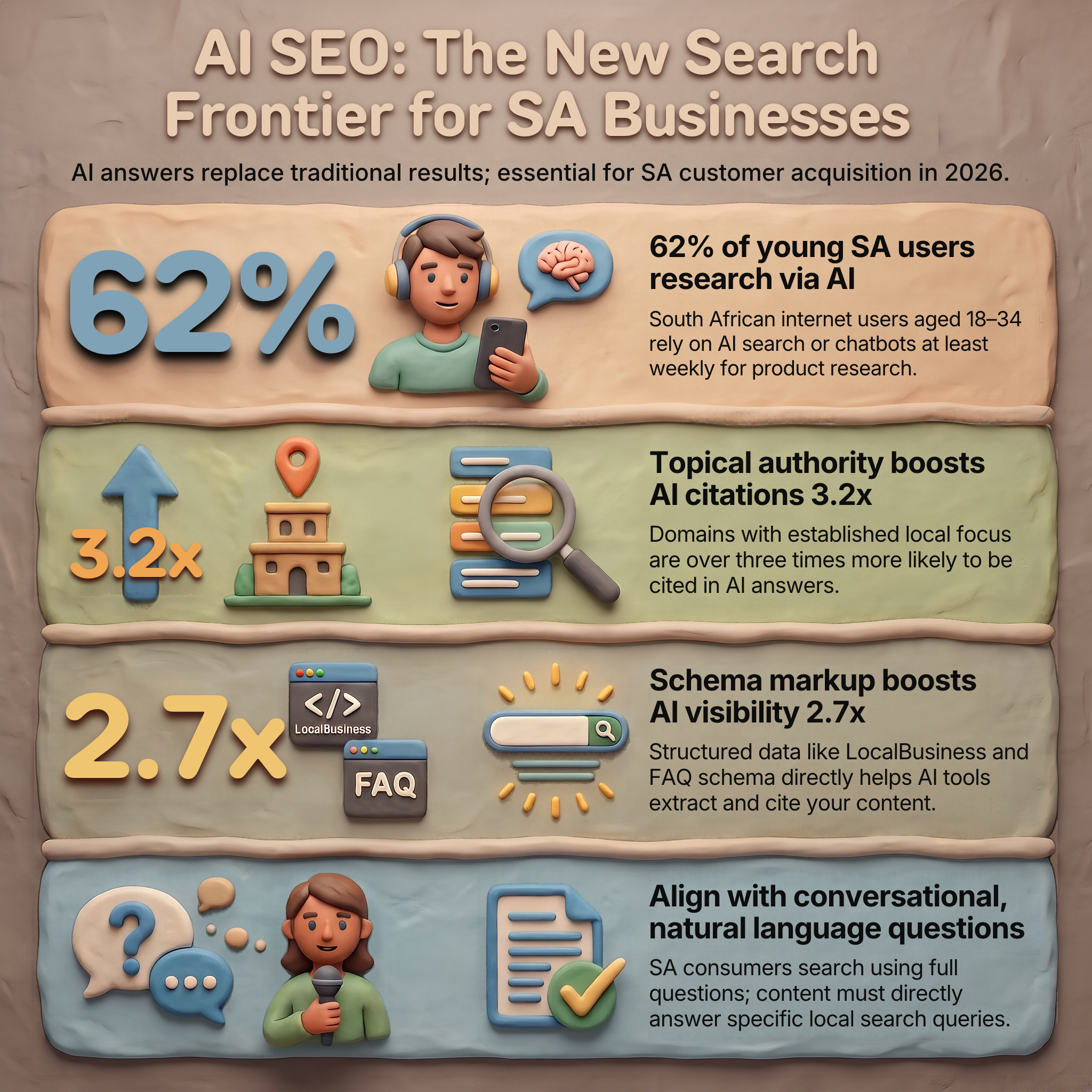
Topical authority. According to research published by Moz in 2025, content from domains with established topical authority is 3.2 times more likely to be cited in AI-generated answers than content from generalist sites. That means if you’ve built a reputation as the voice on commercial property management in the Western Cape, AI tools are more likely to reference your insights.
Natural language alignment. People ask AI tools questions the way they’d ask a colleague — “What’s the best accounting software for a small manufacturing business in SA?” Not “accounting software SME.” Your content needs to anticipate and answer these natural, conversational queries.
None of this replaces traditional SEO. Your website still needs to rank. Your technical foundations still matter. But AI visibility is a complementary layer — and it’s becoming the first layer many customers encounter.

The SA Context: Why This Matters Even More Here
South Africa’s digital landscape has always had its own rhythm. We adapted to mobile-first search years before many international markets because our consumers were accessing the internet primarily on phones, not desktops. We learned to optimise for patchy connectivity and data-conscious users. And we’ve built businesses that survive economic uncertainty, load shedding, and currency fluctuations that would flatten less resilient operators.
AI search visibility fits into this context in three important ways.
First, mobile and voice convergence. South African consumers are heavy users of voice search and voice assistants on mobile devices, often because typing on a phone while navigating Joburg traffic or managing a cash-strapped small business is inefficient. Voice queries are natural language queries — exactly the kind AI tools are designed to handle. If your business isn’t optimised for these conversational searches, you’re missing mobile-first customers who are already comfortable interacting with AI.
Second, research behaviour is shifting younger. According to a 2025 study by World Wide Worx, 62% of South African internet users aged 18-34 reported using AI-powered search or chatbots for product research at least weekly. These aren’t luxury purchases — they’re comparing solar installers, researching business insurance, and finding local suppliers. If your competitors are showing up in AI answers and you’re not, you’re losing the next generation of customers before the buying conversation even starts.
Third, trust and local context. South African buyers — especially in B2B and high-consideration categories like legal services, financial advice, or construction — want local expertise. They want someone who understands SARS regulations, labour law, BEE compliance, and the realities of doing business here. AI tools that cite your content as a local authority signal trust in a way that generic international results can’t.
Ignoring AI visibility because “it’s too early” or “my customers don’t use AI” is the 2026 version of saying “my customers don’t use Google” in 2010. They do. They will. And the gap between early adopters and late followers widens fast.
What AI SEO Visibility Optimisation Actually Involves
So what does it take to show up in AI-generated answers? The good news: much of it builds on the same principles that make for strong traditional SEO. The nuance: execution needs to be tighter, more structured, and more deliberately aligned with how AI models extract and synthesise information.
Content reformatting for extraction. Take your best-performing content — service pages, guides, FAQs — and audit it for scannability. Are your answers to common questions clear and direct? Can an AI model read a single paragraph and extract a coherent answer? Add structured headings. Use bullet points. Answer the question in the first sentence, then expand.
Schema markup expansion. Structured data has always mattered for SEO, but it’s critical for AI visibility. Use FAQ schema, HowTo schema, and LocalBusiness schema to give AI tools explicit signals about what your content covers and who you are. According to Search Engine Journal’s 2025 analysis, pages with comprehensive schema markup were 2.7 times more likely to appear in AI Overviews than pages without.
Conversational keyword mapping. Identify the natural-language questions your customers are actually asking — “How much does it cost to install solar panels on a 3-bedroom house in Pretoria?” or “What’s the difference between a bookkeeper and an accountant for a startup?” — and create content that answers them directly and completely.
Authoritative, cited claims. AI models prioritise content that references credible sources, provides specific data, and demonstrates expertise. If you’re making claims about industry trends, cost benchmarks, or regulatory requirements, back them up. Link to SARS guidance, industry reports, or case studies. This isn’t just good practice — it’s how you build the authority signals AI tools rely on.
Entity strengthening. Make sure your business’s digital footprint is consistent and comprehensive. Your Google Business Profile, your website’s About page, your industry citations, and your mentions across the web should all reinforce the same clear signal: who you are, what you do, and where you do it. AI models build understanding from these entity signals.
This isn’t a one-time project. It’s an evolving optimisation layer that sits alongside your existing SEO work. Some businesses are already seeing results — accounting for 10-15% of their enquiry traffic from AI-driven research paths. Others haven’t started yet and are wondering why competitor names keep appearing in Perplexity results while theirs don’t.

The Window Is Open, But It’s Narrowing
Here’s the truth about early adoption: the businesses that invest in AI search visibility now are building an advantage that compounds over time. Every piece of content that gets cited in an AI answer strengthens your entity authority. Every customer touchpoint that begins with an AI-generated recommendation builds brand recognition before the click even happens.
In 2010, the businesses that took Google SEO seriously from the beginning didn’t just rank — they shaped the expectations for what good online visibility looked like in their industries. The plumbers, the lawyers, the B2B suppliers who invested early became the default options. The ones who waited spent years and significantly more budget trying to catch up.
2026 is that moment for AI search visibility. Traditional Google SEO remains the foundation — you still need to rank, your website still needs to convert, your technical basics still have to be sound. But the businesses that add AI visibility as a strategic layer now are the ones who’ll be explaining their “overnight success” to competitors in 2028.
The question isn’t whether AI search will matter to your SA business. It already does. The question is whether you’re visible in it.
Frequently Asked Questions
Q: Is AI search visibility only relevant for big brands, or does it matter for small SA businesses too?
A: It matters even more for small businesses. AI tools often cite specific, authoritative local sources rather than generic big-brand pages. A Cape Town electrician with well-structured service content and strong local schema can show up in AI answers ahead of a national franchise with weaker content. The playing field is more level than traditional SEO ever was.
Q: Do I need to stop doing traditional Google SEO and focus only on AI visibility?
A: Absolutely not. Traditional SEO remains the foundation of your visibility strategy in South Africa — most search traffic still comes from standard Google results. AI visibility is a complementary layer, not a replacement. Think of it as an additional channel where you can show up, not a new strategy that replaces everything else.
Q: How long does it take to see results from AI SEO optimisation?
A: Early signals can appear within weeks — you might see your content cited in Perplexity or ChatGPT answers relatively quickly if your authority signals are already strong. Broader, consistent visibility across AI platforms typically builds over 3-6 months as your structured content, entity signals, and topical authority strengthen. It’s similar to traditional SEO timelines, but the competitive landscape is less crowded right now.
Q: What’s the biggest mistake SA businesses are making with AI search visibility?
A: Waiting. The same hesitation that cost businesses visibility in 2010 — “it’s too technical,” “my customers aren’t there yet,” “I’ll wait and see” — is happening again. The businesses investing in AI visibility now are building compounding advantages while the field is still open. By the time it’s obvious to everyone, the cost and effort to compete will be significantly higher.
If you’re ready to make sure your SA business shows up in the search answers that matter — traditional and AI-powered — let’s talk. Thickrope Marketing’s AI SEO visibility service is built for businesses that want to lead, not follow. Book a free consultation and we’ll show you exactly where you’re visible today, where you’re not, and what it takes to fix it.