

PPC for Financial Services in South Africa: What Google Won’t Allow, What Actually Converts, and How to Build Campaigns That Work
You’ve got your Google Ads account set up. Your budget’s approved. You’ve written what you think is a brilliant ad for your financial services offering. You hit publish, make yourself a coffee, and wait for the leads to roll in.
Three hours later: Policy violation. Ad disapproved.
Welcome to PPC for financial services — the only sector where Google treats your ad copy like a FICA application and your landing page like it’s applying for a banking licence.
Here’s what most SA financial services firms don’t realise until they’re knee-deep in disapprovals: financial products and services are subject to a completely different rulebook. Google’s advertiser policies for this category are strict, often confusing, and — if you’re operating in South Africa — layered with additional compliance considerations that make running profitable campaigns feel like threading a needle in the dark during load shedding.
This isn’t a Google Ads tutorial. This is what you need to know about the specific policy landscape, conversion dynamics, and campaign structure that make financial services PPC fundamentally different from flogging yoga mats or plumbing services.
What Google Won’t Let You Say (and Why Your Competitors’ Ads Probably Violate Policy Too)
Let’s start with the uncomfortable truth: Google’s financial products and services policy restricts ad formats, prohibits certain claims, and requires certification for specific products — yet enforcement is inconsistent enough that you’ll see competitors running ads that technically breach policy every single day.
Here’s what you categorically cannot do:
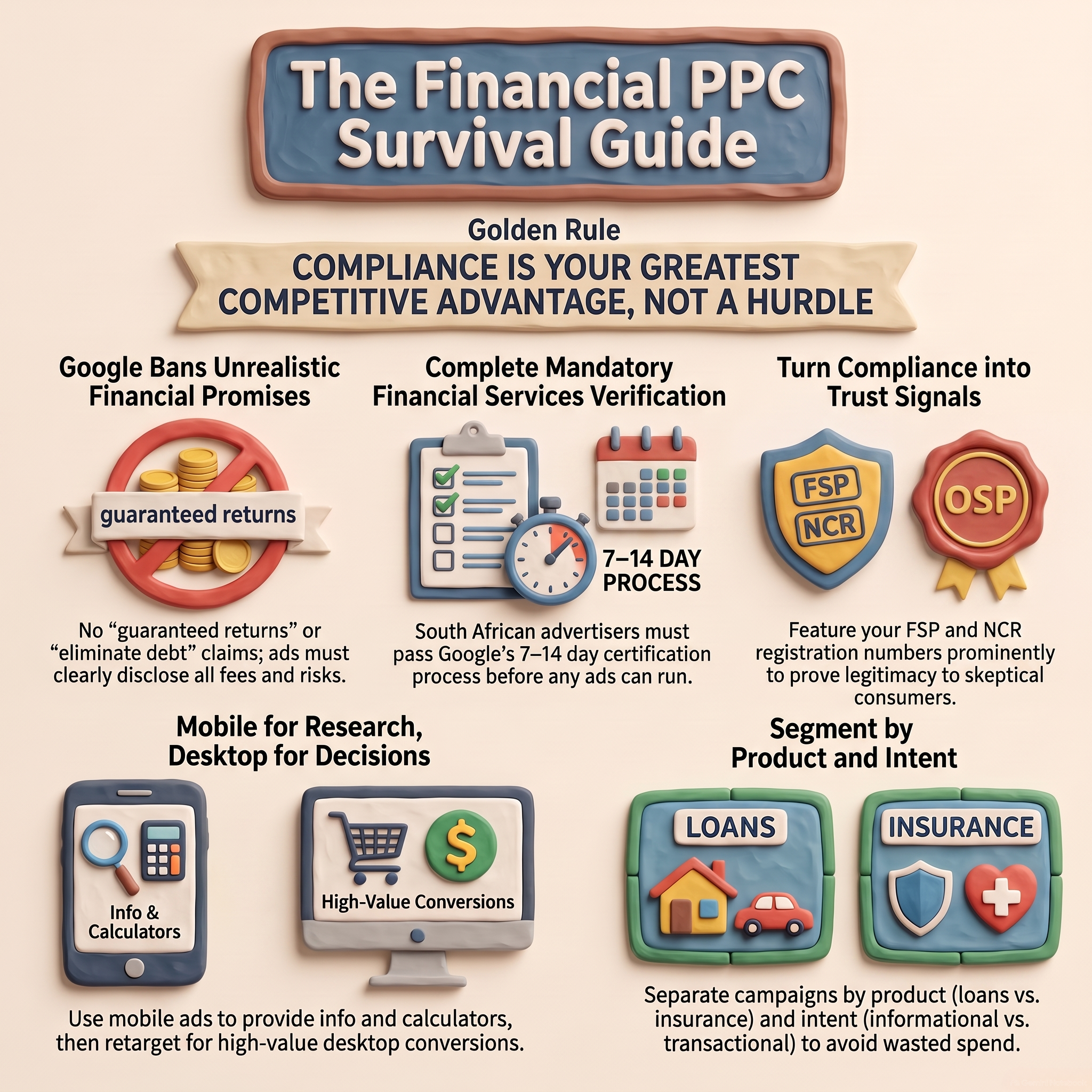
You can’t make unrealistic promises about financial outcomes. No “guaranteed returns,” no “eliminate all your debt,” no “get rich quick.” Google’s policy explicitly prohibits misleading claims about financial products. In South Africa, where the FAIS Act already regulates financial services advertising, this creates a compliance layer most businesses don’t account for until their ads are rejected.
You can’t use certain ad formats for certain products. Trying to advertise credit products, loans, or insurance? Google requires certification through their Financial Services verification programme. Without it, your ads won’t run — full stop. According to Google’s own policy documentation, advertisers offering credit cards, personal loans, mortgages, or insurance in South Africa must complete this certification before ads are approved. The process takes 7–14 days, and most financial services firms only discover this requirement after launching their first campaign.
You can’t skip the disclaimers. Interest rates, fees, eligibility requirements — if your product has them, Google wants them visible. This isn’t optional. The policy states that ads must “clearly and conspicuously disclose fees, risks, and other important details.” In practice, that means your ad copy needs to include the tedious bits that make your CTR plummet, or your ads get disapproved.
Here’s the kicker: your competitors who are running ads without these disclaimers are either flying under the radar temporarily, or they’re racking up policy violations they don’t know about yet. Google’s enforcement is algorithmic and reactive. Just because an ad is running doesn’t mean it’s compliant.

The Conversion Problem: Why Financial Services PPC Is a Trust Game, Not a Traffic Game
Most PPC campaigns optimise for clicks. Financial services campaigns that actually convert optimise for trust signals at every stage of the funnel — because the decision to hand over your retirement savings, apply for a bond, or switch insurance providers isn’t made on impulse.
Research from the Financial Services Board (now the Financial Sector Conduct Authority) found that South African consumers rank “trustworthiness” as the number one factor when choosing financial services providers, ahead of pricing, convenience, or even product features. That trust deficit is built into the category. Your PPC campaign isn’t just competing for attention — it’s competing against decades of financial services advertising that’s conditioned people to be skeptical.
Here’s what that means for your campaigns:
Your Landing Page Isn’t a Conversion Tool — It’s a Credibility Test
The moment someone clicks your ad, they’re evaluating whether you’re legitimate. FSP number displayed prominently? Certificates, registrations, and regulatory disclosures visible? Professional design that doesn’t look like it was built on Wix in 2014? These aren’t nice-to-haves. According to a Stanford Web Credibility Research study, 75% of users admit to making judgements about a company’s credibility based on their website’s design. In financial services, that percentage is higher.
Your landing page needs to answer three questions within five seconds:
1. Are you legitimate? (Regulatory credentials, years in business, recognisable logos)
2. Is this product what the ad promised? (Message match between ad copy and headline)
3. What happens if I fill in this form? (Clear next steps, privacy assurances, response timeframes)
Your Ad Copy Needs to Signal Expertise, Not Urgency
“Limited time offer! Apply now!” might work for e-commerce. In financial services, it signals desperation or, worse, a scam.
The ad copy that converts in this category focuses on specificity and relevance. Not “Get a home loan today” — but “Home loans for self-employed SA business owners, approved in 48 hours.” The more specific your value proposition, the higher your conversion rate, because specificity is a proxy for expertise.
Mobile Conversion Rates Are Lower — But Mobile Traffic Dominates
Here’s the tension: mobile devices account for over 60% of Google searches in South Africa (according to StatCounter data for 2024), but financial services conversion rates on mobile are historically 30–50% lower than desktop. Why? Because nobody’s applying for a R2 million home loan on their phone while sitting in traffic on the N1.
The solution isn’t to ignore mobile traffic. It’s to design your funnel for mobile research and desktop conversion. Mobile ads should focus on capturing interest, providing instant information (calculators, eligibility checkers, downloadable guides), and retargeting users for desktop conversion later. If your financial services PPC campaign treats mobile and desktop the same way, you’re haemorrhaging budget.
What a Properly Structured Financial Services PPC Campaign Actually Looks Like
Most financial services firms approach PPC the same way they’d approach any other channel: broad keywords, generic ads, one landing page for everything. That approach burns budget faster than Eskom burns diesel.
Here’s the structure that works:
Segment by Product and Intent, Not Just Keywords
A search for “retirement annuity” and a search for “best retirement annuity South Africa” represent completely different stages of buyer intent. The first is exploratory. The second is comparative. Your campaign structure needs to reflect that.
Separate campaigns by product category (home loans, vehicle finance, retirement products, short-term insurance) and by intent stage (informational, comparative, transactional). This allows you to control budgets, tailor ad copy, and match landing pages to the specific question the searcher is asking.
Use Compliance as a Competitive Advantage
Remember those disclaimers Google forces you to include? Most financial services firms treat them like a nuisance. Smart firms use them as proof of legitimacy.
Instead of hiding “T’s & C’s apply” in 6pt font, feature your regulatory compliance prominently: “Authorised FSP | NCR Registered | FAIS Compliant.” In a sector plagued by scams and unregistered operators, compliance signals are trust signals.
Build Retargeting Audiences That Reflect the Decision Timeline
The average decision timeline for a financial product in South Africa ranges from 7 days for personal loans to 90+ days for retirement products. Your retargeting strategy needs to match that reality.
Someone who clicked your home loan ad last week isn’t ignoring you — they’re probably comparing rates, speaking to their accountant, and figuring out whether they can actually afford the repayments while budgeting for load shedding solutions. Your retargeting should nurture, not nag. Educational content, customer testimonials, rate comparison tools — these keep you top of mind without being intrusive.
Track Leads, Not Just Conversions
In financial services, a form submission isn’t a conversion — it’s the start of a qualification process. If you’re optimising Google Ads for “conversions” without tracking which leads actually become clients, you’re flying blind.
Integrate your CRM with Google Ads. Pass back actual client acquisition data. Optimise for lead quality, not lead volume. A campaign that generates 50 qualified leads at R800 each is infinitely more valuable than one that generates 200 junk leads at R200 each — even if the latter looks better on your dashboard.

The SA-Specific Compliance Layer Nobody Mentions Until It’s a Problem
Even if you’ve nailed Google’s policies, you’re not done. Financial services advertising in South Africa is regulated by multiple bodies, and ignorance isn’t a defence when the FSCA comes knocking.
FAIS Act Requirements Apply to Digital Ads
The Financial Advisory and Intermediary Services Act applies to all marketing communications, including PPC ads. That means:
- Any performance claims must be substantiated
- Risks must be disclosed where benefits are mentioned
- Your FSP number must be displayed on landing pages
- Advertising must not be misleading or create unrealistic expectations
NCR Registration Is Required for Credit Advertising
If you’re advertising credit products — personal loans, store credit, buy-now-pay-later — you need to be registered with the National Credit Regulator. Your ads and landing pages must include your NCR registration number, and you’re required to display the maximum interest rate and fees.
Non-compliance isn’t just a policy violation — it’s a potential criminal offence under the National Credit Act. Most PPC agencies don’t know this. Most financial services firms assume Google’s approval means they’re legally compliant. They’re wrong.
What to Do Differently Because of All This
Financial services PPC in South Africa isn’t harder than other categories — it’s just differently complex. The firms that win are the ones that treat compliance as table stakes and focus on building trust at scale.
Here’s your checklist before you launch:
- 1. Get certified. Complete Google’s Financial Services verification. Budget 2 weeks for approval.
- 2. Audit your compliance. Every ad, every landing page, every claim — cross-reference against FAIS, NCR, and Google policies. If you’re not certain, get legal sign-off.
- 3. Segment ruthlessly. Different products, different intent stages, different audiences. One campaign to rule them all is a recipe for wasted spend.
- 4. Optimise for trust, not clicks. Your CTR might be lower than other industries. That’s fine. What matters is whether the people who click convert into clients.
- 5. Track the full funnel. Lead to client, not just click to lead. If you don’t know which campaigns generate actual revenue, you’re guessing.
Frequently Asked Questions
Q: How long does Google’s Financial Services certification take?
A: Typically 7–14 business days, assuming your documentation is in order. You’ll need proof of regulatory registration (FSP or NCR number), business verification, and in some cases, specific product documentation. Don’t launch campaigns until this is approved — your ads won’t run.
Q: Can I advertise crypto or forex trading with Google Ads in South Africa?
A: Cryptocurrency advertising is heavily restricted globally and requires separate certification. Forex trading is permitted but subject to Google’s financial services policies and SA regulatory requirements (FSCA registration). Most forex ads get disapproved initially due to policy violations around risk disclosure or unrealistic earning claims.
Q: Do I need different landing pages for each financial product I advertise?
A: Yes. Message match between ad and landing page is critical for Quality Score, conversion rates, and compliance. A generic “Our Services” page won’t cut it. Each product category needs a dedicated landing page with relevant disclaimers, regulatory information, and a clear conversion path.
Q: What’s a realistic cost-per-lead for financial services PPC in South Africa?
A: It varies wildly by product. Personal loans and short-term insurance might run R150–R400 per lead. Home loans and vehicle finance typically sit between R400–R1,200. Retirement and investment products can exceed R2,000 per lead. What matters more than cost-per-lead is cost-per-client and lifetime value — cheap leads that don’t convert are worthless.
Q: Can I run financial services ads without being a registered FSP?
A: Not if you’re providing advice or intermediary services. If you’re purely offering a product (like a bank advertising its own accounts), registration requirements differ. But if you’re a broker, advisor, or intermediary, FAIS registration is legally required — and increasingly, Google is cross-referencing regulatory databases before approving financial services ads.
If you’re a financial services firm tired of disapproved ads, wasted budget, and campaigns that generate leads but not clients, let’s talk. Thickrope builds financial services PPC campaigns that actually understand the compliance landscape, conversion dynamics, and what it takes to win trust at scale in the SA market. Book a free consultation and we’ll audit your current setup — no charge, no obligation.