

The Surprising Truth About AI SEO Automation: Most Businesses Are Automating the Wrong Tasks
Here’s something most South African business owners don’t know: the SEO tasks you think need human creativity are often perfect for AI automation, while the ones that seem “automatable” are precisely where AI will destroy your content quality and tank your rankings.
I’ve watched dozens of SA businesses — from Durban e-commerce stores to Joburg B2B service providers — embrace AI for SEO with wildly different results. The difference isn’t the tools they use. It’s knowing where the line sits between “this saves me ten hours a week” and “this just got my site demoted.”
Let me show you what’s actually working, what’s quietly sabotaging rankings, and how to build AI into your SEO workflow without producing the kind of generic slop that Google’s algorithms now sniff out in milliseconds.
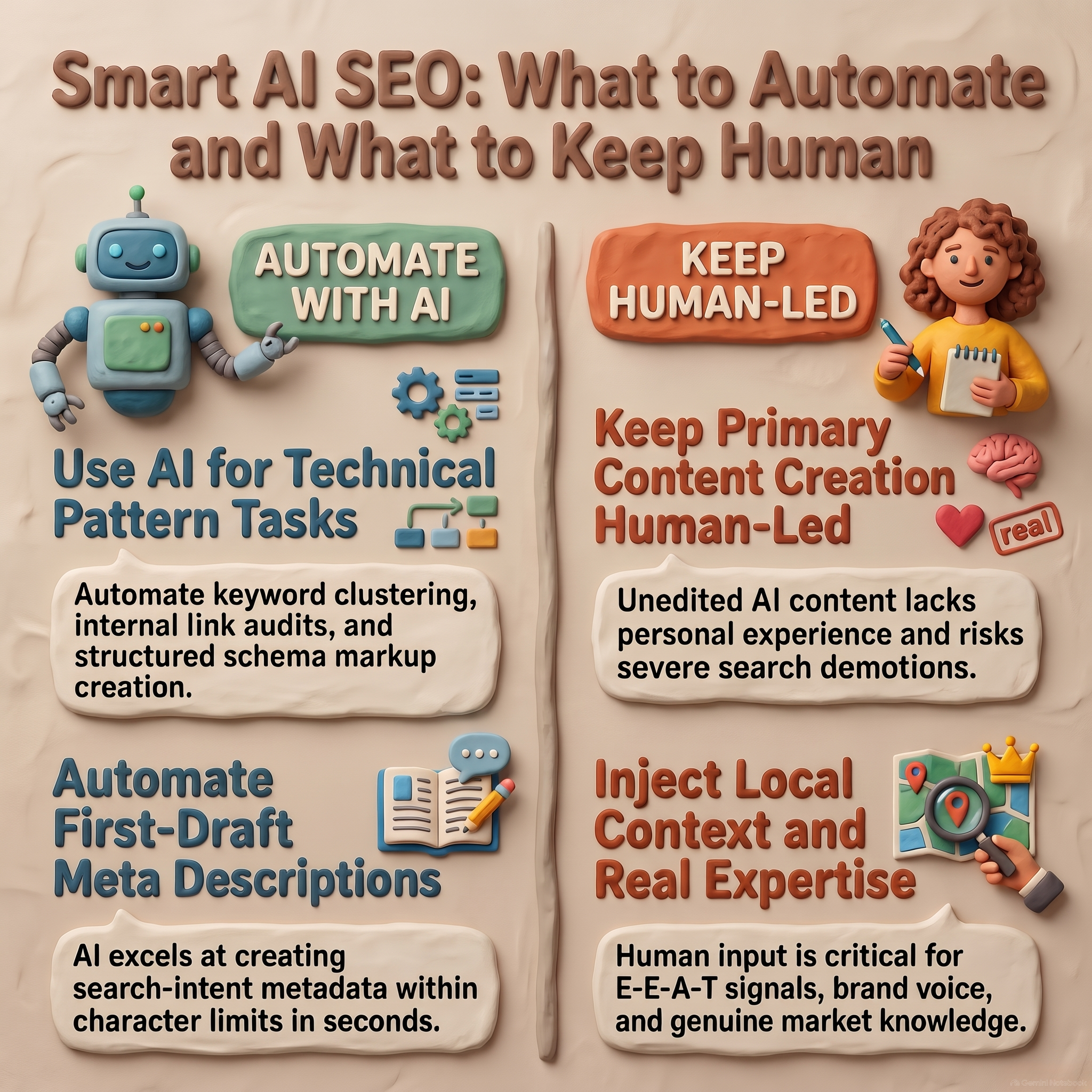
The Thing About AI and SEO That Nobody Mentions
Google’s March 2024 core update specifically targeted AI-generated content that adds no value beyond what already exists — and according to SEMrush’s post-update analysis, sites relying heavily on unedited AI content saw ranking drops averaging 43%. That’s not a small dent; that’s a crater.
But here’s the twist: the same update rewarded sites using AI for technical SEO tasks, structured data implementation, and content optimisation frameworks. Sites that used AI strategically saw improvements in featured snippet capture rates by up to 28%.
The lesson? AI is brilliant at patterns, terrible at nuance. And South African businesses operating in niche markets with local context need to be especially careful about which side of that line they’re on.
Where AI Automation Actually Saves Your Bacon (Without Ruining Your Rankings)
Keyword Research and Clustering
This is where AI genuinely shines. Traditional keyword research involves hours of spreadsheet torture — pulling data from multiple tools, grouping semantically related terms, identifying search intent patterns, and mapping keywords to content opportunities.
AI can cluster 5,000 keywords into logical topic groups in about 90 seconds. It can identify question-based keywords your SA competitors aren’t targeting, spot local search variations (because “robot” in Durban might be searched differently than “robot” in Pretoria), and surface long-tail opportunities that would take you days to find manually.
What to automate: Keyword extraction from search console data, semantic clustering, search intent classification, competitor keyword gap analysis.
What to keep human: Final keyword selection based on your actual business priorities, local market knowledge, and seasonal patterns (back-to-school in SA, festive season shopping behaviours, load shedding impact on search patterns).
Internal Link Auditing and Opportunity Mapping
Your site probably has dozens of internal linking opportunities you’re missing. AI can crawl your content, identify topical relationships, suggest contextual link placements, and flag orphaned pages (pages with no internal links pointing to them, which Google struggles to discover and rank).
According to Ahrefs’ 2025 study, proper internal linking can improve page rankings by an average of 8.5 positions for competitive keywords. For a Johannesburg plumbing company or a Cape Town law firm, that’s the difference between page two obscurity and first-page visibility.
What to automate: Site crawls for broken links, identification of high-authority pages that should link to new content, anchor text variation analysis, orphaned page detection.
What to keep human: Editorial decisions about which links actually serve your reader, contextual fit (does the link genuinely help someone understand the topic better?), and avoiding over-optimisation that looks spammy.
Meta Description Generation
Here’s a controversial one: AI is often better than humans at writing meta descriptions. Why? Because it doesn’t get bored writing the 47th variation of “affordable plumbing services in Sandton” and it naturally incorporates search intent signals that improve click-through rates.
A well-structured prompt can generate meta descriptions that include your target keyword, address search intent, stay within the 155-character limit, and include a subtle CTA — all in about 30 seconds per page.
What to automate: First-draft meta descriptions for large content libraries, product pages, service location pages.
What to keep human: Final review for brand voice, local context (mentioning “load shedding solutions” might dramatically increase CTR for certain SA businesses), and ensuring the description accurately reflects the page content.
Structured Data and Schema Markup Creation
If you’re not using schema markup because it seems technically intimidating, AI just removed your excuse. AI tools can analyse your page content and generate the appropriate JSON-LD structured data — whether that’s Local Business schema, Product schema, FAQ schema, or Article schema.
Google explicitly states that structured data helps them understand page content and can result in rich snippets, which according to Search Engine Land data improve click-through rates by 20-40%. For a restaurant in Stellenbosch or a hardware store in Bloemfontein, that’s a massive competitive advantage.
What to automate: Schema markup generation, syntax validation, bulk implementation across similar page types.
What to keep human: Verification that the markup accurately represents your business (wrong opening hours or service areas can damage trust), and strategic decisions about which schema types serve your business goals.

Where AI Automation Will Absolutely Wreck Your Rankings
Primary Content Creation
This is the big one. Using AI to write your main service pages, blog posts, or product descriptions without substantial human input is like putting your rankings into a wood chipper.
Why? Because AI produces statistically probable text based on patterns it’s seen before. It doesn’t know that your Pretoria-based HVAC company offers same-day service during load shedding, or that your customer’s biggest pain point isn’t price — it’s trustworthiness after three bad experiences with fly-by-night operators.
Google’s documentation on “helpful content” specifically warns against content created primarily for search engines rather than people. And AI content, without human expertise layered in, reads exactly like what it is: generic information assembly.
The dangerous temptation: “I’ll just use AI to write 50 blog posts and dominate long-tail keywords.”
The reality: You’ll spend three months watching those posts fail to rank, or worse — rank briefly then disappear after the next core update.
Local/Cultural Context and Expertise
AI doesn’t understand that “just now” in South Africa means anything from five minutes to never. It doesn’t know that referencing load shedding in your content immediately signals local relevance and builds trust with SA readers. It can’t write about the practical challenges of running a Gauteng logistics business during taxi strikes or how Cape Town’s water restrictions affect landscaping services.
According to BrightEdge research, content that includes location-specific context and expertise sees 67% better engagement metrics than generic content — and Google’s algorithms are increasingly sophisticated at detecting genuine local expertise versus keyword-stuffed location pages.
What AI can’t replicate: Actual experience serving SA customers, understanding of local pain points, cultural nuance, industry expertise earned through years in the market.

E-E-A-T Signals (Experience, Expertise, Authoritativeness, Trustworthiness)
Google’s search quality guidelines emphasise E-E-A-T for any content that could impact someone’s wellbeing, finances, or major decisions. That includes most business services — from financial advice to medical services to home repairs.
AI cannot demonstrate experience. It can’t tell a story about solving a specific customer problem. It can’t offer an expert opinion that contradicts conventional wisdom based on years of seeing what actually works in the SA market.
The gap AI can’t fill: Personal insights, case studies with real outcomes, contrarian positions backed by experience, specific advice that goes beyond generic best practices.
The Smart Framework: Automation + Expertise
Here’s how successful SA businesses are actually using AI for SEO without sacrificing quality:
Layer 1: AI Does the Heavy Lifting
- Keyword research and clustering
- Technical audits and error detection
- Content gap analysis against competitors
- First-draft meta descriptions and title tags
- Schema markup generation
- Internal link opportunity identification
Layer 2: Human Expertise Adds the Value
- Strategic keyword selection based on business priorities
- Content creation that demonstrates genuine expertise
- Local context and cultural relevance
- Editorial decisions about link placement and anchor text
- Brand voice and messaging consistency
- Customer insight and pain point articulation
Layer 3: AI Optimises the Output
- Content readability analysis
- Keyword density and semantic relevance checking
- Headline A/B testing suggestions
- Image alt text generation
- FAQ schema generation from existing content
Think of it as a relay race, not a substitution. AI passes the baton to human expertise at the exact moment where quality becomes more important than speed.
The South African Context: Why This Matters More Here
SA businesses operate in a uniquely challenging environment. You’re competing against international sites with massive content budgets, dealing with load shedding that affects your ability to publish consistently, and serving customers who are increasingly sceptical of generic marketing promises.
You can’t afford to waste time on SEO tasks that don’t move the needle. But you also can’t afford to damage your rankings by publishing thin AI content that makes you indistinguishable from every other business in your category.
According to Google Trends data for South Africa, searches for “[industry] near me” have increased 178% since 2023, and “best [service] in [SA city]” searches are up 143%. Local specificity and genuine expertise are becoming the primary ranking factors for SA businesses competing in local markets.
AI automation gives you the time efficiency to compete with bigger budgets. Human expertise gives you the quality differentiation to win the customer.

The Red Flags: Signs Your AI Automation Has Gone Too Far
Watch for these warning signs that your automation is hurting more than helping:
Your content could describe any business anywhere. If you can swap out “Johannesburg” for “Melbourne” and “Rands” for “Dollars” without changing anything else, you’ve automated away your competitive advantage.
Engagement metrics are dropping. If time-on-page, pages-per-session, and conversion rates are declining even as you publish more content, your AI content isn’t connecting with real humans.
You can’t remember the last time you edited AI output. If you’re publishing AI-generated content with minimal review, you’re gambling with your rankings.
Your rankings are volatile. If pages are ranking well briefly then disappearing, Google’s algorithms may be identifying your content as low-quality.
The Practical Starting Point for SA Businesses
If you’re running a business in Durban, Cape Town, Pretoria, or anywhere in between, here’s your sensible entry point:
Start with technical automation. Use AI for keyword research, technical audits, schema markup, and internal link analysis. These tasks are time-consuming, pattern-based, and difficult to mess up with automation.
Keep content human-led. Write your own service pages, about page, and core content that demonstrates expertise. Use AI as a research assistant and first-draft generator, but add the insights that only you possess.
Automate content optimisation, not creation. Let AI suggest improvements to existing content — readability enhancements, keyword variations, FAQ additions, structured data — rather than generating new content from scratch.
Measure what matters. Track rankings, yes, but also watch engagement metrics, conversion rates, and customer feedback. If customers tell you your content doesn’t sound like you anymore, your automation has gone too far.
Frequently Asked Questions
Q: Can Google detect AI-generated content and will it penalise my site?
A: Google can identify many patterns common in AI content, but they don’t penalise AI content specifically — they penalise low-quality, unhelpful content regardless of how it’s created. Well-edited AI content that demonstrates expertise and serves users can rank perfectly fine. Unedited generic AI content increasingly struggles.
Q: What’s a realistic time saving from AI SEO automation for a typical SA small business?
A: Most small businesses report saving 8-15 hours per month on keyword research, technical audits, and content optimisation tasks. That’s time you can redirect to client work, business development, or creating genuinely valuable content. The savings scale with your content volume.
Q: Should I disclose when I’m using AI for SEO tasks?
A: For behind-the-scenes SEO tasks like keyword research or schema markup, disclosure isn’t necessary or expected. For content creation, transparency builds trust — many successful businesses note when content is “AI-assisted” or include editorial oversight disclaimers. The key is ensuring quality, not hiding your tools.
Q: How much does AI SEO automation cost for a South African business?
A: Basic AI tools start around R200-500/month. Enterprise SEO platforms with AI features run R2,000-8,000/month. But many free AI tools (ChatGPT, Claude, Gemini) can handle foundational tasks if you know how to prompt them effectively. The real cost is the learning curve and strategic oversight, not the tools themselves.
Q: What happens if everyone starts using AI for SEO — won’t we all just blend together?
A: This is exactly why human expertise becomes more valuable as AI adoption increases. As baseline technical SEO becomes commoditised through automation, the differentiators become local knowledge, genuine experience, customer understanding, and content that only you can create. AI raises the floor; expertise raises the ceiling.
If you’d like expert guidance on which SEO tasks to automate and which require the human touch for your specific SA business, Thickrope Marketing offers strategic SEO consultations that map automation opportunities to your actual business goals — without the generic playbook approach. Get in touch and let’s build an SEO workflow that saves time without sacrificing rankings.