

What Local SEO Optimisation Services Actually Include — And How to Tell If You’re Getting Them
You’re paying someone to “do your local SEO.” But when you ask what that actually means, you get vague assurances about “visibility” and “optimisation” and “Google love.”
Here’s the problem: local SEO optimisation services are one of the most oversold, under-defined offerings in South African digital marketing. And because most business owners don’t know what a proper service should include, they can’t tell whether they’re getting genuine value or just expensive admin wrapped in jargon.
If you’re a Johannesburg plumber, a Durban accountant, or a Cape Town physio competing for customers in your area, local SEO isn’t a luxury — it’s how people find you when they need what you sell. According to Google, 46% of all searches have local intent, and 76% of people who search for something nearby on their smartphone visit a business within 24 hours. In South Africa, where most searches happen on mobile and load shedding makes every click count, showing up in local results is non-negotiable.
So let’s pull back the curtain. Here’s what a professionally structured local SEO optimisation service should actually deliver for a South African business — and how to hold your provider accountable for each piece.
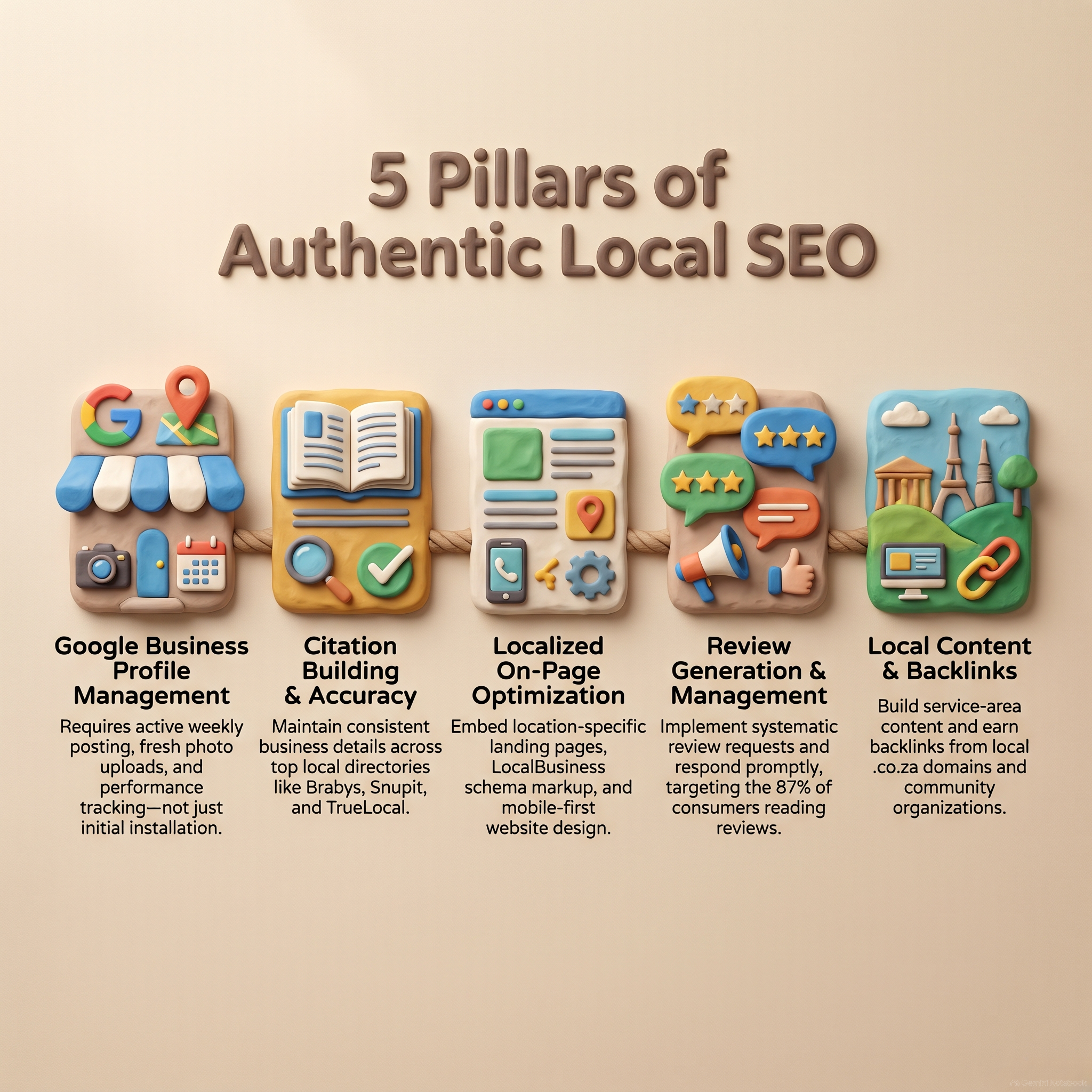
The Core Components of Proper Local SEO Services
A legitimate local SEO service isn’t one thing. It’s a structured programme covering five interconnected areas. If your provider isn’t addressing all five, you’re not getting the full picture.
1. Google Business Profile Management (Not Just “Setting It Up”)
Your Google Business Profile is the centrepiece of local SEO. It’s what shows up in Google Maps, the local pack (those three businesses that appear above organic results), and Knowledge Panel results when someone searches for your business name or category.
But here’s where most services fall short: they’ll set up your profile once, add a few photos, and walk away. That’s not management — that’s installation.
What proper GBP management actually includes:
- Weekly posting (offers, updates, events) — Google favours active profiles, and fresh posts signal that you’re a real, operating business
- Photo and video uploads — businesses with photos receive 42% more requests for directions and 35% more click-throughs to their websites than those without, according to Google’s own data
- Attribute optimisation — ticking the right boxes (wheelchair accessible, free Wi-Fi, accepts cards) based on what your customers actually search for
- Category refinement — choosing primary and secondary categories that match search intent, not just what sounds impressive
- Monitoring and responding to Q&A — the Questions & Answers section on your profile is user-generated; if you’re not managing it, someone else is writing your script
- Performance tracking — monthly reports showing search queries, actions taken (calls, direction requests, website clicks), and how you compare to competitors in your area
If your provider set up your GBP in January and hasn’t touched it since, you’re not getting ongoing management. You’re paying a retainer for past work.
2. Citation Building and Management Across SA Directories
Citations are mentions of your business name, address, and phone number (NAP) across the web — on directories, industry sites, and local listings. They matter because Google uses them to verify that your business is legitimate and where you say you are.
But not all citations are equal, and international providers often waste time on directories South African consumers don’t use.
What proper citation work looks like for an SA business:
- Core directory submissions — getting your business listed accurately on TrueLocal, Snupit, Brabys, Localsearch.co.za, and other directories South Africans actually use
- Industry-specific listings — if you’re a restaurant, you need to be on Zomato and Google Maps; if you’re a tradesperson, you need to be on Service Directory and Hello Peter; if you’re a B2B service, LinkedIn Company Pages and industry associations matter
- NAP consistency audits — finding and fixing inconsistent listings (old addresses, disconnected phone numbers, outdated trading names) that confuse Google and dilute your authority
- Ongoing monitoring — citations decay over time as platforms shut down, merge, or change; a one-off citation blast in 2022 isn’t helping you in 2026
In South Africa, where business addresses can be complex (units, complexes, informal trading areas), citation accuracy matters even more. A proper service includes quarterly audits and cleanup, not just initial submissions.
3. Localised On-Page SEO Signals on Your Website
Your website needs to clearly tell Google (and humans) where you operate and who you serve. This isn’t about stuffing “Pretoria plumber” into every sentence — it’s about intelligent, deliberate localisation.
What local on-page optimisation includes:
- Location-specific service pages — if you serve multiple suburbs or towns, each should have its own landing page with unique, relevant content (not templated rubbish)
- Schema markup for LocalBusiness — structured data that tells Google exactly what you do, where you’re located, your hours, and contact details
- Embedded Google Maps — showing your service area or physical location on your contact page
- Local keywords in meta titles, H1s, and body copy — naturally woven in where they make sense, not hammered into irrelevance
- Mobile optimisation — because 70% of South African internet users access the web primarily via smartphone, and Google’s local results are mobile-first
A proper service will audit your existing site, identify gaps, and either implement fixes directly or provide you with a prioritised list of changes your web developer should make. If your local SEO provider has never asked to access your website, they’re not doing on-page work.
4. Review Generation and Response Strategy
Online reviews are one of the strongest local ranking factors Google uses, and they’re how South African consumers decide whether to trust you. According to BrightLocal’s research, 87% of consumers read online reviews for local businesses, and 79% trust them as much as personal recommendations.
But here’s what separates real review strategy from box-ticking:
What a professional review service includes:
- A systematic process for requesting reviews — templated emails, SMS follow-ups, or QR codes that make it easy for happy customers to leave feedback on Google (and other platforms relevant to your industry)
- Response management — replying to every review, positive and negative, in a tone that matches your brand and reassures future customers
- Review monitoring — tracking new reviews across Google, Facebook, HelloPeter, and industry-specific platforms so nothing slips through
- Reputation troubleshooting — strategies for dealing with fake reviews, unfair feedback, or review attacks from competitors (yes, it happens)
A local SEO service that doesn’t include review generation is ignoring one of the highest-impact levers you have. If your provider has never sent you a review request template or shown you response analytics, you’re missing a massive piece.
5. Local Content Strategy and Link Building
Local content isn’t about writing “10 Things to Do in Sandton” unless you’re a Sandton tourism operator. It’s about creating content that answers the specific questions your local audience asks — and earning links from other local businesses, chambers of commerce, news sites, and community platforms.
What proper local content and link work includes:
- Service-area blog posts — content that addresses local search queries (e.g., “how to choose a conveyancer in Cape Town” if you’re a property attorney)
- Community involvement and coverage — sponsoring a local sports team, speaking at a business breakfast, or supporting a charity — then getting that mentioned and linked on local sites
- Local backlinks from SA domains — links from .co.za sites, especially those in your region or industry, carry more local relevance than international directories
- Partnerships and co-marketing — working with complementary local businesses to cross-promote and earn natural links
This is the hardest part to scale and the easiest to fake. If your provider is building “local links” but can’t show you where those links are or why they matter to your business, you’re likely getting low-value spam links that do more harm than good.

What You Should Receive Every Month — And How to Check It’s Real
Here’s the accountability test: ask your local SEO provider to show you a monthly report that includes:
- GBP insights — search queries that triggered your profile, total searches, actions taken (calls, clicks, direction requests), photo views
- Ranking changes — where you rank for your core local keywords (e.g., “electrician Centurion,” “family lawyer Durban”), tracked in Google’s local pack and organic results
- Citation updates — new citations built, errors corrected, and a current NAP consistency score
- Review summary — new reviews received, response rate, average rating, and comparison to previous months
- Traffic and conversion data — website visitors from local searches, form submissions, calls, and other goal completions
If they can’t produce this — or if the report is full of vanity metrics like “impressions” and “engagement” without tying it to actual business outcomes — you’re not getting local SEO optimisation. You’re getting reporting theatre.
What a Fair Investment Looks Like in South Africa
Local SEO optimisation services in South Africa typically range from R3,500 to R15,000 per month, depending on your industry competitiveness, service area size, and the scope of work.
At the lower end (R3,500–R6,000/month), you’re looking at basic GBP management, citation building, and review monitoring for a single-location business in a less competitive space (e.g., a suburban physio or independent retailer).
At the mid-range (R6,000–R10,000/month), expect comprehensive GBP optimisation, ongoing citation management, on-page recommendations, review strategy, and monthly content for a business with moderate local competition (e.g., a law firm, accounting practice, or trades business serving a metro area).
At the upper end (R10,000–R15,000+/month), you’re paying for multi-location management, aggressive review generation, custom local content, strategic link building, and advanced tracking for highly competitive sectors (e.g., real estate, medical specialists, or hospitality).
Be wary of anyone offering “full local SEO” for under R3,000/month — at that price, corners are being cut, and you’re likely getting automation, offshore labour with no SA context, or recycled work sold to multiple businesses.
The Questions to Ask Before You Sign Anything
If you’re evaluating a local SEO optimisation service — or auditing what you’re currently paying for — here are the questions that separate pros from posers:
1. “Can I see a sample monthly report for a client similar to my business?”
If they won’t show you what reporting looks like, assume it doesn’t exist.
2. “Who will actually do the work — and are they based in South Africa?”
Offshore teams often lack local context and can’t identify SA-specific directories, regional keywords, or cultural nuances that matter.
3. “What happens to my Google Business Profile and citations if I stop working with you?”
You should own your GBP and have access to all login credentials. If they built citations under their agency email and won’t transfer ownership, you’re locked in.
4. “How do you handle reviews, and what’s your response time?”
Real providers monitor daily and respond within 24–48 hours. If they check weekly or outsource responses to a template bot, you’ll lose trust and rankings.
5. “What local keywords are you targeting, and why?”
If they can’t explain the search intent behind the keywords they’re optimising for, they’re guessing — or worse, targeting volume with no conversion potential.
Frequently Asked Questions
Q: How long does it take to see results from local SEO optimisation services?
A: Most SA businesses start seeing measurable improvements in Google Business Profile visibility and local rankings within 8–12 weeks, with compounding growth over 6–12 months. If a provider promises page-one rankings in 30 days, they’re either targeting irrelevant keywords or using tactics that’ll get you penalised.
Q: Do I need local SEO if I already rank organically for my main keywords?
A: Yes — organic rankings and local pack rankings are different beasts. You can rank #1 organically for “Cape Town dentist” but not appear in the local pack (the map results), which is where most mobile users click first. Local SEO optimises specifically for that local pack, Google Maps, and location-based queries.
Q: Can I do local SEO myself, or do I need to hire a service?
A: You can handle the basics (claim your GBP, request reviews, ensure your website has your address) — but citation management, schema markup, competitive analysis, and ongoing optimisation require time, tools, and expertise most SA business owners don’t have. The ROI question is whether your time is better spent running your business or learning local SEO. For most, a professional service pays for itself in leads.
Q: What’s the difference between local SEO and regular SEO?
A: Regular SEO focuses on ranking for keywords regardless of location (e.g., “best project management software”). Local SEO focuses on ranking for location-specific searches and appearing in Google’s local features (Maps, local pack, “near me” queries). The tactics overlap, but local SEO prioritises geographic signals — your GBP, citations, reviews, and local content — over pure domain authority.
Q: How do I know if my current provider is doing enough, or if I should switch?
A: If you’re not receiving monthly reports with GBP insights, ranking updates, and citation progress — or if you can’t see tangible growth in calls, direction requests, or foot traffic — request a detailed breakdown of what’s being done each month. If they can’t provide it, or if the work is limited to “monitoring” and “optimisation” without specifics, it’s time to evaluate alternatives.
If you’re not sure whether your current local SEO provider is delivering the full picture — or if you’re ready to invest in a service that actually moves the needle — let’s talk. Thickrope’s local SEO optimisation services are built for South African businesses that need results, not reports. Book a free 30-minute consultation and we’ll audit what you’re currently getting, show you what’s missing, and map out what genuine local visibility looks like for your business.