

Why Financial Services Marketing in South Africa Still Works Like It’s 1998 (And Why That’s Actually Your Advantage)
Here’s something that’ll sound odd coming from a digital marketing agency: the financial services sector in South Africa hasn’t fully bought into the Instagram-everything, meme-it-till-you-make-it approach that dominates most marketing conversations. And thank goodness for that.
Because while every other sector sprints toward the next shiny platform, financial services firms that understand South Africa’s trust economy are quietly cleaning up — not despite being conservative, but because they’ve recognised something fundamental about how South Africans choose who handles their money.
The trust dynamic in SA financial services isn’t a marketing challenge. It’s a historical, cultural, and economic reality that demands a completely different playbook.
The Trust Tax: Why Financial Services Marketing Costs More (and Should)
Let’s establish the commercial reality first: acquiring a financial services client in South Africa costs roughly 3-5 times more than acquiring a retail customer, and the conversion timeline stretches from weeks to months. According to research from the Financial Sector Conduct Authority, the average South African consumer takes between 6-8 weeks to switch banks, even when actively dissatisfied — not because the process is complicated, but because the psychological barrier to trusting someone new with your money is enormous.
This isn’t inefficiency. It’s rationality.
When you’re operating in a country where:
- Load shedding can wipe out online access mid-transaction
- Financial scams cost South Africans an estimated R2.2 billion in 2023 alone (SABRIC figures)
- Living memory includes stories of pension funds disappearing, investment schemes collapsing, and entire banks failing
- …then trust isn’t a marketing buzzword. It’s the actual product you’re selling before you sell anything else.
A financial services marketing company that doesn’t understand this will burn your budget on conversion tactics designed for impulse purchases. They’ll A/B test your call-to-action buttons while completely missing that your prospect has already visited your site nine times over three months, checking whether you’re still in business.
What Changed: How the VBS Scandal and Steinhoff Collapse Rewrote SA Financial Marketing
Before 2017, you could still get away with generic credibility signals in South African financial services marketing. Stock photos of diverse families smiling at laptops. Mission statements about “putting clients first.” The usual corporate wallpaper.
Then VBS Mutual Bank collapsed, taking R2 billion in depositor funds with it — much of it from municipal workers and pensioners in Limpopo and the North West who’d been convinced by community trust and word-of-mouth that their money was safe.
Around the same time, Steinhoff’s accounting fraud vaporised R200 billion in market value, gutting retirement funds that held the stock.
These weren’t abstract financial crises. They were kitchen-table catastrophes that reinforced a very specific lesson for South African consumers: formal registration, impressive offices, and professional marketing materials mean absolutely nothing about whether you can be trusted.
What emerged from that wreckage was a new hierarchy of trust signals in SA financial services marketing:
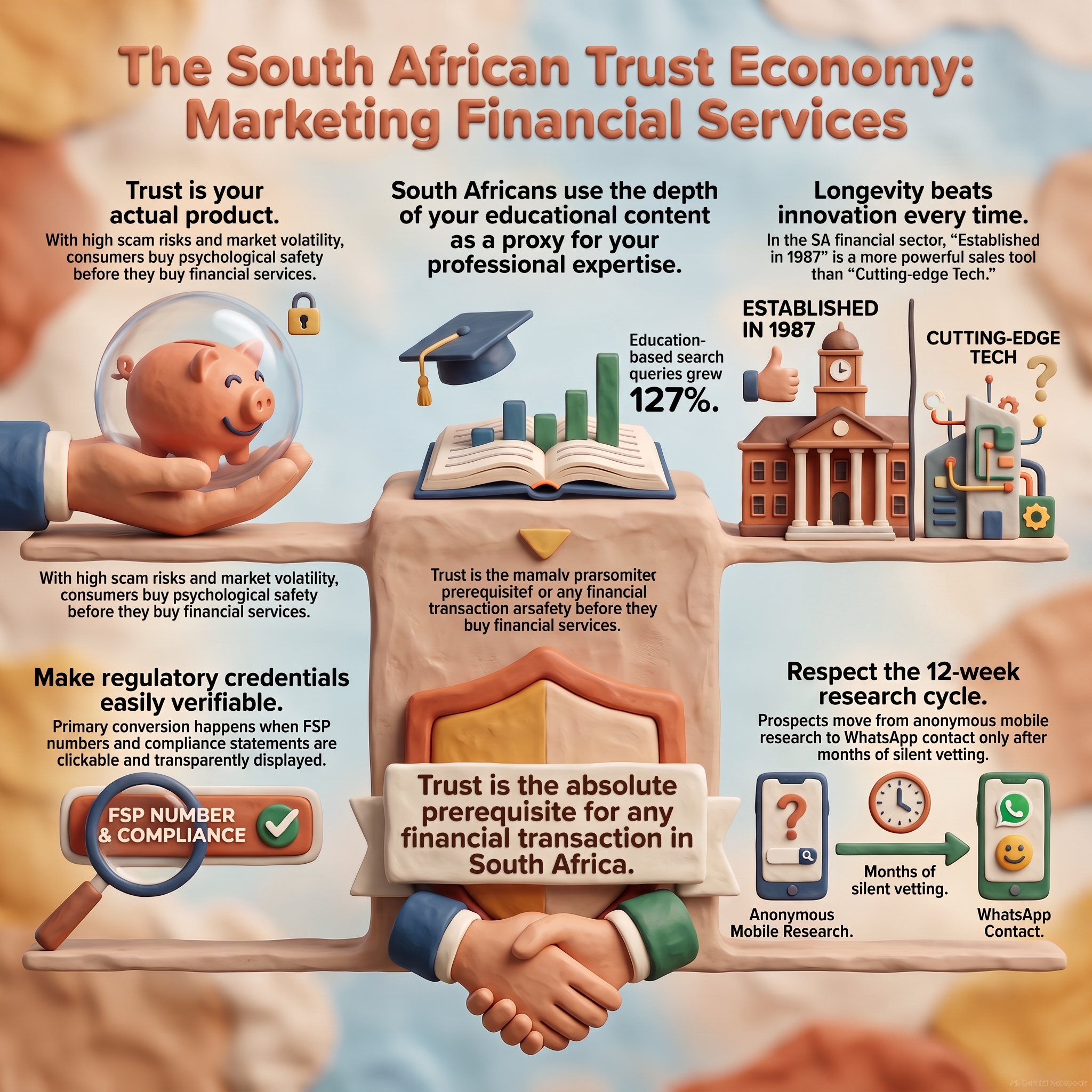
Third-party verification trumps everything. FSP license numbers, FSCA compliance statements, membership in recognised industry bodies — these aren’t footer footnotes anymore. They’re primary conversion elements. When Thickrope audits financial services websites, we check whether the FSP number is clickable and verifiable within two clicks. If it’s buried in a PDF, you’re losing qualified leads who’ve learned to verify before engaging.
Proof of longevity matters more than proof of innovation. In most sectors, “established in 1987” sounds dated. In SA financial services, it’s a competitive advantage. We’ve seen insurance brokers increase conversion rates by 34% simply by adding a timeline to their About page showing decades of continuous operation.
Educational content has become a trust prerequisite, not a value-add. According to Google South Africa search trend data, queries like “[financial product] explained South Africa” have grown 127% since 2020. Consumers are self-educating before they even consider contacting a provider, and they’re using depth and clarity of explanation as a proxy for trustworthiness.
This is where most generalist marketing agencies get financial services spectacularly wrong: they treat educational content as top-of-funnel filler. In reality, it’s your credibility deposit. A prospect who’s read your detailed guide to retirement annuities and tax implications is far more qualified than one who clicked a Facebook ad promising “Better returns, guaranteed!”

The Compliance Layer: Why “Move Fast and Break Things” Will Break Your Business
Here’s the part that separates a financial services marketing company from a generalist agency with a financial services client or two: understanding that virtually everything you publish must pass compliance review, and that “compliance” in South Africa means navigating FAIS Act requirements, POPIA data regulations, and industry-specific advertising codes that can fine you for claims a consumer goods company makes every day without consequence.
You cannot promise guaranteed returns. You cannot use certain urgency triggers (“Limited spaces available!”) without substantiation. You cannot collect contact information without explicit, auditable consent workflows. You cannot make comparative claims without meeting specific disclosure standards.
A campaign that would work brilliantly for a restaurant or online retailer can expose a financial adviser to regulatory action and reputational damage that takes years to recover from.
We’ve worked with financial planning firms who came to us after their previous agency launched a Google Ads campaign featuring headlines like “Double your pension in 5 years” — which is approximately as compliant as selling medical advice without a license. The firm faced an FSCA inquiry, had to publish corrections, and spent six months rebuilding trust with their existing client base who suddenly wondered what else wasn’t being disclosed properly.
The right financial services marketing company doesn’t see compliance as a creativity killer. They see it as the boundary within which credibility is built. When everyone in your sector is constrained by the same regulations, the competitive advantage goes to whoever can create compelling, conversion-driving content while staying squeaky clean.
The SA-Specific Client Journey: Why WhatsApp Beats Your Website (But Shouldn’t Replace It)
Here’s what the client acquisition journey actually looks like for most South African financial services firms:
Stage 1: Extended anonymous research (4-12 weeks)
Your prospect is Googling variations of your service, reading blog posts, checking credentials, possibly lurking on your social media. They’re mobile-first — StatsSA’s 2024 General Household Survey showed 91.5% of South African internet users access primarily via mobile — and they’re doing this research in stolen moments between load shedding, work, and family obligations.
Stage 2: Indirect social proof gathering (2-4 weeks)
They’re asking friends, checking HelloPeter, reading Google reviews, possibly asking about you in WhatsApp groups you’ll never see. This is the dark funnel you can’t track but absolutely must influence. One detailed negative review about unresponsiveness will cost you a dozen prospects you never knew you had.
Stage 3: Low-commitment initial contact (1 week)
They fill out a form, send a WhatsApp message, or make a call — and this is where most financial services firms lose deals they think they never had. Response time in SA financial services marketing is a conversion rate multiplier. Research from the South African Customer Satisfaction Index shows that 68% of consumers expect a response within 24 hours, but expect it to take 3-5 days based on past experience. Meet the expectation, win the deal.
Stage 4: The reassurance loop (2-8 weeks)
They’re not ghosting you. They’re still deciding. They’ll revisit your website multiple times, reread the information you sent, and have internal conversations you’re not part of. This is normal for a purchase decision that could affect their financial future for decades.
Understanding this journey means your marketing strategy needs to serve each stage specifically:
- SEO-optimised educational content for Stage 1 (because if you’re not showing up when they search “difference between living annuity and life annuity South Africa,” your competitor is)
- Review generation and reputation management for Stage 2 (those HelloPeter responses aren’t peripheral — they’re conversion assets)
- Multi-channel response systems with SLA tracking for Stage 3 (we build WhatsApp Business integrations specifically because that’s where your prospects are)
- Automated nurture sequences with genuine value for Stage 4 (not sales pressure, but continued education and social proof that reinforces their preliminary decision)

What a Financial Services Marketing Company Actually Does Differently
The technical difference between a generalist agency and a financial services marketing company isn’t mystical, but it is specific:
They build compliance into creative from day one. Every headline, every claim, every lead magnet is designed with regulatory review in mind. This doesn’t mean boring — it means strategically credible.
They understand search intent in financial services is overwhelmingly informational. People searching for “retirement annuity” aren’t ready to buy yet. They’re trying to understand whether they need one, how it works, and whether they can afford it. Your content strategy needs to answer those questions before you ask for a meeting.
They track metrics that matter for trust-based conversions. Not just clicks and form fills, but time-on-site for key pages, return visitor rates, document downloads, and qualitative indicators like the questions prospects ask when they finally do reach out. If everyone’s asking the same basic question, your content isn’t doing its job.
They design for the SA infrastructure reality. Fast-loading mobile sites aren’t nice-to-have in a country where many prospects are on capped data plans and intermittent connectivity. A 5MB landing page isn’t just slow — it’s actively excluding qualified prospects who can’t afford to load it.
They integrate offline and online trust building. Speaking at chamber of commerce events, getting featured in business publications, sponsoring community financial literacy initiatives — these create search volume and referral traffic that your digital assets need to be ready to convert. The best financial services marketing is omnichannel by necessity.
The Thickrope Approach: How We Market Firms That Handle Other People’s Money
When a financial adviser, wealth manager, or insurance firm comes to us, we don’t start with ad campaigns. We start with a trust audit:
- Where does your FSP information appear, and how easy is it to verify?
- What do the first three pages of Google results say about you? (Because your prospects are definitely looking.)
- What questions are prospects asking during sales calls that your website should have answered?
- Where in your content are you making claims that sound promotional rather than substantiated?
- What’s your actual response time to new enquiries, and how does that compare to prospect expectations?
Then we build a financial services marketing strategy around three pillars:
Authority content that demonstrates expertise without selling. Deep-dive guides, tax-year updates, breakdown of regulatory changes — the kind of content that gets bookmarked and shared because it’s actually useful. This is what ranks, what builds trust, and what differentiates you from competitors whose blogs haven’t been updated since 2019.
Conversion infrastructure designed for long sales cycles. Email nurture sequences that deliver value over weeks, not just sales pitches. Retargeting campaigns that reinforce credibility rather than chasing clicks. Landing pages that answer concerns rather than just collecting information.
Reputation and social proof systems. Review generation workflows, testimonial collection and display, case study development, and response protocols for feedback platforms. In a trust economy, your reputation is your most valuable search asset.
We’ve helped financial planning firms increase qualified enquiries by 340% while reducing cost-per-acquisition, not by spending more, but by aligning marketing with how SA consumers actually research and choose financial services providers.
Frequently Asked Questions
Q: How long does it take to see results from financial services marketing in South Africa?
A: Most financial services firms see meaningful traffic growth within 3-4 months, but qualified lead flow typically takes 5-7 months to establish. This isn’t slower than other sectors — it’s realistic for trust-based services with multi-week decision cycles. Quick wins come from low-hanging fruit like claiming your Google Business Profile and fixing technical SEO issues, but sustainable growth requires building authority over time.
Q: What should a financial services firm budget for digital marketing in South Africa?
A: Effective financial services marketing in SA typically requires R15,000-R45,000 monthly depending on market competitiveness and firm size, split between strategy/content creation and media spend. Unlike retail, you’re not optimising for volume — you’re optimising for quality. One proper client is worth dozens of tyre-kickers, so the math works very differently than impulse-purchase sectors.
Q: Do financial services firms need to be on social media?
A: Yes, but not how consumer brands use it. Your LinkedIn presence matters for B2B credibility and professional networking. Facebook and Instagram work for brand awareness and social proof (sharing educational content, client testimonials, community involvement), but direct lead generation from social is typically inefficient compared to search. WhatsApp Business, on the other hand, is non-negotiable — it’s where your prospects expect to reach you.
Q: Can financial services firms use Google Ads effectively in South Africa?
A: Absolutely, but the strategy differs significantly from other sectors. You’re bidding on high-intent, high-value keywords where cost-per-click can reach R80-R150 for competitive terms. The key is targeting informational queries (“how does retirement annuity work”) rather than just transactional ones (“buy retirement annuity”), and sending traffic to educational landing pages rather than hard-sell forms. Rushed Google Ads campaigns in financial services burn budgets fast; strategic ones generate qualified enquiries worth 10-50x the acquisition cost.
If you’re in financial services and your current marketing feels like it’s built for selling sneakers rather than building trust with people’s retirement savings, let’s talk. Thickrope specialises in marketing for firms where credibility isn’t a nice-to-have — it’s the entire proposition. Book a free financial services marketing audit and we’ll show you exactly where your current approach is leaking trust (and what to do about it).