

Why Right Now Is the Most Important Moment for Polokwane Businesses to Invest in SEO
Polokwane isn’t the same city it was five years ago. And if you’re running a business here, you’ve felt it — the expansion, the new developments, the steady drumbeat of economic growth that’s making Limpopo’s capital one of South Africa’s genuine success stories.
But here’s what most business owners haven’t noticed yet: the digital landscape is changing just as fast as the physical one. And unlike a new shopping centre or business park, the window to establish your position in Polokwane’s search results is narrow, competitive, and closing faster than you might think.
This isn’t another “act now before it’s too late” scare piece. This is about understanding what’s actually happening in your market right now, and why the businesses that invest in Polokwane SEO in 2026 will have a competitive advantage that becomes almost impossible to disrupt by 2029.
The Growth Numbers That Change Everything
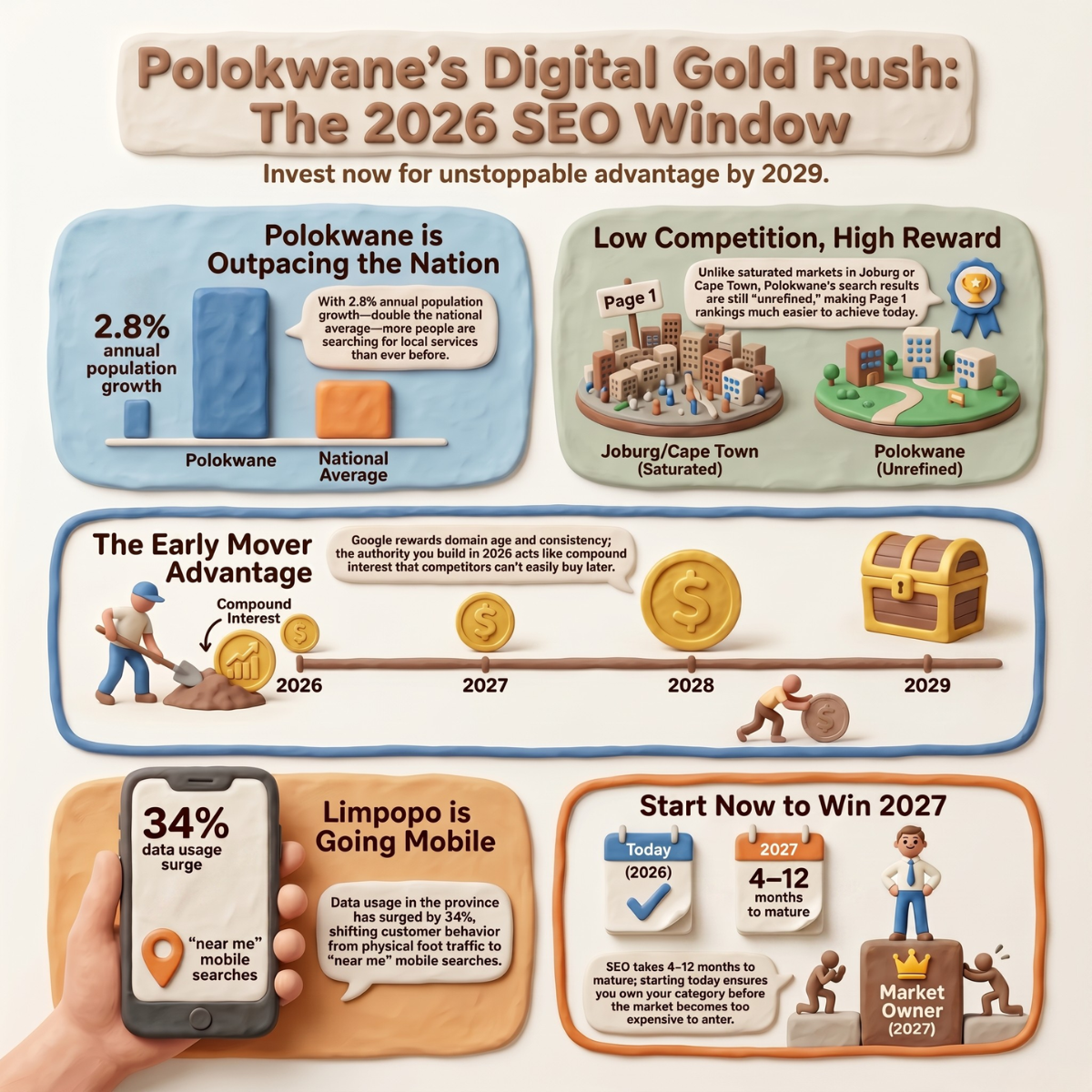
Let’s start with what makes Polokwane different. According to StatsSA’s 2023 Community Survey, Polokwane showed a population growth rate of 2.8% annually — substantially higher than the national average of 1.4%. That’s not just demographic noise; that’s more households, more purchasing power, and critically, more people searching Google for local services every single month.
The Limpopo Provincial Treasury’s 2024 economic review highlighted that Polokwane’s GDPR contribution grew by 3.2% in real terms, outpacing both Gauteng (2.1%) and the Western Cape (2.4%). Mining expansion, agricultural processing, government services, and retail development are all contributing to an economy that’s genuinely expanding while many SA metros are treading water.
What does this mean for search? More competition. More businesses opening. More entrepreneurs realising they need to be found online. And most importantly: the rankings you see today in Polokwane won’t look anything like the rankings in two years’ time.
What Polokwane’s Search Landscape Looks Like Right Now
If you search for most service-based keywords in Polokwane today — “accountant Polokwane”, “plumber Polokwane”, “lawyer Polokwane” — you’ll notice something interesting: the top results are often not particularly sophisticated. Many businesses ranking well are doing so because they got the basics right, early, and nobody’s seriously challenged them yet.
That’s the window. That’s the opportunity.
We’re currently working with clients in Polokwane who are ranking on page one for competitive terms with websites that are good but not exceptional, with backlink profiles that are modest, and with content that’s thorough but hardly groundbreaking. They’re ranking because they started investing in SEO 18–24 months ago, before the market heated up.
Compare that to what we see in Pretoria, Cape Town, or Johannesburg, where even appearing on page two requires a substantially more aggressive SEO strategy, deeper content investment, and often 12+ months of consistent optimisation. Polokwane hasn’t reached that level of competitive intensity yet. But it’s heading there, quickly.

Why Early Movers Win (and Keep Winning)
Here’s how Google’s ranking algorithm creates compound advantages for businesses that establish authority early:
Domain age and trust signals accumulate over time. A website that’s been publishing quality content, earning backlinks, and building citations for two years has an intrinsic advantage over a site that starts tomorrow — even if the newer site does everything perfectly. Google rewards consistency and longevity.
Link equity is harder to build in competitive markets. Right now, if you publish genuinely useful content about your industry in Polokwane, you can earn local backlinks from business directories, news sites, industry associations, and community organisations relatively easily. In three years, when twenty other businesses are also publishing content and competing for those same links, your cost per quality backlink will be substantially higher.
Brand signals create ranking momentum. Google’s algorithm increasingly factors in direct searches, brand mentions, and user engagement. If people in Polokwane start recognising your brand because you’ve been visible in search for two years, that brand equity becomes a ranking signal that reinforces your position. New entrants have to overcome not just your SEO, but your accumulated brand recognition.
A 2023 study by Backlinko analysing 11.8 million Google search results found that the average top-ranking page was over 950 days old. In competitive markets, that number climbs even higher. The businesses that own page one in Polokwane in 2029 are being built right now, in 2026.
The Specific Dynamics Making This Moment Critical
Mobile search growth in Limpopo
Limpopo has seen one of South Africa’s fastest growth rates in mobile internet penetration, with the ICASA State of ICT Sector Report 2024 showing a 34% year-on-year increase in data usage in the province. That’s thousands of new mobile searchers every quarter — people looking for plumbers at 10pm when a geyser bursts, searching for “restaurant near me” on Saturday afternoon, or trying to find a local accountant in February when tax season looms.
Mobile-first indexing means Google prioritises how your site performs on mobile. If your competitors aren’t optimised for mobile yet (and many in Polokwane aren’t), you can leapfrog them simply by getting that right before they do.
The Mall of the North effect
The expansion and success of Mall of the North has fundamentally changed shopping and service behaviour in Polokwane. Consumers who now expect a certain retail experience are also expecting businesses to be easily discoverable online. The gap between “traditional local business” and “digitally sophisticated local business” is widening, and customers are increasingly choosing the latter.
Load shedding’s unexpected SEO advantage
Here’s an irony: load shedding has actually accelerated digital adoption in Polokwane. When physical stores can’t guarantee opening hours, consumers search online first to check. When businesses can’t rely on foot traffic during Stage 4, they invest in being found on Google. The challenge that’s made running a business harder has also made digital visibility more valuable.
If you’ve adapted your business to survive load shedding — generators, solar, adjusted hours — then you’ve already shown resilience. SEO is the next adaptation that separates survivors from market leaders.

What You’re Actually Competing For
Let’s be specific about what rankings mean in revenue terms for Polokwane businesses.
Say you’re a conveyancing attorney. “Conveyancer Polokwane” gets roughly 210 searches per month (based on Google Keyword Planner data for the region). If you rank first, you’ll typically capture about 28-30% of those clicks — roughly 60 visits per month. If your conversion rate is a conservative 10%, that’s six new client enquiries monthly from one keyword alone.
Expand that across “property lawyer Polokwane”, “transfer attorney Polokwane”, “bond attorney Polokwane”, and related long-tail terms, and you’re looking at 15–25 qualified leads per month from organic search. For high-value services, that’s transformational.
Now imagine a competitor establishes that position before you do, builds authority, earns backlinks, and starts showing up with featured snippets and review-rich listings. Displacing them doesn’t just require matching their SEO — it requires substantially exceeding it. That’s expensive, time-consuming, and sometimes not even commercially viable.
The businesses that win the 2026 SEO race in Polokwane will own their market categories for years.
What Investment Looks Like Right Now
We’re not going to pretend SEO is cheap, but it’s substantially more cost-effective in Polokwane’s current market conditions than it will be in 18 months.
For most local businesses, effective Polokwane SEO requires:
- Technical site optimisation (mobile performance, Core Web Vitals, schema markup)
- Google Business Profile optimisation and ongoing management
- Local citation building across SA directories and Limpopo-specific platforms
- Content creation targeting commercial and informational keywords
- Link building from relevant local and industry sources
- Monthly performance tracking and strategy adjustment
In Polokwane right now, a properly executed SEO campaign typically ranges from R5,000–R12,000 per month depending on competition level and business goals. That investment gets you significantly more market share today than the same budget would in Johannesburg, where you’d be competing against businesses spending R30,000+ monthly.
That pricing advantage won’t last. As more Polokwane businesses recognise SEO’s value and competition intensifies, the cost to achieve the same results will climb. Basic supply and demand.

The Risk of Waiting
Every month you delay is a month your competitors could be:
- Publishing content that establishes them as the local authority
- Earning backlinks that build domain strength
- Accumulating positive Google reviews that improve rankings
- Building brand recognition in search results
- Collecting user engagement signals that reinforce their position
By the time many Polokwane businesses recognise they need SEO, they’ll find themselves trying to outrank competitors who’ve had a 12–24 month head start. That’s not impossible, but it requires a more aggressive strategy and substantially higher investment.
The businesses that prosper in the next phase of Polokwane’s growth will be the ones that saw the curve before it went vertical.
What Success Actually Looks Like
Let’s be clear about realistic expectations. SEO isn’t a light switch — you don’t go from invisible to page one overnight.
For most Polokwane businesses in moderately competitive sectors, you should expect:
- Months 1-3: Technical foundation, content framework, initial visibility improvements
- Months 4-6: Consistent page-two and page-three rankings, increasing organic traffic
- Months 7-12: Page-one rankings for long-tail keywords, measurable lead generation
- 12+ months: Competitive rankings for primary commercial terms, sustained traffic growth
The businesses that started investing in mid-2024 are seeing those page-one results now, in mid-2026. The businesses that start today will be in that position by late 2027. The businesses that wait until 2028 will be trying to catch up in a market that’s already been divided.
Frequently Asked Questions
Q: Is SEO worth it for a small business in Polokwane, or is it only for bigger companies?
A: SEO is actually more impactful for smaller businesses in Polokwane right now, precisely because the competitive landscape hasn’t matured yet. A well-optimised local business can outrank larger competitors who haven’t invested in their digital presence. The advantage small businesses have is agility — you can implement SEO faster and capture market share before bigger players wake up to the opportunity.
Q: How long before I see actual leads from SEO in Polokwane?
A: Most businesses start seeing qualified enquiries from organic search between months 4–6, with momentum building significantly from month 7 onwards. That said, some of our Polokwane clients see results faster because local competition is still developing. The timeline depends on your industry, current website state, and how aggressively competitors are investing in their own SEO.
Q: Can’t I just run Google Ads instead of investing in SEO?
A: You absolutely can, and for immediate leads, Google Ads works brilliantly. But here’s the difference: Ads stop the moment your budget runs out, while SEO builds an asset that generates traffic month after month without ongoing ad spend. In Polokwane’s current market, investing in both gives you immediate results from Ads while building long-term competitive advantage through SEO. The businesses doing both are the ones taking serious market share right now.
Q: What happens if I invest in SEO and Google changes its algorithm?
A: Google makes thousands of algorithm updates annually, but the fundamentals rarely change: quality content, good user experience, relevant backlinks, and strong local signals consistently perform well. What changes are the tactics that try to game the system. Working with an agency that focuses on sustainable, white-hat SEO means your rankings improve over time rather than collapsing when Google updates. We’ve navigated every major algorithm shift since 2015, and properly optimised sites typically become more stable, not less.
The Polokwane market is at an inflection point. The businesses that recognise this moment and act on it will own their categories for years to come.
If you’re ready to establish your position before the competitive window closes, let’s talk about what a tailored Polokwane SEO strategy looks like for your business. Book a free consultation with Thickrope Marketing, and we’ll show you exactly where the opportunities are in your market right now.