

What Happened When a Middelburg Business Finally Took SEO Seriously
Look, I’ll be honest. For the longest time, I thought SEO was something Cape Town agencies sold to companies with money to burn. Not for us. Not for a town like Middelburg.
We’re a manufacturing supplier—industrial parts, safety equipment, that sort of thing. Been operating here in Mpumalanga since 2009. Good reputation. Solid client base. But somewhere around 2022, things started shifting. Our usual referrals were drying up. The guys we’d relied on for decades were Googling suppliers instead of just phoning us. And we weren’t showing up.
I’d had three different “digital marketing experts” pitch me SEO over the years. Each time, I nodded politely and did nothing. It felt like throwing money at something I couldn’t see, couldn’t measure, and frankly didn’t understand. How was fiddling with keywords going to help when everyone in our industry knew each other anyway?
Turns out, I was wrong. Very wrong. And expensive wrong.
The Turning Point (Or: When I Finally Pulled My Head In)
The wake-up call came during a tender meeting in eMalahleni. A procurement manager mentioned she’d found our competitor online while searching for “industrial safety suppliers Mpumalanga” during load shedding—on her phone, at home, because their office had no power. She didn’t even know we existed.
That stung.
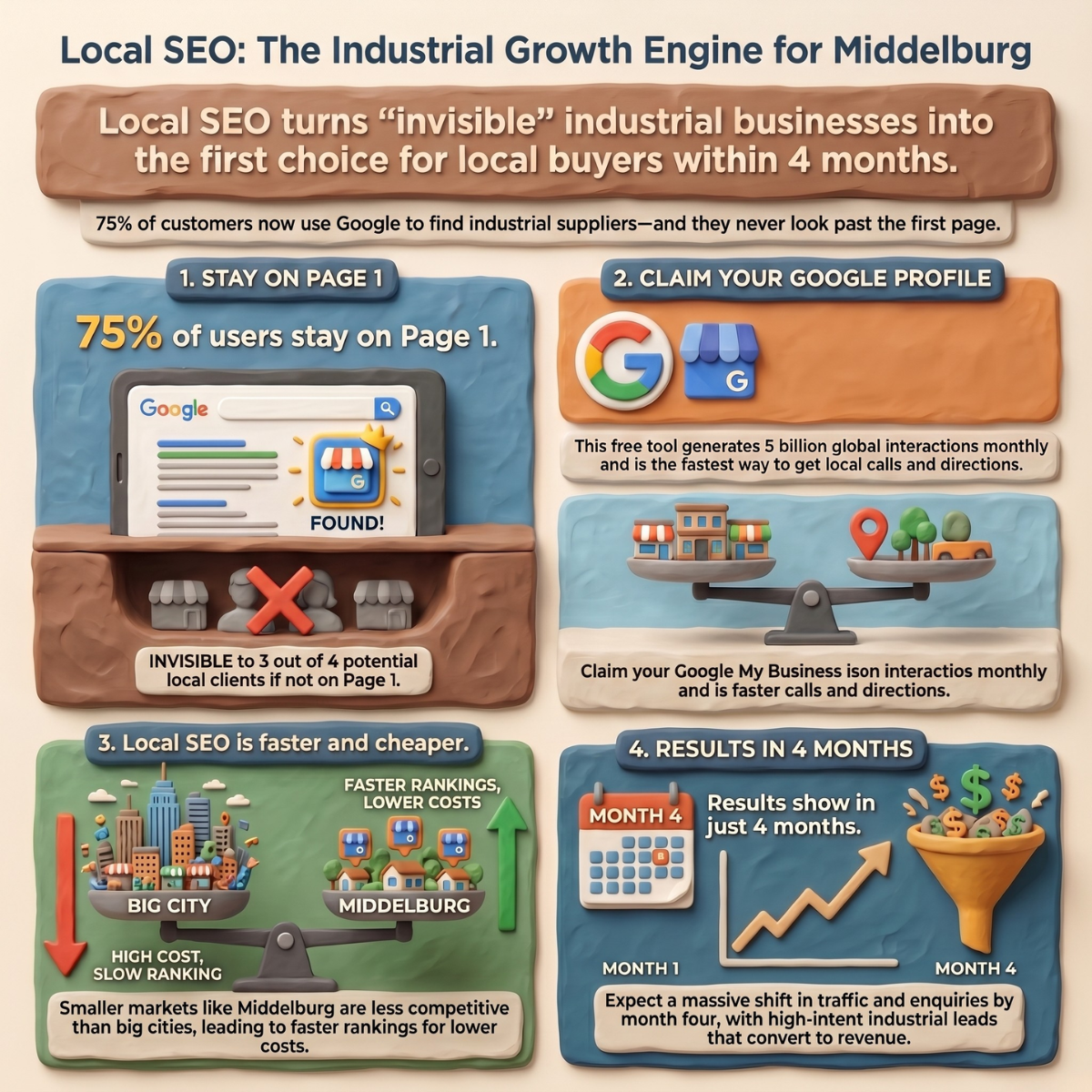
I went home and Googled our own business. We were on page three. Might as well have been page three hundred. According to research, 75% of users never scroll past the first page of search results. I was invisible to the exact people I needed to reach.
The next week, I phoned an SEO agency—a proper one, not someone’s cousin who “knows computers.” We had a long, surprisingly honest conversation about what was realistic for a business our size, in a town like Middelburg, with a budget that wasn’t going to buy us a Sandton miracle.
What “Taking SEO Seriously” Actually Looked Like
Here’s what I learned: good SEO for a Middelburg business isn’t the same as SEO for a Johannesburg e-commerce shop. The approach is different. The keywords are different. The competition is different.
Month One: The Audit (Less Glamorous Than It Sounds)
They started with a technical audit of our website. Turns out, our site was a disaster. Images the size of small farm plots. Mobile version that looked like it had been designed by someone who’d never seen a phone. No Google My Business listing—which, considering Google My Business gets 5 billion interactions per month globally, was basically business malpractice.
The first month was all foundation work:
- Fixing technical issues that were actively pushing us down in rankings
- Setting up proper Google My Business with photos, operating hours, service areas
- Keyword research focused on what Mpumalanga businesses actually search for
- Creating service pages that mentioned the towns we serve: Middelburg, eMalahleni, Witbank, Groblersdal
Nothing sexy. Nothing I could show off to my mates at the club. But necessary.
Month Two to Three: Content (Not As Boring As I Expected)
This is where I nearly lost patience. They wanted to add blog posts and service descriptions. I thought: “Who’s reading blog posts about industrial safety equipment?”
Turns out, people researching purchases at 11pm during load shedding, that’s who.
We created content around actual questions our customers asked:
- “What safety equipment is required for mining operations in Mpumalanga?”
- “Industrial suppliers near me with same-day delivery”
- “SABS-approved safety gear Middelburg”
Each piece was optimised for local search. Each one mentioned our town, our region, our service area. The agency explained that Google’s algorithm increasingly prioritises local intent—especially on mobile, which accounts for over 60% of all searches in South Africa.
Month Four: When Things Started Shifting
This is when I stopped rolling my eyes at the monthly reports.
Our Google My Business listing started getting views. Actual views. Then calls. Then direction requests—people using Google Maps to find our physical location.
We started appearing on page one for “Middelburg industrial suppliers” and “safety equipment Mpumalanga.” Not always at the top, but visible. Present.
A company in Ermelo found us through Google and placed a R47,000 order. They’d never heard of us before. Just searched, found us, called.
That order alone paid for four months of SEO.
Month Six: The Results I Couldn’t Ignore
By the half-year mark, here’s what had changed:
Website traffic: Up 340%. Most of it from Mpumalanga and surrounding areas—exactly where we operate.
Enquiries through the website contact form: We went from maybe two a month to three or four a week.
Phone calls: Google My Business tracked 67 calls in month six alone. Before SEO, our website generated maybe five calls a month.
Actual revenue: We closed six new accounts that found us through organic search. Combined value over six months: just over R280,000.
The cost? About R30,000 total over six months.
Not exactly a tough ROI to justify.

What I Wish I’d Known From the Start
SEO isn’t instant, but it’s not glacial either. I’d been told it takes a year to see results. That’s rubbish—at least for local SEO in a smaller market. We saw meaningful movement by month three and proper commercial results by month four.
Middelburg businesses have an advantage. The competition for local keywords here is nothing compared to Gauteng. That means you can rank faster, for less money, and dominate your specific service area without battling multinational corporations.
Mobile matters more than you think. I was still thinking about people at desks, Googling during work hours. The reality? Most searches happen on phones, during load shedding, at odd hours. If your site doesn’t work on mobile, you’re losing business every single day.
Google My Business is criminally underused. It’s free. It’s powerful. It connects you directly to customers searching for exactly what you offer, in exactly your area. Not having one optimised is leaving money on the table.
The Honest Bit: What SEO Can’t Do
SEO didn’t solve all our problems. It didn’t make load shedding disappear or fix our supply chain issues. It didn’t turn us into an overnight sensation.
What it did do: put us in front of people actively searching for what we sell, when they’re ready to buy, in the areas we serve.
It levelled the playing field. Made us visible. Gave us a shot at business we would have never even known about otherwise.
For a Middelburg business—any Mpumalanga business, really—that’s not nothing. In this economy, that’s everything.
What I’d Tell Another Middelburg Business Owner
If you’re where I was two years ago—sceptical, budget-conscious, not sure if “SEO” is just marketing nonsense—I get it.
But here’s the thing: your customers are Googling. Not all of them, but enough of them to matter. And if you’re not showing up, your competitor is.
You don’t need a R50,000-a-month Sandton agency. You need someone who understands Mpumalanga, understands smaller markets, and can build a local SEO strategy that actually makes sense for your budget and your business.
Start small. Fix your Google My Business. Make sure your website works on phones. Target the local keywords your customers actually use.
And give it four months. Proper four months, with consistent effort.
Then check your phone. Check your enquiries. Check your bank account.
That’s when you’ll know.

Frequently Asked Questions
Q: How much does SEO cost for a Middelburg business?
A: Realistically, you’re looking at between R2,800 and R8,000 per month, depending on how competitive your industry is and how many service areas you’re targeting. It’s significantly less than Gauteng rates, and for local SEO in smaller markets, you can see solid results at the lower end of that range.
Q: How long before I see results from Middelburg SEO?
A: Local SEO in smaller markets moves faster than national campaigns. Expect to see initial movement—better rankings, increased visibility—within 6-8 weeks. Commercial results like enquiries and sales typically start appearing around month three to four, then build from there.
Q: Can I do SEO myself or do I need an agency?
A: You can handle the basics—Google My Business, mobile-friendly website, decent content—yourself if you’ve got the time and inclination. But technical SEO, link building, and competitive keyword strategy are genuinely specialised. Most Middelburg businesses get better results faster by working with someone who knows what they’re doing, even if it’s just a few hours of consulting a month.
Q: Does SEO work for industrial or B2B businesses, or just retail?
A: SEO works brilliantly for B2B and industrial businesses—often better than for retail, because the search intent is so specific. When someone Googles “hydraulic equipment supplier Middelburg” or “industrial safety gear Mpumalanga,” they’re not browsing. They’re buying. Those high-intent searches convert exceptionally well.
Q: What’s the difference between Middelburg SEO and national SEO?
A: Middelburg SEO focuses on local and regional visibility—ranking for searches that include your town, region, or “near me” queries. It’s faster, cheaper, and more targeted than national SEO. You’re competing with local businesses, not national brands, which means you can dominate your specific service area without a massive budget.
If your Middelburg business is still invisible on Google, let’s fix that. Thickrope Marketing specialises in practical, results-driven SEO for Mpumalanga businesses—the kind that actually moves the needle. Have a no-obligation chat with us and let’s see what’s possible.