

Marketing in Polokwane Is Not the Same as Marketing in Johannesburg — Here’s What’s Actually Different
If you’re running a business in Polokwane and working with a marketing agency that’s applying a copy-paste Joburg strategy, you’re likely wondering why your results feel… off. Not terrible. Just consistently underwhelming.
Here’s the thing: Polokwane’s consumer base, competitive landscape, and digital behaviour are genuinely different from Gauteng’s metros. And a marketing strategy built for Sandton applied to the capital of Limpopo will consistently underperform — not because Polokwane is “behind” (it’s not), but because the market dynamics are fundamentally different.
Let’s get specific about what actually changes when you’re marketing in Polokwane, and what a marketing agency Polokwane actually needs to understand to drive results here.
The Language Layer Most Agencies Miss Completely
Here’s what most national agencies get wrong from day one: they assume English-first targeting works the same way everywhere in South Africa.
In Polokwane, that’s leaving serious money on the table.
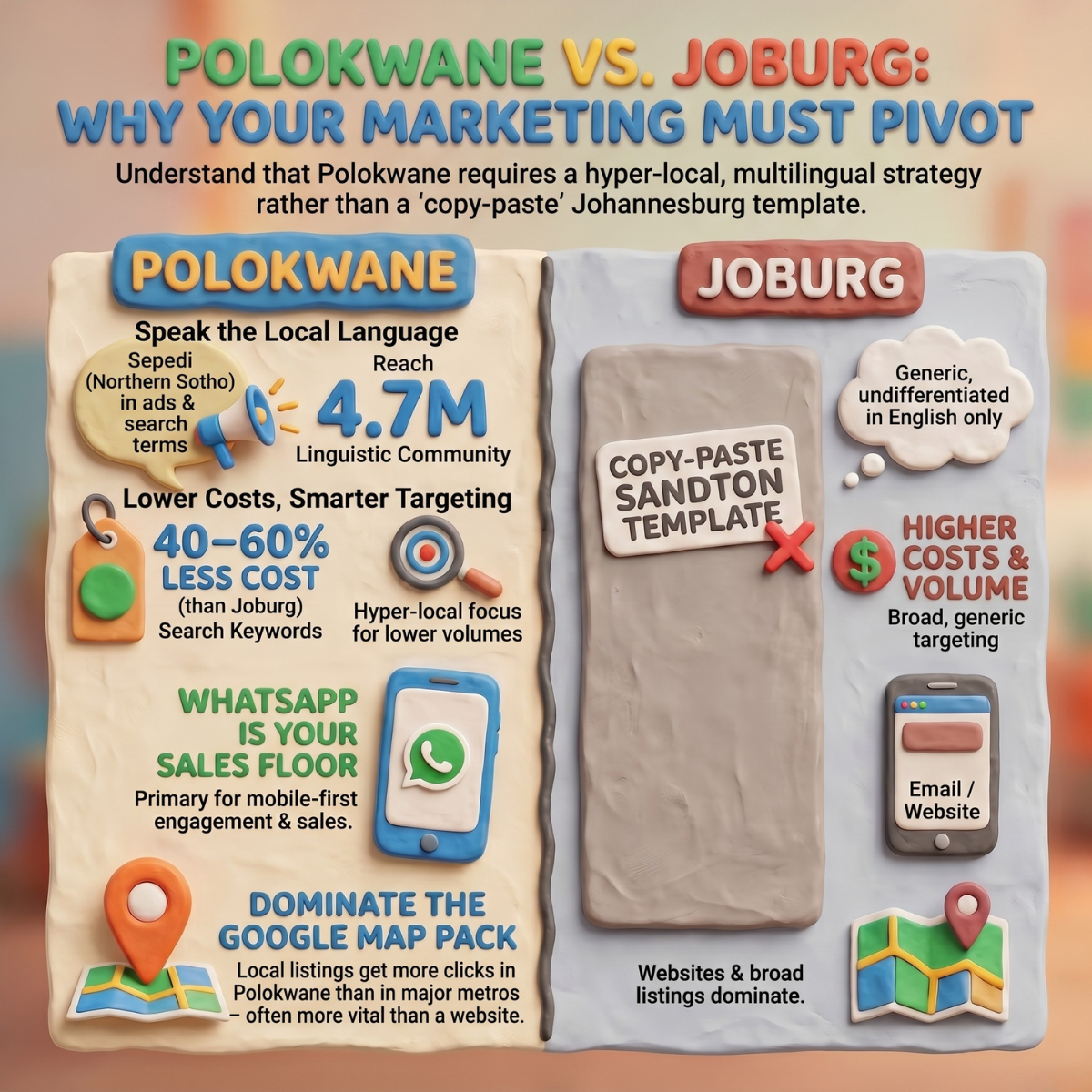
Northern Sotho (Sepedi) is spoken by roughly 4.7 million South Africans, and Polokwane sits at the heart of that linguistic community. When you’re targeting consumers in Seshego, Mankweng, or even mixed suburbs like Fauna Park and Bendor, language context changes everything — from Facebook ad creative to Google search terms people actually use.
A Joburg agency running English-only campaigns will capture professionals and urban middle-class buyers, but they’ll completely miss the broader consumer base that searches in Sepedi, responds better to code-switching creative, and engages more deeply with culturally relevant messaging.
This isn’t about translation. It’s about understanding that “funeral cover Polokwane” and “inshorense ya lešo Polokwane” are being searched by different audience segments with different purchase behaviours — and both matter for your bottom line.
What this means for your marketing strategy:
- Facebook and Google campaigns need multilingual keyword research specific to Polokwane’s linguistic mix
- Creative and landing pages should reflect local language patterns, not just formal Sepedi translations
- Your customer service and follow-up processes need to accommodate language preferences seamlessly
A marketing agency in Polokwane worth their salt will already know this. A Joburg agency applying their standard template? They’ll miss it entirely.
The Competitive Landscape Is Fundamentally Different
Polokwane has approximately 500,000 residents. Johannesburg has over 5 million. That’s not just a size difference — it completely changes competitive dynamics and what works in paid advertising.
In Johannesburg, Google Ads costs for high-value keywords can be punishing. “Lawyer Johannesburg” or “plumber Sandton” might cost you R45–R85 per click because you’re competing with dozens of established firms with serious budgets.
In Polokwane, those same service keywords typically cost 40–60% less. Competition is real but manageable. The cost-per-lead economics are genuinely better — if you know how to capitalise on it.
But here’s the catch: lower competition also means lower search volume. A Joburg agency used to optimising for 10,000 monthly searches might build you a beautiful campaign targeting keywords that get 47 searches a month in Polokwane. Technically correct, practically useless.
What changes:
- You need hyper-local keyword targeting that captures suburbs, surrounding towns (Mokopane, Tzaneen, Makhado traffic coming into Polokwane), and regional variations
- Broad match and audience expansion strategies work differently when your addressable market is smaller and more defined
- Your ad spend sweet spot is lower, but your targeting needs to be smarter to avoid wasting budget on irrelevant clicks
The Mall of the North has changed retail dynamics in Polokwane significantly since opening in 2017. Consumer expectations around service, choice, and convenience have risen. Your digital presence needs to reflect that you’re competing with brands that have established national trust — but you can’t outspend them. You need to out-local them.

Mobile Behaviour and Network Realities
South Africa is a mobile-first country — with 38.9 million mobile internet users as of 2024, representing over 65% of the population accessing the internet primarily via smartphones. But network quality and data costs hit differently outside the metros.
Polokwane has decent coverage from all major providers, but load times, data costs, and connectivity consistency still vary more than they do in Johannesburg’s fibre-heavy suburbs.
What this means practically:
- Your website load time isn’t just a “nice to have” — it’s a conversion killer. Google’s data shows 53% of mobile users abandon sites that take longer than 3 seconds to load, and in Polokwane’s network conditions, every kilobyte counts
- WhatsApp isn’t just a chat app — it’s a primary customer service and sales channel. If your marketing strategy doesn’t include click-to-WhatsApp ads and proper WhatsApp Business integration, you’re missing how Polokwane consumers actually want to engage
- Video content needs to be optimised differently. That slick 90-second brand video that works in Joburg might eat too much data for casual mobile viewers here
A marketing agency Polokwane that understands local conditions will build campaigns assuming mobile-first, data-conscious consumers — not desktop users on uncapped fibre.
Seasonality Hits Different Industries at Different Times
Every South African business knows about Black Friday and the December retail surge. But Polokwane’s economy has specific seasonal patterns that don’t match Gauteng’s rhythm.
Education sector timing: With the University of Limpopo and several major TVET colleges in the area, student accommodation, food services, tech retailers, and entertainment businesses see massive spikes in January/February and again in July when students return. A Joburg agency won’t instinctively plan campaigns around Turfloop academic calendars.
Agricultural services and inputs: Polokwane serves as a commercial hub for surrounding agricultural areas. Planting season (October–December) and harvest periods create predictable demand cycles for everything from equipment financing to logistics services. Your paid advertising should flex with these cycles, not run steady-state year-round.
Government and corporate spending cycles: With significant government infrastructure and services based in Polokwane as Limpopo’s capital, B2B and procurement-focused businesses need to align marketing with fiscal year timelines, tender periods, and budget availability in ways that differ from private sector-heavy Gauteng.
Tourism and hospitality: Polokwane benefits from being a gateway city — people travelling to Kruger, Zimbabwe, and Mozambique often overnight here. But tourism marketing timing needs to capture advance planning (3–6 months out) and route traffic differently than a Johannesburg hotel would.
A generic marketing calendar won’t capture these nuances. You need a marketing agency Polokwane that knows when your customers are actually in buying mode.

Local Search Behaviour and Map Pack Dominance
Here’s a lesser-known fact that changes everything for service businesses in Polokwane: the Google Map Pack (those three local business listings that appear above organic results) captures a disproportionately higher percentage of clicks in regional cities than in major metros.
In Johannesburg, users often scroll past the Map Pack because they have pre-existing brand preferences or they’re looking for specific comparison content. In Polokwane, the Map Pack is where buying decisions happen — especially for services like restaurants, mechanics, doctors, and contractors.
Why this matters:
- Your Google Business Profile optimisation isn’t secondary — it’s often more important than your website
- Reviews, response rate, and local relevance signals (like accurately listing all Polokwane suburbs you serve) directly impact revenue
- If you’re not in the top three for “your service + Polokwane” or “your service + [specific suburb]”, you’re essentially invisible for high-intent local searches
A Joburg agency treating Google Business Profile as an afterthought will cost you the most valuable traffic you can get.
The Community Network Effect
Polokwane operates more like a large town than a small city in terms of business networks and word-of-mouth dynamics. Your reputation travels fast — both good and bad.
This changes digital marketing strategy in subtle but significant ways:
Social proof matters more intensely: A bad review or poor customer experience doesn’t just affect one stranger’s opinion — it ripples through actual social networks. Your online reputation management can’t be reactive; it needs to be proactive and genuinely responsive.
Community partnerships and local sponsorships amplify digital campaigns: Supporting local sports clubs, schools, or events creates brand awareness that makes your digital advertising work harder. People clicking your ad already recognise your name from the U13 rugby team sponsorship.
Influencer marketing looks completely different: Forget national influencers with 500k followers. In Polokwane, a local radio personality, well-known businessperson, or community figure with 8,000 genuinely engaged local followers will drive more actual business than a Joburg lifestyle influencer ever could.
A marketing agency Polokwane embedded in local networks understands these dynamics instinctively. An outside agency will miss them entirely or try to apply influencer strategies that simply don’t translate.

What Doesn’t Change (And Why That Matters)
For balance: not everything is different.
The fundamentals of good digital marketing — clear value propositions, mobile-optimised websites, data-driven campaign optimisation, proper conversion tracking — work exactly the same in Polokwane as anywhere else.
Google’s algorithm doesn’t care where you are. Facebook’s ad auction operates on the same principles. Email marketing best practices are universal.
The difference is in execution context, not core principles. You still need proper strategy, consistent measurement, and ongoing optimisation. You just need those things applied with genuine understanding of Polokwane’s specific market conditions.
What to Look for in a Marketing Agency Polokwane
If you’re evaluating agencies (or questioning whether your current one actually gets it), here’s what matters:
Local market knowledge that goes beyond demographics: Do they understand which suburbs, communities, and audience segments behave differently? Can they explain why a campaign would be structured differently for Polokwane versus Johannesburg?
Multilingual capability that’s culturally informed: Not just translation services, but genuine understanding of how language preferences affect search behaviour, ad engagement, and conversion rates.
Realistic about scale and opportunity: Polokwane offers genuine business growth opportunities, but an agency promising you 10,000 new leads a month is either lying or doesn’t understand the addressable market. You want an agency that can scale appropriately, not one that promises metropolitan volumes.
Track record with Polokwane or regional city clients: Have they actually delivered results for businesses operating in markets similar to yours, or is their portfolio exclusively Joburg and Cape Town brands?

Frequently Asked Questions
Q: Is it better to work with a local marketing agency in Polokwane or a larger agency in Johannesburg?
A: Local agencies understand market nuances, language dynamics, and competitive realities that national agencies consistently miss. The best option is an agency with both local expertise and sophisticated digital marketing capability — not one or the other. Size matters less than relevant experience and proven results in markets like Polokwane.
Q: How much should I expect to spend on digital marketing in Polokwane?
A: Budget depends entirely on your industry, goals, and competition, but Polokwane’s lower cost-per-click and more efficient local targeting often means you can achieve meaningful results with 30–50% less ad spend than comparable campaigns in Gauteng metros. A realistic starting point for most SMEs is R8,000–R15,000/month including both ad spend and management, scaled based on results.
Q: Do Facebook ads or Google ads work better in Polokwane?
A: It’s industry-specific. Google captures high-intent searches when people need your service now (plumbers, lawyers, emergency services). Facebook works brilliantly for building awareness, reaching specific demographic or interest-based audiences, and driving consideration for purchases people plan ahead (retail, hospitality, education). Most successful Polokwane businesses use both strategically, not one or the other.
Q: How important is having a website in Sepedi or Northern Sotho?
A: Full translation is less critical than culturally informed, multilingual campaign targeting and customer service capability. Most Polokwane consumers are comfortable navigating English websites, but your ads, social content, and customer interactions should accommodate language preferences. Start with multilingual paid campaigns and WhatsApp support before investing in full website translation.
The bottom line: Polokwane is a dynamic, growing market with genuine opportunities for businesses that understand how to reach its consumers effectively. But marketing strategies built for Johannesburg and applied without local context will consistently underperform — wasting your budget on approaches that miss how your actual customers search, engage, and buy.
If you’re ready to work with a marketing agency Polokwane that understands what actually drives results in Limpopo’s capital, let’s talk about building campaigns that work for your specific market and business goals. [Book a free consultation with Thickrope Marketing](https://thickrope.co.za/contact) — we’ll review your current approach and show you exactly what could be working better.