

How to Do Local SEO Marketing: What SA Business Owners Can Do Themselves — and Where Professional Help Changes the Outcome
You’re here because you want customers who are geographically close enough to actually walk through your door, call your landline (if you still have one), or tap “directions” on their phone while standing two blocks away. That’s local SEO marketing. And the good news? You can absolutely start doing it yourself today — no agency retainer required.
The even better news? Knowing exactly where your own effort pays off versus where a professional takes your foundations and turns them into compounding revenue is what separates businesses that dabble from businesses that dominate their local market.
Let’s break down both sides honestly. What you can — and should — do yourself, and where bringing in someone who does this full-time changes the game entirely.
What Local SEO Marketing Actually Is (and Why It Matters More in SA Right Now)
Local SEO marketing is the process of making your business visible when someone nearby searches for what you sell. When a Joburger types “plumber near me” at 22:00 during load shedding because a geyser just burst, or a Durban restaurant owner searches “bookkeeper Umhlanga” on their phone between lunch and dinner service — that’s local search. And if you’re not showing up, someone else is getting the job.
Here’s the context that makes this especially urgent for South African businesses: according to Google, 46% of all searches have local intent. In SA, where mobile is the primary internet device for most consumers and “near me” searches have grown over 900% globally in recent years, that percentage is likely even higher. Your customers are searching on the move, often with immediate purchase intent, and they’re comparing you to competitors within a 5km radius.
If you’re a retail store, a service provider, a restaurant, or any business with a physical location or defined service area, local SEO isn’t optional. It’s the difference between being found and being forgotten.
The Foundational Local SEO Steps Any SA Business Owner Can (and Should) Do Themselves
Let’s start with what you absolutely can handle without hiring anyone. These aren’t quick hacks — they require effort and consistency — but they don’t require a degree in digital marketing or a monthly retainer.
1. Claim and Fully Optimise Your Google Business Profile
This is the single highest-impact thing you can do for free. Your Google Business Profile (formerly Google My Business) is what populates the local pack — those three businesses with map pins that appear at the top of local searches.
What to do yourself:
- Claim your profile at google.com/business
- Choose the most accurate primary category (this matters more than you think — “Restaurant” vs “Italian Restaurant” vs “Pizza Restaurant” will show you for different searches)
- Fill in every single field: business description, hours (including public holidays), service areas, attributes, products if applicable
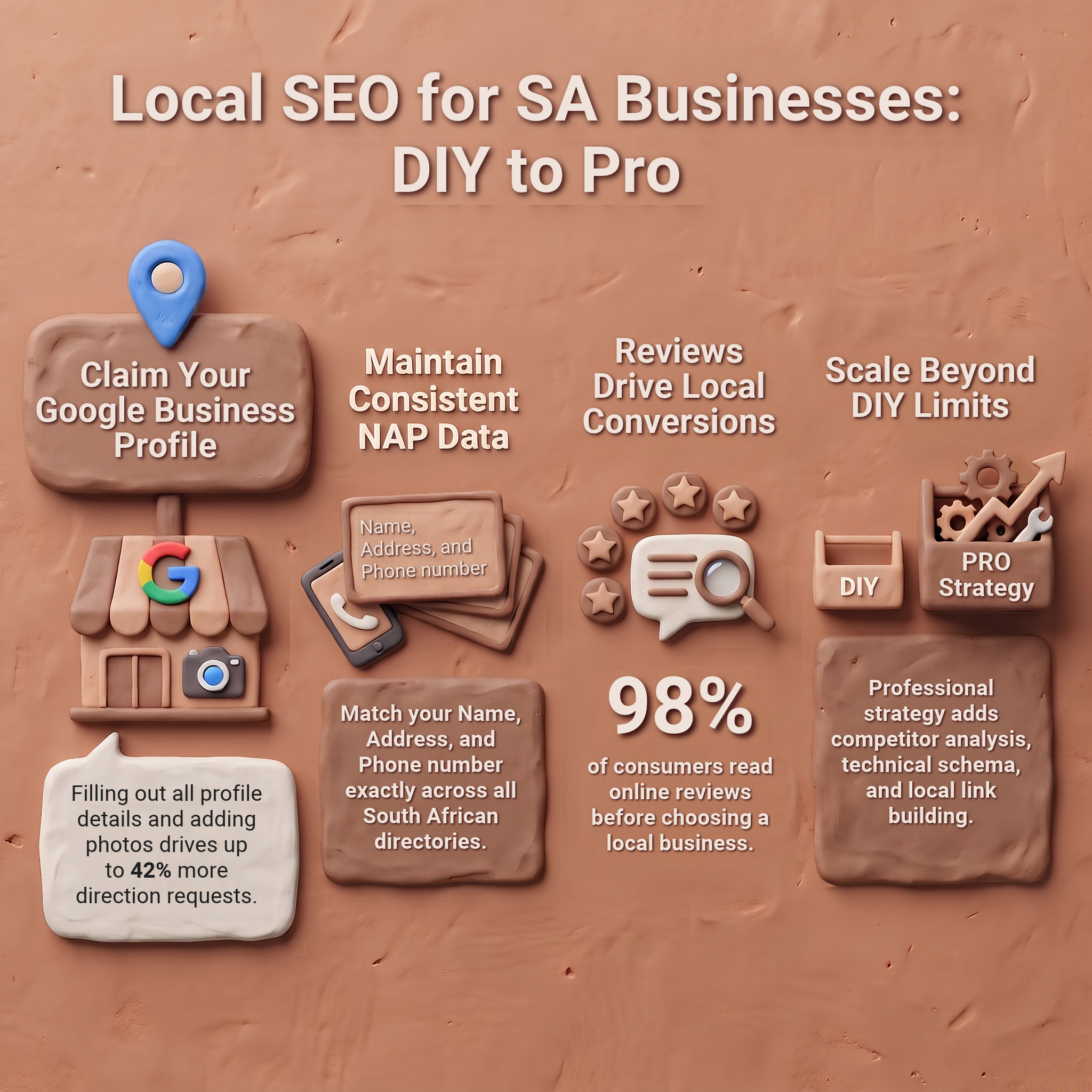
- Upload high-quality photos — at minimum your logo, storefront, interior, and examples of your product or service. According to Google, businesses with photos receive 42% more requests for directions and 35% more click-throughs to their websites than those without
- Add your menu, services list, or price ranges where relevant
- Keep your operating hours updated (especially around load shedding if it affects when you’re genuinely available — customers will thank you for honesty)
The DIY limit: You can absolutely set this up properly. What you can’t easily do yourself is optimise it strategically against competitor profiles, fix technical issues when your profile gets suspended (it happens), or manage the ongoing updates and features Google rolls out quarterly that affect ranking.
2. Build Consistent NAP Citations Across Key SA Directories
NAP = Name, Address, Phone number. Google uses consistency across the web to verify you’re a legitimate business. If your business is listed as “Joe’s Plumbing” on your website, “Joe’s Plumbing Services” on Snupit, and “Joe Plumbing Pty Ltd” on Afribiz, Google gets confused — and confused Google doesn’t rank you well.
What to do yourself:
- Create a master NAP document with exactly how your business name, address, and phone number should appear everywhere
- Get listed on the South African directories that actually matter: Snupit, Cylex South Africa, Afribiz, Hotfrog South Africa, and industry-specific directories (ASASA if you’re in security, SAPOA for property, etc.)
- Ensure every listing matches your master NAP exactly — same spelling, same abbreviations (or lack thereof), same phone format
The DIY limit: You can handle the major directories. What gets time-consuming and technical is finding the 30-50 secondary citations that compound authority, fixing duplicate listings that confuse signals, and monitoring for citation decay (when directories change your info without telling you).
3. Generate and Respond to Google Reviews Actively
Reviews are both a direct ranking factor and a conversion factor. A business with 50+ reviews and a 4.5+ star rating will outrank and out-convert a competitor with 8 reviews, even if the competitor has better on-page SEO.
What to do yourself:
- Create a simple, repeatable process for asking happy customers to leave a Google review (email follow-up, SMS, printed card at checkout, QR code on receipts)
- Respond to every review — positive or negative — within 48 hours
- Keep responses genuine and specific (avoid copy-paste “Thanks for your feedback!” templates)
- Never incentivise reviews with discounts or freebies (it violates Google’s terms and can get you penalised)
According to BrightLocal’s 2024 research, 98% of consumers read online reviews for local businesses, and 76% of consumers who search for something nearby visit a business within 24 hours. Reviews aren’t vanity metrics — they’re revenue drivers.
The DIY limit: You can absolutely manage the asking and responding. What’s harder to do yourself is strategically timing review campaigns, dealing with fake negative reviews or competitor sabotage, and integrating review generation into your CRM or booking systems automatically.
4. Optimise Your Website for Local Search Terms
If your website doesn’t mention the specific suburbs, cities, or regions you serve, you’re invisible for geo-modified searches.
What to do yourself:
- Add your city and region to your homepage title tag and H1 (e.g., “Affordable Bookkeeping Services in Cape Town & Surrounds”)
- Create dedicated service area or location pages if you serve multiple areas (e.g., separate pages for “Plumbing Services Sandton”, “Plumbing Services Randburg”)
- Include local landmarks, neighbourhoods, and references naturally in your content
- Add a Google Map embed showing your location
- Make sure your website is mobile-friendly — over 60% of Google searches in South Africa happen on mobile devices, and Google prioritises mobile experience for ranking
The DIY limit: You can handle the basics if you’re comfortable editing your website. What’s harder without technical expertise is optimising site speed (critical for SA’s mobile networks), structured data markup for local business schema, and creating content strategies that target local search intent without keyword stuffing.

Where DIY Local SEO Hits Its Ceiling — and Professional Strategy Starts Compounding Returns
Here’s the honest truth: the steps above will get you visible. They’ll get you onto the map, literally. For some businesses — especially those in low-competition niches or smaller towns — that foundation might be enough to generate a steady flow of local leads.
But if you’re in a competitive market (any major metro area, any saturated industry like legal services, real estate, home services, restaurants), or if you want to dominate your category rather than just participate, DIY effort plateaus quickly.
Here’s where professional local SEO changes outcomes:
Strategic Competitor Analysis and Positioning
You can see which competitors rank above you. A professional analyses why they rank — which specific signals they’re stronger on, which gaps exist in their strategy, and which opportunities they’re missing that you can exploit. It’s the difference between “I should probably get more reviews” and “Our competitor has 47% more reviews but weaker citation diversity and no geo-targeted content — here’s the 90-day plan to outrank them.”
Advanced Citation Building and Management
Professionals have access to citation tools and databases you don’t, can identify and fix duplicate listings that dilute your authority, and monitor hundreds of directories for accuracy. They also know which citations matter most for your specific industry and location (hint: it’s not the same for a Pretoria law firm and a Ballito surf shop).
Content That Actually Drives Local Rankings
Writing blog posts with your city name sprinkled in isn’t a strategy. Professionals create location-based content that targets specific local search intent, leverages semantic relevance, and builds topical authority. They also know how to structure content to capture featured snippets and “People also ask” boxes that dominate local SERPs.
Technical SEO and Structured Data
Schema markup for LocalBusiness, structured data for services and reviews, geo-tagging images, managing hreflang if you serve multiple language communities — this is where most DIY efforts stall completely. It’s technical, it changes frequently, and getting it wrong can actively hurt your rankings.
Link Building with Local Relevance
Backlinks still matter enormously for local SEO. But not just any links — locally relevant links from SA news sites, industry associations, chambers of commerce, local event sponsorships, and community organisations. Professionals have relationships and strategies to earn these systematically rather than hoping they happen organically.
Ongoing Optimisation and Algorithm Adaptation
Google’s local algorithm updates several times per year. The November 2024 local ranking update, for example, dramatically shifted how proximity and relevance are weighted. If you’re doing local SEO yourself while running your actual business, you’re not monitoring algorithm changes, testing impacts, and adjusting strategy in real time. Professionals are.
What Fair Professional Local SEO Investment Looks Like in South Africa
If you’re considering bringing in help, here’s what reasonable looks like:
Setup and optimisation (once-off): R8,000 – R25,000 depending on complexity, number of locations, and current state of your online presence. This includes full GBP optimisation, citation building and cleanup, review strategy setup, and technical website optimisation.
Ongoing management (monthly): R3,500 – R12,000 depending on market competitiveness and scope. This includes monthly reporting, review monitoring and response, content creation, citation monitoring, and strategic adjustments.
The businesses that see the best ROI typically do the foundational DIY work first (claim and optimise their GBP, get their first 10-20 reviews, fix obvious NAP inconsistencies), then bring in professionals to build compounding competitive advantage on top of those foundations.
You don’t need to choose between DIY and professional. You need to understand what each does best.

The Recommendation: Start Now, Scale Strategically
Here’s the practical path for most SA business owners:
Month 1-2: Do the foundational work yourself. Claim and optimise your Google Business Profile fully. Get listed on the top 5-7 SA directories with consistent NAP. Start asking every customer for reviews and responding to them. Add local keywords to your website’s core pages.
Month 2-3: Measure what’s happening. Are you showing up in the local pack for your primary search terms? Are calls and direction requests increasing? Are you ranking in the top 10 for “your service + your suburb/city”?
If yes, keep going — add more content, build more citations, generate more reviews. If you’re plateauing or if competitors are still dominating despite your effort, that’s your signal to explore professional help.
Month 3+: Bring in strategic support where it multiplies outcomes. You don’t need to hand over everything — many businesses keep review management and content creation in-house while outsourcing technical optimisation, citation management, and competitive strategy. Find the model that uses your time for what you’re best at (running your business) and pays professionals for what they’re best at (outmanoeuvring your competition in search results).
The businesses winning local search in South Africa right now aren’t the ones with the biggest budgets. They’re the ones who started with the fundamentals, measured honestly, and scaled strategically when DIY hit diminishing returns.
Frequently Asked Questions
Q: How long does it take to see results from local SEO marketing?
A: Foundational changes like optimising your Google Business Profile can show impact within 2-4 weeks — you’ll start appearing in more local searches and the local pack. Competitive ranking improvements for saturated keywords typically take 3-6 months of consistent effort. Unlike paid ads, local SEO builds compounding returns — the longer you invest, the stronger and more defensible your position becomes.
Q: Can I do local SEO if I’m a service business without a physical storefront?
A: Absolutely. Google allows service area businesses (plumbers, consultants, mobile pet groomers, etc.) to hide their physical address and instead define service areas by suburb or radius. You’ll optimise your GBP as a service area business, create location-specific pages on your website for each area you serve, and build citations on directories that support service businesses. The fundamentals are the same — you’re just targeting geography differently.
Q: What’s the single most important local SEO factor to focus on first?
A: Your Google Business Profile completion and accuracy. It’s free, it’s entirely within your control, and it directly influences whether you appear in the local pack — which captures the majority of clicks for local searches. If you do nothing else, claim it, fill every field, add quality photos, and start generating reviews. Everything else builds on that foundation.
Q: How many Google reviews do I actually need to rank well locally?
A: There’s no magic number, but research shows diminishing returns after about 50-75 reviews for most local businesses. What matters more than raw quantity is review velocity (steady new reviews over time, not 50 in one week then nothing), average rating (4.0+ is the practical minimum; 4.5+ is competitive), and recency (reviews from the last 3 months carry more weight). A business with 30 recent reviews and a 4.7 rating will often outperform one with 80 old reviews and a 4.2 rating.
Q: Does load shedding affect my local SEO rankings?
A: Not directly — Google doesn’t penalise you for Eskom’s failures. But load shedding affects user behaviour and site performance, which do impact rankings. If load shedding slows your website hosting or makes your site inaccessible intermittently, that hurts user experience signals. If customers can’t reach you during blackouts and leave negative reviews about availability, that affects reputation. The smart play: update your GBP hours to reflect actual availability during load shedding stages, invest in reliable hosting with backup power, and communicate clearly about your operating status during outages.
Ready to move beyond local SEO foundations and start actually dominating your local market? Thickrope Marketing builds local SEO strategies for SA businesses who’ve done the basics and want compounding competitive advantage. Book a free 30-minute local SEO audit and we’ll show you exactly where your DIY effort is working — and where professional strategy would change your revenue trajectory.