

How to Choose a Local SEO Marketing Agency in South Africa — The Questions That Separate Genuine Expertise From a Monthly Report
The local SEO marketing agency market in South Africa has a dirty little secret: most of them are selling you the same repackaged checklist, delivered with varying degrees of enthusiasm, then charging you monthly for a PDF you’ll never read.
That’s not cynicism — that’s pattern recognition after watching hundreds of SA business owners get burned by agencies that optimise their Google Business Profile once, submit to three directories, then spend the next eleven months telling you why you’re “building momentum.”
If you’re a plumber in Durban, a physio in Stellenbosch, or a restaurant in Soweto, local SEO isn’t a nice-to-have. It’s the difference between your phone ringing and your competitor’s phone ringing. And in an economy where every lead counts, choosing the wrong local SEO marketing agency isn’t just wasteful — it’s expensive.
Here’s how to separate the specialists from the report-generators before you sign anything.
The Business Problem: You’re Invisible When It Matters Most
Let’s start with what’s actually happening when a potential customer searches for your service.
According to Google, 76% of people who search for something nearby on their smartphone visit a business within a day, and 28% of those searches result in a purchase. In South Africa, where mobile accounts for over 60% of all web traffic (partly thanks to our patchy desktop infrastructure and the lingering trauma of load shedding), that local search moment is the commercial moment.
When someone in your suburb searches “emergency electrician near me” or “best sushi Sandton” at 7pm on a Friday, Google decides in milliseconds who gets the business. If you’re not in that Map Pack — those three businesses Google shows above the organic results — you’ve essentially not bothered to pitch.
That’s the problem a proper local SEO marketing agency solves. Not “visibility” in some abstract sense. Visibility in the exact moment someone near you is ready to spend money.
What Fair Investment Looks Like in the SA Market
Before we talk about what to look for, let’s talk about what it should cost — because price is often the first filter that separates serious agencies from chancers.
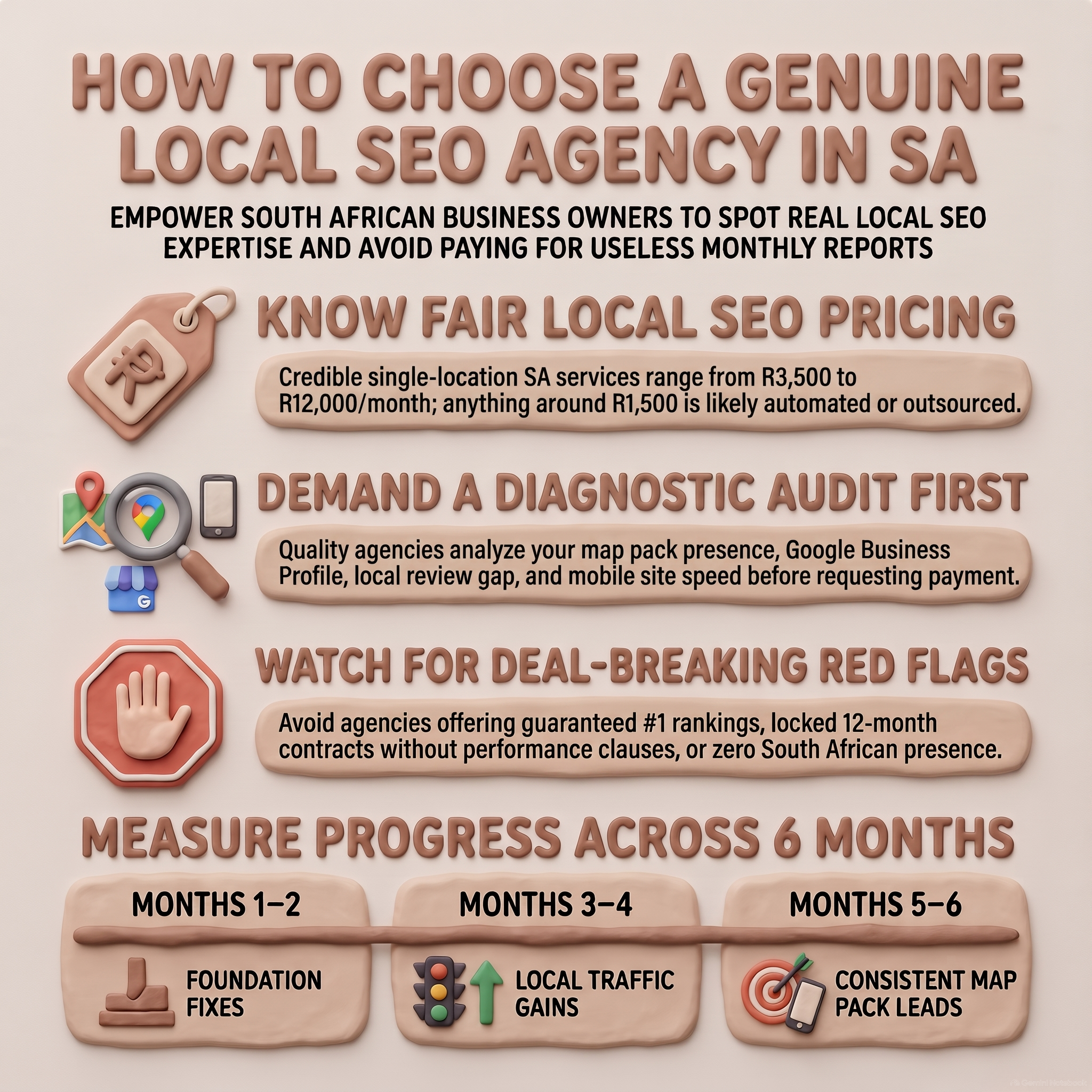
In South Africa, credible local SEO services for a single-location business typically range from R3,500 to R12,000 per month, depending on competition, location, and scope.
The lower end (R3,500–R5,500/month) usually covers:
- Google Business Profile optimisation and monitoring
- Basic citation building (directories, listings)
- Monthly reporting
- Review management support
The mid-range (R6,000–R9,000/month) adds:
- Localised on-page SEO (location pages, schema markup)
- Competitor analysis
- Local content creation
- Link building with local relevance
The upper range (R9,500–R12,000+/month) includes:
- Multi-location strategies
- Advanced technical SEO
- Conversion rate optimisation
- Integrated local PPC support
If someone quotes you R1,500/month, they’re either automated, outsourced to a country with no idea what Gauteng is, or both. If someone quotes you R25,000/month for a single location with modest competition, check what else is included — you might be paying for strategy you don’t need yet.
The investment makes sense when the lifetime value of a single new customer justifies the monthly cost. A plumber charging R2,500 per callout needs two extra jobs a month. A medical practice billing R1,200 per patient needs five new patients to break even. Do the maths for your business first.

The Pre-Engagement Audit: What They Should Show You Before You Pay Anything
Here’s your first filter: any local SEO marketing agency worth their salt will conduct a preliminary audit before asking for a retainer. Not a full technical teardown (that’s what you’re paying for), but enough diagnostic work to demonstrate they understand your specific competitive landscape.
A credible initial audit includes:
Your Current Local Search Footprint
They should show you:
- Where you rank in the Map Pack for your core service keywords
- Whether your Google Business Profile is verified, complete, and optimised
- How many reviews you have versus your top three local competitors
- Whether your NAP (Name, Address, Phone) is consistent across major directories
If they can’t show you this in the first conversation, they’re guessing.
The Competitive Reality in Your Suburb or City
Local SEO isn’t a national game — it’s a 5km radius game. An agency that talks about “South Africa” without drilling into your specific suburb or neighbourhood doesn’t understand local search.
They should identify:
- Who currently owns the Map Pack for your main keywords
- What those competitors are doing right (review volume, content depth, citation coverage)
- Where the gaps are that you can exploit
Technical Blockers You Might Not Know About
Even in the discovery phase, a decent agency will spot obvious technical issues:
- Is your site mobile-friendly? (Essential, given SA’s mobile dominance)
- Is it fast enough for SA network conditions? Google’s data shows 53% of mobile users abandon sites that take longer than 3 seconds to load — and that’s with fast international connectivity. On SA mobile networks, you’re toast if you’re slow.
- Do you have location schema markup?
- Is there a robots.txt or indexing issue blocking your location pages?
If they don’t mention technical foundations, they’re planning to ignore them.
The Questions That Reveal Strategic Depth
Once you’re past the audit, the real evaluation begins. Here are the questions that separate template delivery from genuine local SEO expertise:
“What’s your process for optimising my Google Business Profile beyond the basics?”
Everyone can fill in your business name and upload a logo. What you’re listening for:
- Category selection strategy (primary + secondary categories, and why)
- Attribute optimisation (the specific features customers can filter by)
- Post scheduling and content themes
- Photo optimisation (geotagged, keyword-relevant file names)
- Q&A seeding and management
If they say “we’ll complete your profile and keep it updated,” that’s not a strategy. That’s admin.
“How do you approach citation building for SA businesses specifically?”
Generic international citation lists are useless here. You want an agency that knows:
- Which SA-specific directories matter for your industry (Brabys, Cylex SA, Snupit, etc.)
- How to handle SA address formatting (suburb, city, province, postal code)
- How to navigate directories that don’t recognise new suburbs or developments
- When citations outside SA actually help (hint: rarely, unless you serve international clients)
“What does review generation look like, and how do you stay within Google’s guidelines?”
Review volume and recency are massive local ranking factors. According to BrightLocal’s research, 87% of consumers read online reviews for local businesses, and the average consumer reads 10 reviews before feeling able to trust a business.
But Google’s guidelines prohibit incentivised reviews, review gating (only asking happy customers), and bulk review requests from the same IP address.
A good agency will have a process that:
- Automates review requests after service delivery (timing matters)
- Makes it genuinely easy for customers to leave reviews (direct links, SMS options)
- Asks all customers, not just the happy ones
- Helps you respond to negative reviews constructively (Google rewards engagement)
If they promise “we’ll get you 50 five-star reviews in a month,” run. That’s a penalty waiting to happen.
“How do you build local relevance through content and links?”
This is where strategy diverges sharply from template work.
Weak answer: “We’ll write blog posts.”
Strong answer: “We’ll create location-specific content that targets [specific suburb/area] + [service] searches, build relationships with local business associations and chambers of commerce for backlinks, identify local sponsorship or community involvement opportunities that earn links and citations, and create content that answers the specific questions your local customers ask.”
In SA, local link building might mean:
- Getting listed on municipal or city council business directories
- Building relationships with local news sites (Caxton community papers, regional online publications)
- Partnering with complementary local businesses (a physio and a gym, a lawyer and an accountant)
If they’re talking about generic “high DA backlinks” without local context, they don’t understand local SEO.
“What does month-to-month accountability look like?”
This is the question that exposes report-factories.
You want specific, measurable commitments:
- Map Pack ranking changes for your core keywords
- Google Business Profile insights (views, clicks, direction requests, calls)
- Review acquisition rate
- Website traffic from local organic search
- Conversion actions (form fills, calls, bookings) attributed to local search
The report should show you what they did (citations built, content published, technical issues fixed) and what changed as a result.
If the monthly report is 40 pages of generic SEO metrics with no clear connection to leads or revenue, you’re being managed, not served.

Realistic Timelines in the SA Local Search Landscape
Local SEO is faster than national SEO, but it’s not instant. Here’s what realistic progression looks like:
Months 1–2: Foundation and quick wins
- Google Business Profile fully optimised
- NAP consistency across major directories
- Basic schema markup implemented
- Low-hanging technical issues resolved
- Review generation process launched
You might see minor ranking improvements, especially if you were previously invisible or had glaring errors.
Months 3–4: Momentum building
- Citation coverage expanding
- Review volume increasing
- Local content published and indexed
- Link building relationships forming
Map Pack visibility should be improving for lower-competition keywords. You should be seeing measurable increases in “near me” traffic.
Months 5–6: Competitive displacement
- Sustained review velocity
- Local authority building through content and links
- Conversion optimisation based on data
- Competitor gaps being exploited
You should be consistently appearing in the Map Pack for your core keywords, and leads from local search should be clearly attributable.
If an agency promises top 3 Map Pack rankings in 30 days, they’re either lying or planning to use tactics that’ll get you penalised. If they can’t show you measurable progress by month 4, something’s broken.
Red Flags That Should End the Conversation
Some warning signs are universal:
They guarantee #1 rankings. Google’s algorithm has over 200 factors. No one controls it. Anyone who guarantees specific rankings is either deluded or dishonest.
They won’t show you previous client results. Credible agencies have case studies, even if they’re anonymised. If they can’t show you what they’ve achieved for businesses similar to yours, they probably haven’t achieved it.
They use vague language about “proprietary systems.” Local SEO isn’t mysterious. The principles are well-documented. If they’re obscuring what they actually do behind jargon, they’re hiding the fact that they’re not doing much.
They don’t ask about your business goals. If the conversation is all about rankings and traffic without connecting it to revenue, they’re optimising for vanity metrics. A proper agency wants to understand your customer lifetime value, your conversion process, your capacity to handle new leads.
The contract locks you in for 12+ months with no performance clauses. Retainers are normal, but if you can’t exit after 90 days with reasonable notice if results aren’t materialising, you’re being trapped, not partnered with.
They operate entirely offshore with no SA presence. Local SEO requires local knowledge. An agency that doesn’t understand SA geography, business culture, suburbs, or search behaviour will optimise for keywords no one here uses and build citations in directories no one here checks.

What Genuine Expertise Looks Like in Practice
After all the questions and filters, here’s what working with a competent local SEO marketing agency actually feels like:
Month 1: They conduct a thorough audit, present findings in plain language, and give you a prioritised roadmap with clear rationale. You understand why each action matters.
Month 2: You see evidence of work (citations live, GMB optimised, schema implemented) and early data. The report shows actions and initial impact.
Month 3: You start getting calls or enquiries mentioning “I found you on Google.” The agency connects this to specific ranking improvements.
Month 4: You’re in conversations about scaling — more locations, additional services, seasonal campaigns. The relationship feels consultative, not transactional.
Month 6: Local search is a predictable lead source. You know roughly how many enquiries come from it monthly. The agency is proactively suggesting tests and optimisations.
That’s the trajectory you’re buying. Not just rankings. Not just reports. Predictable, measurable leads from people near you who are ready to buy.
Frequently Asked Questions
Q: Can I do local SEO myself, or do I genuinely need an agency?
A: You can absolutely do the basics yourself — claim and optimise your Google Business Profile, ensure your NAP is consistent, ask customers for reviews. Where an agency earns their fee is in technical SEO (schema, site speed, indexation), strategic citation building, content that actually ranks, and sustained link acquisition. If you’re technical and have 10–15 hours a month to learn and execute, DIY is viable. Most SA business owners don’t have that time, and the learning curve is steep.
Q: How long should I commit to a local SEO agency before deciding if it’s working?
A: Give it 90 days minimum to see meaningful traction, and 6 months to evaluate properly. Local SEO compounds — reviews accumulate, citations mature, content indexes, links pass authority. But you should see some measurable improvement (traffic, rankings, or leads) by month 3. If there’s zero movement after 4 months, something’s wrong with the strategy or the execution.
Q: What happens if I stop paying for local SEO — do I lose my rankings immediately?
A: No. Local SEO builds assets (citations, reviews, content, links) that persist. Your Google Business Profile doesn’t disappear if you stop paying an agency. But rankings will gradually decline if competitors keep optimising and you don’t, reviews stop coming in, and your content becomes stale. Think of local SEO as ongoing maintenance, not rent. You own the assets; the agency just builds and tends them.
Q: Do I need separate local SEO if I’m already doing national SEO?
A: Usually, yes. National SEO targets broad keywords (“best accountant South Africa”); local SEO targets intent with geographic proximity (“accountant near me,” “tax consultant Pretoria East”). The tactics differ — national SEO focuses on domain authority and content depth; local SEO prioritises Google Business Profile, reviews, local citations, and geo-targeted content. If you serve customers locally, local SEO will drive more qualified leads than national efforts.
Q: How do I know if my city or suburb is competitive enough to need professional help?
A: Search your main service keyword + your location (e.g., “dentist Umhlanga”). If the Map Pack is full and those businesses have 50+ reviews, active GMB posts, and well-optimised websites, it’s competitive. If the Map Pack is sparse, businesses have incomplete profiles and few reviews, you can probably gain traction with DIY basics. Johannesburg, Cape Town, Durban, Pretoria, and major suburban nodes are almost always competitive. Smaller towns and less saturated service categories may not need agency-level investment yet.
If you’re tired of agencies that send reports while your competitors take the calls, we should talk. Thickrope Marketing’s local SEO service is built for SA businesses that need leads, not vanity metrics — let’s start with an honest audit of where you stand.