

BrightLocal vs Yoast Local SEO: What Each Tool Does — and Why Neither Replaces a Proper Local SEO Strategy
If you’ve been searching for local SEO solutions and landed on “BrightLocal vs Yoast Local SEO,” you’ve already stumbled into one of the most misleading comparisons in digital marketing. It’s a bit like asking whether a spanner is better than a screwdriver — the answer depends entirely on what you’re trying to fix.
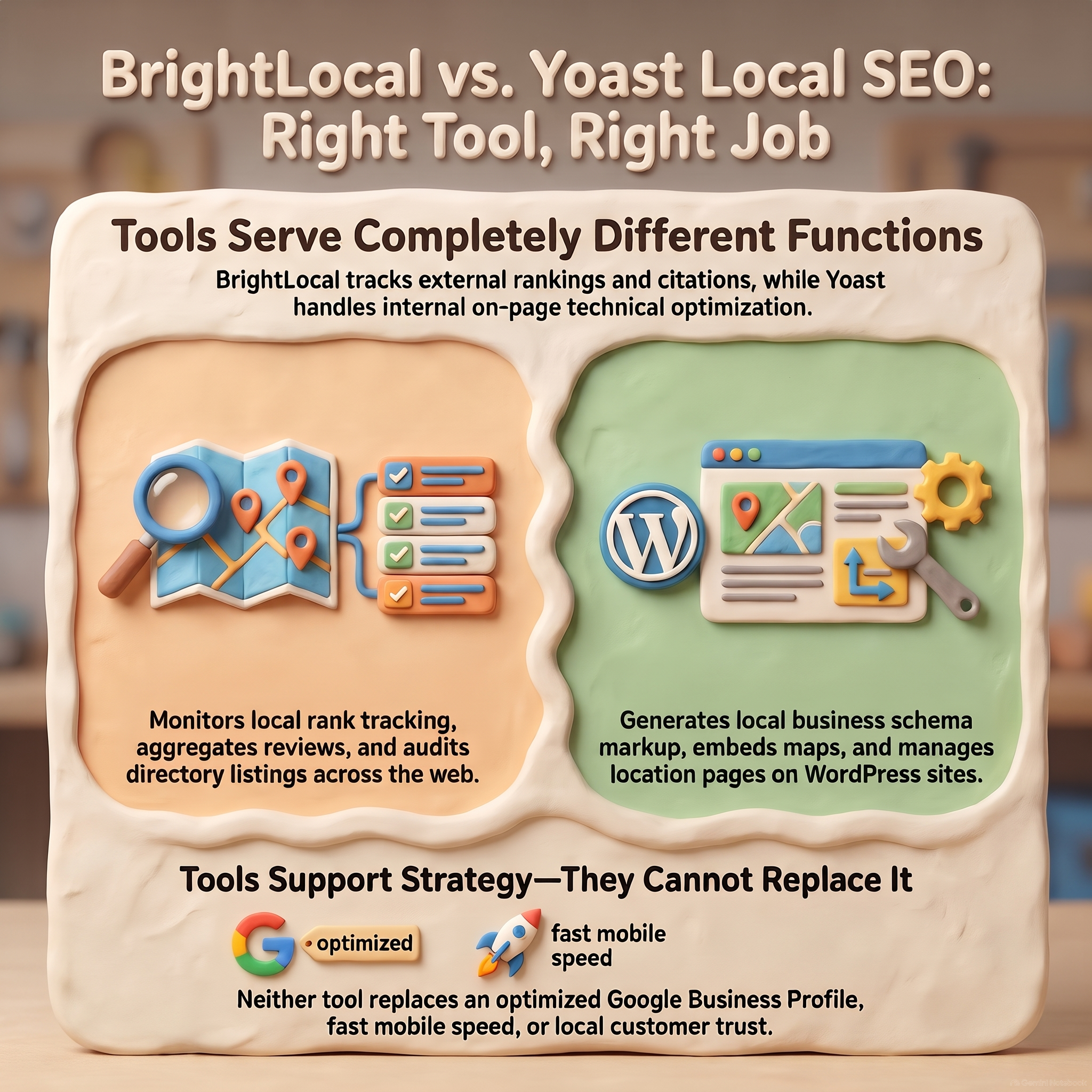
Here’s the truth upfront: BrightLocal and Yoast Local SEO aren’t competitors. They’re completely different tools designed to solve different problems. And more importantly for SA business owners operating on tight budgets and tighter timelines: neither one is a local SEO strategy. They’re tools that support a strategy, which means buying either one without understanding what it actually does is like investing in a bakkie without checking whether you need to haul livestock or deliver cupcakes.
Let’s break down what each tool genuinely offers, where they fit into a local SEO plan, and why the most important investment isn’t the software — it’s the expertise to use it properly.
What BrightLocal Actually Does (and Doesn’t Do)
BrightLocal is a reporting and citation management platform built for agencies and businesses managing local SEO at scale. Think of it as your dashboard for tracking how your business appears across the internet, particularly in local search results and directories.
Here’s what it handles well:
Citation tracking and management: BrightLocal scans hundreds of online directories — from Google Business Profile to industry-specific listings — and tells you where your business name, address, and phone number (NAP) are listed, where they’re inconsistent, and where you’re missing entirely. For a Johannesburg restaurant appearing as “Joe’s Grill” on one site and “Joe’s Grille Sandton” on another, this matters. Google trusts consistent information; inconsistency looks suspicious.
Local rank tracking: The platform monitors where your business ranks for specific search terms in specific locations. If you’re a plumber in Durban tracking “emergency plumber Durban,” BrightLocal shows you whether you’re position 3 or position 13 — and how that changes over time.
Review monitoring: It aggregates reviews from multiple platforms (Google, Facebook, HelloPeter) into one dashboard, so you’re not logging into seven different sites every morning to see who’s complained about your service during load shedding.
Competitor analysis: You can track how competing businesses rank for the same terms, which citations they’ve secured, and how their review profiles compare to yours.
Reporting: BrightLocal generates white-label reports, which is why agencies love it. If you’re Thickrope reporting to a client on their local SEO progress, BrightLocal packages everything neatly.
What it doesn’t do: BrightLocal doesn’t change anything on your actual website. It won’t add schema markup to your contact page. It won’t optimise your homepage title tag. It won’t write location-specific landing pages or fix your mobile site speed. It’s a monitoring and management tool, not an on-page optimisation engine.
Pricing reality for SA businesses: BrightLocal starts around $35/month (roughly R650) for basic plans, scaling up to $165/month (R3,000+) for more locations and features. That’s not outrageous for what it does, but it’s a recurring cost that only makes sense if someone’s actually acting on the data it surfaces.
What Yoast Local SEO Actually Does (and Doesn’t Do)
Yoast Local SEO is a WordPress plugin that helps you implement on-page local SEO elements. If BrightLocal is your diagnostic dashboard, Yoast Local SEO is the toolkit for fixing what’s under the bonnet — but only if your website runs on WordPress.
Here’s what it handles:
Schema markup for local businesses: Yoast automatically adds structured data to your site that tells Google exactly what kind of business you are, where you’re located, your opening hours, and how to contact you. According to research from BrightLocal’s 2023 Local Consumer Review Survey, 98% of consumers used the internet to find local business information — and schema markup is how you make sure Google understands your details well enough to display them properly.
Multiple location support: If you’ve got branches in Cape Town, Pretoria, and Durban, Yoast lets you create separate location pages with unique schema for each one.
Google Maps integration: It embeds maps on your contact or location pages, which helps both users and search engines understand where you physically operate.
Store locator functionality: For multi-location businesses, Yoast can power a “find your nearest store” feature.
Opening hours display: Including special hours for public holidays — handy when you’re closed for Heritage Day but Google’s still sending people to your door.
What it doesn’t do: Yoast Local SEO doesn’t manage your citations. It won’t tell you if your business is listed incorrectly on Snupit or Brabys. It doesn’t track your rankings. It doesn’t monitor reviews. And critically, it only works if your website is built on WordPress — if you’re on Wix, Shopify, or a custom-built platform, Yoast isn’t even an option.
Pricing reality for SA businesses: Yoast Local SEO costs €99/year (around R2,000 annually, depending on the exchange rate) for a single site. That’s reasonable, but only if you’re already using WordPress and only if someone actually configures it correctly. A poorly implemented plugin is just expensive clutter.

The SA-Specific Reality: Tools Don’t Execute Strategy
Here’s the part that matters most for South African business owners: neither BrightLocal nor Yoast Local SEO constitutes a local SEO strategy. They’re tools. And tools without strategy are just expensive paperweights.
Let’s say you invest in BrightLocal. It tells you that your NAP details are inconsistent across 47 directories, your rankings have dropped for “electrician Centurion,” and your main competitor has 53 more Google reviews than you do. Fantastic. Now what?
If you don’t know how to systematically correct those citations, which directories actually matter in SA (spoiler: it’s not the same list as the UK or US), how to structure a review generation campaign that doesn’t violate Google’s guidelines, or how to diagnose why your rankings dropped (was it a Google update, a new competitor, a technical issue, or all three?), then BrightLocal just becomes an expensive reminder that things aren’t working.
Similarly, you install Yoast Local SEO. It adds schema markup to your site. Great — but if your Google Business Profile isn’t optimised, if your homepage still loads in 8 seconds over a 4G connection (which 33% of South Africans rely on according to ICASA’s 2023 State of the ICT Sector Report), if your content doesn’t actually mention the neighbourhoods you serve, or if you’ve got zero inbound links from local sources, that schema markup is just correct code on an underperforming site.
The strategy layer — the part that actually drives results — includes:
- Competitor and keyword research specific to your SA market
- Google Business Profile optimisation (category selection, post strategy, Q&A management, attribute selection)
- Citation building on directories that South African consumers and search engines actually use
- On-page optimisation: location-specific content, internal linking, mobile performance, Core Web Vitals
- Review generation and management (including dealing with the inevitable “1-star because of load shedding” reviews)
- Link building from locally relevant sources
- Tracking, testing, and iterating based on what’s working in your specific niche and geography
BrightLocal can support that strategy with data. Yoast can support it with technical implementation. But neither one replaces the expertise required to build and execute the strategy in the first place.
Which Tool Fits Which Business?
So how do you decide whether you need one, both, or neither?
You might benefit from Yoast Local SEO if:
- Your website runs on WordPress
- You have one or more physical business locations
- Your website doesn’t currently have proper schema markup (you can check by running your site through Google’s Rich Results Test)
- You want an affordable, one-time investment to improve how search engines understand your location data
- You have someone (in-house or an agency) who can configure it correctly and maintain it
You might benefit from BrightLocal if:
- You’re serious about local SEO as an ongoing channel (not just a one-off project)
- You need to track rankings, citations, and reviews across multiple locations or competitors
- You’re working with an agency or have in-house resource that will actually use the reporting data to make decisions
- You have the budget for a recurring monthly subscription
- You want to monitor your local SEO health over time, not just implement it once
You probably need neither (or both won’t help) if:
- You haven’t sorted the basics: an optimised Google Business Profile, a mobile-friendly website, consistent NAP information, and some genuine customer reviews
- You don’t have anyone who understands local SEO enough to act on what the tools surface
- You’re hoping the tool itself will “do” local SEO for you
And here’s the bit most comparisons won’t tell you: for many SA businesses, the right starting point isn’t buying tools at all — it’s investing in the strategic layer first. Get your Google Business Profile properly optimised. Fix your site speed. Build ten high-quality citations on directories that matter locally. Generate your first 20 genuine reviews. Get those fundamentals right, and you’ll see results before you’ve spent a cent on software.
Once you’re at the stage where you need detailed rank tracking, large-scale citation management, or advanced schema implementation, then tools like BrightLocal or Yoast make sense. But they’re accelerators, not replacements for expertise.

The Real Comparison: Tools vs Strategy
The question “BrightLocal vs Yoast Local SEO” is actually the wrong question. The right question is: “Do I have a local SEO strategy, and what tools (if any) will help execute it?
According to Google, 76% of people who search for something nearby on their smartphone visit a related business within a day — and 28% of those searches result in a purchase. For a Pretoria retailer or a Cape Town service provider, that’s not abstract data; that’s revenue walking past your competitors and into your business (or not).
But capturing that demand requires more than software. It requires:
1. Understanding your local market: Who’s searching, what they’re searching for, how they phrase it (hint: South Africans don’t search like Americans), and what they expect to find
2. Technical execution: Fast, mobile-friendly sites with proper schema, clear location signals, and strong user experience
3. Content and relevance: Landing pages, blog posts, and service pages that answer local questions and target local keywords
4. Off-site authority: Citations, links, and reviews that tell Google you’re a legitimate, trusted business in your area
5. Ongoing optimisation: Local SEO isn’t a once-off project; it’s a channel that requires regular attention, especially as competitors improve and Google’s algorithms evolve
Tools can support all of that. But they can’t replace the expertise required to do it properly — especially in a market as specific as South Africa, where the competitive dynamics, consumer behaviour, mobile usage patterns, and even infrastructure challenges (yes, load shedding affects SEO, particularly site uptime and user experience) create unique conditions.
Frequently Asked Questions
Q: Can I use BrightLocal and Yoast Local SEO together?
A: Absolutely — they’re not mutually exclusive. Yoast handles on-page schema and location data on your WordPress site; BrightLocal tracks how your business appears across the web and monitors your rankings. Many agencies use both as part of a broader local SEO toolkit.
Q: Do either of these tools work for service-area businesses without a physical storefront?
A: Yes, but with caveats. Yoast Local SEO can still implement schema for service-area businesses (like plumbers or electricians who travel to customers), and BrightLocal can track rankings for service-area terms. However, your local SEO strategy will differ significantly from a storefront business, particularly around Google Business Profile setup.
Q: Are there free alternatives to BrightLocal or Yoast Local SEO?
A: Partially. You can manually track citations and rankings using spreadsheets and Google Search Console (tedious but free). For schema markup, you can use free plugins like Schema Pro or even hand-code it if you’re technical. But the time cost often exceeds the software cost, especially if you’re managing multiple locations.
Q: Will these tools help me outrank national competitors as a local business?
A: Tools alone won’t — but they support the strategy that can. If you’re a Durban accounting firm competing against national chains, your advantage is relevance and proximity. Yoast helps Google understand your location; BrightLocal helps you track whether your local strategy is working. But the actual competitive advantage comes from optimised local content, reviews, citations, and a Google Business Profile that signals strong local authority.
If you’re a South African business owner who’s realised that local SEO is more than just installing a plugin or subscribing to a dashboard, we should talk. Thickrope builds local SEO strategies tailored to SA businesses — the kind that use tools when they’re useful, but never mistake software for expertise. Get in touch for a free local SEO audit and let’s figure out what’ll actually move the needle for your business.