
Why the Standard Local SEO Playbook Falls Flat for Dental Practices in South Africa
Most local SEO advice treats every business the same. Optimise your Google Business Profile, collect some reviews, sprinkle in location keywords, and Bob’s your uncle. But if you’re running a dental practice in Johannesburg, Cape Town, or Durban, you’ve probably noticed something: the standard playbook doesn’t quite deliver the patient flow you were promised.
That’s because dental local SEO operates under a completely different set of rules. The way South Africans search for dentists, the outsized role of emergency intent, the medical aid versus cash patient dynamic, and the healthcare marketing constraints you’re bound by — none of this fits neatly into generic local SEO frameworks.
Let’s unpack what makes dental local SEO genuinely different, and what your practice needs to do instead.
The Google Maps Dependency Is Extreme (and Gets Worse Under Load Shedding)
For most local businesses, Google Maps is important. For dental practices, it’s oxygen.
According to research by BrightLocal, 93% of consumers used the internet to find a local business in 2023, and dental services rank among the highest intent categories — people searching for a dentist are usually ready to book now, not browsing for later. But here’s the kicker specific to South African dentistry: the majority of those high-intent searches happen on mobile, often during moments of actual dental pain or anxiety.
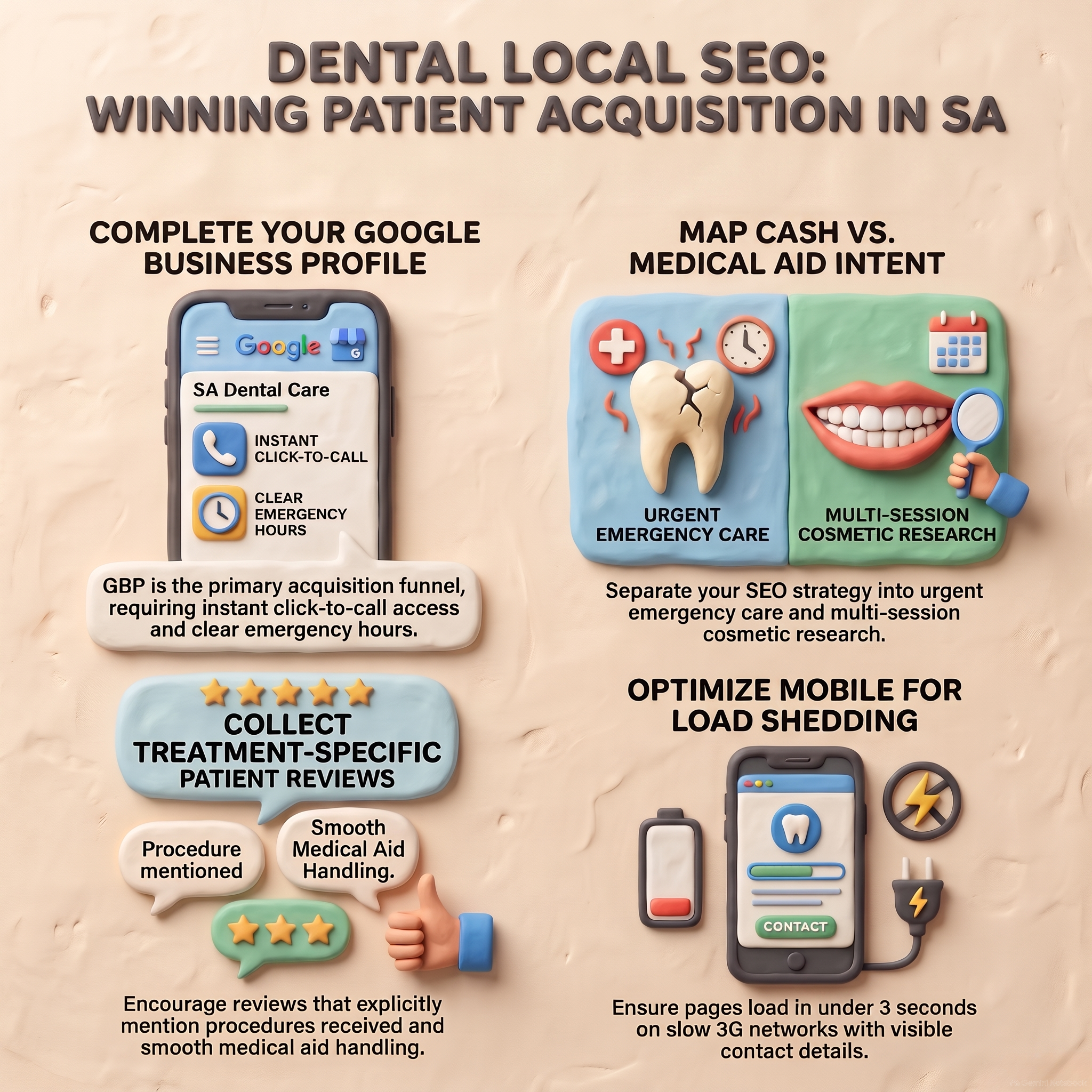
When someone chips a tooth at a Saturday braai or wakes up with a throbbing molar at 2am, they’re not leisurely comparing practice websites on their laptop. They’re Googling “emergency dentist near me” on their phone, usually with terrible signal because, well, South Africa. Your Google Business Profile needs to load instantly, show your emergency hours clearly, and make it brain-dead simple to tap the call button.
This isn’t just about having a Google listing. It’s about understanding that your Maps presence often *is* the entire patient acquisition funnel. If your address is slightly wrong, your phone number doesn’t click-to-call properly, or your emergency services aren’t prominently featured in your business description, you’ve lost the patient before they ever see your website.
The Cash vs Medical Aid Split Changes Everything About Keywords
Here’s something most international dental SEO guides completely miss: South Africa’s dual healthcare economy fundamentally changes search behaviour.
A patient searching for “affordable dentist Pretoria” is sending you a completely different signal than someone searching for “cosmetic dentist Sandton.” The first is likely a cash patient or someone with basic medical aid looking for essential care at a manageable price. The second is probably on a comprehensive plan or paying privately for elective work, and price sensitivity is lower.
Your keyword strategy can’t just target “dentist + location.” You need to understand the commercial intent behind each search pattern:
- Emergency dental searches (“toothache help”, “broken tooth repair”) — highest urgency, mixed payment ability, need immediate response capability
- Routine care searches (“dentist near me”, “dental check-up”) — often medical aid driven, comparing convenience and scheme participation
- Cosmetic/elective searches (“teeth whitening”, “Invisalign Johannesburg”) — typically cash or gap cover, comparing expertise and results
- Paediatric searches (“kids dentist”, “child-friendly dental practice”) — driven by parents on family plans, prioritising trust and experience
Each of these requires different content, different landing pages, and different conversion paths. A generic local SEO strategy that treats all “dentist + city” keywords the same is leaving money on the table.
Treatment-Specific Search Intent Patterns Are Wildly Different
Not all dental treatments are created equal in the eyes of Google searchers. The search journey for someone needing a root canal versus someone considering veneers looks nothing alike — and your SEO strategy needs to reflect that.
Emergency and restorative treatments generate short, high-intent search cycles. Someone with an abscess isn’t doing three weeks of research. They search, they scan the top three Maps results, they call. Your local SEO for these services needs to prioritise visibility in the Map Pack, clear emergency messaging, and immediate response capability (even if that’s just a well-optimised voicemail with emergency instructions during load shedding).
Cosmetic and orthodontic treatments follow a completely different pattern. According to Google’s own research, healthcare-related searches often involve 3+ sessions before conversion, and for elective dental work, that number is higher. These patients are researching extensively, comparing before-and-after galleries, reading reviews obsessively, and often searching across multiple months.
For these treatment categories, your local SEO strategy needs depth: detailed service pages with actual cost guidance (because every SA patient wants to know “what’s this going to cost me”), case studies with real results, video content showing your technique or practice environment, and a review acquisition strategy that specifically asks cosmetic patients about their experience and results.
The Healthcare Marketing Constraints Are Real (and Competitors Ignore Them at Their Peril)
Here’s an uncomfortable truth: most dental websites in South Africa are technically in violation of Health Professions Council of South Africa (HPCSA) advertising guidelines. Not massively, but enough to create competitive risk.
The HPCSA is clear that healthcare practitioners can’t make unsubstantiated claims, use testimonials in certain ways, or advertise in a manner that’s misleading. Yet scroll through dental practice websites and you’ll see all manner of “best dentist in [city]” claims, cherry-picked testimonials, and before-and-after galleries that would make a marketing agency blush.
Most practices get away with it because enforcement is inconsistent. But as a strategic matter, this creates an opportunity: you can build a local SEO presence that’s both HPCSA-compliant *and* more trustworthy than your competitors precisely because you’re not making inflated claims.
Instead of “Johannesburg’s #1 Cosmetic Dentist” (says who?), your title tags and content can focus on specific, defensible value: “Cosmetic Dentistry in Rosebank — Invisalign Certified, 15 Years’ Experience.” Instead of curated testimonials, you drive patients to your Google reviews, where real experiences sit alongside the 4-star ones that mention you were running late because of load shedding.
This approach won’t win any creative awards, but it builds the kind of steady, credible online presence that converts patients who’ve been burned by practices that overpromise and underdeliver.
Google Business Profile Categories Matter More Than You Think
Most dental practices use the primary category “Dentist” and call it a day. That’s a mistake.
Google allows multiple categories, and for dental practices, the secondary categories you choose directly influence which searches you appear in. If you offer orthodontics but haven’t added “Orthodontist” as a category, you’re not showing up properly for “orthodontist near me” or “Invisalign [your area]” searches — even if your website mentions these services.
Similarly, if you have a particular focus — cosmetic dentistry, paediatric dentistry, emergency dental services — these should be reflected in your categories. Google’s local algorithm uses these signals to determine relevance for specific search queries.
But here’s the nuance: don’t add categories you can’t actually deliver on. If you’re not set up for genuine dental emergencies outside normal hours, don’t list “Emergency dental service” as a category just to capture those searches. You’ll get the clicks, but the reviews will savage you when patients realise you’re not actually available.
Reviews Need a Dental-Specific Acquisition Strategy
Every local SEO guide tells you to get more reviews. But for dental practices, *which* reviews you get and *what* they say matters enormously.
Google’s algorithm looks at review recency, volume, and diversity, yes. But it also analyses review content for relevance signals. A dental practice with 50 generic “great service” reviews will perform worse than one with 30 reviews that specifically mention the treatments patients received, the quality of care, and aspects like pain management, explanation of procedures, or medical aid claims handling.
Your review acquisition strategy should actively guide patients toward mentioning specifics:
- Post-treatment timing: Ask for reviews 2-3 days after treatment when the experience is fresh but any immediate discomfort has subsided
- Treatment-specific requests: After a cosmetic procedure, explicitly mention you’d appreciate them sharing their results if they’re happy (this gets you review content that mentions “veneers” or “teeth whitening”, which helps rankings for those services)
- Address the medical aid question: Encourage patients who had smooth medical aid experiences to mention it — this is pure gold for other patients researching whether you’re worth visiting
And please, respond to every review — even the five-star ones. South Africans notice when a practice engages with feedback, and Google’s algorithm certainly does.
Location Pages Need to Reflect How South Africans Actually Search for Dentists
If you’re a practice with multiple locations, or you’re trying to capture patients from surrounding areas, you need location-specific pages. But not the thin, templated rubbish most practices publish.
South African search behaviour is intensely local, often down to suburb level. Someone in Umhlanga isn’t searching for “dentist Durban” — they’re searching “dentist Umhlanga” or even “dentist near Gateway.” Your location pages need to reflect this specificity.
Each location page should include:
- Actual local landmarks and directions: Not just “Sandton” but “Corner Rivonia and 5th, opposite Sandton City, parking in the building”
- Suburb-specific service focus: If your Constantia practice does more cosmetic work than your Observatory one, the content should reflect that reality
- Local medical aid partnerships: If certain schemes are particularly common in that area, mention them
- Load shedding contingencies: If you have backup power, say so explicitly — this is a genuine patient concern
These pages also need unique content. Google is wise to the “copy location page, find-and-replace suburb name” trick. If your practice has genuinely been in a neighbourhood for years, you should be able to write 500 words about what makes that location and patient base unique.

The Mobile Experience Isn’t Optional — It’s the Entire Game
According to Google’s own data, more than 60% of local searches now happen on mobile devices, and for dental searches specifically, that number skews even higher because of the emergency and “near me” nature of the queries.
But here’s the South African twist: mobile doesn’t just mean smartphone optimisation. It means optimisation for slow, intermittent connectivity on frequently load-shed networks.
Your practice website needs to:
- Load in under 3 seconds on a 3G connection — test it on an actual mobile device, tethered to your phone, with full signal but not WiFi
- Have a click-to-call button in the header that stays visible as patients scroll
- Display your hours prominently, including whether you handle emergencies after hours
- – **Show your physical address with a one-tap Google Maps link**, not an embedded map that takes 30 seconds to load
- List your core services above the fold so patients don’t have to scroll through your practice philosophy to find out if you do root canals
If your website is built on a bloated WordPress theme with a 4MB hero image and seventeen scripts loading before the content appears, you’re losing patients before they even see your name.
Frequently Asked Questions
Q: How long does it take for dental local SEO to show results in South Africa?
A: For Google Maps visibility, you can see movement within 4-6 weeks if you’re optimising properly — especially if competitors aren’t. For organic search rankings (the blue links below the Map Pack), count on 3-6 months for competitive keywords. Emergency and treatment-specific long-tail keywords often rank faster because there’s less competition for them.
Q: Should my dental practice invest in paid Google Ads or focus on local SEO?
A: For most SA dental practices, the answer is both, strategically. Use Google Ads for high-value services (cosmetic, orthodontics, implants) where the patient lifetime value justifies the cost-per-click, and for emergency terms where you need immediate visibility. Build local SEO for everything else — the routine care, check-up, and general dentist searches that drive consistent patient flow and don’t cost you R50 per click.
Q: Do I need separate Google Business Profiles for each location, or can I use one?
A: Each physical location needs its own Google Business Profile with a unique address and phone number. Google treats each location separately in local search results, so a practice in Sea Point and one in Claremont should have distinct profiles. If you’re a mobile dentist or work from multiple locations without a permanent presence, the rules are different — and frankly, harder to optimise for.
Q: How do I handle negative reviews without violating patient confidentiality?
A: Respond publicly with empathy and professionalism, but keep it generic: “We’re sorry to hear about your experience and would like to discuss this further. Please contact us directly so we can address your concerns properly.” Never, ever discuss patient details or defend yourself by referencing treatment specifics — that’s both a HPCSA violation and terrible optics. Many negative reviews soften when the practice responds professionally and resolves the issue offline.
Q: What’s the single most important local SEO factor for dental practices in South Africa?
A: Google Business Profile completeness and accuracy, hands down. It’s the foundation everything else builds on. If your profile has the wrong phone number, outdated hours, or no services listed, nothing else you do will compensate. Get that right first, then layer on reviews, website optimisation, and content strategy.
If you’re running a dental practice and your local SEO hasn’t been built with these healthcare-specific realities in mind, you’re likely invisible to the patients who need you most. Thickrope’s local SEO service for dental practices handles the full strategy — from HPCSA-compliant content to treatment-specific keyword targeting to review acquisition that actually mentions your services. Book a free consultation and we’ll audit where your practice is losing patients right now.