

What a Proper Local SEO Audit Actually Looks Like — and What Thickrope Examines Before Making Any Recommendations
You’re not here for theory. You want to know what actually happens when you engage someone to audit your local SEO — what they look at, what you get at the end of it, and whether it’s worth the investment.
Fair enough. You’re running a business in South Africa, where every rand counts and “trust the process” doesn’t pay the bills. So let’s walk through exactly what a proper local SEO audit involves, what Thickrope examines before making any recommendations, and what happens after you get the report.
No smoke. No mirrors. Just the transparent breakdown you deserve before signing anything.
The Business Problem a Local SEO Audit Solves
Here’s the thing: most SA businesses aren’t invisible online because they’re doing everything wrong. They’re invisible because they’re doing fifteen things 60% right — and Google rewards the business that does eight things 95% right.
A local SEO audit identifies which of those fifteen things actually matter for your business, which ones are haemorrhaging opportunity, and which ones you can safely ignore because they don’t move the needle in your specific market.
According to BrightLocal’s 2024 research, 98% of consumers used the internet to find local business information — and 87% of those searchers won’t look past the first page. If you’re a plumber in Sandton, a physio in Durban North, or a bakery in Stellenbosch, that first page is your entire market. The audit tells you exactly what’s keeping you off it.
What Thickrope’s Local SEO Audit Actually Covers
Let’s get specific. When we conduct a local SEO audit, we’re examining six core areas. Each one gets documented, scored, and translated into actionable recommendations — not vague suggestions like “improve your online presence,” but specific tasks like “add operating hours to your Google Business Profile and upload three photos of your actual premises.”
1. Google Business Profile Completeness and Optimisation
Your GBP is the single most important local SEO asset you own. It’s also the one most businesses treat like a “set and forget” directory listing from 2012.
We check:
- Profile completeness: Are all fields filled? Business description, categories (primary and secondary), attributes, services, products, operating hours, special hours (yes, including load shedding adjustments if you’ve got them).
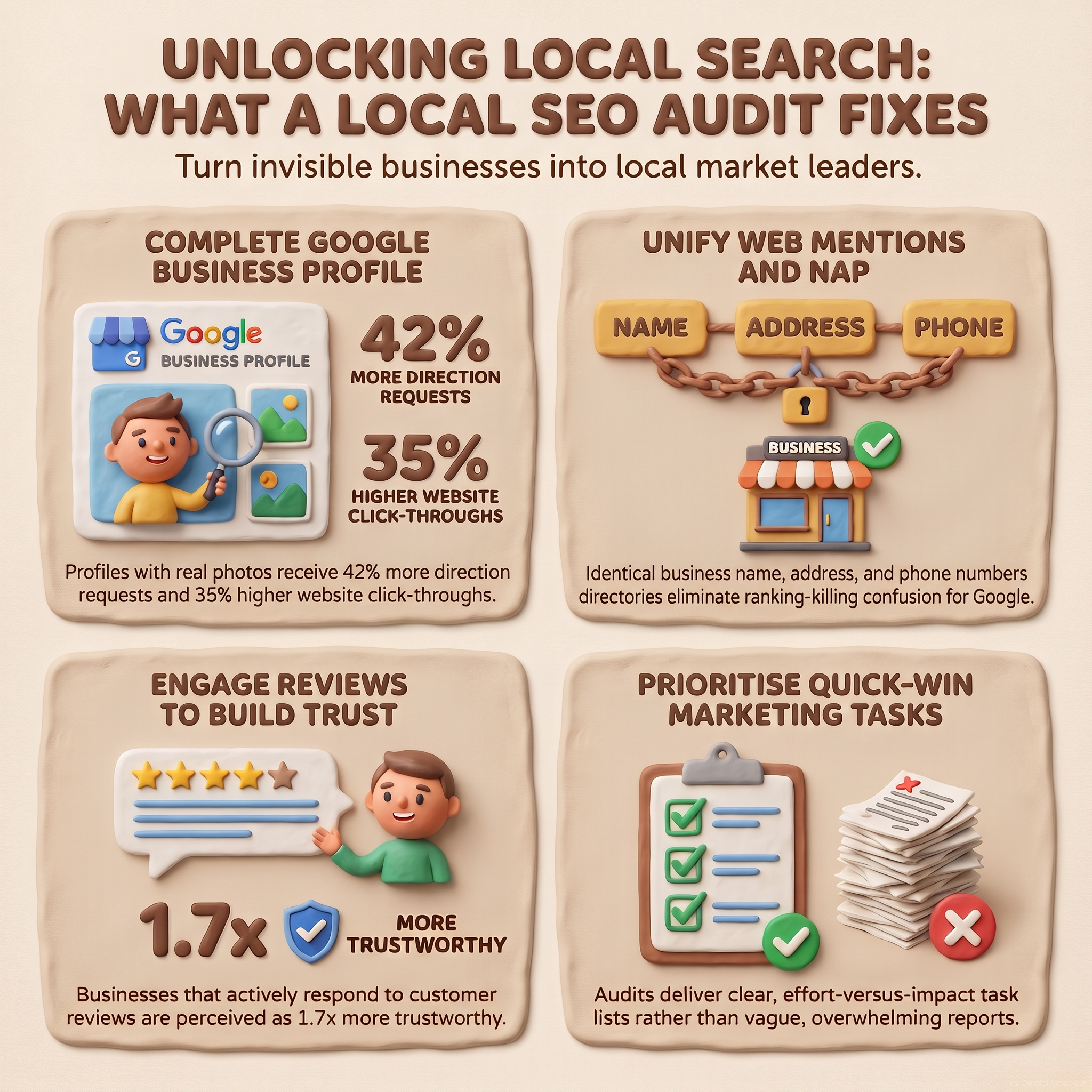
- Photo and video quality: Do you have recent, high-quality images? Google’s own data shows that businesses with photos receive 42% more requests for directions and 35% more click-throughs to their websites. Stock photos don’t count. We want your actual premises, your actual team, your actual work.
- Post frequency: Are you using GBP posts to signal freshness? Competitors who post weekly have a measurable ranking advantage.
- Q&A management: Is the Q&A section populated with helpful answers, or is it full of spam and unanswered questions from 2021?
- Booking and messaging setup: If your industry supports it, are these features activated?
2. Citation Consistency Across the Web
Citations are mentions of your business name, address, and phone number (NAP) across the web — directories, review sites, industry listings, local blogs, chamber of commerce pages.
Google uses these to verify that your business is real and where you say it is. Inconsistent citations (different addresses, old phone numbers, misspelt business names) create confusion — and confusion kills rankings.
We audit:
- Core citations: Are you listed on the major SA directories (Google, TrueLocal, Snupit, Brabys, Cylex, Hotfrog)?
- NAP consistency: Is your business name, address, and phone number identical everywhere? “Thickrope Marketing” vs. “Thickrope Marketing SA” vs. “Thickrope Mktg” are three different signals to Google.
- Citation quality vs. quantity: Ten citations on relevant, authoritative sites beat 100 on spammy directories that also list businesses in Estonia.
- Duplicate or conflicting listings: Old addresses from a previous location, duplicate GBPs from a franchise setup gone wrong, listings you didn’t even know existed.
3. On-Page Local Signals
Your website needs to speak the language of local search. That means embedding location and service information in ways that both humans and Google’s crawlers understand.
We examine:
- Title tags and meta descriptions: Do they include your city or service area? “Best Accountant in Cape Town” is targeting local intent. “Best Accountant” is not.
- Header tags (H1, H2, H3): Are you naturally weaving in location modifiers?
- Location pages: If you serve multiple areas, does each area have a dedicated, substantive page (not just thin, templated content)?
- Schema markup: Are you using LocalBusiness schema to explicitly tell Google your business type, location, hours, and contact info? This is table stakes in 2026, but most SA sites still don’t have it.
- Embedded maps: Does your contact page have a Google Map embed? It’s a simple trust signal.
- Mobile experience: Given that StatCounter reports mobile devices accounted for over 60% of web traffic in South Africa in 2023, if your site isn’t mobile-optimised, you’ve already lost half your potential customers before they read a word.
4. Review Velocity, Volume, and Response Strategy
Reviews are social proof, ranking signals, and conversion drivers all in one. Google doesn’t just count them — it evaluates recency, sentiment, diversity of sources, and whether you respond.
We assess:
- Review volume: How many reviews do you have compared to competitors in your category and location?
- Review velocity: Are you getting fresh reviews consistently, or did you get 20 in 2019 and none since?
- Average rating: Where do you sit? Anything below 4.0 stars is a red flag; above 4.5 is strong.
- Response rate and quality: Are you responding to reviews (especially negative ones) professionally and promptly? According to Google, businesses that respond to reviews are seen as 1.7x more trustworthy.
- Review diversity: Are reviews coming from multiple platforms (Google, Facebook, industry-specific sites), or just one?
- Keyword presence in reviews: Do your reviews naturally mention the services you offer? “Great plumber, fixed our geyser quickly” is worth more than “Nice guy.”
5. Competitor Gap Analysis
You’re not competing in a vacuum. You’re competing against the bakery three blocks away who hired someone’s nephew to “do the Google stuff” and somehow they’re ranking above you.
We identify:
- Who’s actually ranking: For your core local keywords (e.g., “electrician Pretoria East”), who holds positions 1–3 in the map pack and organic results?
- What they’re doing differently: Do they have more reviews? Better citations? Stronger on-page optimization? More backlinks from local sources?
- Opportunities they’re missing: Are there service keywords they’re not targeting? Locations they’re ignoring? Content gaps you can exploit?
- Quick wins: Where can you leapfrog them with the least effort?
6. Local Backlink Profile and Trust Signals
Links from local sources — SA news sites, regional blogs, industry associations, business directories, local government pages, sponsorships — signal to Google that you’re embedded in the community.
We evaluate:
- Link quantity and quality: How many local backlinks do you have, and are they from relevant, authoritative sources?
- Anchor text relevance: Are the links using natural language that includes your services and location?
- Competitor backlink gaps: Where are your competitors getting links that you’re not?
- Trust signals: Do you have links from .gov.za or .ac.za domains, local chamber of commerce sites, or well-regarded SA industry publications?

What You Actually Get at the End
Here’s what a Thickrope local SEO audit delivers:
1. A prioritised action plan: Not a 47-page PDF that sits in your downloads folder forever. You get a clear, ranked list of what to fix first, what to tackle next, and what can wait.
2. Specific tasks, not vague goals: “Add ’emergency plumber Johannesburg’ to your H1 tag on the homepage” beats “optimise your headings.”
3. Competitive context: Where you rank now, where your competitors rank, and what it takes to close the gap.
4. Effort vs. impact scoring: We flag quick wins (high impact, low effort) so you see results fast.
5. Technical issue documentation: Screenshots, examples, and explanations of what’s broken and why it matters.
6. A 30-minute debrief call: We walk you through the findings, answer your questions, and make sure you understand the roadmap.
What Happens After the Audit
You’ve got three options:
Option 1: DIY it. You take the audit and implement the recommendations yourself or with your internal team. We’re happy to provide this roadmap — some businesses have the time and skill in-house, and that’s brilliant.
Option 2: Hybrid approach. You handle some tasks (like responding to reviews or updating your GBP hours), and we handle the technical or time-intensive work (schema markup, citation building, content creation).
Option 3: Full engagement. We implement the entire plan, monitor the results, and iterate monthly based on performance data. This is the fastest route to results, and it’s what most SA businesses choose because local SEO isn’t a “set and forget” discipline — it’s ongoing optimisation.
No pressure. The audit has value either way. You’ll know exactly where you stand and what needs to happen. What you do with that information is entirely up to your capacity, budget, and timeline.
What a Fair Investment Looks Like (And What Determines Fit)
A proper local SEO audit — the kind described above, not a 15-minute automated tool scan — typically costs between R3,500 and R8,500 in South Africa, depending on the complexity of your business.
Factors that influence cost:
- Number of locations: Single location vs. multi-location (franchise, multiple branches).
- Industry competitiveness: Ranking as a lawyer in Sandton is harder than ranking as a niche B2B service in a smaller town.
- Current state of your digital presence: If you’ve got no GBP, no website, and no citations, there’s more ground to cover than if you’ve got the basics in place.
Here’s the litmus test for fit: if local customers finding you online would directly impact revenue — and you’re currently not showing up when they search — the audit pays for itself the moment it prevents one lost customer from going to a competitor.

The Recommendation
If you’re relying on local customers finding you online, and you’re not certain why you’re ranking where you are (or why you’re not ranking at all), a local SEO audit removes the guesswork.
It’s diagnostic work. You wouldn’t run a business without looking at your financials. This is the same principle — you need to know what’s working, what’s broken, and what’s costing you customers.
Most SA businesses we audit discover they’re closer to page one than they thought — they’re just missing two or three critical optimisations that competitors nailed. Fixing those isn’t a six-month project. It’s a few focused weeks.
The businesses that stay stuck are the ones who keep guessing. The ones that grow are the ones who measure, fix, and move forward.
Frequently Asked Questions
Q: How long does a local SEO audit take?
A: Typically 5–7 business days from kickoff to delivery, depending on the scope. We don’t rush it — accuracy matters more than speed. You’ll get a thorough audit, not a surface-level scan.
Q: Will the audit guarantee I rank #1 in my area?
A: No audit can guarantee rankings — anyone who promises that is lying to you. What it does guarantee is a clear, honest assessment of where you stand and what’s required to compete. Rankings follow when you fix the right things consistently.
Q: Do I need a website to benefit from a local SEO audit?
A: Ideally, yes — but even if you don’t have one, we can still audit your Google Business Profile, citations, and review strategy. That said, a website significantly expands your ranking potential and gives you more control over the customer journey.
Q: What if I’ve already done some SEO work — is an audit still useful?
A: Absolutely. In fact, it’s often more valuable. You might’ve focused on the wrong areas, or done 80% of the work but missed the 20% that drives results. An audit identifies what’s working, what’s not, and where to double down.
Q: Can I get an audit for multiple locations at once?
A: Yes. Multi-location audits are common for franchises, retail chains, or service businesses operating in several cities. Pricing adjusts based on the number of locations, but the per-location cost typically decreases at scale.
If you’re ready to stop guessing and start knowing exactly where your local SEO stands, get in touch with Thickrope for a transparent, no-fluff local SEO audit. We’ll show you what’s working, what’s broken, and what it takes to show up when your customers are searching.