

Why Internet Marketing Looks Completely Different for a Construction Company Than for Almost Any Other Industry
You’re not selling sneakers. You’re not flogging meal kits or SaaS subscriptions. You’re pitching a R750,000 office renovation or a R4.5 million warehouse build—and the bloke researching you has already been burned twice, is comparing three other quotes, and won’t make a decision for another six weeks.
This is why construction internet marketing is a different beast entirely. Everything you’ve been told about “conversion rate optimisation” and “social media engagement” was written for businesses selling £20 impulse purchases to people scrolling Instagram during load shedding. It doesn’t translate.
Let’s talk about what actually works when your sales cycle is measured in months, your average deal value has six or seven figures attached, and trust isn’t a nice-to-have—it’s the entire game.
The Sales Cycle Changes Everything About Your Digital Strategy
When someone buys a pair of takkies online, the entire journey—awareness, consideration, decision—can happen in fourteen minutes. They see an ad, click through, check the reviews, chuck it in the cart, done.
Your construction client? They’ve been thinking about this project for eight months. They’ve spoken to their accountant. They’ve had three internal meetings. They’ve driven past your previous job sites. They’ve Googled your company name at 11 p.m. on a Sunday. They’ve shown your website to their business partner, who then Googled you again from a different device.
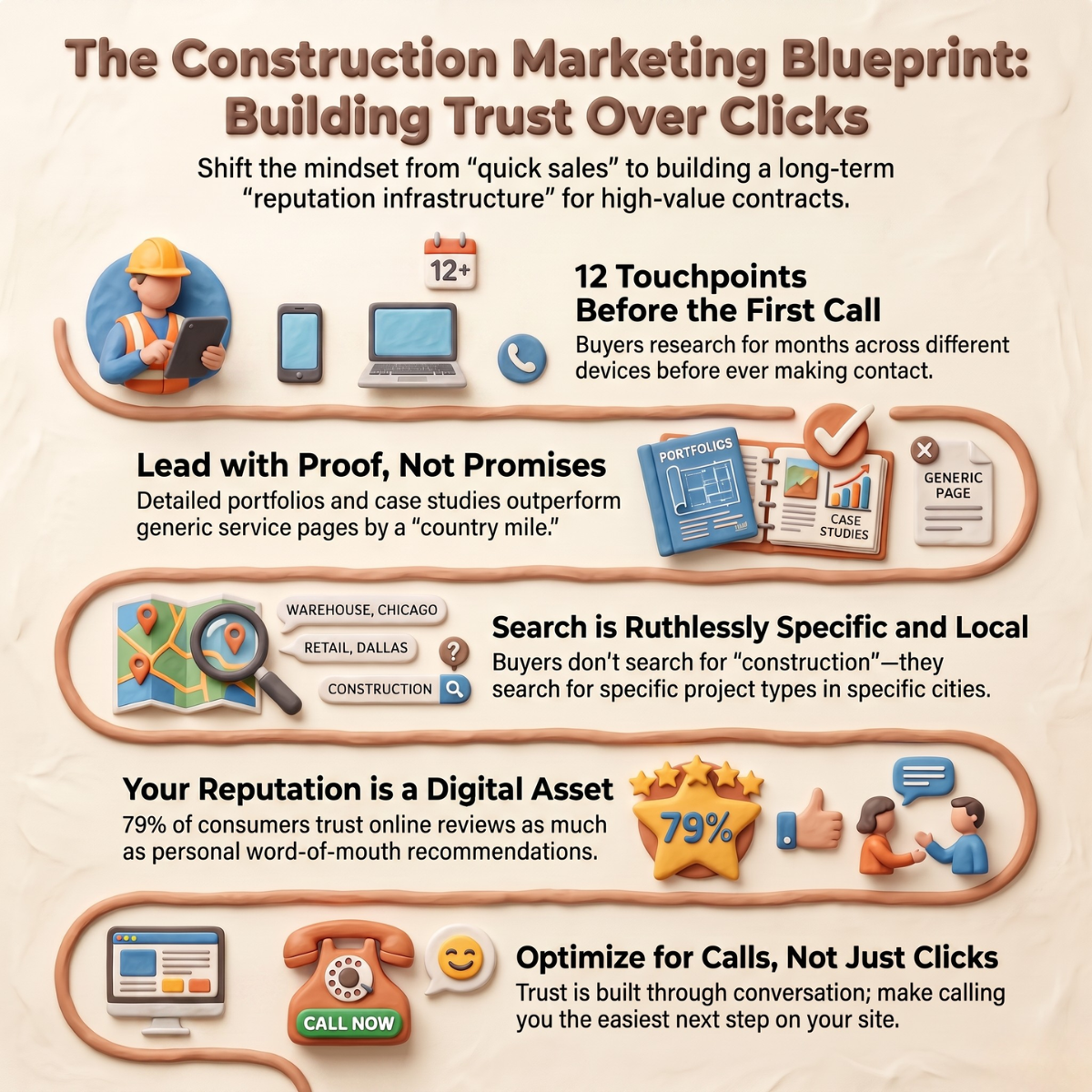
According to research from the Construction Marketing Association, the average commercial construction buyer interacts with a contractor’s brand 12 times before making contact. Twelve. That’s not twelve clicks on a Facebook ad—that’s twelve separate research moments spread across weeks or months, using different devices, different channels, and different levels of intent.
This fundamentally changes what “performance marketing” even means. You’re not optimising for impulse conversions. You’re building a reputation infrastructure that works while you sleep, answers questions you’ll never hear, and reassures people who aren’t ready to phone you yet.

Why Your Portfolio Does More Heavy Lifting Than Your Service Pages
Here’s something most construction companies get wrong: they build their website like a brochure. Services page. About Us page. Contact page. Job done.
But when a facilities manager in Sandton is trying to decide whether you can handle a three-storey office fit-out, they don’t care that you offer “comprehensive commercial construction services with a focus on quality and client satisfaction.” That sentence means nothing.
What they do care about: Have you done this exact type of project before? Did it go well? Can you prove it?
This is why portfolio content—proper case studies with photos, timelines, budget brackets, and obstacles overcome—outperforms generic service pages by a country mile. It’s proof of work, not promises of competence.
A detailed project showcase answering the question “Can you actually do what I need?” is worth more than a thousand words about your “commitment to excellence.” According to BrightLocal’s research, 79% of consumers trust online reviews and case studies as much as personal recommendations—and in construction, where word-of-mouth has always ruled, that’s your digital equivalent of a solid referral.
Your internet marketing needs to surface this proof everywhere: in search results, on your Google Business Profile, in retargeting ads that follow researchers around for weeks. Because unlike retail, where features and price win, construction buyers are hiring you—your track record, your reliability, your ability not to disappear halfway through the job.
Search Behaviour in Construction is Ruthlessly Specific (and Local)
Nobody Googles “construction company.” That’s not how this works.
They Google “commercial builders Durban industrial projects,” or “office renovation contractor Cape Town references,” or “warehouse construction companies Gauteng.” The search terms are longer, more specific, and almost always tied to location and project type.
Why? Because the risk is enormous. A bad hire doesn’t mean a dodgy pair of jeans that gets returned—it means a six-month project that runs over budget, finishes late, and torpedoes their own commitments to clients or investors.
So they research like their business depends on it. Because it does.
This has massive implications for your SEO strategy. Targeting broad keywords like “construction services” is a waste of time and budget. You need to own the specific, intent-heavy searches that signal real projects: “retail fit-out contractors Johannesburg,” “cold storage facility builders Western Cape,” “factory extension construction Pretoria.”
And because 61% of B2B searches now start on mobile (according to Google), your site better load fast even when some project manager is researching you on a patchy 4G connection in a half-built office park during—you guessed it—load shedding.
Local SEO isn’t optional. It’s the entire game. Your Google Business Profile, your local citations, your geo-targeted content, your reviews visible in Maps results when someone’s literally driving past your last completed site—it all compounds into the kind of visibility that brings in qualified leads, not tyre-kickers.

Reputation Marketing Isn’t Fluffy—It’s Your Most Valuable Asset Online
In retail and e-commerce, reputation is important. In construction, it’s everything.
Think about it: would you hire a builder with two Google reviews and a 3.8-star rating to oversee a R2 million project? Not a chance. You’d assume they’re either new, unreliable, or actively avoiding feedback from unhappy clients.
But a construction company with 47 reviews, an average rating of 4.7 stars, and detailed responses to every piece of feedback—including the critical ones? That tells a story. It says: we’ve done this dozens of times, most clients are happy, and when something goes wrong, we front up and sort it out.
This is why reputation marketing needs to be baked into your construction internet marketing from day one. Not as an afterthought. Not as damage control. As a deliberate strategy to collect, showcase, and amplify the trust you’ve earned on job sites.
Encourage reviews at project milestones. Respond to every single one. Feature testimonials prominently on project pages. Use video testimonials if you can—nothing beats a facilities manager standing in front of a completed warehouse saying, “These okes delivered on time and under budget during load shedding and a cement shortage.”
And when someone Googles your company name at 11 p.m. (and they will), what they find needs to reassure them that you’re the safe bet.
Retargeting and Nurture Campaigns: Playing the Long Game
Here’s where construction internet marketing really diverges from the fast-twitch world of e-commerce: your prospects aren’t ready to buy now. They’re ready to buy in four months. Maybe six.
So what do you do in the meantime? You stay visible. You stay helpful. You stay top-of-mind without being a pest.
This is where retargeting ads, email nurture sequences, and content marketing earn their keep. Someone visits your case study page about a cold storage facility build? Great. Now show them a retargeting ad with another relevant project. Then an article about common pitfalls in temperature-controlled construction. Then a checklist for selecting a commercial builder.
You’re not pushing for a sale. You’re building familiarity and authority over time, so that when they **are** ready to request quotes, your name is already on the shortlist—and you’re the one they feel like they already know.
According to HubSpot, companies that excel at lead nurturing generate 50% more sales-ready leads at 33% lower cost. In construction, where every qualified lead is worth thousands (or hundreds of thousands) in potential revenue, that’s not a nice-to-have. It’s a competitive advantage.

What Actually Converts in Construction: Calls, Not Clicks
Let’s get practical. When you’re running Google Ads or Facebook campaigns for a construction business, your conversion goal isn’t “add to cart.” It’s not even “fill out a form.”
It’s: get them to pick up the phone.
Why? Because construction is consultative. Every project is different. Pricing depends on variables the client hasn’t even thought of yet. Trust is built in conversation, not through an automated email sequence.
Your internet marketing needs to make calling you the easiest, most obvious next step. That means:
- Click-to-call buttons that work flawlessly on mobile (because most of your traffic is mobile).
- Your phone number visible in the header, footer, and on every service and project page.
- Google Ads campaigns optimised for call conversions, not just clicks.
- Call tracking so you know which keywords, ads, and landing pages are driving actual enquiries, not just web traffic.
A “contact us” form is fine as a backup. But if you’re spending money on ads and not optimising for phone calls, you’re leaving money—and projects—on the table.
The Role of LinkedIn and Industry Networks (Not Facebook and TikTok)
Quick reality check: your next R3 million client is not discovering you through a viral TikTok. They’re not engaging with your latest Instagram carousel about “5 Tips for Choosing a Builder.”
They’re on LinkedIn. They’re in industry groups. They’re asking for recommendations in private WhatsApp groups with other business owners.
This doesn’t mean social media is irrelevant—it means you need to be strategic about **where** you show up. LinkedIn is where commercial decision-makers live. It’s where you can share case studies, publish thought leadership on industry challenges (load shedding-proof builds, anyone?), and connect directly with facilities managers, property developers, and procurement leads.
Facebook and Instagram? Sure, they have a place—especially for residential or smaller commercial work, and especially for building brand awareness. But if you’re chasing commercial and industrial contracts, your social energy is better spent on LinkedIn and industry-specific platforms.
And don’t underestimate good old-fashioned networking—online and offline. Construction is still a relationship business. Internet marketing amplifies those relationships; it doesn’t replace them.

Why DIY Digital Marketing Usually Fails for Construction Companies
Look, we get it. You’re running a construction business. You’ve got project managers to manage, subbies to chase, clients to keep happy, and a dozen fires to put out before 9 a.m. The last thing you need is to become a digital marketing expert.
So you try the DIY route. You throw up a website on Wix. You boost a couple of Facebook posts. You ask your nephew who “knows computers” to help with Google.
And six months later, you’ve spent money, wasted time, and generated precisely zero qualified leads.
Why? Because construction internet marketing isn’t plug-and-play. It’s not about following a generic template. It’s about understanding how your specific clients research, what they need to see before they trust you, and how to stay visible throughout a long, complex buying journey.
It’s about knowing that a click doesn’t mean anything if it’s not the right click. That a website visitor from Johannesburg searching for “industrial builders” is worth 50 times more than random traffic from a Facebook ad promoting “construction services.”
It’s about having the tools, the tracking, and the strategy to play the long game—because that’s the only game that works in this industry.
Frequently Asked Questions
Q: How long does it take to see results from construction internet marketing?
A: Be realistic—this isn’t retail. You’re looking at 3 to 6 months to start seeing consistent qualified leads, and 6 to 12 months to build the kind of search visibility and reputation footprint that generates inbound enquiries regularly. The long sales cycles mean your marketing works over months, not weeks.
Q: Should a construction company invest more in SEO or Google Ads?
A: Both, but for different reasons. Google Ads gets you visibility fast and works brilliantly for high-intent, location-specific searches when someone’s actively looking now. SEO builds long-term authority and trust, captures earlier-stage research, and costs nothing per click once you’re ranking. Most successful construction companies do both.
Q: What’s a realistic monthly budget for digital marketing for a mid-sized construction company in South Africa?
A: For a company doing R10 million to R50 million annual revenue, expect to invest between R15,000 and R40,000 per month across SEO, Google Ads, content, and reputation management. That might sound steep, but one commercial project pays for a year of marketing—it’s about ROI, not cost.
Q: Do construction companies really need to be on social media?
A: Yes, but be strategic. LinkedIn is non-negotiable for commercial work—it’s where decision-makers live. Facebook and Instagram work for brand awareness and residential projects. TikTok? Probably not. Focus your energy where your clients actually spend time researching contractors.
Q: How important are online reviews for construction companies?
A: Absolutely critical. Most buyers will Google your company name before making contact, and what they find determines whether you make the shortlist. Aim for at least 20+ reviews with an average above 4.5 stars, and respond to every one. Reviews are social proof at scale—your reputation working while you’re on-site.
If you’re serious about filling your pipeline with qualified commercial and industrial projects—not just tyre-kickers and time-wasters—let’s talk about building a construction internet marketing strategy that actually reflects how your clients buy. [Book a free consultation with Thickrope](https://www.thickrope.co.za/contact) and let’s map out what works for your business.