

PPC for Accountants Works Differently — Because Your Clients Aren’t Shopping, They’re Choosing Who to Trust
Here’s something most accounting firms don’t realise when they try PPC: the person searching “tax accountant near me” is not in the same headspace as someone searching “pizza delivery Sandton.”
One’s hungry and wants a Margherita in 30 minutes. The other is entrusting someone with their financial compliance, their SARS submissions, their business’s most sensitive numbers — and possibly their freedom if things go sideways.
That difference changes everything about how PPC for accountants needs to be structured, written, and measured. And if your agency is running your accounting firm’s Google Ads like they’re selling sneakers or gym memberships, you’re haemorrhaging budget on clicks that were never going to convert.
Let’s dig into what actually works when you’re selling trust, expertise, and long-term professional relationships through paid search — especially in a South African market where competition is fierce, budgets are tight, and nobody’s got patience for fluff.
The Search Intent Gap: Why “Accountant Near Me” Isn’t a Buying Signal
Most businesses assume that if someone Googles “accountant Johannesburg” or “tax consultant Cape Town,” they’re ready to hire.
Not quite.
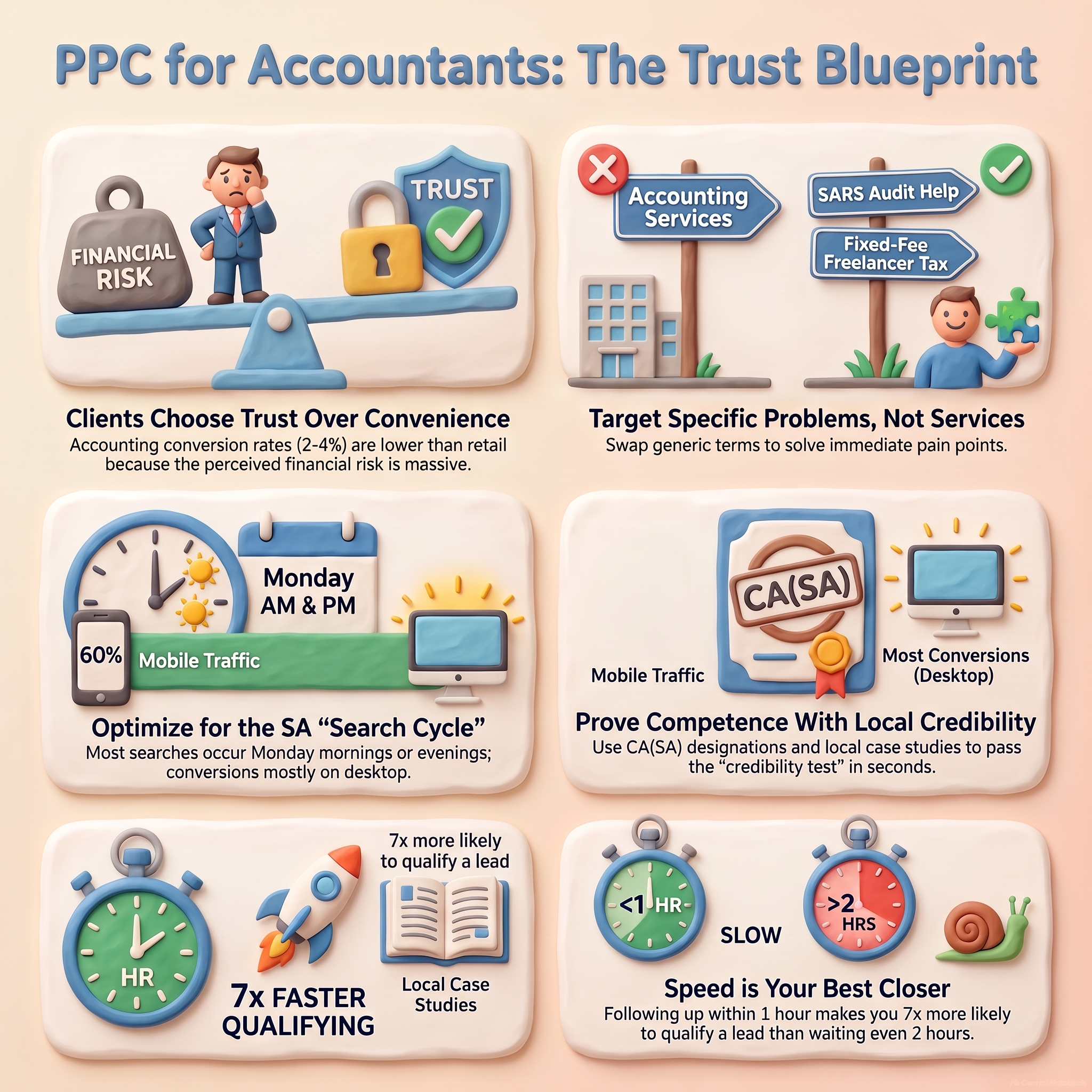
According to research from Hinge Marketing, professional services buyers consume an average of 13 pieces of content before they’re ready to engage. For accounting specifically, that number trends higher — because the perceived risk is massive. Get your bookkeeping wrong and you’re facing SARS penalties. Botch your tax planning and you’re leaving money on the table. Choose the wrong firm and you’re stuck in a miserable professional relationship for years.
So when someone clicks your PPC ad for “small business accountant Pretoria,” they’re often at the beginning of a research journey, not the end. They’re not ready to book. They’re ready to evaluate whether you’re even worth a phone call.
This is why conversion rates for PPC in the accounting space sit much lower than retail or e-commerce. A well-optimised retail campaign might hit 5–10% conversion. For accountants? You’re looking at 2–4% if you’re doing it right — and that’s converting to an enquiry, not a signed client.
The implication: your PPC strategy can’t just drive clicks. It has to build enough credibility in seconds to justify the next step.
What High-Trust PPC Actually Looks Like (And Why Most Firms Get It Wrong)
Let’s talk about what doesn’t work first.
Generic ad copy. “Expert accounting services. Call us today!” tells me nothing except that you paid someone on Fiverr to write your ads.
Landing pages that look like every other firm. Stock photos of diverse people shaking hands in a glass boardroom. Bullet points about “integrity” and “client-focused service.” A contact form with six fields and no reason I should fill it out.
No proof. No client testimonials, no case studies, no evidence you’ve ever solved a problem like mine.
Here’s what does work when you’re running PPC for accountants in South Africa:
1. Hyper-specific ad copy that speaks to a narrow problem
Don’t advertise “accounting services.” Advertise solutions to the exact pain point someone is Googling at 11 p.m. during load shedding because they just got a SARS audit notice.
Examples:
- “SARS Audit Notice? We Specialise in Tax Dispute Resolution — Pretoria-Based CA(SA) Firm”
- “Freelancers: Provisional Tax Sorted Without the Stress — R950/Quarter, Fixed Fee”
- “Switching Accountants? We Handle the Entire Transition — No Gaps, No Drama”
Notice what those do: they speak to a specific situation, they remove a friction point (location, price transparency, process anxiety), and they signal expertise.
2. Landing pages that prove competence before asking for trust
Your landing page isn’t a brochure. It’s a credibility test.
The structure that works:
- Headline that mirrors the ad promise (so the scent is consistent)
- Immediate proof: “We’ve handled 340+ SARS audits in the last four years. Here’s what that looks like.” Then show a short case study or anonymised example.
- Credentials that matter locally: CA(SA) designation, SAICA membership, industry specialisations (construction, medical practices, NPOs, etc.)
- Transparent next step: Not “Contact us for a free consultation” (vague, high-commitment). Instead: “Book a 20-minute intro call — we’ll tell you if we’re a fit and what working together looks like.”
One accounting firm we worked with in Durban tested two landing pages. The original had a 1.8% conversion rate. The new version — same traffic, same ad copy — hit 6.2%. The only changes: added a client video testimonial, simplified the form to three fields (name, email, one-line description of need), and replaced “Submit” with “Request a Call Back Within 24 Hours.”
That last bit matters. In South Africa’s high-context, relationship-driven business culture, people want to talk before they commit. A form submission feels like paperwork. A callback feels like a conversation.
3. Remarketing that nurtures, not nags
Remember: your prospect isn’t ready to hire after one click. So what happens after they leave your site?
Most accounting firms either do nothing (wasted opportunity) or run generic remarketing ads that say “Come back!” (annoying and ineffective).
Smart remarketing for accountants:
- Serve different ads based on which page they visited. If they read your SARS audit page, remarket with a case study about a successful dispute resolution.
- Offer a low-commitment content download: “The 2026 SA Tax Deadlines Cheat Sheet — Free PDF.” Capture the email, start a nurture sequence.
- Use YouTube remarketing (cheaper than display) to run a 60-second video where one of your partners explains a common misconception or shares a quick tax tip. Builds familiarity and authority without asking for anything.

The SA-Specific Nuances That Change the Game
Running PPC for accountants in South Africa isn’t the same as running it in the UK or Australia. A few realities that shape the strategy:
Mobile-first search behaviour (but desktop conversions)
According to StatCounter, mobile accounts for over 60% of web traffic in South Africa — higher than most developed markets. But here’s the rub: people research on mobile (often during their commute, between meetings, while waiting for load shedding to end), but they convert on desktop.
What that means for your PPC:
- Your mobile landing page experience has to be flawless: fast load times (under 3 seconds even on 3G), no intrusive pop-ups, click-to-call buttons prominent.
- But don’t panic if mobile conversion rates are lower. Track assisted conversions in Google Analytics — mobile clicks often lead to desktop form fills later.
- Use call extensions and location extensions aggressively on mobile. Many people would rather phone than fill out a form on a small screen.
Regional targeting beats metro-wide blanketing
Johannesburg is not one market. It’s Sandton (high-net-worth individuals, corporate), Randburg (SMEs, trade businesses), Soweto (emerging businesses, different service expectations).
Broad geo-targeting wastes money. If your firm specialises in medical practice accounting, target suburbs near hospital clusters. If you do construction accounting, target industrial nodes in Durban or Cape Town.
We’ve seen cost-per-lead drop by 40% when accounting firms tighten their radius from “Gauteng” to “5km around our office + specific high-value suburbs.”
Timing: when SA business owners actually search
Your PPC dayparting (when ads run) should reflect when business owners are thinking about accounting, not when you’re in the office.
Peak search times for accounting queries in SA:
- Monday mornings (7–10 a.m.): Business owners planning their week, realising they need help.
- Evenings (7–10 p.m.): After hours, when they’re finally sitting down and dealing with the financial admin they’ve been avoiding.
- Mid-month (around the 15th): When cash flow pressures hit and reality bites.
- Tax deadlines minus 2–4 weeks: Panic mode.
Adjust your bids to be more aggressive during these windows. No point paying full price for clicks at 2 p.m. on a Thursday when conversion likelihood is half what it is at 8 p.m.
The Keywords That Actually Convert (And the Ones That Just Burn Budget)
Not all accounting keywords are created equal. Some signal intent; others signal idle curiosity.
High-intent, high-conversion keywords (worth paying for):
- “SARS audit help [city]”
- “switch accountants [city]”
- “tax consultant for [specific industry]”
- “freelance accountant tax services”
- “provisional tax deadline” (around deadline periods)
- “[your suburb] chartered accountant”
These indicate a specific need, a sense of urgency, or a decision-making moment.
Low-intent, budget-draining keywords (exclude or bid low):
- “accounting degree requirements”
- “how to become an accountant”
- “accounting software free”
- “DIY tax return”
These are students, DIYers, and info-seekers. Not your client.
Also: negative keywords are your best friend. Add terms like “jobs,” “salary,” “course,” “software,” “free,” “DIY,” “template,” and “intern” to your negative keyword list immediately.
One firm we audited was spending R4,200/month on clicks for “accounting jobs Johannesburg” because their campaign had broad match on “accounting Johannesburg.” Zero enquiries. All waste.

What to Expect: Realistic PPC Performance Benchmarks for SA Accounting Firms
Let’s set honest expectations, because too many firms get sold a fantasy by agencies who’ve never run a campaign for a professional service.
Typical PPC metrics for a well-run accounting campaign in SA:
- Cost-per-click (CPC): R18–R45, depending on keyword competition and location. Johannesburg and Cape Town metros run higher; smaller cities like Bloemfontein or Nelspruit run cheaper.
- Click-through rate (CTR): 3–6% for search ads (lower is fine if your keywords are tightly qualified).
- Conversion rate (click to enquiry): 2–5%. Anything above 4% is strong.
- Cost-per-lead (CPL): R250–R850, depending on service complexity. SARS audit help will run higher; basic bookkeeping lower.
- Lead-to-client conversion: This happens offline and depends on your sales process, but expect 15–30% of enquiries to become clients if you’re following up promptly and qualifying properly.
Monthly budget reality: You need at least R8,000–R12,000/month to gather enough data to optimise effectively. Less than that and you’re essentially running a test that never reaches significance.
The Biggest Mistake: Treating PPC Like a Lead Vending Machine
Here’s the hardest truth about PPC for accountants: it doesn’t work in isolation.
You can drive 50 qualified enquiries a month, but if your phone manner is rushed, your follow-up is slow, or your onboarding process feels like applying for a bond, you’ll convert none of them.
PPC is the top of the funnel. It gets someone to raise their hand. The rest is on you:
- Answer the phone. Sounds obvious, but we’ve mystery-shopped accounting firms where calls went to voicemail three times in a row. If you’re in client meetings all day, hire someone to answer or use a call-handling service.
- Follow up within 2 hours. According to a Harvard Business Review study, firms that contact leads within an hour are 7x more likely to qualify them than those who wait even 2 hours. In SA’s competitive market, if you wait till tomorrow, they’ve already spoken to two other firms.
- Have a structured intro process. Not “let’s meet and see what you need” (vague, time-wasting). Instead: “I’ll send you a short questionnaire so I understand your situation, then we’ll have a 20-minute call to discuss fit and next steps.”
PPC brings them to the door. Your process gets them through it.

Why DIY PPC for Accountants Usually Fails (And When It Might Work)
Can you run your own PPC?
Technically, yes. Google Ads isn’t locked behind a secret guild. But here’s what we see when accounting firms try it themselves:
Common DIY mistakes:
- Using broad match keywords and haemorrhaging budget on irrelevant clicks.
- Writing ad copy that’s too generic to stand out.
- Sending all traffic to the homepage instead of dedicated landing pages.
- Not setting up conversion tracking properly, so they have no idea what’s working.
- Giving up after two weeks because “it’s not working” (when in reality, they needed 6–8 weeks of data and optimisation).
When DIY might work:
- You’re genuinely willing to invest 5–10 hours/month learning and optimising.
- You start with a tiny budget (R3,000–R5,000/month) and hyper-specific keywords (3–5 only).
- You’re running it as a test, not as your primary lead gen channel.
When you should hire it out:
- You want predictable, scalable lead generation.
- Your time is worth more than R500/hour (which, if you’re a CA(SA), it absolutely is).
- You’ve tried DIY and it didn’t work — because chances are, the problem wasn’t PPC itself, but the setup.
Frequently Asked Questions
Q: How long does it take to see results from PPC for accounting firms?
A: You’ll start seeing clicks and enquiries within the first week, but meaningful data for optimisation takes 4–6 weeks. Give it at least 8 weeks and R15,000–R20,000 in total spend before deciding whether it’s working. Early-stage campaigns are learning; mature campaigns are earning.
Q: Should I run PPC year-round or only during tax season?
A: Year-round is smarter. Tax season is competitive and expensive (CPCs spike 30–50% in February–March). Running consistently builds visibility, captures evergreen needs (bookkeeping, payroll, business advisory), and lets you optimise while costs are lower. Then ramp up budget during peak periods.
Q: What’s the difference between PPC and SEO for accountants — which should I prioritise?
A: PPC is fast but paid; SEO is slow but compounding. If you need leads this quarter, start with PPC. If you’re building long-term, invest in both. Ideally, use PPC to generate cash flow now while your SEO matures over 6–12 months. They’re not either/or — they’re a one-two punch.
Q: Can I target only high-value clients with PPC, or will I get tyre-kickers?
A: You’ll get both, but targeting reduces tyre-kickers significantly. Use ad copy that includes qualifiers (“R15,000+ monthly revenue,” “CA(SA)-led team,” “specialist in medical practices”), set minimum engagement thresholds on your landing page (e.g., “Our retainers start at R4,500/month”), and use demographic targeting if your ideal client skews toward certain income brackets or industries.
If you’re ready to stop wasting money on clicks that don’t convert and start running PPC that actually understands how accounting clients think, search, and choose — let’s talk. Thickrope builds PPC campaigns specifically for SA professional services firms, and we know the difference between a click and a client. [Book a free 30-minute PPC audit here](https://thickropemarketing.co.za/contact/).