

What to Look for in a Social Media Marketing Expert in Vanderbijlpark — And the Questions That Reveal Whether Someone Actually Is One
The Vaal Triangle has no shortage of people willing to manage your Facebook page. Post a job listing, scroll through LinkedIn, or mention at a networking breakfast that you need social media help, and you’ll have ten proposals by lunchtime.
The problem? Most of them will offer the same thing: three posts a week, stock images, generic captions, and a monthly report showing impressions you can’t convert into sales.
That’s activity. It’s not strategy. And for a Vanderbijlpark business operating in a competitive local market—where your competitors are a five-minute drive away and your customers are price-sensitive—activity without strategy is just expensive noise.
So how do you tell the difference? How do you evaluate someone’s social media expertise when you’ve never hired for it before, and the jargon makes your head spin?
This guide gives you a practical framework: what genuine expertise looks like, what questions reveal strategic thinking, and what accountability should look like when someone’s managing your business’s online presence.
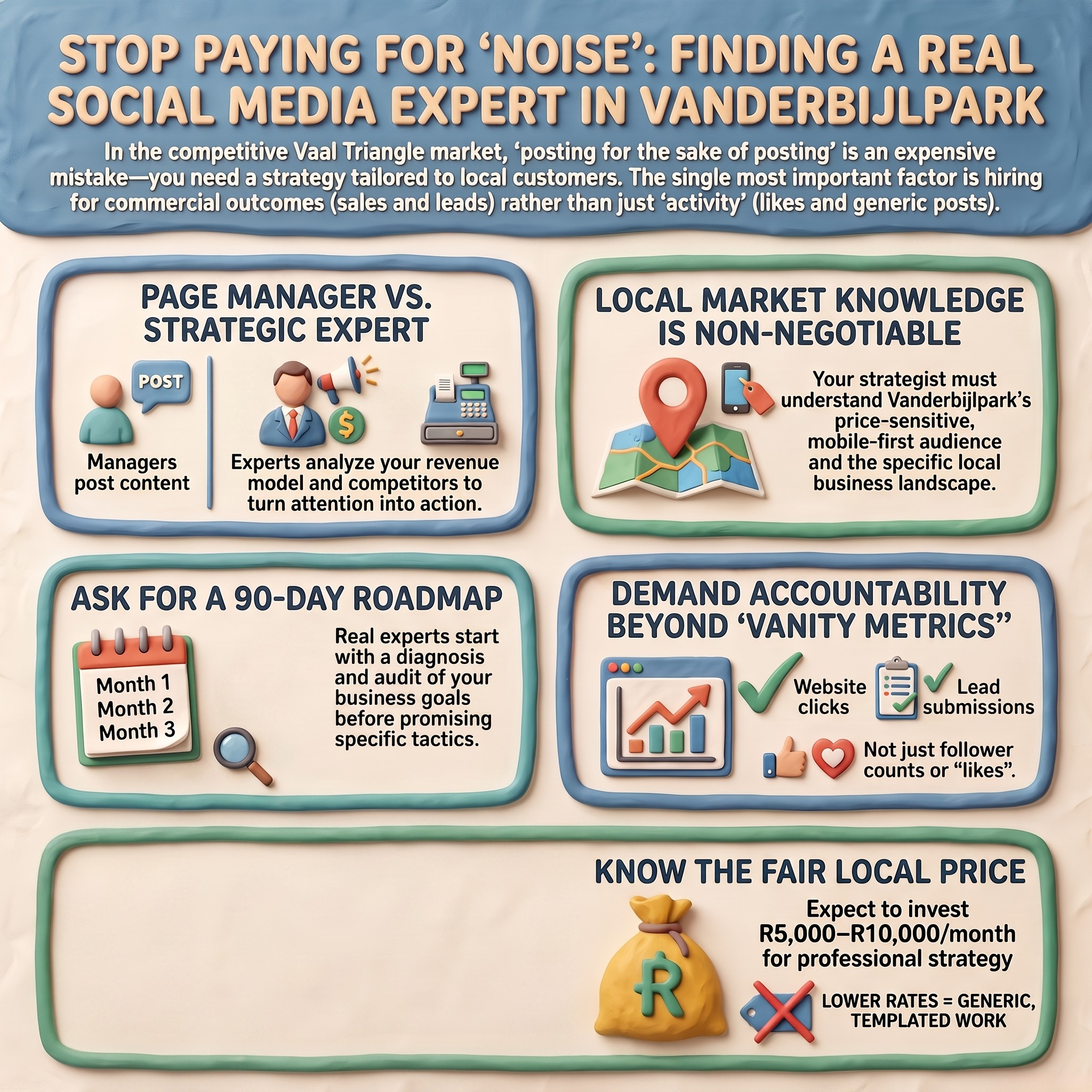
The Difference Between a Page Manager and a Social Media Marketing Expert
Let’s start with a blunt distinction.
A page manager posts content, responds to comments, and keeps your accounts active. They’re often skilled at design tools, they understand platform mechanics, and they’ll keep your feed looking professional.
A social media marketing expert does all of that—but starts three steps earlier. They ask what you’re trying to achieve, who you’re trying to reach, and how social media fits into your broader revenue model. They analyse your competitors’ presence in Vanderbijlpark and surrounding areas. They track what converts, not just what gets likes. And they adjust the strategy when the data tells them something isn’t working.
Both are valuable. But if you’re investing R5,000 to R15,000 a month (the typical range for local SME social media management in South Africa), you need the second one.
According to research from We Are Social and Meltwater, South Africa had 25 million active social media users as of early 2024—that’s over 40% of the population. Your customers are online. The question isn’t whether social media works; it’s whether the person running yours knows how to turn attention into action.
What Genuine Social Media Expertise Looks Like in a Vaal Triangle Context
Vanderbijlpark businesses face specific challenges that a Johannesburg or Cape Town agency might not immediately understand.
Your audience is often local and price-conscious. They’re comparing you to competitors they can see from the road. Many are mobile-first users dealing with data costs and inconsistent connectivity. And if you’re in retail, manufacturing support services, or hospitality, your revenue is closely tied to economic conditions in the Vaal Triangle—which means your marketing budget isn’t infinite.
An expert working in this context should demonstrate:
1. Local Market Knowledge
They should know the Vanderbijlpark business landscape. Who are your competitors? What’s working for similar businesses in Vereeniging, Sasolburg, or Meyerton? What community events, local partnerships, or Vaal-specific content opportunities exist?
If someone pitches you a strategy that could apply to any business anywhere, it’s a template. And templates don’t account for the fact that your customers have different concerns than someone shopping in Sandton.
2. Platform-Specific Strategy (Not Just Presence)
A common mistake: being on every platform because “that’s what businesses do.”
Facebook still dominates in South Africa—particularly among the 25-54 age group that makes up most local purchasing power. Instagram works for visually driven businesses (décor, food, retail). LinkedIn is essential if you’re B2B. TikTok is growing fast among younger demographics.
An expert should recommend where you should be active based on where your actual customers are—and be willing to say “you don’t need TikTok” if that’s true.
3. Content That Drives Commercial Outcomes
Engagement is nice. Sales are better.
Your social media content should do at least one of three things: build trust (testimonials, behind-the-scenes content, proof of expertise), drive action (promotions, lead magnets, event invitations), or support search and discovery (local SEO signals, tagged locations, keyword-rich captions).
If someone’s strategy is “post three times a week and see what happens,” they’re guessing. If they can explain why they’re recommending video testimonials from Vanderbijlpark clients, or how geotagged posts help you show up in local discovery, they’re thinking strategically.
4. Paid Social Understanding
Organic reach on Facebook has been declining for years. Meta’s algorithm prioritises paid content. If your social media expert doesn’t have experience running Facebook or Instagram ads—targeted to Vanderbijlpark and surrounding areas, optimised for mobile, and tracked for actual ROI—you’re missing half the toolbox.
South African businesses spent an estimated R6.79 billion on social media advertising in 2023, according to PwC’s Entertainment and Media Outlook. That money works when it’s targeted properly. It’s wasted when it’s boosted posts with no audience strategy.
The Questions That Reveal Whether Someone Actually Knows What They’re Doing
Here’s where you take control of the conversation. These questions separate strategists from page managers.
1. “Can you walk me through how you’d approach the first 90 days with my business?”
What you’re listening for: Do they start by asking you questions? Do they mention auditing your current presence, researching competitors, defining goals, and testing content approaches? Or do they jump straight to “we’ll post three times a week and run a giveaway”?
Strategy starts with diagnosis, not tactics.
2. “How do you decide what content to create?”
Red flag answer: “We’ll create a content calendar based on industry best practices.”
Good answer: “We’d start by understanding what questions your customers ask before they buy, what objections they have, and what your competitors are doing locally. Then we’d test different content types—educational posts, customer stories, product highlights—and double down on what drives engagement and inquiries.”
3. “How do you measure success, and how often will I see results?”
Red flag answer: Vague references to “growing your following” or “increasing engagement.”
Good answer: “We’ll track follower growth, engagement rate, website clicks, lead form submissions, and—if you have e-commerce—conversions. I’ll send you a monthly report that connects social activity to business outcomes. Some things, like audience growth, take 3-6 months. Others, like ad performance, we can optimise weekly.”
They should also acknowledge that social media is a long game. If someone promises 10,000 followers in 30 days, they’re either buying fake accounts or setting you up for disappointment.
4. “What happens if load shedding kills our posting schedule or a campaign tanks?”
This one’s South Africa-specific, but it reveals flexibility and contingency thinking.
Good answer: They have scheduling tools that post even during outages, backup content ready to go, and a process for pausing ad spend if something isn’t working. They should also be comfortable saying “we tried this, it didn’t work, here’s what we’re testing next.”
5. “Can you show me examples of work you’ve done for businesses similar to mine?”
You’re not looking for glossy case studies. You’re looking for evidence they’ve worked with local businesses, understand your audience, and can show results—not just pretty graphics.
If they can’t show you anything relevant, that’s not necessarily disqualifying (everyone starts somewhere), but it means you’re taking on more risk.

What Accountability Should Look Like
One of the biggest frustrations South African business owners express is paying for social media management and having no idea whether it’s working.
Here’s what accountability should look like from a social media marketing expert in Vanderbijlpark:
Monthly reporting that includes metrics you care about—not just vanity numbers. Leads generated, website traffic from social, conversion rates if you’re running ads.
Access to the accounts and ad manager. You’re paying for this work; you should own the assets and be able to see the backend.
Regular strategy check-ins (monthly or quarterly) where you review what’s working and adjust course if needed.
Transparency about ad spend. If they’re running Facebook or Instagram ads, you should see exactly where your money is going and what it’s returning.
If someone’s reluctant to share data, dodges questions about performance, or makes you feel like an inconvenience when you ask for clarification, that’s not a partnership. That’s a vendor hoping you won’t notice they’re underdelivering.
Red Flags That Should Make You Walk Away
Not everyone advertising themselves as a social media expert actually is one. Here are the warning signs:
- They guarantee specific follower numbers or viral posts. No one controls the algorithm. Promises like this are either naive or dishonest.
- They don’t ask about your business goals. If they pitch a package before understanding what you’re trying to achieve, they’re selling a product, not a strategy.
- Their own social media presence is a mess. If they can’t manage their own accounts professionally, how will they manage yours?
- They talk in jargon without explaining it. Expertise means being able to simplify complexity, not hide behind buzzwords.
- They’re not willing to sign a contract or provide references. Professionalism matters. Handshake deals are risky when money and your business reputation are on the line.

What Fair Pricing Looks Like in the South African Market
Budget is always a concern, especially in the current economy. So what should you expect to pay for social media management in Vanderbijlpark?
Here’s the realistic range for 2024-2026:
R2,500–R5,000/month: Basic page management—content creation and posting, community management, no ads. Suitable for very small businesses or startups testing the waters.
R5,000–R10,000/month: Strategic management—custom content, audience research, monthly reporting, light ad management. This is the sweet spot for most local SMEs.
R10,000–R20,000/month: Comprehensive service—multi-platform management, ad campaign optimisation, advanced analytics, content production (video, graphics). Best for businesses with significant online revenue or competitive markets.
Ad spend: Separate from management fees. You should budget at least R1,500–R3,000/month for Facebook/Instagram ads if you want meaningful reach.
If someone’s charging R1,500/month, they’re either using templates, outsourcing to cheap labour, or can’t afford to spend the time your account needs. If someone’s charging R25,000/month for a local Vanderbijlpark business, they’re likely overpriced unless you’re running a multi-location operation.
Why This Matters More Than Ever for Vanderbijlpark Businesses
South Africa’s digital economy is growing, but it’s also getting noisier. According to Statista, the average South African internet user spent 3 hours and 41 minutes per day on social media in 2023—more than the global average.
Your customers are scrolling. Your competitors are posting. And if your social media presence is an afterthought—or worse, actively unprofessional—you’re losing business to someone who figured this out before you did.
But here’s the good news: most of your local competitors are still doing this badly. They’re posting sporadically, ignoring comments, running ads with no targeting, or not on social media at all.
Which means hiring a genuine social media marketing expert in Vanderbijlpark—someone who understands strategy, knows the local market, and can connect your online presence to your bottom line—is still a competitive advantage.
You just need to know what to look for. And now you do.
Frequently Asked Questions
Q: How long does it take to see results from social media marketing?
A: It depends on what you’re measuring. Paid ads can drive traffic and leads within days. Organic growth—building an engaged audience—typically takes 3-6 months of consistent, strategic posting. Anyone promising overnight success is overselling.
Q: Do I need to be on every social media platform?
A: No. It’s better to do one or two platforms well than to spread yourself thin. For most Vanderbijlpark businesses, Facebook is essential. Instagram works if your business is visual. LinkedIn matters for B2B. Choose based on where your customers actually spend time.
Q: What’s the difference between boosting a post and running a proper Facebook ad?
A: Boosting is quick but limited—you’re amplifying an existing post with basic targeting. A proper ad campaign uses Facebook Ads Manager, allows detailed audience segmentation (location, age, interests, behaviour), and includes conversion tracking. Boosting occasionally is fine; relying on it exclusively leaves money on the table.
Q: Should I hire someone local or work with an agency in Johannesburg?
A: Both can work, but local has advantages: they understand the Vanderbijlpark market, can meet in person, and often have better responsiveness. A Joburg agency might have more resources but may not grasp the nuances of your specific community. Ask about local experience regardless of where they’re based.
Q: Can I do social media marketing myself, or do I need to hire someone?
A: You can do it yourself if you have the time and willingness to learn. Many small businesses start that way. But as you grow, your time becomes more valuable spent running the business. Hiring an expert makes sense when the opportunity cost of doing it yourself exceeds the cost of hiring someone who’ll do it better and faster.
If you’re a Vanderbijlpark business owner tired of social media that looks busy but delivers nothing, let’s have a conversation. Thickrope Marketing works with Vaal Triangle businesses to build social media strategies that actually connect to revenue—no fluff, no templates, just practical marketing that works in the real South African economy. [Get in touch for a free consultation].