

SaaS and B2B: Why the Hard Sell Is Actually the Better Deal
If you’re selling B2B SaaS in South Africa, you’ve probably already realised that closing a deal feels less like a sprint and more like the Comrades Marathon — uphill, with multiple checkpoints, and at least three people questioning whether you’ve trained enough.
Unlike consumer software where someone downloads your app on a whim (usually while waiting for load shedding to end), B2B SaaS sales involve procurement managers, IT directors, finance teams, and at least one person who still prefers Excel because “it works fine.” Your sales cycle isn’t measured in days. It’s measured in follow-up emails, demos that get rescheduled, and stakeholder meetings where you’re not even invited.
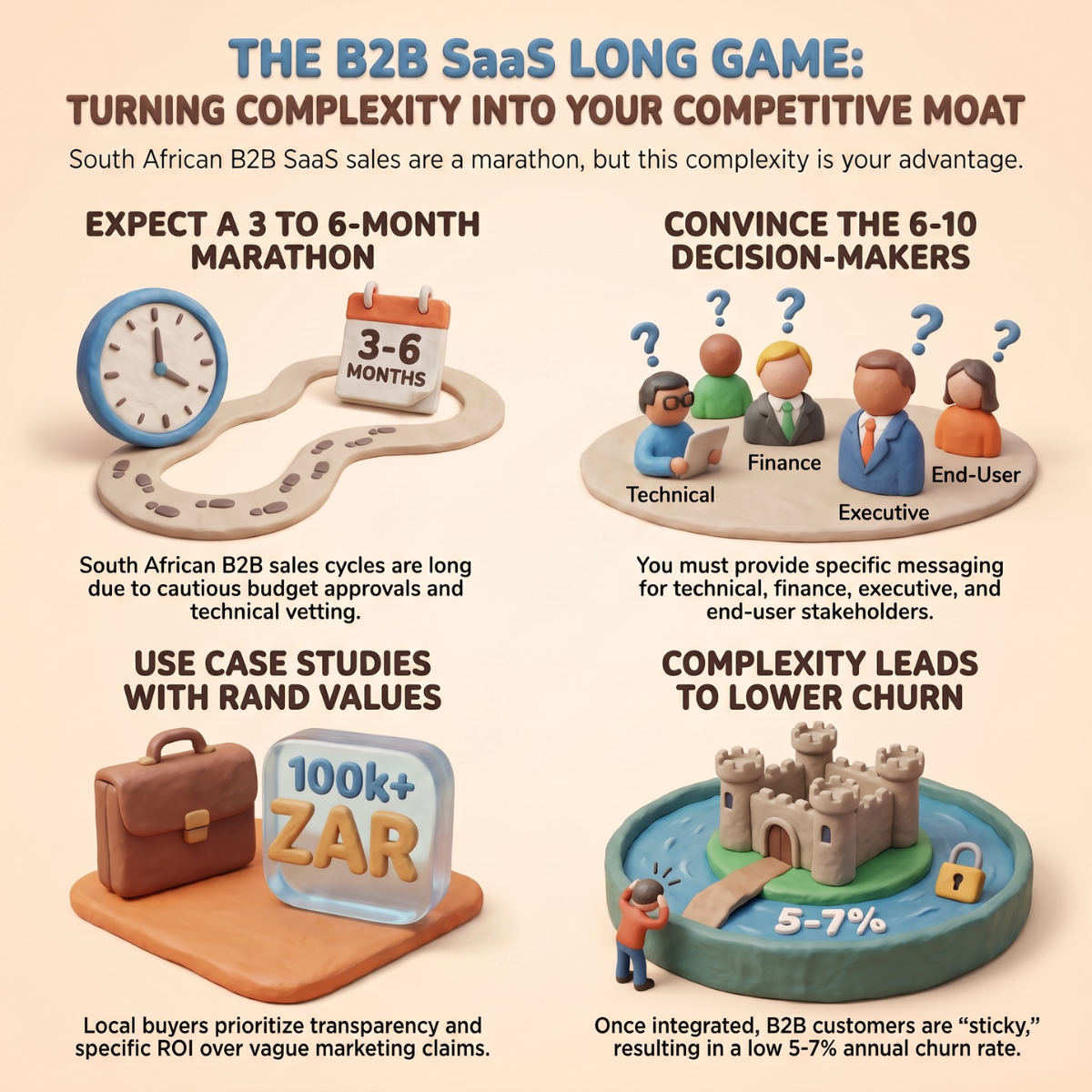
But here’s the thing: this complexity isn’t a bug. It’s a feature. And if you market your B2B SaaS correctly, those long sales cycles translate into higher contract values, lower churn rates, and customers who stick around because switching would require another six-month procurement process that nobody wants to endure.
Let’s talk about how to turn the messy, stakeholder-heavy, committee-driven reality of B2B SaaS sales into your competitive moat.
Why B2B SaaS Marketing Is a Different Animal
According to research from SaaS Capital, the average B2B SaaS company has a sales cycle of around 84 days — nearly three months from first contact to signed contract. In South Africa, where budget approvals often coincide with financial year-ends and economic uncertainty makes CFOs extra cautious, that timeline can stretch even longer.
This isn’t B2C, where someone sees an Instagram ad, clicks, and subscribes during lunch. B2B buyers are committing company resources, integrating your software into existing workflows, and quite possibly putting their own reputations on the line if your product doesn’t deliver.
Your marketing can’t just convince one person. It needs to educate the technical team, reassure the finance department, demonstrate ROI to executives, and provide enough social proof that the decision-maker doesn’t lose sleep wondering if they’ve backed the wrong horse.
Multiple Stakeholders Mean Multiple Messages
A typical B2B SaaS purchase involves 6-10 decision-makers, according to Gartner research. Each one has different priorities:
- The technical team wants to know about integrations, security protocols, API documentation, and whether your platform will play nicely with their existing tech stack (which, let’s be honest, is probably held together with duct tape and prayer).
- The finance team wants clear pricing, contract flexibility, and proof that your solution will either save money or generate enough value to justify the expense — preferably with a spreadsheet they can take to the CFO.
- The executive sponsor wants strategic alignment, measurable business outcomes, and confidence that this won’t turn into a failed implementation that ends up on the “what were we thinking” pile.
- The end users just want something that actually works and won’t require a three-day training course to figure out.
Your marketing content needs to speak to all of them. Not in a scattergun “something for everyone” way, but with deliberate, targeted messaging that meets each stakeholder where they live.

Content Is Your Sales Team’s Best Friend
In B2B SaaS, content marketing isn’t fluffy brand-building. It’s the scaffolding that supports your entire sales process.
According to Demand Gen Report, 96% of B2B buyers want content with more input from industry thought leaders — not just promotional material. They’re doing research before they ever fill out a contact form. They’re reading case studies, comparing features, downloading whitepapers, and lurking on your website long before they’re ready to book a demo.
This is especially true in South Africa, where business owners are cautious with budgets and want to feel confident before committing. They’re not impulse buyers. They’re researchers.
The Content You Actually Need
Forget the blog post about “5 Tips for Productivity” that could apply to literally any business. Here’s what B2B SaaS buyers are actually looking for:
Case studies with real numbers. Not “Company X improved efficiency,” but “Company X reduced invoice processing time by 40%, saving 15 hours per week and R80,000 annually.” South African businesses respond to specifics, especially when those specifics include rand values they can relate to.
Comparison guides. Your prospects are already comparing you to competitors. Write the comparison yourself — honestly. Acknowledge where competitors might have an edge, then clearly articulate where you win. It builds trust and positions you as the confident choice.
Technical documentation that doesn’t require a computer science degree. If your target includes non-technical decision-makers (and it should), your documentation needs to be accessible. Explain integrations, security, and technical capabilities in plain language.
ROI calculators and pricing transparency. Nothing kills momentum like “contact us for pricing.” If your pricing is genuinely custom, at least provide ranges or a calculator that lets prospects ballpark the investment. South African businesses are allergic to hidden costs — we’ve all been burned by “setup fees” and “implementation charges” that mysteriously appear later.
Webinars and demos on-demand. Not everyone wants to sit through a live presentation at a time that suits your sales team. Record your demos, make them accessible, and let prospects self-educate at their own pace — even if that pace is 11 PM on a Sunday when they’ve finally got time to think.
Account-Based Marketing: When and Why It Matters
Account-Based Marketing (ABM) has become something of a buzzword in B2B circles. The basic idea: instead of casting a wide net, you identify high-value target accounts and create personalised campaigns specifically for them.
For B2B SaaS companies in South Africa, ABM makes sense when you’re targeting enterprise clients or specific industries. If your ideal customer list includes the JSE-listed companies, major retailers, or government entities, ABM lets you focus resources where they’ll have the most impact.
But here’s what ABM isn’t: a magic solution that works for everyone. If you’re an early-stage SaaS company still figuring out product-market fit, or if your sweet spot is SMEs rather than enterprise, traditional demand generation — building awareness, nurturing leads, optimising your funnel — is probably more effective than white-glove ABM campaigns.
Where ABM Fits in the South African Context
ABM works best when:
- Your deal sizes are large enough to justify the investment. Personalised campaigns for R10,000 annual contracts don’t make financial sense. Campaigns for R500,000+ enterprise deals absolutely do.
- You’re targeting a defined list of companies. If you can literally name the 50-100 companies you want as clients, ABM gives you a framework to pursue them systematically.
- You have sales and marketing alignment. ABM falls apart if your sales team isn’t looped in. They need to know which accounts you’re targeting, what messaging you’re using, and when to follow up on engagement signals.
In practice, many South African B2B SaaS companies find success with a hybrid approach: broad demand generation to fill the top of the funnel, with ABM tactics reserved for high-value accounts that show buying signals.

The Trust Factor: Why Reputation Matters More in B2B
Consumer products can recover from bad reviews. B2B SaaS products? Not so easily. When a business commits to your software, they’re not just spending money — they’re investing time in implementation, training, and workflow changes. If it doesn’t work out, the cost isn’t just financial. It’s operational disruption, frustrated employees, and a decision-maker who now has to explain why this failed.
That’s why trust-building is non-negotiable in B2B SaaS marketing.
Social proof is currency. Testimonials, case studies, client logos, and third-party reviews (G2, Capterra, etc.) all signal that other businesses have taken the risk and lived to tell the tale. In South Africa, where business networks are tight and word-of-mouth carries weight, a referral from a trusted peer is worth more than any ad campaign.
Thought leadership builds credibility. When your team publishes genuinely useful insights — not just promotional content disguised as advice — you position your company as experts who understand the problems your prospects face. That credibility becomes a differentiator when you’re up against competitors with similar features.
Transparency reduces friction. Be upfront about limitations, pricing, implementation timelines, and what success realistically looks like. South African business owners have good bullshit detectors. Overpromising might get you the meeting, but it won’t get you the renewal.
Measuring What Actually Matters
B2B SaaS marketing requires patience, but it shouldn’t require blind faith. The metrics that matter aren’t vanity numbers like website traffic or social media followers. They’re the indicators that actually connect to revenue.
Pipeline contribution. How much of your sales pipeline originated from marketing efforts? Track this by source — organic search, paid ads, content downloads, webinar attendees — so you know what’s actually working.
Cost per acquisition (CPA) by channel. Not all leads are created equal. A lead from a targeted LinkedIn campaign might cost more upfront but convert at a higher rate and deliver better long-term value than a cheap but unqualified lead from a generic ad.
Time to close by source. Some marketing channels attract prospects who are further along in their buying journey. If webinar attendees close 30 days faster than cold outbound leads, that’s valuable intelligence for how you allocate resources.
Customer lifetime value (LTV) relative to acquisition cost. According to research from ProfitWell, B2B SaaS companies should aim for an LTV to CAC ratio of at least 3:1. Anything lower and you’re spending too much to acquire customers who don’t stick around long enough to be profitable.
In South Africa, where marketing budgets are often tight and every rand needs to justify itself, these metrics aren’t academic exercises. They’re the difference between marketing that’s seen as a cost centre and marketing that’s recognised as a revenue driver.

Embracing Complexity as Competitive Advantage
Here’s the uncomfortable truth: B2B SaaS sales are hard. The cycles are long. The stakeholders are many. The objections are real, and the competition is fierce.
But that difficulty is precisely what makes it valuable.
Every friction point in your sales process — every stakeholder meeting, every security questionnaire, every procurement hoop — is a barrier that keeps out competitors who aren’t willing to do the work. When you invest in marketing that educates, builds trust, and supports a complex buying journey, you’re not just closing deals. You’re building relationships that are harder for competitors to disrupt.
B2C SaaS customers can churn on a whim. B2B customers who’ve gone through a six-month evaluation, integrated your software into their operations, and trained their teams? They’re sticky. According to research from Totango, B2B SaaS companies typically see annual churn rates between 5-7% — significantly lower than consumer subscription products.
That stickiness translates to predictable revenue, better unit economics, and the kind of customer relationships that generate referrals, case studies, and expansion opportunities.
The businesses that win in B2B SaaS aren’t the ones trying to simplify or shortcut the complexity. They’re the ones who embrace it, market through it, and turn a difficult sales process into a moat that competitors can’t easily cross.
Frequently Asked Questions
Q: How long should I expect a B2B SaaS sales cycle to take in South Africa?
A: Realistically, 3-6 months for mid-market deals, and 6-12 months for enterprise. Budget approval processes, especially around financial year-ends, can add time. Build your marketing and cash flow planning around these timelines, not wishful thinking.
Q: Is account-based marketing worth it for smaller B2B SaaS companies?
A: Only if you’re targeting high-value accounts with deal sizes that justify the investment. If you’re still figuring out product-market fit or targeting SMEs, focus on demand generation first. ABM works best when you have a defined list of dream clients and the resources to pursue them properly.
Q: What’s the most important metric to track for B2B SaaS marketing?
A: Pipeline contribution — how much qualified pipeline your marketing is generating. Vanity metrics like traffic and impressions don’t pay the bills. Focus on metrics that connect directly to revenue: lead quality, conversion rates, and customer acquisition cost relative to lifetime value.
Q: How do I create content that appeals to both technical and non-technical buyers?
A: Layer your content. Start with business outcomes and strategic value (for executives), then provide technical depth for those who want it (in separate sections, FAQs, or linked resources). Don’t force the CFO to wade through API documentation, but make sure your tech team can find the details they need to evaluate feasibility.
If you’re marketing B2B SaaS and wrestling with long sales cycles, multiple stakeholders, and the challenge of standing out in a crowded market, we’ve been in those trenches. At Thickrope Marketing, we specialise in the kind of strategic, patient, ROI-focused marketing that actually works for complex B2B sales. Let’s talk about what’s working, what’s not, and how to build a marketing engine that supports your sales team instead of just generating noise. [Get in touch for a free consultation](https://thickrope.co.za/contact).