

Ecommerce Marketing in South Africa: Strategies Built for the Local Market
Running an ecommerce business in South Africa isn’t for the faint-hearted. You’re competing against global giants with bottomless budgets, battling delivery delays caused by infrastructure challenges, and trying to convert customers who’ve been burned by dodgy online sellers one too many times. Oh, and you need to do all of this while the lights are off.
Welcome to ecommerce marketing in South Africa — where international best practices meet local reality, and only the strategies that account for both actually deliver results.
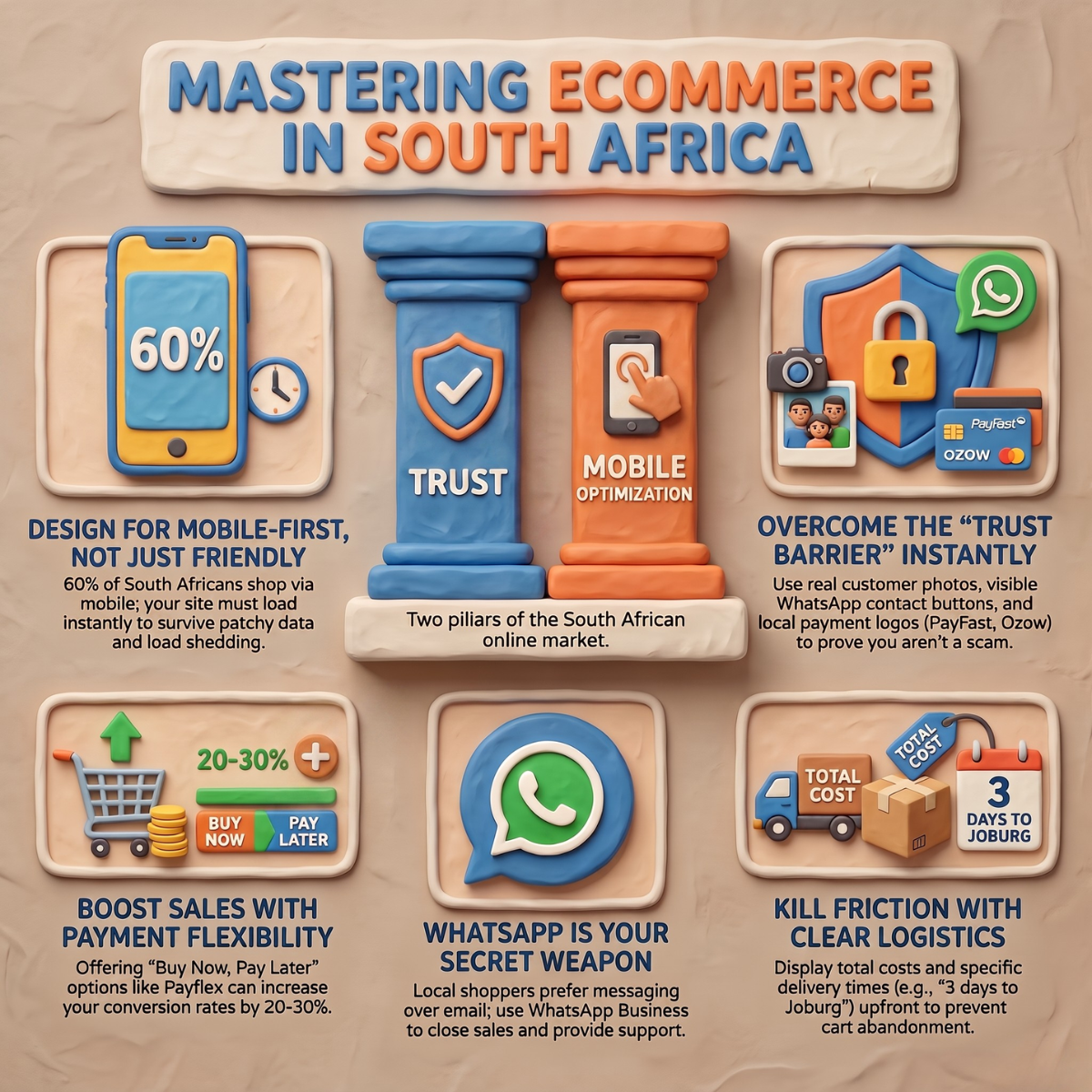
This isn’t another generic guide rehashed from a US marketing blog. This is about the channels, tactics, and conversion strategies that work here — in a market where 60% of online shopping happens on mobile devices, where cash-on-delivery still matters, and where building trust isn’t a nice-to-have, it’s your entire foundation.
The South African Ecommerce Landscape: What Makes It Different
Before we dive into tactics, let’s acknowledge what you’re working with.
South Africa’s ecommerce market has grown significantly — revenue hit approximately R50 billion in 2023, with projections suggesting it could reach R100 billion by 2028. That’s promising. But it’s also a market where consumer trust remains fragile, where logistics can make or break you, and where payment friction kills conversions faster than a Stage 6 announcement kills your productivity.
Mobile dominates everything. According to StatsSA’s data on internet usage patterns, roughly 60% of South Africans access the internet primarily via mobile devices. Your ecommerce marketing strategy needs to be mobile-first, not mobile-friendly. There’s a difference — one means it works on phones, the other means you designed for phones and adapted for desktop.
Trust barriers are real. South African consumers are cautious online shoppers, and for good reason. Scams, delivery failures, and payment security concerns mean your marketing needs to address trust *before* it addresses features or pricing.
Load shedding changed shopping behaviour. When the power’s out, people shop on their phones using mobile data. Your site speed, mobile checkout flow, and data usage all matter more than they would in markets with stable electricity.
These aren’t obstacles to complain about — they’re the playing field. And if you design your ecommerce marketing around them, you’ll outperform competitors who are still copying strategies from overseas blogs.

Building the Foundation: Trust and Technical Performance
You can’t market your way out of a broken foundation. Before you spend a cent on ads or content, two things need to be sorted.
Trust Signals That Actually Work in SA
South African online shoppers need reassurance. If your site looks like it was built in 2009 or if there’s no evidence that real people buy from you, you’re fighting an uphill battle.
Here’s what moves the needle:
Customer reviews and testimonials — with photos. Not fabricated ones. Real customers, real names (or first names if privacy is a concern), real feedback. Bonus points if they mention delivery times or product quality, because those are the concerns keeping people awake at night.
Visible contact details. Phone number in the header. Physical address if you have one. WhatsApp Business integration if possible — because many South Africans would rather message than call or email.
Clear delivery and returns policies. Not buried in the footer. Right there on product pages. If you offer cash-on-delivery or Payflex/PayJustNow options, make it visible. These payment methods reduce friction for trust-wary buyers.
Security badges and payment icons. Yupii, PayFast, Peach Payments, Ozow — whichever gateway you use, show the logos. Display SSL certificates. These signals matter more here than in markets where online trust is assumed.
Site Speed and Mobile Performance
Google’s research consistently shows that 53% of mobile users abandon sites that take longer than three seconds to load. In South Africa, where network conditions can be patchy and data costs still matter, this number is probably higher.
Your ecommerce marketing will fail if it drives traffic to a slow site. Full stop.
Optimise images ruthlessly. Product photos need to look good, but a 3MB hero image is a conversion killer on mobile data.
Simplify your checkout flow. Every additional step or form field costs you customers. Aim for three steps maximum: cart review, delivery details, payment. If you can do it in two, even better.
Test on a throttled connection. Don’t just check your site on office Wi-Fi. Test it on a 3G connection, because that’s the reality for a significant portion of your potential customers.
Channel Strategy: Where to Focus Your Efforts
Not all marketing channels deliver equal results in the South African ecommerce context. Here’s where your time and budget should go.
Google Ads: Still the Heavyweight
When South Africans want to buy something online, they Google it. Google Shopping campaigns and search ads remain the highest-intent channels for ecommerce.
But you need to approach them with local nuance:
Bid on delivery-related keywords. “Free delivery Johannesburg,” “same-day delivery Cape Town,” “shipping to Durban” — these searches indicate buyers who are ready to purchase but concerned about logistics. If you can solve their delivery concerns, you’ll convert them.
Use location targeting intelligently. Don’t blow your budget on areas you can’t deliver to efficiently. Tighten your geographic targeting to major metros or areas where your logistics partner performs reliably.
Create mobile-specific landing pages. Your Google Ads shouldn’t send mobile users to your desktop homepage. Create landing pages designed for thumb-friendly navigation and fast loading.
Facebook and Instagram: The Window Shoppers’ Playground
Social media marketing for ecommerce in South Africa isn’t about going viral — it’s about consistent visibility and social proof.
Facebook and Instagram users here aren’t necessarily in buying mode when they open the app, but they’re open to discovering products if you present them well.
User-generated content beats studio photography. Show real customers using your products. Repost their content (with permission). South African buyers trust other South Africans more than they trust polished brand messaging.
Use Facebook Marketplace strategically. It’s not just for second-hand goods. Many SA consumers browse Marketplace when looking for products, and listing there (if your business model allows) can capture buyers who wouldn’t otherwise find you.
WhatsApp-first customer service. Link your ads and posts to WhatsApp Business. Many South Africans prefer messaging to phone calls or forms, and it creates a more personal connection that builds trust.
Email Marketing: The Underrated Revenue Driver
Email marketing works exceptionally well for South African ecommerce businesses, largely because it’s a channel you own. You’re not at the mercy of algorithm changes or rising ad costs.
According to various industry studies, email marketing delivers an average ROI of R38 for every R1 spent — higher than almost any paid channel. But most SA ecommerce stores do it badly or not at all.
Segment ruthlessly. Don’t send the same message to first-time browsers and repeat customers. Create separate flows for abandoned carts (massive opportunity), post-purchase follow-ups, and re-engagement.
Localise your send times. Schedule emails for when South Africans are actually checking their inboxes — typically early morning (before work) or evening (after dinner). Avoid public holidays and long weekends when people are less likely to be online.
Make your emails load quickly. Heavy HTML emails with large images will frustrate mobile users on data. Keep them lean, text-focused, and with clear calls to action.
Content Marketing and SEO: The Long Game
If you’re only doing paid advertising, you’re renting attention. SEO and content marketing let you own it.
South African ecommerce businesses often neglect content because it doesn’t deliver instant results. But if you’re planning to be in business in 12 months (and you should be), it’s one of the best investments you can make.
Create buying guides for your product categories. “How to choose the right running shoes for trail running in SA conditions” will attract ready-to-buy traffic for years.
Answer the questions your customers actually ask. Monitor your customer service channels and turn repeated questions into blog content. If ten people ask about delivery times to Mpumalanga, that’s a content opportunity.
Optimise product pages properly. Unique descriptions (not copy-pasted from suppliers), customer reviews, clear specifications, and delivery information. These aren’t just conversion elements — they’re SEO elements.

Conversion Optimisation: Turning Traffic Into Customers
Getting traffic to your site is only half the battle. South African ecommerce conversion rates tend to sit around 1-2% on average — meaning 98 out of 100 visitors leave without buying.
Small improvements in conversion rate have exponential impacts on revenue, especially since you’ve already paid to get that traffic.
Reduce Checkout Friction
Every additional click, field, or decision point in your checkout process costs you sales.
Offer guest checkout. Forcing account creation before purchase is a conversion killer. Let people buy first, create an account later.
Display all costs upfront. Hidden delivery charges revealed at checkout are one of the primary reasons for cart abandonment in SA. Show the total cost (including delivery) as early as possible.
Provide multiple payment options. Credit card, EFT, cash-on-delivery, PayFlex, Mobicred — the more options you offer, the more barriers you remove. According to payment industry data, offering buy-now-pay-later options can increase conversion rates by 20-30% in the South African market.
Use Urgency and Scarcity (Honestly)
Genuine urgency works. Fake urgency damages trust.
If you have limited stock, say so. If a sale genuinely ends on Sunday, communicate that. But don’t run a “24-hour flash sale” every week for six months — South African consumers aren’t stupid, and once you’ve lost trust, it’s nearly impossible to rebuild.
Abandoned Cart Recovery
Between 60-80% of online shopping carts are abandoned before purchase. That’s not unique to South Africa, but the reasons often are — unexpected delivery costs, payment security concerns, or simply being interrupted by load shedding.
Set up automated cart recovery emails. Send the first one within an hour, the second after 24 hours, the third after 72 hours. Include product images, a direct link back to the cart, and consider offering a small incentive (free delivery, 10% off) in the final email.
Use retargeting ads strategically. Facebook and Google retargeting can remind cart abandoners what they left behind. But be careful not to stalk them across the internet — frequency capping matters.
Logistics and Fulfilment: The Silent Conversion Killer
You can have the best ecommerce marketing in South Africa, but if your delivery experience is terrible, you won’t get repeat customers or referrals.
Be honest about delivery times. If it takes five business days to deliver to Port Elizabeth, say so upfront. Under-promising and over-delivering builds trust. The opposite destroys it.
Offer tracking. This should be non-negotiable. South African customers want to know where their parcel is, especially given the challenges with courier services in some areas.
Communicate proactively. If there’s a delay, tell the customer before they have to chase you. A simple SMS or email explaining a delay and providing a new estimate maintains goodwill.

Measuring What Matters
Ecommerce marketing without analytics is just guessing with a credit card.
Track these metrics religiously:
Customer Acquisition Cost (CAC) by channel. How much does it cost you to acquire a customer through Google Ads versus Facebook versus email? This tells you where to allocate budget.
Lifetime Value (LTV). What’s a customer worth over 12 months, not just their first purchase? If your LTV is R2,000 and your CAC is R200, you can afford to be aggressive with marketing spend.
Conversion rate by device. If your mobile conversion rate is half your desktop rate, you have a mobile experience problem, not a traffic quality problem.
Cart abandonment rate. A rate above 70% suggests friction in your checkout process that needs immediate attention.
The Reality Check: What Ecommerce Marketing in South Africa Actually Costs
Let’s talk money, because budget is reality for most SA businesses.
A functional ecommerce marketing strategy — one that includes Google Ads, social media advertising, email marketing, and basic SEO — typically requires between R15,000 and R50,000 per month, depending on your product category, competition, and growth goals.
That’s not pocket change, but it’s also not a luxury expense. It’s the operating cost of running a modern retail business. The alternative — relying on word-of-mouth and hoping customers find you — isn’t a strategy, it’s a risk.
If you’re doing it yourself, expect to invest 20-30 hours per week learning, implementing, testing, and optimising. If you’re hiring help, whether freelancers or an agency, vet them on their South African ecommerce experience specifically — not just their ability to run Facebook ads.
Frequently Asked Questions
Q: Should I focus on Facebook or Google Ads for my South African ecommerce store?
A: Google Ads typically deliver higher-intent traffic because people are actively searching for products. Facebook and Instagram are better for discovery and building awareness. Most successful SA ecommerce businesses use both, but if you’re starting with a limited budget, begin with Google Shopping campaigns and expand from there.
Q: How important is WhatsApp Business for ecommerce in South Africa?
A: Extremely. WhatsApp is the preferred communication channel for many South African consumers. Integrating WhatsApp Business allows customers to ask questions, confirm orders, and get support in a format they’re comfortable with. It also builds trust faster than email or contact forms. Enable the WhatsApp click-to-chat feature on your product pages.
Q: What’s a realistic timeframe to see results from ecommerce marketing in South Africa?
A: Paid advertising (Google Ads, Facebook Ads) can generate results within days, though optimisation takes 4-8 weeks. Email marketing shows ROI within the first month if you have a decent subscriber list. SEO and content marketing require 3-6 months before meaningful organic traffic arrives. Plan for the long term, but expect early indicators within 30-60 days.
Q: Do buy-now-pay-later options really improve conversion rates?
A: Yes, significantly. Payment flexibility options like PayFlex, Payflex, or Mobicred reduce the psychological barrier of upfront payment and make higher-ticket items accessible to more buyers. South African payment industry data suggests these options can increase conversion rates by 20-30% and boost average order values, particularly for purchases above R1,000.
Q: How do I handle delivery challenges in my marketing messaging?
A: Be upfront and specific. Instead of vague promises, state exact delivery times by region: “3-5 business days to major metros, 5-7 days to regional areas.” If you offer tracking, say so. If there are known delays due to courier issues or high demand periods, communicate that. South African customers appreciate honesty far more than unrealistic promises.
If your ecommerce marketing feels like you’re throwing money at a problem without seeing consistent returns, or if you’re doing bits and pieces without a cohesive strategy, let’s have a conversation. Thickrope Marketing works with South African ecommerce businesses to build marketing systems that account for local realities and deliver measurable growth. [Book a free 30-minute strategy session](https://thickrope.co.za/contact) and let’s see where the gaps are.