

How to Build a SaaS Marketing Strategy That Drives Compounding Growth
You’ve probably been there: fired up about your SaaS product, convinced it solves a real problem, and absolutely hemorrhaging cash on Facebook ads that deliver single-digit conversions. Or perhaps you’ve watched your PPC budget evaporate faster than water in a Cape Town drought, with nothing to show but a handful of free trial sign-ups who ghosted you after day three.
Here’s the thing most SA SaaS founders learn the hard way: tactics without strategy is just expensive noise. And in our market — where bandwidth costs actual money, where your customers are comparing your subscription price to their electricity bill, and where trust takes time to build — you need a marketing approach that compounds over time rather than requiring constant cash injections to stay alive.
This isn’t about growth hacking your way to overnight success. It’s about building a system that gets more effective, more efficient, and more profitable the longer it runs. Let’s dig into how.
Why SaaS Marketing in SA Is Different (And Why That Matters)
Before we get into the framework, let’s acknowledge the elephant in the room: most SaaS marketing advice comes from Silicon Valley types who’ve never had to explain why their software costs $49/month when that’s two weeks’ worth of groceries for many South Africans.
Your market is sophisticated but skeptical. Mobile-first but data-conscious. Ready to adopt new tech but burnt by platforms that promised the world and delivered a laggy dashboard that doesn’t load during load shedding.
According to World Wide Worx, South Africa’s SaaS market grew by 32% in 2024, but churn rates remain higher than global averages — largely due to pricing sensitivity and competition from international players offering rand-denominated pricing. Your marketing strategy needs to acknowledge this reality, not pretend it doesn’t exist.
The Compounding Marketing Framework: Five Layers That Build On Each Other
Layer 1: Get Your Positioning and ICP Properly Sorted
You can’t market to everyone, and in SA, you especially can’t afford to. Trying to serve both enterprise and SME simultaneously usually means you end up serving neither particularly well.
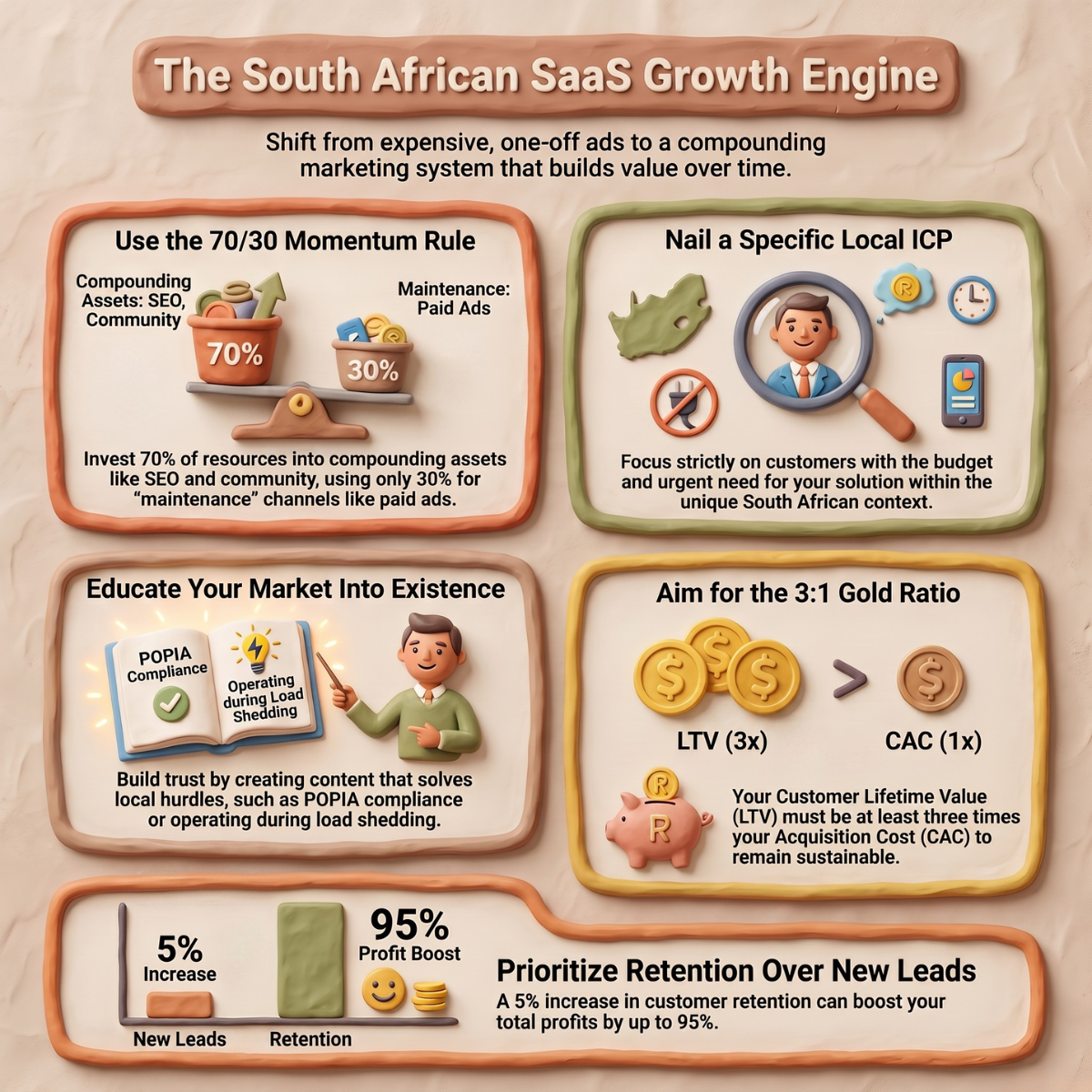
Your Ideal Customer Profile (ICP) isn’t just “businesses that need our software.” It’s a specific profile of companies that have:
- The budget to pay for your solution consistently
- The problem your software solves in an acute, urgent way
- The technical capability to adopt and use your product
- The authority to make purchasing decisions relatively quickly
For a project management SaaS, your ICP might be “Cape Town-based creative agencies with 10-50 staff, currently using a mix of email and spreadsheets, experiencing project delays that cost them client relationships.”
Get specific. Then build your positioning around why you’re the obvious choice for that exact person.
Positioning isn’t what you say about yourself — it’s the mental real estate you occupy in your customer’s mind. Are you the affordable alternative to international giants? The only solution built specifically for SA compliance requirements? The simple option when everything else feels bloated?
Write it down. One sentence. Then make sure every piece of content, every ad, every sales conversation reinforces that singular idea.
Layer 2: Build Your Channel Mix for Momentum, Not Just Volume
Here’s where most SaaS founders mess it up: they chase every channel simultaneously, spreading their budget and attention so thin that nothing gets proper traction.
Instead, think in terms of momentum channels vs. maintenance channels.
Momentum channels compound over time. Each unit of effort produces more returns than the previous one:
- SEO and content marketing: Every quality article you publish continues attracting traffic months and years later. HubSpot reports that 75% of their blog views come from posts published months or even years ago. That’s compounding.
- Product-led content: Tools, calculators, templates that rank in Google and naturally demonstrate your product’s value
- Community building: Whether it’s a Slack group, LinkedIn community, or regular webinars — each member makes the community more valuable to the next
Maintenance channels require ongoing spend to maintain results:
- Paid search and social ads: Turn off the tap, traffic stops
- Sponsored content: Pays off once, then it’s done
- Paid partnerships: Effective but not compounding
You need both, but the ratio matters enormously. A sustainable SaaS marketing strategy allocates 60-70% of resources to momentum channels and 30-40% to maintenance channels. Early stage, you might need more paid activity to generate initial traction, but the goal is always to shift toward compounding assets.
Layer 3: Content Strategy That Educates Your Market Into Existence
If you’re selling something genuinely new, your biggest competitor isn’t another SaaS platform — it’s the spreadsheet, the manual process, the “we’ve always done it this way” inertia.
Your content strategy needs to do three jobs simultaneously:
Job 1: Create category awareness
Most of your potential customers don’t yet know they have the problem you solve, or they don’t know solutions exist. Content at this stage answers questions like:
- “Why manual invoicing is costing SA businesses more than they think”
- “The hidden cost of project delays (and how to measure it)”
Job 2: Build trust and authority
Once they know the problem exists, they need to believe you understand their world. This is where SA-specific context becomes your unfair advantage:
- “How to choose accounting software that works offline during load shedding”
- “POPIA compliance for SaaS platforms: what SA businesses actually need to know”
Job 3: Demonstrate product value without being salesy
Use case studies, comparison guides, implementation roadmaps. Show, don’t just tell.
According to Demand Gen Report, 96% of B2B buyers want content with more input from industry thought leaders, and 67% rely more on content to research and make purchasing decisions than they did a year ago. Your content isn’t marketing fluff — it’s how buyers decide whether you’re worth their money.
The key is to create content that serves readers whether they buy from you or not. That builds actual trust, not just SEO rankings.
Layer 4: Product-Led Growth Loops (Your Marketing’s Secret Multiplier)
Here’s where SaaS marketing gets properly interesting: your product can do marketing work for you, if you design it that way.
A growth loop is a system where each action a user takes makes the product more valuable and/or attracts more users. Think about:
Viral loops: Every report your user generates includes “Created with [Your Product]” branding that introduces new potential customers to your solution.
Network effects: Project management tools become more valuable when team members invite colleagues. Each new user makes the product stickier for existing users and exposes your brand to new potential buyers.
Content flywheels: Your users’ activity generates data that you can aggregate (anonymously) into industry benchmarks, which become content that attracts more users, whose data improves the benchmarks.
A Cape Town-based HR SaaS we worked with implemented a simple loop: their platform generated professional-looking org charts that users could export. They added subtle branding and a “Create your own” link. That single feature generated 23% of their free trial sign-ups over a 12-month period, at essentially zero ongoing cost.
The question to ask: “What would need to be true for our users’ success to naturally expose our product to new potential customers?”
Layer 5: Align Marketing, Product, and Sales (Or Watch Everything Leak)
Your marketing can generate perfect-fit leads all day long, but if your sales team doesn’t know how to convert them, or your product doesn’t deliver on the marketing promise, you’re just funding an expensive education for your competitors.
Real alignment means:
Marketing and Product talk regularly: Marketing understands roadmap priorities and can create anticipation for new features. Product understands what messages are resonating and what objections keep coming up.
Marketing and Sales share metrics that matter: Not just “how many MQLs?” but “which lead sources convert best?” and “what content do closed deals consume before buying?”
Everyone obsesses over the same North Star metric: Usually some version of “revenue from customers who stick around.” Not just sign-ups, not just MRR, but profitable, retained revenue.
Create a simple shared dashboard. Weekly 30-minute sync meetings. Shared Slack channels. Whatever works for your team, but make it happen. Companies with strong sales and marketing alignment achieve 27% faster profit growth and 36% higher customer retention rates, according to research from MarketingProfs.

How to Measure Compounding Growth (Not Just Vanity Metrics)
Here’s what matters:
Customer Acquisition Cost (CAC) trend over time: Is it decreasing as your content compounds and word-of-mouth kicks in? If it’s increasing or flat, something’s not working.
Organic traffic as a percentage of total: Should increase month-over-month if your content strategy is working.
CAC payback period: How many months to recover the cost of acquiring a customer? Six months is decent, three months is excellent, twelve months means you need serious funding runway.
Net Revenue Retention (NRR): Are existing customers expanding their usage (NRR > 100%) or are you losing revenue to churn? The best SaaS marketing in the world can’t fix a product people don’t want to keep using.
Content ROI: Track which pieces drive trials, which drive demos, which get shared. Double down on what works.
Set up a simple monthly review. Plot the trends. Celebrate the wins, diagnose the losses, adjust.
The SA SaaS Marketing Flywheel: A Practical 90-Day Start
You’re convinced, but where do you actually start? Here’s a realistic 90-day roadmap:
Month 1: Foundation
- Nail your ICP (interview 10 customers, find the patterns)
- Write your positioning statement (one sentence)
- Audit your current content and channels (what’s working? What’s not?)
- Set up proper analytics (GA4, conversion tracking, the works)
- Create your first product-led growth experiment (what can users share or invite others to?)
Month 2: Content Engine
- Publish 4 pieces of cornerstone content targeting different stages of awareness
- Set up a simple email nurture sequence for free trial users
- Launch one piece of product-led content (calculator, template, tool)
- Start tracking which content drives qualified trials
Month 3: Optimisation and Scale
- Review what content is performing, double down there
- Launch referral program or other viral loop mechanism
- Run focused paid campaigns to high-performing content
- Set up regular marketing/product/sales sync
This isn’t sexy. It won’t get you featured in TechCrunch. But it will build momentum that makes Month 6 easier than Month 3, and Month 12 easier than Month 6.
Common Pitfalls (And How SA SaaS Founders Can Avoid Them)
Pitfall 1: Optimising for free trials instead of qualified trials
You’ll hit your sign-up targets and completely miss revenue targets. Focus on quality over quantity from day one.
Pitfall 2: Copying US pricing strategies without localisation
Your $49/month price point that seems affordable in dollars is R900+ to SA buyers. Frame pricing around ROI and local comparisons, not Silicon Valley benchmarks.
Pitfall 3: Neglecting existing customers while chasing new ones
In subscription businesses, retention is growth. A 5% increase in retention can increase profits by 25-95%, according to research from Bain & Company. Market to your existing base.
Pitfall 4: Treating content as a campaign instead of an asset
One blog post won’t move the needle. Twenty quality articles that target your ICP’s real questions? That’s a moat.
Pitfall 5: Ignoring mobile experience
Over 60% of South African internet users are mobile-only. If your sign-up flow doesn’t work brilliantly on a phone with patchy signal, you’re losing deals.

Frequently Asked Questions
Q: How much should a SA SaaS startup budget for marketing?
A: Typical SaaS companies spend 30-50% of revenue on marketing, but early-stage companies often invest more (even exceeding revenue initially). In SA, expect to allocate R30,000-R100,000 monthly for a serious B2B SaaS marketing effort that includes content, paid acquisition, and tools. Bootstrap-stage? Focus on content and product-led growth, which require time more than money.
Q: How long before SEO and content marketing actually delivers results?
A: Honest answer: 6-9 months before you see meaningful organic traffic, 12-18 months before it becomes a primary growth channel. This is why you need paid channels to bridge the gap early on. But once content compounds, it often becomes your most cost-effective channel. Patience is expensive, but it pays dividends.
Q: Should SA SaaS companies focus on local or international markets?
A: Depends on your product, but generally: prove product-market fit locally first, then expand. Marketing to international audiences from SA is absolutely viable (we’ve helped several clients do exactly this), but nail your positioning and messaging with customers you can meet face-to-face before trying to convert someone in Munich who’s never heard of your brand.
Q: What’s the single most important metric for SaaS marketing?
A: Customer Acquisition Cost (CAC) relative to Lifetime Value (LTV). Your LTV should be at least 3x your CAC. If it’s not, you either need to reduce acquisition costs (better marketing), increase revenue per customer (pricing, upsells), or improve retention (product and customer success). Everything else is just interesting data.
Building a SaaS marketing strategy that compounds isn’t about finding the one weird trick that unlocks exponential growth. It’s about making dozens of smart decisions that reinforce each other, creating momentum that makes Month 12 easier than Month 1.
If you’re a SA SaaS founder looking to move beyond ad-hoc tactics and build a marketing system that actually scales with your business, we’d love to show you how we’ve helped local SaaS companies reduce CAC while increasing qualified trials. [Book a free 30-minute strategy session](https://thickrope.co.za/contact) and let’s map out what compounding growth could look like for your specific product and market.