

What a Nelspruit Business Discovered When It Stopped Relying on Word of Mouth and Started Advertising Properly
For eight years, I ran a successful service business in Nelspruit without spending a cent on advertising. Not one cent. My clients came from referrals, repeat business, and the occasional person who’d spot our bakkie around town. We were doing fine — not exactly rolling in it, but fine. The kind of fine where you’re always busy enough to feel like advertising would be a waste of money you don’t have.
Then 2023 happened, and “fine” stopped being fine.
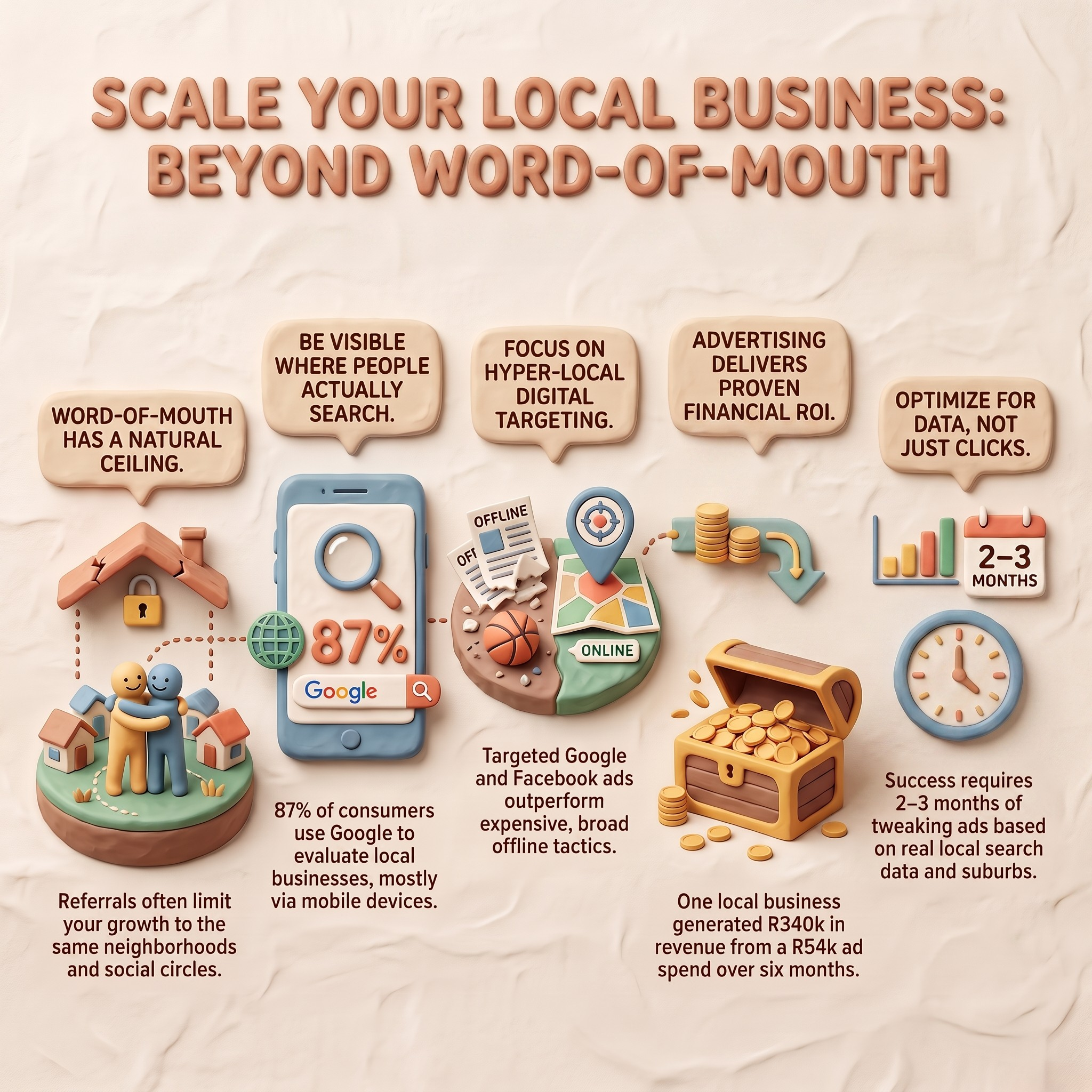
When Word of Mouth Stops Being Enough
Here’s what nobody tells you about building a business on referrals: it works brilliantly until it doesn’t. For years, I’d get two or three new clients a month just from existing customers telling their mates. Enough to replace the natural churn, enough to inch forward. But somewhere around mid-2023, that trickle just… stopped growing.
I wasn’t losing clients. The work was still good. But I’d hit a ceiling, and I could feel it. We were getting the same types of jobs from the same types of people in the same neighbourhoods around Nelspruit. Stonehenge. West Acres. The usual spots. Nobody from Mbombela Stadium area. Nobody from the new developments near the N4. Nobody we hadn’t already worked with or who wasn’t connected to someone we knew.
The Lowveld business community is tight-knit, which is beautiful when you’re starting out. But when you want to grow beyond your immediate circle? That’s when you realise word of mouth has natural limits.
According to research from BrightLocal, 87% of consumers used Google to evaluate local businesses in 2023 — but if you’re not advertising or optimising your presence, you’re invisible to that entire pool of potential customers actively searching for what you offer.
The Awkward Conversation About Actually Spending Money
My bookkeeper had been nudging me for months. “We need to advertise properly,” she’d say, usually while I was in the middle of quoting a job or fixing something that had broken. I’d nod, agree in principle, and then do absolutely nothing about it.
Why? Honestly, I didn’t know where to start. Facebook ads felt like a gamble. Google was intimidating. I’d heard horror stories about businesses spending thousands and getting nothing back except a inbox full of unqualified enquiries from people just price-shopping.
But when I looked at the numbers — properly looked at them — I realised I was already spending money on growth. Just badly. We’d printed flyers twice that year (total waste). We’d sponsored a local sports team (nice for goodwill, zero new business). We’d even paid for a listing in one of those community magazines that gets delivered and goes straight into the recycling.
All of that added up to about R18,000 over six months. And we had precisely nothing to show for it except a team photo on someone’s clubhouse wall.
So I made a decision: if I was going to spend money anyway, I might as well spend it on something that could actually be measured and improved.

What Proper Nelspruit Advertising Actually Looked Like
I started working with a local digital agency in March. Not naming names here, but they understood the Nelspruit market — which mattered more than I’d expected. They knew which suburbs were growing, where new developments were popping up, what people in Mbombela actually search for versus what I thought they’d search for.
The strategy was simpler than I’d imagined:
Google Ads targeting specific service searches in Nelspruit and surrounding areas. When someone in Mbombela typed in what we do plus “near me” or “Nelspruit”, we’d show up at the top. Not organic results — we’d work on that separately — but paid placement while we built up the organic side.
A proper Google Business Profile. Turns out I’d claimed ours years ago and then completely forgotten about it. No recent photos, no posts, reviews weren’t being responded to. We cleaned it up, added current work photos, and started asking happy clients to leave reviews. Properly, not in that awkward “please give us five stars” way.
Facebook and Instagram ads aimed at homeowners and businesses in specific Nelspruit suburbs. This was the bit I was most sceptical about, but the targeting options were wild. We could show ads specifically to people who owned homes in certain areas, within certain age ranges, who’d shown interest in services like ours. Not just blasting it out to everyone in Mpumalanga and hoping.
The first month’s budget was R8,500. Less than we’d wasted on printed flyers and magazine ads, but it felt like more because I could see exactly where every rand was going.
The First Month: Hope, Panic, and Dodgy Enquiries
Week one was magical. The ads went live on a Tuesday, and by Thursday we had eleven enquiries through the website contact form. Eleven! In three days! I thought we’d cracked it.
Then I actually read the enquiries.
Three were from competitors checking our pricing. Two were people looking for something we didn’t offer at all (wrong keywords, apparently — got fixed). Four were so far outside our service area they might as well have been in Gauteng. And two were legitimate.
Two out of eleven. Still better than the flyers, to be fair.
But that first month taught me something crucial: advertising doesn’t just bring you customers. It brings you data. We learned which search terms were attracting time-wasters. Which suburbs had the highest intent. Which ad copy resonated and which fell flat. The agency tweaked things weekly based on what was actually happening, not what we’d guessed would happen.
By week four, we were getting about fifteen enquiries a week, and the quality had improved dramatically. The conversion rate from enquiry to quote request went from about 18% to nearly 40%.
Month Three: When the Patterns Started Showing
This is where it got interesting.
We started noticing enquiries from areas we’d never worked in before. Kiepersol. Steiltes. White River. People who’d found us on Google, checked our reviews, looked at our Facebook page, and then contacted us already half-sold on using us.
The enquiries were different too. Instead of “How much for [service]?” we’d get “I saw your ad and noticed you do [specific thing]. We need that done by [date]. Can you quote?” They’d already looked at our work. They knew roughly what we charged because we’d started being more transparent about pricing online.
According to Google, 76% of people who search for something nearby on their smartphone visit a related business within a day. In Nelspruit, where everyone’s within 20 minutes of everyone else, that stat became real. People would search on their phones during lunch, contact us by 3pm, and we’d have a site visit booked before they left work.
The mobile factor was huge. The agency had made sure everything — the ads, the landing pages, the contact forms — worked perfectly on phones. Because in South Africa, that’s how most people search. According to StatsSA, 60.2% of South African internet users access the web primarily via mobile devices. If your advertising doesn’t work on a phone, you’re missing more than half your potential market.

Six Months In: The Honest Numbers
By September — six months after starting — here’s what had changed:
New client enquiries per month: Up from about 6-8 (through referrals) to 35-40 (through advertising and organic search).
Conversion rate on enquiries: Around 35%, which meant we were closing 12-14 new clients a month versus the previous 2-3.
Average job value: Slightly higher. About 15% higher, actually. Because the clients coming through search were often finding us for more specific, higher-value work rather than just “someone my cousin knows who can help.”
Total ad spend over six months: R54,000 (it increased slightly as we scaled what was working).
Additional revenue directly attributed to advertising: Around R340,000.
Look, I’m not going to pretend every business will see those exact numbers. We were starting from a position of being decent at what we do but terrible at being visible. If you’re already advertising, your growth curve will look different. But for us? That return on investment meant I stopped wincing every time the agency invoice came through.
The Stuff That Actually Mattered (and the Stuff That Didn’t)
What worked:
- Being specific about what we do and where we do it. No vague “quality service in Mpumalanga” nonsense. We named suburbs. We showed photos of actual local projects. We mentioned landmarks people knew.
- Responding fast. In Nelspruit, if you don’t respond to an enquiry within a few hours, someone else will. We set up notifications and made it someone’s job to reply same-day, every time.
- Reviews, reviews, reviews. Once we had 15+ Google reviews, the enquiry quality jumped noticeably. People trusted us before they even made contact.
- Adjusting constantly. What worked in March didn’t work in July. The agency kept testing, tweaking, and improving. That ongoing optimisation mattered more than getting everything perfect on day one.
What didn’t work:
- Trying to compete on price in ads. When we mentioned pricing, we attracted price shoppers who’d contact six other businesses and go with whoever was cheapest. When we focused on quality and specific expertise, we attracted people who cared about getting it done right.
- Broad targeting. When we tried targeting all of Mpumalanga, the enquiries were all over the place. When we focused tight on Nelspruit and immediately surrounding areas, everything got better.
- Being clever with ad copy The ads that performed best were almost boring. “Need [service] in Nelspruit? 8 years local experience, free quotes, work guaranteed.” That out-performed every “clever” headline we tested.
What I Wish I’d Known Before Starting
I wish I’d understood that advertising isn’t a switch you flip to get instant customers. It’s more like… planting a garden that starts producing faster than word of mouth ever could, but still needs tending.
I wish I’d known that the first month would feel wasteful. It wasn’t — it was learning — but it felt that way.
I wish I’d started tracking where every enquiry came from, properly, right from day one. We set that up properly in month two, and the insights were gold.
And honestly? I wish I’d done it two years earlier. Because the clients we’ve gained through advertising aren’t just one-off jobs. They’re referring us to others. They’re coming back for additional work. We’ve essentially expanded our word-of-mouth network to include areas and demographics we’d never have reached organically.
A study by Nielsen found that 92% of consumers trust recommendations from people they know, but 70% trust online consumer reviews. Advertising didn’t replace word of mouth — it supercharged it by making us visible to people *before* they asked their mates for a recommendation.

The Nelspruit Reality Check
Here’s the thing about advertising in Nelspruit specifically: you’re not competing with massive national companies for most local searches. You’re competing with other local businesses, many of whom still aren’t advertising properly online. Or at all.
That’s an advantage, but it’s also a responsibility. If you’re going to advertise, you need to actually be good at what you do. Because in a town this size, your reputation spreads fast — both ways. Advertising will amplify whatever you already are. If you’re great, it’ll bring you more customers who’ll tell others. If you’re dodgy, it’ll just speed up how quickly everyone finds out.
The other Nelspruit reality: load shedding. Our ads performed noticeably worse during heavy load shedding periods, presumably because people were dealing with more urgent problems than hiring service providers. The agency adjusted the budget down during those times and ramped it back up when the schedule lightened. That kind of local understanding made a real difference to not wasting money.
Where We Are Now
We’re still advertising. The budget’s actually a bit higher now — around R12,000 a month — because we know what works and we’re reinvesting the returns. We’ve hired two additional people to handle the increased workload. We’ve started getting enquiries from places like Hazyview and Sabie, which we’re considering expanding into.
Most importantly, I don’t lie awake anymore worrying about what happens if the referrals slow down. Because we’ve built a system that brings in new business consistently, predictably, and measurably.
Would I recommend this path to other Nelspruit businesses still relying entirely on word of mouth? Absolutely. But with a caveat: find someone who knows what they’re doing. The difference between good digital advertising and amateur hour is the difference between what we experienced and what we’d have got if I’d tried to muddle through it myself with a YouTube tutorial and a prayer.
Frequently Asked Questions
Q: How much should a Nelspruit business expect to spend on advertising to see results?
A: It depends entirely on your industry and competition, but in our experience, anything under R5,000/month is too little to gather meaningful data and sustain visibility on Google Ads. Most Nelspruit service businesses see results starting around R7,000-10,000/month, adjusted based on what’s working. The key is sustainability — better to spend R8,000 consistently than R20,000 for two months and then nothing.
Q: How long before you see actual customers from advertising, not just enquiries?
A: We saw our first converted customer from advertising in week three, but it took about two months before the flow became consistent and predictable. The first 4-6 weeks are partly about optimising the campaigns, partly about building trust signals like reviews. Anyone promising instant results is overselling.
Q: Can’t you just do Facebook ads yourself and save the agency cost?
A: You can, and plenty of people do. But in our case, the time I’d have spent learning, testing, and managing ads was time I wasn’t spending actually running the business. Plus, the agency caught expensive mistakes I’d have made (wrong targeting, weak landing pages, poorly structured campaigns) that would’ve cost more than their fees. If you’ve got the time and aptitude, go for it. If you don’t, false economy.
If you’re a Nelspruit business that’s hit the word-of-mouth ceiling and you’re wondering what proper advertising might look like for your specific situation, we’d be happy to have an honest conversation about it — including whether it makes sense for you right now. [Get in touch for a no-obligation chat about Nelspruit advertising options](https://thickrope.co.za/contact).