

Why Midrand Businesses Are Losing Local Search Traffic to Competitors in Joburg and Pretoria — And How to Stop It
You’ve probably never thought of your location as a digital marketing problem.
But if you’re running a business in Midrand — whether you’re in Waterfall, Carlswald, or anywhere along the N1 corridor — there’s a good chance you’re hemorrhaging search traffic to competitors in Johannesburg and Pretoria without realising it.
Not because your service is worse. Not because your website’s terrible. But because Midrand occupies one of the most awkward positions in South African local SEO: you’re geographically sandwiched between two of the country’s most competitive digital markets, and Google’s local algorithm doesn’t know what to do with you.
Most Midrand businesses make one of three mistakes when it comes to SEO, and all three cost you customers.
The Three Ways Midrand Businesses Accidentally Tank Their Own Rankings
Mistake 1: You Only Optimise for “Midrand” — And Miss 70% of Your Potential Market
Here’s the thing: when someone in Halfway House searches “accounting services near me,” Google doesn’t necessarily show them Midrand businesses. It shows them whoever’s done a better job of claiming that specific geographic territory.
If you’ve only optimised your Google Business Profile for Midrand, created content around “Midrand [your service],” and built citations that say “Midrand, Gauteng,” you’ve unintentionally told Google: “I only serve this small slice between two bigger cities.”
But your actual customers? They’re in Fourways. Sandton. Centurion. Halfway Gardens. Kyalami. They don’t care that you’re technically in Midrand — they care that you’re 15 minutes away.
By focusing exclusively on Midrand SEO without accounting for your cross-metro reach, you’ve made yourself invisible to the majority of people who’d actually hire you.
Mistake 2: You Try to Rank in Joburg AND Pretoria — And Google Thinks You’re Spam
The opposite mistake is just as common.
You know your customers come from both directions, so you stuff your website with references to Johannesburg, Pretoria, Centurion, Sandton, and Midrand. Your Google Business Profile says you “serve Gauteng.” Your homepage mentions five different suburbs.
Google sees this and assumes you’re either:
- A lead generation site trying to game the system
- A business with no actual physical presence
- Confused about where you actually operate
Result? You don’t rank well for any of those locations. You’ve diluted your local SEO signal so thoroughly that you’ve disappeared from the Map Pack in all three areas.
The algorithm rewards specificity. When you try to be everything to everyone, you become invisible to all of them.
Mistake 3: Your Citations Are a Geographic Mess — And Google Doesn’t Trust You
Here’s where Midrand businesses get properly tripped up.
Some directories list you under Johannesburg. Others under Midrand. Your old Yellowpages listing says Halfway House. Your Snupit profile says Gauteng. Your Google Business Profile says Midrand, but your website footer says “Proudly serving Johannesburg North.”
Every inconsistency is a trust signal to Google that you might not be a legitimate local business.
And because Midrand’s postal codes, municipal boundaries, and colloquial geography don’t always line up — is Waterfall in Midrand or Joburg? Is Carlswald part of Midrand or Kyalami? — it’s incredibly easy to end up with citation data that contradicts itself.
Google’s local algorithm relies on citation consistency to verify your location. When your business details are all over the map (literally), you won’t rank on any map.
What Makes Midrand SEO Different From Everywhere Else in South Africa
If you were running a business in Durban, Cape Town, or even central Joburg, local SEO would be relatively straightforward: optimise for your city, dominate your suburb, and expand outward.
But Midrand doesn’t work that way.
You’re not in a city with clear digital borders. You’re in a commercial corridor that straddles two metros, serves customers who identify with either Joburg or Pretoria, and competes in search results against businesses from both.
The Map Pack Problem
Google’s Map Pack — those three businesses that show up at the top of local search results — is determined by proximity, relevance, and prominence.
When someone in Waterfall searches for your service, Google has to decide: do I show them businesses in Midrand, businesses in Sandton (which is technically closer to some parts of Waterfall), or businesses in Centurion (which some Waterfall residents would consider “local”)?
If your SEO strategy hasn’t explicitly told Google how to categorise you, the algorithm will default to showing bigger, better-optimised businesses from the metros. Even if you’re closer.
The “Serving Area” Confusion
Google My Business allows you to set a service area, but here’s what most Midrand businesses don’t realise: the bigger your service area, the less likely you are to rank for any specific suburb within it.
If you tell Google you serve all of Gauteng, you’re competing against every business in Gauteng. If you say you serve Midrand, Sandton, Fourways, Centurion, and Pretoria, you’re competing in five different local markets simultaneously — and you’ll lose in all of them to businesses that focus on one.
The trick is knowing which geographic footprint to claim, and how to structure your content and citations to support it without confusing the algorithm.

How to Actually Fix This: A Midrand-Specific SEO Strategy
Here’s what works when you’re stuck between two metros.
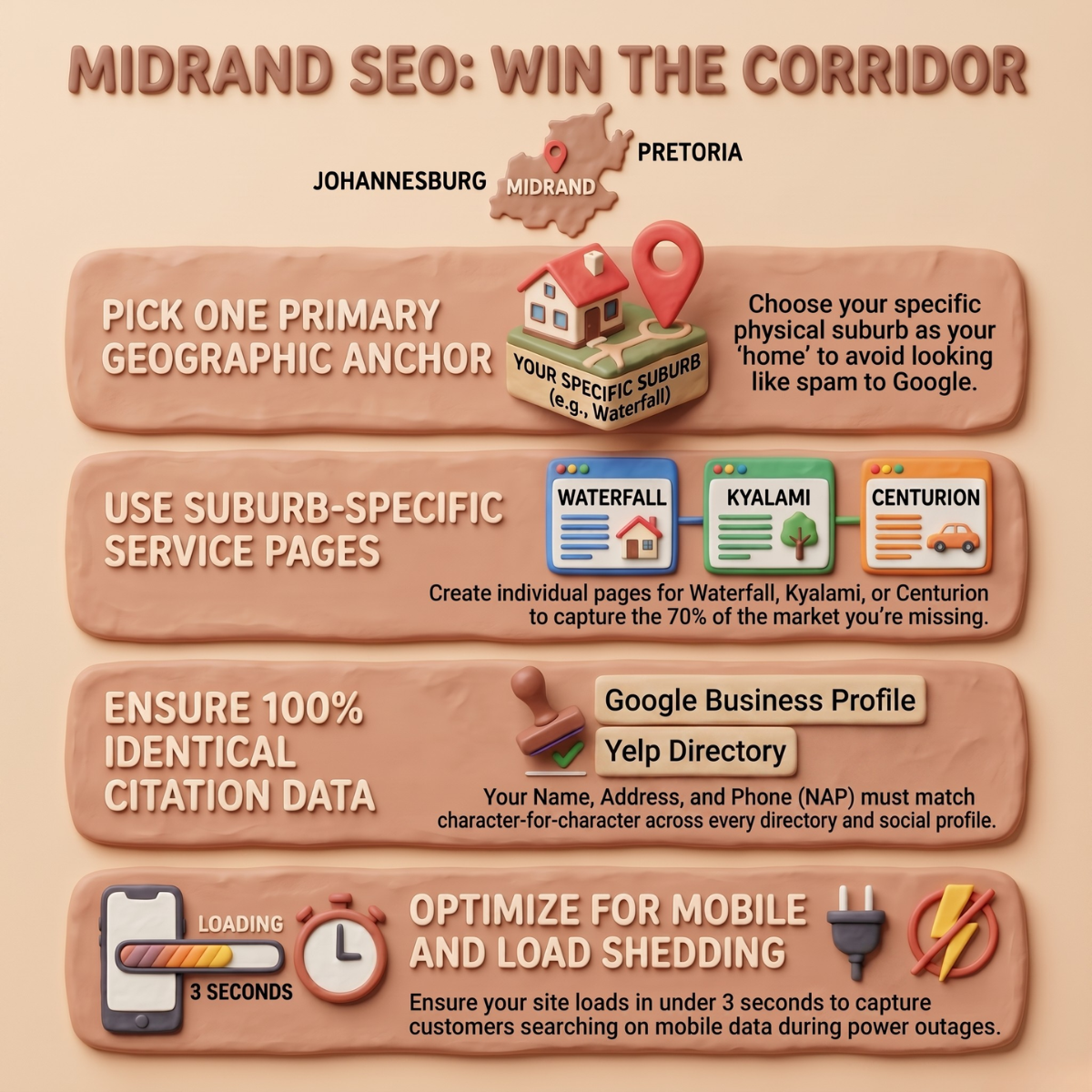
1. Pick Your Primary Territory — And Own It Completely
You need one clear geographic anchor. For most Midrand businesses, that’s Midrand itself, or the specific suburb where you’re physically located (Waterfall, Carlswald, Midstream, etc.).
Your Google Business Profile, your homepage, your NAP (name, address, phone number) citations — all of these should consistently reference this primary location.
Don’t hedge. Don’t say “Midrand/Johannesburg.” Pick one.
2. Use Suburb-Specific Service Pages for Cross-Metro Reach
Here’s how you capture Joburg and Pretoria traffic without diluting your core local signal:
Create individual service pages targeting the suburbs you actually serve.
Example: If you’re a Midrand-based plumber, your site structure might look like this:
- Homepage: Optimised for “plumber Midrand”
- /plumbing-services-waterfall/ — Optimised for “plumber Waterfall”
- /plumbing-services-centurion/ — Optimised for “plumber Centurion”
- /plumbing-services-fourways/ — Optimised for “plumber Fourways”
Each page includes:
- Specific references to that suburb
- Unique content (not just find-and-replace suburb names)
- Directions from that area to your office
- Testimonials from customers in that suburb, if you have them
This tells Google: “I’m based in Midrand, but I have legitimate service history in these other areas.” You’re not pretending to be based everywhere — you’re accurately representing your service footprint.
3. Fix Your Citations — One Consistent Address Everywhere
Go through every directory, social profile, and listing where your business appears:
- Google Business Profile
- TrueLocal
- Snupit
- Cylex South Africa
- Hotfrog
- Local.co.za
- Any industry-specific directories
Make sure your business name, address, and phone number are identical everywhere. Use the exact same formatting. If your Google Business Profile says “123 Waterfall Drive, Midrand, 1685,” every other citation should match it character-for-character.
Yes, it’s tedious. Yes, it matters. A lot.
4. Create Content That Reflects How People Actually Search
When someone in Centurion searches for your service, they’re not typing “Midrand [service].” They’re typing “[service] near me” or “[service] Centurion.”
Your content needs to reflect the search behaviour of people in surrounding areas — without keyword-stuffing or pretending you’re based somewhere you’re not.
Blog posts like:
- “How Long Does It Take to Get a Plumber from Midrand to Centurion?”
- “Do Midrand [Service Providers] Service Fourways? Here’s What to Expect”
- “Why Businesses in Waterfall Choose Midrand-Based [Your Service]”
These pieces target real search queries, build topical authority, and explain your geographic reach in a way that feels natural to users and legitimate to Google.
5. Get Reviews That Mention Specific Locations
Social proof matters for local SEO, but generic reviews don’t help much.
When you ask satisfied customers for reviews, prompt them (gently) to mention where they’re based:
“John in Centurion helped us with [problem]. Even though they’re based in Midrand, response time was incredible and…”
These location-specific reviews signal to Google that you have verified service history in those areas. It’s one of the most powerful trust signals you can build.

The Load Shedding Factor: Why Mobile-First Matters Even More in Midrand
Here’s something most Midrand businesses haven’t connected to their SEO performance: load shedding has fundamentally changed how people search for local services.
When the power’s out and someone needs a sparky, a plumber, or a last-minute courier, they’re searching on their phone. From their car. On mobile data. Often while driving along the N1 trying to figure out who’s closest.
If your website takes 8 seconds to load on a 3G connection, you’ve lost them.
Google knows this. Mobile page speed is a direct ranking factor for local search. And in South Africa, where mobile is often the primary (or only) way people access the internet, it’s even more critical.
Run your site through Google’s PageSpeed Insights. If your mobile score is below 70, you’re actively losing customers to faster competitors — even if your service is better.
What Good Midrand SEO Actually Looks Like
When it’s done right, here’s what happens:
- You rank in the Map Pack for “Midrand [your service]”
- You appear in organic results for surrounding suburbs you actually serve
- When someone in Waterfall, Kyalami, or Halfway House searches “[service] near me,” you’re visible
- Your Google Business Profile shows accurate service area information
- Your website loads fast on mobile
- Your citations are consistent across every directory
- You get reviews from customers in multiple suburbs
- Your content answers the actual questions people in your area are searching for
You’re not trying to trick the algorithm. You’re giving Google clear, consistent signals about where you’re based and who you serve.
And the result is visibility where it counts: in front of people who are actually looking for what you offer, right now, in your service area.
Frequently Asked Questions
Q: Should I list my business as Midrand or Johannesburg on Google?
A: Use your actual physical location. If you’re in Midrand, list Midrand. Trying to claim Johannesburg when you’re not physically there will hurt your rankings. Use service pages and content to capture Joburg traffic instead.
Q: How long does it take for Midrand SEO to start showing results?
A: Citation cleanup and Google Business Profile optimisation can show movement in 4–8 weeks. Ranking for competitive suburb terms typically takes 3–6 months of consistent effort. It’s not instant, but it’s measurable.
Q: Can I rank in both Pretoria and Johannesburg search results from a Midrand location?
A: Yes, but not by stuffing both city names into your homepage. You need a structured approach: primary location optimisation for Midrand, plus suburb-specific service pages and content for areas you serve in both metros.
Q: What’s the biggest mistake Midrand businesses make with local SEO?
A: Inconsistent citations. Your business details are scattered across directories under different variations of your address, and Google doesn’t trust any of them. Fix that first — it’s foundational.
Q: Do I need to hire someone or can I do Midrand SEO myself?
A: You can handle citation cleanup, Google Business Profile optimisation, and basic content yourself if you’ve got time. The technical stuff — site speed, schema markup, backlink strategy — is where most business owners bring in help. It depends on your capacity and what your time’s worth.
If you’re a Midrand business that’s tired of watching Joburg and Pretoria competitors soak up traffic that should be yours, we should talk. Thickrope Marketing specialises in local SEO for South African businesses, and we’ve sorted this exact problem for dozens of clients stuck in the geographic middle. [Get a free Midrand SEO audit](#) and we’ll show you exactly where you’re losing ground — and how to get it back.
“`