
What a South African Business Discovered When It Finally Invested in Proper SEO Link Building
I’m not going to name the business—it’s not mine to share—but I sat across the table from the owner in Johannesburg last year, and the frustration was palpable. Two years of SEO investment. Monthly retainers paid. Blogs written. Meta descriptions optimised. Page speed tweaked to within an inch of its life.
And yet: page two. Always page two.
“We rank seventh for everything,” he told me. “Not terrible, but not helpful. And my agency keeps saying just give it more time.”
I’ve heard this story more times than I care to count. It’s the South African business owner’s SEO nightmare: you’ve done everything right on your website, but Google treats you like you’re invisible. You’re optimised. You’re mobile-friendly. Your content is solid. And still, your competitors—some with worse websites—outrank you.
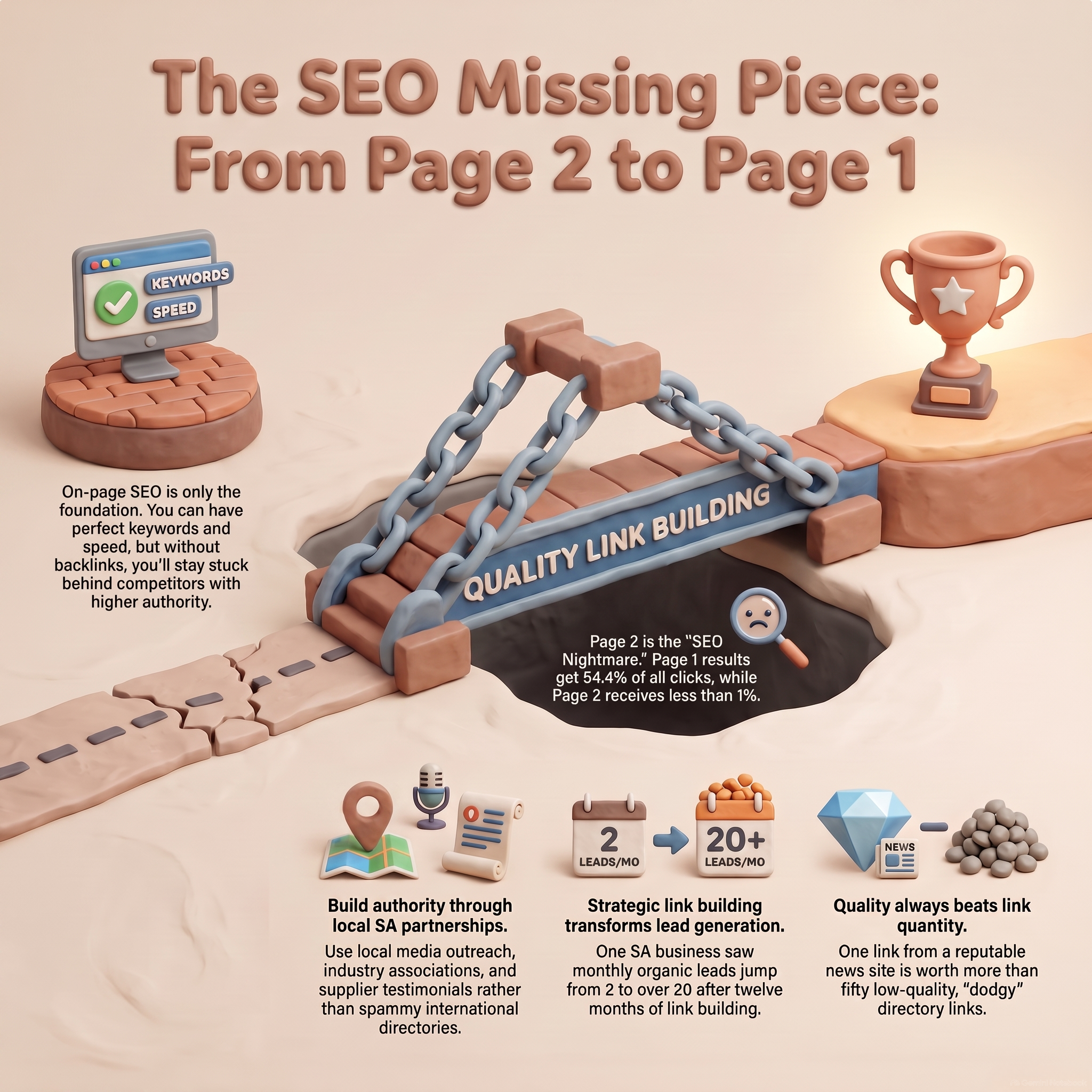
The missing piece? SEO link building. Proper, strategic, high-quality link building that actually signals authority to Google.
Here’s what happened when this business finally invested in it—and what changed over the next twelve months.
The Audit That Revealed the Problem
The business had been working with an agency that specialised in on-page SEO. Everything was done correctly: keyword research, title tags, internal linking, schema markup, image optimisation. The website was technically sound.
But when we ran a backlink audit using Ahrefs, the picture became painfully clear:
- 11 total referring domains (websites linking back to them)
- Domain Rating of 9 (out of 100)
- Most links were from low-authority directories and their own social profiles
- Their top three competitors? Between 45 and 120 referring domains each
According to a 2023 study by Backlinko analysing 11.8 million Google search results, the number one result in Google has an average of 3.8 times more backlinks than positions two through ten. Link authority isn’t just a ranking factor—it’s often the deciding factor when everything else is equal.
In South Africa, where many businesses are still catching up on digital maturity, this gap is common. Your competitors might not have flashy websites, but if they’ve been around longer or invested in PR, media coverage, or partnerships, they’ve likely accumulated link authority you simply don’t have yet.
What a Proper SA Link Building Campaign Actually Involved
The business committed to a twelve-month SEO link building strategy. Not shortcuts. Not spammy directory submissions. Not buying links from dodgy overseas “SEO services” that promise 100 backlinks for R500.
Here’s what the campaign included:
1. Local Business Directories and Industry Listings (The Foundation)
Yes, directories. But the right ones: BusinessTech’s company listings, industry-specific associations, local chambers of commerce, and verified Google Business Profile optimisation. These aren’t glamorous, but they establish baseline local authority.
2. Digital PR and Media Outreach
The business had recently navigated load shedding with an innovative operational shift. We packaged that story and pitched it to SA business publications. Result: coverage on two reputable local news sites and one industry trade publication—all with contextual backlinks.
Media coverage serves double duty: it builds links and drives direct referral traffic from readers who are already interested in your industry.
3. Guest Contributions on Relevant SA Blogs
Not spam. Not low-quality “write for us” farms. We identified three established South African blogs in adjacent industries—complementary, not competitive—and pitched genuine, useful content. Two accepted. Each piece included one natural, contextual link back.
4. Partnerships and Supplier Links
The business worked with several suppliers and service providers. We reached out and asked: would you feature us as a case study or client testimonial on your site? Three said yes. These are often the easiest, most natural links to earn—and they come from domains with established authority.
5. Resource-Worthy Content
We created one genuinely useful resource: a free guide specific to their industry that solved a common problem their audience faced. Then we promoted it to industry contacts, associations, and relevant bloggers. Over six months, it earned eleven organic backlinks—people linked to it because it was actually helpful.
This isn’t revolutionary. But it works. According to research from Moz, links earned through high-quality content creation and outreach remain one of the most effective SEO strategies, with resource pages and original research attracting links naturally over time.
The Investment
Total cost over twelve months: R72,000 (R6,000/month). That included outreach, content creation, relationship management, and reporting. Not cheap, but significantly less than what they were losing by staying invisible on page two.

What Rankings and Traffic Looked Like Twelve Months Later
Let’s talk numbers, because that’s what matters.
Before link building (month 0):
- Domain Rating: 9
- Referring domains: 11
- Average keyword position: 12.3 (page two)
- Monthly organic traffic: ~340 sessions
- Leads from organic search: 2-3/month
After twelve months of SEO link building:
- Domain Rating: 28
- Referring domains: 47
- Average keyword position: 5.8 (page one for most target keywords)
- Monthly organic traffic: ~1,850 sessions
- Leads from organic search: 18-22/month
The business didn’t just move up in rankings. They crossed the threshold that actually matters: page one visibility. According to Backlinko’s analysis of click-through rates, the top three results in Google receive 54.4% of all clicks, while results on page two receive less than 1%. Moving from position twelve to position six wasn’t incremental—it was transformational.
Revenue-wise? The owner told me organic search went from “nice to have” to their second-largest lead source, behind referrals. Three high-value clients came directly from organic search in the final quarter—clients they would never have reached otherwise.
What Changed (Beyond the Numbers)
The shift wasn’t just technical. It was psychological.
For two years, the business owner had been investing in SEO with the sinking feeling that maybe it just didn’t work for their industry. Maybe their competitors had some secret advantage. Maybe Google was biased against smaller businesses.
None of that was true. The problem was simpler: they were trying to win a credibility contest without building credibility signals.
On-page SEO gets your website ready to rank. Link building is what convinces Google you deserve to rank.
In South Africa, where many businesses are still figuring out digital marketing, this distinction gets lost. Agencies sell “SEO packages” that ignore link building entirely—or worse, they include low-quality link schemes that do more harm than good.
The reality? Google’s algorithm is built on links. It always has been. PageRank, the original algorithm that made Google dominant, is fundamentally about link authority. Modern Google uses hundreds of ranking factors, but links remain one of the most heavily weighted.
If you’re doing everything else right and still not ranking, it’s almost always a link authority problem.

The Lessons for SA Businesses
Here’s what this business learned—and what you should take away:
1. On-page SEO is necessary but not sufficient.
You can’t rank without it, but it won’t get you to page one on its own. Think of on-page SEO as the foundation and link building as the structure.
2. Link building takes time.
This wasn’t a three-month sprint. Meaningful link acquisition—the kind that actually moves rankings—requires consistency, relationship-building, and patience. But the results compound over time.
3. Quality beats quantity, every single time.
One link from a reputable SA news site or industry publication is worth more than fifty spammy directory links. Focus on relevance and authority.
4. SA-specific link opportunities exist—you just have to look.
Local media, industry associations, supplier partnerships, chambers of commerce, regional business networks. These are underutilised link sources that international guides won’t mention.
5. Link building isn’t just SEO—it’s visibility.
Those media placements and guest posts? They brought direct traffic, brand awareness, and even two client enquiries before the SEO benefit kicked in. You’re not just building links; you’re building presence.
What to Watch Out For
Not all SEO link building is created equal. If an agency promises you:
- Hundreds of links in a short time period: Run. Fast. Google’s spam algorithms are sophisticated, and link schemes get penalised.
- Links from overseas, irrelevant sites: A backlink from a random blog in Mumbai about “top 10 gadgets” does nothing for your Johannesburg-based accounting firm. Relevance matters.
- Guaranteed rankings in 30 days: SEO doesn’t work like that. Anyone who says otherwise is lying or using tactics that will get you penalised.
Good link building is strategic, manual, and relationship-driven. It’s outreach, content creation, and partnership development. It’s slower than you’d like and more expensive than directory submissions—but it’s what actually works.
Frequently Asked Questions
Q: How long does it take to see results from SEO link building?
A: Most businesses start seeing movement in rankings around the three to four-month mark, with more significant changes by month six. It’s not instant, but the results are durable—unlike paid ads, which stop the moment you stop paying.
Q: Can I do link building myself, or do I need an agency?
A: You can absolutely do it yourself if you have the time and know-how. The process involves research, outreach, content creation, and relationship management—all learnable skills. An agency just accelerates it and brings existing relationships and experience to the table.
Q: What’s a realistic monthly budget for link building in South Africa?
A: For a small to medium business, expect between R5,000 and R10,000/month for a proper campaign that includes outreach, content, and reporting. Anything significantly cheaper is likely low-quality or automated.
Q: Will link building work for local businesses, or is it only for e-commerce and national brands?
A: It works brilliantly for local businesses—especially when you focus on local media, community partnerships, and regional directories. Local SEO and link building go hand in hand. If you’re a Cape Town-based business, a link from a Cape Town news site or business directory is gold.
Q: What happens if I stop link building after twelve months?
A: Your existing links continue to provide value, but your competitors keep building theirs. SEO is competitive—standing still means falling behind. Many businesses scale back after the initial push but maintain some level of ongoing link acquisition to stay ahead.
If you’ve been investing in SEO without seeing the rankings you expected, the problem probably isn’t your website—it’s your link profile. Thickrope Marketing builds strategic, SA-focused link building campaigns that earn authority the right way: through media coverage, partnerships, and genuinely useful content. Let’s have a look at where you stand and what’s possible—book a free SEO audit and we’ll show you exactly what’s missing.